When it comes to virtual reality, two names dominate the conversation: Meta’s Oculus (now branded under Meta Quest) and HTC’s Vive. Both have shaped the VR landscape for over a decade, but which one truly delivers a better experience? The answer isn’t as simple as checking box scores or reading marketing claims. Real-world performance, comfort, ease of use, and long-term satisfaction all play crucial roles. This article dives deep into both hardware specifications and authentic user experiences to give you a clear, balanced comparison that helps you make an informed decision.
Hardware Showdown: Specs That Matter
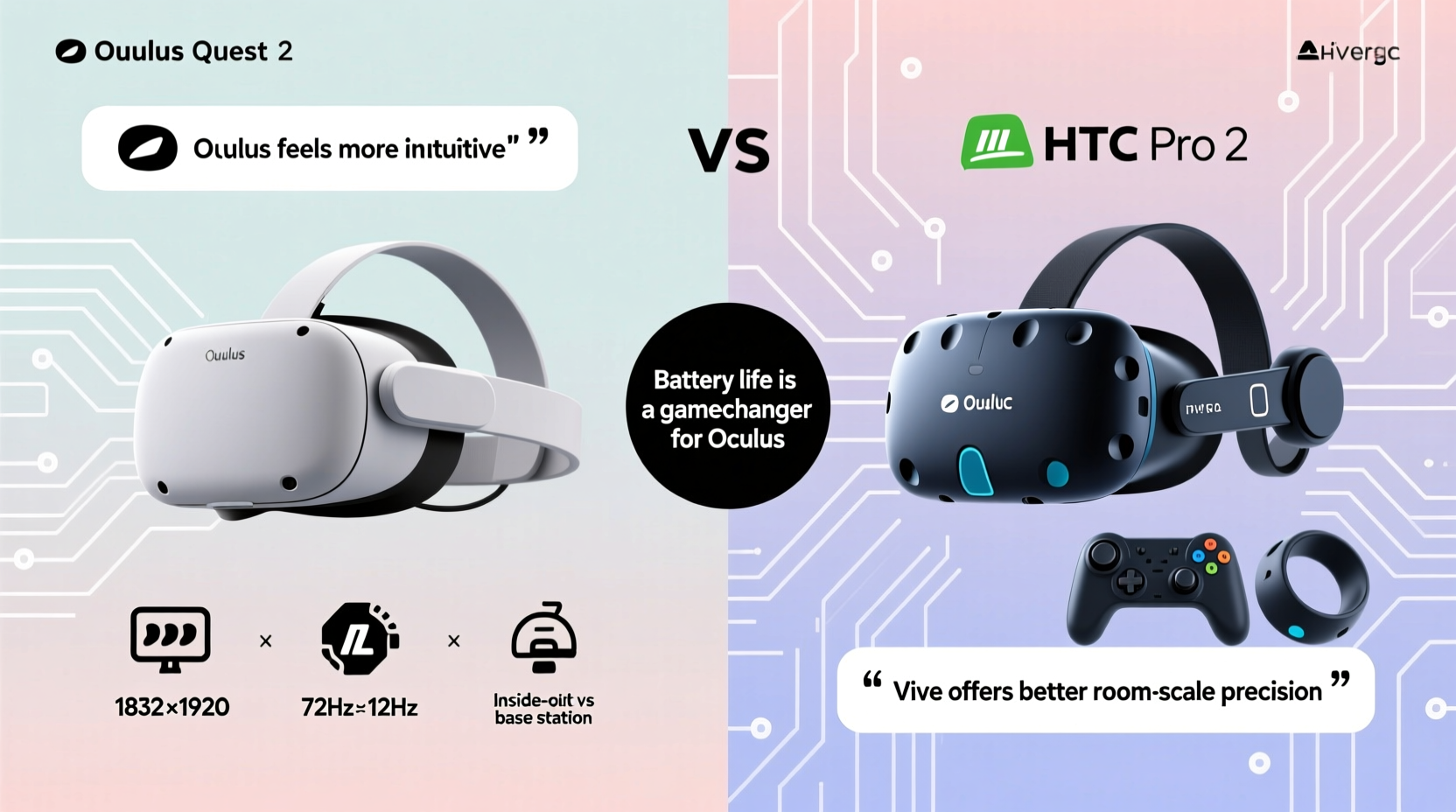
On paper, both Oculus and HTC Vive offer compelling technical profiles. But not all specs translate equally into real-world immersion. Let’s break down the key differences using the latest widely adopted models: the Meta Quest 3 and the HTC Vive Pro 2.
| Feature | Meta Quest 3 | HTC Vive Pro 2 |
|---|---|---|
| Display Type | Fast-switch LCD | RGB subpixel LCD |
| Resolution (per eye) | 2064 x 2208 | 2448 x 2448 |
| Refresh Rate | Up to 120Hz | Up to 120Hz |
| Field of View | Approx. 110° | Approx. 110° |
| Tracking System | Inside-out (cameras on headset) | Outside-in (Lighthouse base stations) |
| Processor | Qualcomm Snapdragon XR2 Gen 2 | Depends on PC GPU/CPU |
| Standalone Mode | Yes | No (requires PC) |
| Price (starting) | $499 | $799 (headset only) |
The Vive Pro 2 wins on raw resolution and display clarity, especially for users with high-end gaming PCs. However, the Quest 3 offers a more accessible entry point with its standalone functionality and mixed-reality capabilities. For many consumers, convenience often outweighs pure pixel density.
Tip: If you don’t already own a VR-ready PC, the Quest 3 eliminates a $1,000+ investment in hardware needed to run the Vive Pro 2 effectively.User Experience: Comfort, Setup, and Daily Use
Specs tell half the story. Long-term comfort and ease of setup are where these headsets diverge significantly.
Oculus has consistently prioritized consumer-friendly design. The Quest 3 is lightweight (approx. 500g), balances well on the face, and requires zero external sensors. Users report being able to set it up and start playing within minutes. It’s ideal for casual gamers, fitness enthusiasts, and families.
In contrast, the Vive Pro 2 demands more from its users. It’s heavier (around 850g without cables), requires precise placement of Lighthouse base stations, and needs a powerful PC connected via cable (or wireless adapter). While tracking precision is excellent, the setup complexity can deter less tech-savvy users.
“After switching from Vive to Quest, I gained back two hours a week just in setup and troubleshooting time.” — Daniel R., VR developer and streamer
One recurring theme in user forums like Reddit’s r/Vive and r/Oculus is fatigue during extended sessions. Multiple reviewers mention neck strain after 90+ minutes with the Vive Pro 2, whereas the Quest 3 allows longer gameplay due to better weight distribution and active cooling.
Content Ecosystem and Software Flexibility
A headset is only as good as the content it supports. Here, Meta’s aggressive investment in exclusive titles gives the Quest series a strong edge.
The Meta Store features polished, self-contained games like *Lone Echo II*, *Resident Evil 4 VR*, and *The Walking Dead: Saints & Sinners*. These are optimized for standalone play and often cost less than PCVR equivalents. Additionally, the Quest platform supports sideloading through tools like SideQuest, giving users access to thousands of free or experimental apps.
HTC Vive relies on SteamVR, which hosts the largest library of VR content—including professional training simulations, architectural walkthroughs, and indie experiments. However, discovering quality titles can feel overwhelming, and many apps lack polish or regular updates.
For enterprise users, Vive excels. Hospitals, engineering firms, and flight schools frequently choose Vive due to its superior tracking accuracy and compatibility with multi-user setups. But for home users seeking plug-and-play entertainment, Quest remains the go-to.
Mini Case Study: Sarah’s Home Fitness Journey
Sarah, a 34-year-old teacher from Portland, bought a Vive Cosmos in 2021 hoping to get fit with VR workouts. She struggled with frequent tracking errors, tangled cables, and the need to keep her PC running constantly. After six months, she sold it and switched to a Quest 2. Within a week, she was doing daily boxing routines in *FitXR* and meditation in *Tripp*. “It just works now,” she said. “I don’t have to be a technician to exercise.”
Longevity and Future-Proofing
Another critical factor is how well each system adapts to future advancements.
Meta has committed to annual hardware updates and a clear roadmap toward AR integration. The Quest 3’s depth sensor enables passthrough mixed reality, letting digital objects interact with physical spaces—a feature absent in most Vive models. With Meta’s billions in R&D, users can expect rapid innovation.
HTC, while still innovating, operates on a smaller scale. The Vive Focus 3 targets business users, but consumer momentum has slowed. Firmware updates are less frequent, and new accessories roll out slowly. That said, Vive’s open platform means greater customization. Enthusiasts can upgrade facial interfaces, swap batteries, or integrate third-party trackers like Vive Tracker for full-body motion capture.
- Oculus path: Simplicity, speed, mainstream adoption
- Vive path: Precision, modularity, niche optimization
Checklist: Choosing the Right Headset for You
- Do you own a VR-ready gaming PC? → Yes: Vive is viable; No: Lean toward Quest.
- Will you use VR primarily at home for gaming or fitness? → Choose Quest for ease.
- Need room-scale precision for simulation or creative work? → Vive offers superior tracking.
- Want to try mixed reality or AR features? → Only Quest 3 currently delivers this natively.
- Planning to use VR in a shared space with kids or non-tech users? → Quest’s intuitive interface wins.
- Are you building a custom VR rig or integrating peripherals? → Vive’s open ecosystem provides flexibility.
Frequently Asked Questions
Can I use SteamVR games on Oculus?
Yes, but not directly. You can connect your Quest to a PC via Link cable or Air Link and access SteamVR through virtual desktop mode. Performance depends on your connection quality and PC specs.
Is the Oculus tracking as accurate as Vive’s Lighthouse system?
For most users, yes—but with caveats. Inside-out tracking on Quest is impressive for 95% of applications. However, competitive esports players or professionals using full-body tracking often prefer Vive’s sub-millimeter precision and lower latency.
Which headset lasts longer?
Durability varies by model. The Quest 2 had known lens scratching issues early on, but the Quest 3 uses improved coatings. Vive headsets are generally built with higher-grade materials but suffer from cable wear and base station alignment problems over time. Proper care extends lifespan for both.
Expert Insight: What Industry Leaders Say
“The future of VR isn’t about specs—it’s about accessibility. Meta’s strategy of lowering barriers has brought millions into VR who would never have tried it otherwise.” — Dr. Lena Park, Human-Computer Interaction Researcher, MIT Media Lab
“HTC still leads in fidelity and freedom of movement. For medical training or industrial design, nothing matches Vive’s consistency.” — Mark Tran, CTO at SynapseXR
Final Verdict: Is Oculus Really Better Than HTC Vive?
“Better” depends entirely on your priorities.
If you value simplicity, affordability, and a seamless experience—from unboxing to daily use—Oculus (Quest) is likely the better choice. Its growing library, intuitive interface, and wireless freedom make it ideal for most consumers. Parents, casual gamers, and fitness users will appreciate how little maintenance it requires.
However, if you demand maximum visual fidelity, precise tracking, and plan to use VR for professional or advanced simulation purposes, the HTC Vive remains a top-tier option. It’s favored in enterprise settings and by developers who need granular control over their environment.
In terms of market trajectory, Meta is clearly winning the consumer race. They’ve made VR approachable. HTC maintains a loyal following among purists and professionals, but their products require more effort to master.
🚀 Ready to take the plunge? Try the Meta Quest 3 for a hassle-free start, or explore Vive if you’re building a high-performance rig. Your perfect VR experience starts with knowing what matters most to you—then choosing accordingly.








