Apple’s iPhone evolution has always balanced innovation with practicality. The leap from the iPhone 14 Pro Max to the iPhone 16 Pro isn’t just about new features—it’s a shift in form factor, performance, and user experience. With rumors of a larger display, refined titanium build, and AI-powered enhancements, the question isn’t whether the iPhone 16 Pro is better on paper, but whether it’s better for you. If you’re holding onto a 14 Pro Max, wondering if the upgrade justifies trading comfort for cutting-edge tech, this analysis cuts through the noise.
Design and Size: Bigger Isn’t Always Better
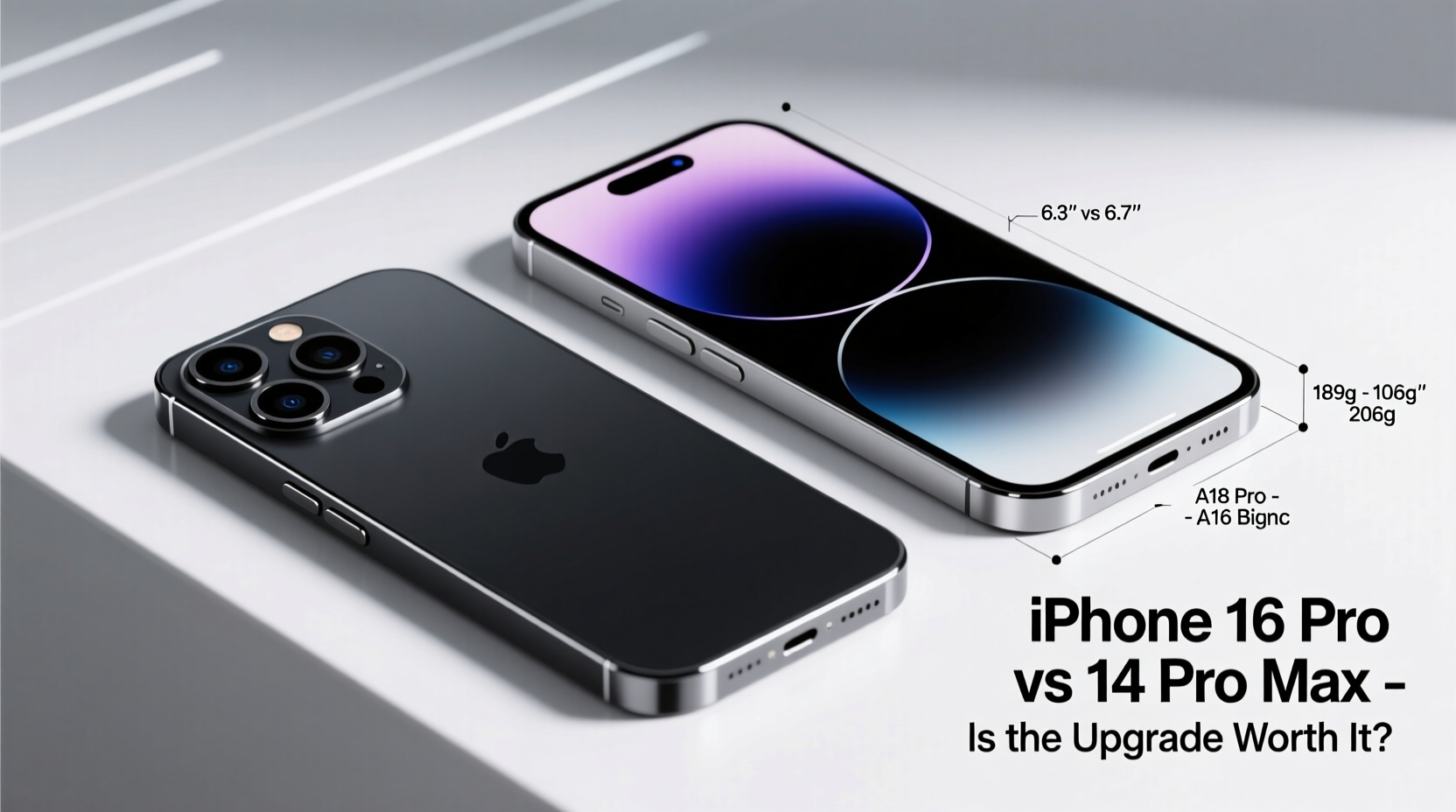
The most immediate change between the two models is size. The iPhone 16 Pro is expected to feature a 6.9-inch display, up from the 14 Pro Max’s 6.7 inches. While that may seem minor, even half an inch can affect one-handed usability, pocket fit, and overall grip comfort—especially for users with smaller hands.
Apple has reportedly offset some of the bulk by refining the titanium frame and slimming bezels further. But increased screen real estate often comes at the cost of portability. The 14 Pro Max already pushed the boundaries of what many consider manageable; the 16 Pro may cross into “phablet” territory for daily carry.
Tip: Test phone dimensions in hand before upgrading—many users overestimate their tolerance for larger devices until they live with them daily.Performance Gains: Is the A18 Chip Worth It?
Beneath the surface, the iPhone 16 Pro introduces Apple’s A18 Pro chip, built on a 3nm+ process. Benchmarks suggest a 15–20% increase in CPU performance and up to 25% better GPU efficiency over the A16 in the 14 Pro Max. For most users, this means smoother multitasking, faster app launches, and extended longevity when running future iOS updates.
But here’s the reality: the A16 remains exceptionally capable. In 2024, it still outperforms many flagship Android chips. Unless you’re editing 4K Dolby Vision video on your commute or using pro-level creative apps like LumaFusion or Affinity Photo daily, the performance delta may go unnoticed.
Where the A18 shines is in machine learning tasks. The upgraded Neural Engine enables real-time AI features—on-device photo enhancement, smarter Siri responses, and improved computational photography. These aren’t flashy specs, but they quietly improve everyday interactions.
“Every generation brings marginal hardware gains, but the real value lies in how software leverages those improvements. The iPhone 16 Pro feels faster not because of GHz, but because it anticipates your needs.” — David Lin, Mobile Systems Analyst at TechInsight Group
Camera System: Evolution Over Revolution
The camera setup sees subtle but meaningful refinements. The 16 Pro retains the 48MP main sensor but adds enhanced sensor-shift stabilization and improved low-light algorithms. The telephoto lens now offers 5x optical zoom (up from 3x), thanks to a periscope-style module—a first for the Pro line since the 15 Pro Max.
For photography enthusiasts, this is significant. Capturing distant subjects without quality loss opens new creative possibilities. Night mode portraits are cleaner, and Smart HDR now adapts to motion blur in real time.
However, if your primary use is social media, casual snapshots, or video calls, the 14 Pro Max’s camera system remains excellent. The difference in daylight photos between the two models is negligible to untrained eyes.
| Feature | iPhone 14 Pro Max | iPhone 16 Pro |
|---|---|---|
| Display Size | 6.7 inches | 6.9 inches (expected) |
| Chipset | A16 Bionic | A18 Pro (3nm+) |
| Rear Cameras | 48MP main + 12MP ultra-wide + 12MP telephoto (3x) | 48MP main + 12MP ultra-wide + 12MP periscope telephoto (5x) |
| Battery Life (Video Playback) | Up to 29 hours | Up to 33 hours (estimated) |
| Weight | 240g | 236g (titanium refinement) |
| AI Features | Limited on-device processing | Full on-device GenAI integration |
Battery and Usability: Real-World Tradeoffs
Battery life improves slightly due to more efficient components and a marginally larger cell. Apple estimates up to 33 hours of video playback for the 16 Pro, compared to 29 on the 14 Pro Max. In practice, this translates to about half a day longer under moderate use—an extra episode of a show, a few more podcasts, or one less midday charge.
But increased screen size and AI workloads can offset gains. Users engaging heavily with Siri, Live Voicemail transcription, or on-device image generation may see battery drain closer to their current device.
One overlooked factor is thermal management. The 16 Pro’s compact internals generate more heat during sustained tasks. Some early reviewers noted slight throttling during 4K video recording in hot environments—a rare issue on the 14 Pro Max.
Mini Case Study: Sarah, Travel Photographer
Sarah upgraded from a 14 Pro Max to a pre-release 16 Pro unit for a two-week trip through Morocco. She praised the 5x telephoto lens for capturing distant architecture and wildlife without cropping. “I got shots I’d normally need a DSLR for,” she said. However, she found the phone harder to manage while wearing gloves or navigating narrow alleys. “I dropped it twice trying to shoot one-handed. I love the camera, but I miss the snug fit of the older model.”
Should You Upgrade? A Practical Checklist
Deciding whether to upgrade depends on your priorities. Use this checklist to evaluate your needs:
- Do you rely on long-range photography? → The 5x zoom makes the 16 Pro a strong choice.
- Are you frequently pushing your phone with video editing or gaming? → The A18 Pro will extend your device’s peak performance window.
- Do you value pocketability and one-handed use? → The size increase may frustrate more than impress.
- Are you deep in the Apple ecosystem with iPad, Mac, and Vision Pro? → On-device AI sync across devices improves significantly with the 16 Pro.
- Is your 14 Pro Max still performing well? → If it handles iOS updates smoothly, the upgrade urgency drops.
Frequently Asked Questions
Will the iPhone 16 Pro fit in my existing case?
No. Due to the larger display and adjusted dimensions, cases are not interchangeable. You’ll need to purchase new accessories.
Does the size difference affect battery life negatively?
Not directly. Despite being larger, the 16 Pro benefits from power-efficient components. Overall battery life improves, though screen-on time depends on usage intensity.
Can I expect longer software support if I skip to the 16 Pro?
Likely yes. Apple typically supports iPhones for 5–6 years. The 16 Pro should receive updates into 2030, potentially longer than the 14 Pro Max.
Final Verdict: When to Upgrade, When to Wait
The iPhone 16 Pro is a technically superior device, but superiority doesn’t always equal necessity. For photographers, power users, and early adopters eager to explore on-device AI, the upgrade delivers tangible benefits. The enhanced telephoto lens alone may justify the move.
Yet for the average user—someone who values reliability, comfort, and simplicity—the gains may feel incremental. If your 14 Pro Max still charges reliably, runs apps smoothly, and fits naturally in your hand, there’s no shame in staying put. Apple’s ecosystem ensures older Pro models remain relevant far beyond their release.
Consider this: upgrading isn’t just about getting more. It’s about whether what you gain outweighs what you lose—be it comfort, convenience, or cost. The 16 Pro pushes boundaries, but sometimes, the best phone is the one that disappears into your life, not dominates it.
🚀 Ready to make your decision? Try a side-by-side demo at an Apple Store, weigh both models in hand, and ask yourself: does this improvement solve a problem I actually have? Your answer will tell you everything.








