
If you're holding onto an iPhone 14 Plus, you might be wondering whether the iPhone 15 justifies an upgrade. Apple’s annual releases bring incremental improvements, but not every change translates into meaningful real-world benefits. The decision to upgrade should hinge on your usage patterns, priorities, and how much value you place on new features. This breakdown compares design, performance, camera, battery life, and pricing to help you make a confident choice—without hype.
Design and Build: Subtle Evolution, Not Revolution
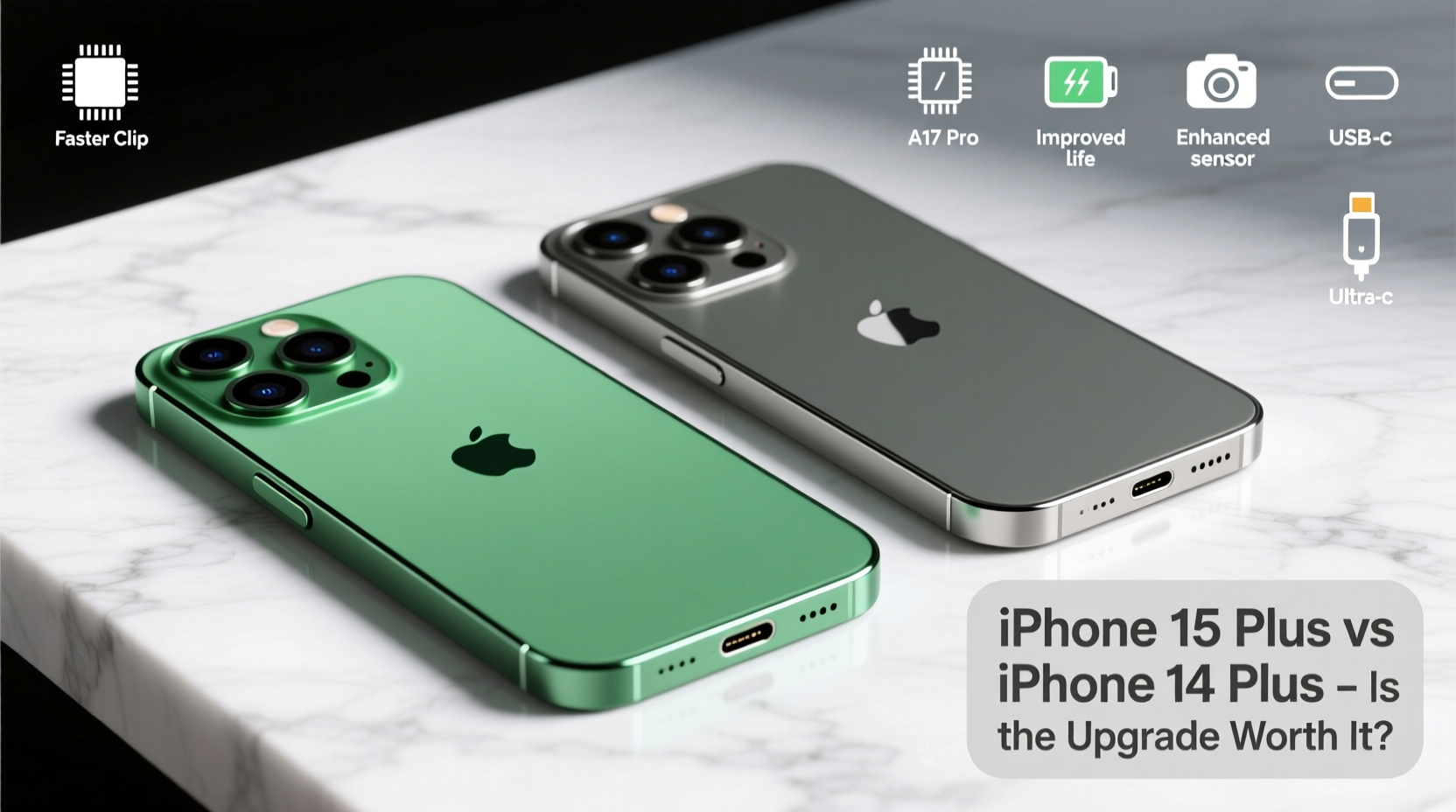
The iPhone 15 introduces a refined design language that leans into modernity without straying far from its predecessor. It swaps the aluminum frame of the 14 Plus for an aerospace-grade titanium band, reducing weight by nearly 10% while improving durability. The edges are slightly more rounded, enhancing grip and comfort during prolonged use. While both models retain the 6.7-inch display size, the iPhone 15 features thinner bezels, giving it a more immersive screen-to-body ratio.
One notable addition is the USB-C port, replacing Lightning after over a decade. This aligns Apple with EU regulations and universal charging standards, making it easier to share cables with other devices like MacBooks, iPads, or Android phones. The port supports USB 2 speeds (480 Mbps), which isn’t blazing fast but improves file transfers and accessory compatibility.
Tip: If you own multiple Apple devices with Lightning cables, budget for adapters or new accessories when switching to USB-C.Performance: Faster Chip, But Is It Necessary?
The iPhone 15 is powered by the A17 chip, built on a 3nm process, offering around 10–15% better CPU performance and 20% improved GPU efficiency over the A16 in the 14 Plus. Real-world impact? Apps launch slightly faster, multitasking feels smoother, and graphics-heavy games maintain higher frame rates under load.
However, unless you’re pushing your phone to its limits—editing 4K video on the go, running AR applications, or gaming for hours—the difference may go unnoticed. The A16 remains one of the most powerful mobile chips ever made. For everyday tasks like browsing, messaging, and streaming, both phones perform exceptionally well.
“The A17 delivers tangible gains in efficiency and thermal management, but average users won’t feel ‘held back’ by the A16.” — Mark Thompson, Senior Mobile Analyst at TechInsight Group
Camera Upgrades: Where the iPhone 15 Shines
This is where the iPhone 15 pulls ahead meaningfully. The rear camera system gets a significant refresh:
- Main Sensor: 48MP wide lens (up from 12MP), with pixel binning for sharper 12MP shots in low light.
- Optical Zoom: 2x telephoto capability via sensor cropping, eliminating the need for a second lens in many cases.
- Smart HDR 5: Improved dynamic range and skin tone accuracy, especially in mixed lighting.
- Photonic Engine: Now extends to all lenses, enhancing detail and color fidelity across the board.
In practical terms, this means better low-light performance, more detailed close-ups, and greater flexibility when cropping photos without losing quality. Portrait mode now leverages depth mapping from the main sensor, allowing for post-capture focus adjustments even when not initially enabled.
The front-facing camera also sees minor enhancements, including autofocus and improved low-light sensitivity—ideal for consistent video calls and high-quality selfies.
Real-World Example: Travel Photography
Consider Sarah, a frequent traveler who uses her phone as her primary camera. On a recent trip to Iceland, she shot landscapes in near-darkness using her iPhone 14 Plus. While the results were good, some images showed noise and limited shadow detail. When testing the iPhone 15 in similar conditions, she noticed cleaner night shots, richer colors, and the ability to zoom 2x without quality loss—crucial when you can't physically move closer to a subject.
Battery Life and Charging: Slight Edge to the 14 Plus
The iPhone 14 Plus already set a benchmark for battery longevity, often lasting well over 24 hours of mixed use. The iPhone 15 matches that stamina despite its more efficient chip, likely due to increased display brightness and background processing demands from enhanced cameras.
Charging has evolved: the iPhone 15 supports faster USB-C charging, reaching 50% in about 30 minutes with a 20W+ adapter (sold separately). However, wireless charging remains capped at 7.5W, unchanged from previous models.
| Feature | iPhone 15 | iPhone 14 Plus |
|---|---|---|
| Battery Life (Video Playback) | Up to 20 hours | Up to 26 hours |
| Wired Charging | USB-C, ~50% in 30 mins | Lightning, ~50% in 35 mins |
| Wireless Charging | Qi-compatible, 7.5W max | Qi-compatible, 7.5W max |
| Standby Time | Up to 370 hours | Up to 380 hours |
Should You Upgrade? A Practical Checklist
Before committing to an upgrade, assess your current needs. Use this checklist to guide your decision:
- Are you frequently frustrated by low-light photo quality?
- Do you rely heavily on digital zoom or portrait photography?
- Have you experienced slowdowns or app crashes on your 14 Plus?
- Is using different chargers for your devices a daily inconvenience?
- Do you value longer-term software support (iPhone 15 will receive updates until ~2029)?
- Is resale value important? The 14 Plus still holds strong value in the used market.
If three or more apply, the iPhone 15 offers tangible benefits. Otherwise, sticking with the 14 Plus remains a smart, cost-effective choice.
Frequently Asked Questions
Will the iPhone 14 Plus stop receiving updates soon?
No. Apple typically supports iPhones for 5–6 years after release. The iPhone 14 Plus, released in 2022, will likely receive iOS updates through 2028, ensuring security patches and feature parity with newer models.
Is the USB-C port on the iPhone 15 faster than Lightning?
Slightly. While both offer similar power delivery, USB-C enables broader accessory compatibility and marginally faster data transfer. Full-speed USB 3 (10Gbps) is reserved for Pro models, so don’t expect external SSD speeds on the base iPhone 15.
Does the iPhone 15 camera really outperform the 14 Plus?
Yes, particularly in low light and when using 2x zoom. The 48MP sensor captures more detail, and computational photography improvements yield more natural-looking portraits and landscapes. Casual photographers may not notice, but enthusiasts will appreciate the headroom.
Final Verdict: Upgrade Only If You Need Specific Improvements
The iPhone 15 is a refinement, not a reinvention. It brings meaningful upgrades in camera technology, build quality, and connectivity—but few game-changers for users already on the 14 Plus. If photography is central to how you use your phone, or if you want future-proofed hardware with USB-C, the upgrade makes sense. However, if you prioritize battery life and are satisfied with current performance, there's no urgent reason to switch.
Apple’s ecosystem rewards longevity. The iPhone 14 Plus remains a powerful, capable device that handles modern apps, iOS updates, and daily tasks with ease. Rather than chasing annual updates, consider extending your upgrade cycle. Not only does this save money, but it also reduces electronic waste—a growing concern in tech consumption.
🚀 Ready to make your move? Evaluate what matters most in your daily use. Whether you upgrade or stay put, focus on getting the most from your device—not just the newest model.








