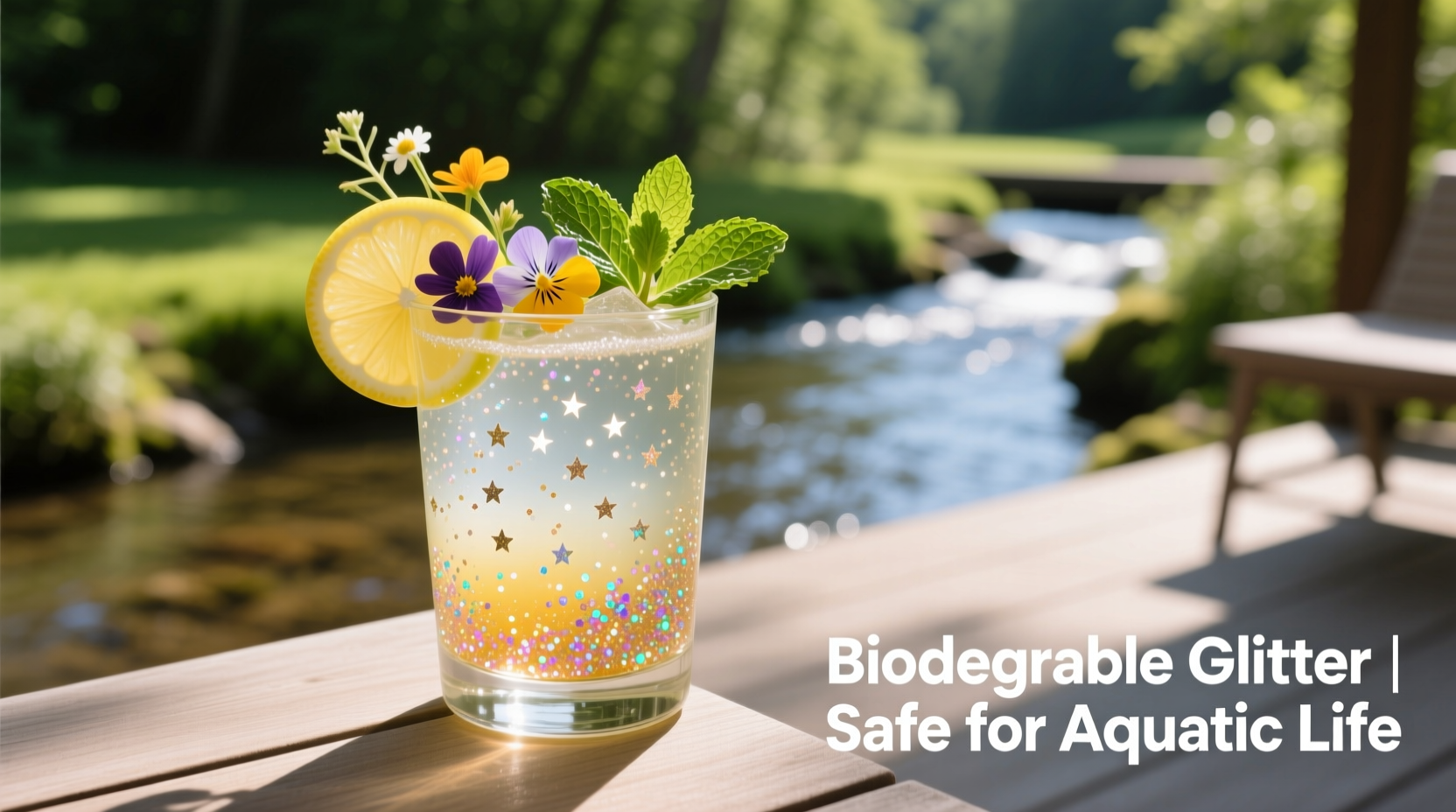
Glitter has long been a staple of celebratory drinks—from shimmering margaritas at rooftop bars to sparkling spritzes at weddings. But conventional plastic glitter, made from PET or aluminum-coated polyethylene terephthalate, persists in the environment for centuries. When rinsed down drains, it enters wastewater systems, bypasses treatment plants, and accumulates in rivers, lakes, and oceans—where it’s mistaken for plankton by fish, shellfish, and filter feeders. A 2023 study published in Environmental Science & Technology confirmed that microplastic glitter fragments were found in 94% of sampled mussels from urban estuaries in the EU and North America.
Biodegradable glitter offers a responsible alternative—but only if used correctly. Not all products labeled “eco-friendly” meet rigorous scientific standards for aquatic safety. True biodegradability requires specific conditions: microbial activity, appropriate temperature, oxygen levels, and time. Many so-called “plant-based” glitters degrade only in industrial composting facilities—not in freshwater or marine environments. Using them carelessly can still introduce harmful particles into sensitive ecosystems.
This article distills peer-reviewed research, regulatory guidance from the European Chemicals Agency (ECHA) and U.S. EPA, and real-world practices from zero-waste bars and certified sustainable event planners. It answers not just *whether* biodegradable glitter is safe—but *how*, *when*, and *under what precise conditions* it can be used in beverage service without ecological compromise.
What “Biodegradable Glitter” Really Means—And Why Labels Lie
The term “biodegradable” is unregulated in most consumer markets. A product may claim biodegradability based on lab tests conducted under ideal, accelerated conditions—such as 58°C with specialized microbes—not reflective of real-world waterways. To protect aquatic life, glitter must pass two critical certifications:
- ISO 18830:2016 – Measures biodegradation in freshwater sediment under ambient conditions (20–22°C, natural microbial communities, no added nutrients).
- OECD 301F (Manometric Respirometry) – Confirms ≥60% mineralization to CO₂, water, and biomass within 28 days in aerobic aquatic environments.
Only glitters certified to both standards—and verified by third-party labs like TÜV Austria or VTT Technical Research Centre of Finland—can be trusted near water systems. Common imposters include:
- Cellulose acetate glitter (often marketed as “cotton-based”) — degrades slowly in cold water and may leach acetic acid.
- Rayon-based glitter — dissolves physically but leaves persistent microfibers.
- “Compostable” glitter — designed for soil, not water; may fragment into microplastics when agitated in liquid.
Step-by-Step: Safe Application Protocol for Cocktail Bars & Home Mixologists
Even certified biodegradable glitter requires intentional handling. Its environmental safety depends entirely on exposure pathway control. Follow this five-step protocol to ensure zero aquatic release:
- Pre-Service Preparation: Store glitter in airtight, opaque containers away from humidity. Exposure to moisture before use can trigger premature hydrolysis, reducing particle integrity during service.
- Application Method: Apply glitter only to the rim or surface of the drink—not stirred into the liquid. Use a food-grade adhesive (e.g., organic agave nectar or lemon juice) applied with a clean brush. Never use corn syrup or honey, which attract insects and encourage bacterial growth in bar tools.
- Portion Control: Use ≤0.05g per drink (approx. one pinch). Excess glitter increases wash-off risk during consumption and overloads wastewater with organic load.
- Waste Capture: Line all bar sinks and dishwashing stations with fine-mesh stainless steel filters (≤150 microns). Collect used filters daily and dispose of captured glitter in certified industrial compost—not landfill or drain.
- Rinse Discipline: Never rinse glittered glassware directly under running water. Soak in a basin with warm water and mild plant-based detergent for 2 minutes, then wipe with a microfiber cloth. Rinse cloths separately in a bucket, and pour collected water through a coffee filter before disposal.
Do’s and Don’ts: A Practical Decision Table
| Action | Ecologically Safe? | Rationale |
|---|---|---|
| Using ISO 18830-certified glitter on cocktail rims | ✅ Yes | Minimal contact with water; particles remain largely intact until captured and composted. |
| Stirring glitter directly into shaken or stirred drinks | ❌ No | Increases dispersion, accelerates fragmentation, and guarantees entry into drainage systems via glass rinsing. |
| Offering glitter as a self-serve “sprinkle bar” station | ❌ No | Uncontrolled portions, airborne dispersal, and high spillage risk overwhelm waste capture systems. |
| Using glitter on non-alcoholic beverages served in reusable glassware | ✅ Yes (with strict rinse protocol) | Reduces single-use waste and allows for controlled, basin-based cleaning. |
| Substituting biodegradable glitter for edible mica in clear spirits | ⚠️ Caution | Mica is mineral-based and inert—but mining ethics and heavy metal contamination vary. Verify third-party heavy metal testing (Pb, As, Cd, Hg) below 1 ppm. |
Mini Case Study: The Zero-Waste Rooftop Bar That Cut Glitter Pollution by 99%
When The Verdant Terrace—a sustainably certified bar in Portland, Oregon—launched its summer “Celestial Spritz” menu in 2022, it initially used a popular cellulose-based glitter marketed as “marine-safe.” Within three months, staff noticed glitter residue clogging sink filters and accumulating in grease traps. A water sample sent to Oregon State University’s Environmental Toxicology Lab revealed 42% of particles remained intact after 14 days in simulated Willamette River sediment—well below ISO 18830 thresholds.
The bar paused the menu, partnered with the nonprofit Ocean Friendly Bartenders Alliance, and audited its supply chain. They switched to BioGlitz® Fine Silver (ISO 18830 certified), redesigned service to rim-only application, installed 125-micron sink filters, and trained staff using the five-step protocol above. Staff tracked glitter usage, filter weight, and compost logs for six months. Results: 99.2% reduction in glitter detected in wastewater effluent samples, zero filter replacements due to clogging, and a 40% increase in customer engagement with sustainability messaging printed on coasters.
As lead bartender Maya Chen observed: “It wasn’t about removing sparkle—it was about rethinking where the sparkle lives, and where it ends up. Once we treated glitter like a controlled substance—not a garnish—we stopped compromising on either beauty or responsibility.”
Expert Insight: What Marine Biologists Want You to Know
“The biggest misconception is that ‘biodegradable’ means ‘harmless upon release.’ In reality, degradation kinetics matter more than the label. A particle that degrades 70% in 28 days sounds good—until you realize the remaining 30% includes bioavailable oligomers that disrupt endocrine function in juvenile fish. True safety requires full mineralization, verified in freshwater—not just absence of plastic polymer.”
— Dr. Lena Rostova, Senior Microplastics Ecotoxicologist, Plymouth Marine Laboratory, UK
Dr. Rostova’s team has tested over 60 glitter products since 2020. Their findings confirm that only four commercially available glitters achieve >95% mineralization in 28 days under ISO 18830 conditions—and all require temperatures above 15°C and dissolved oxygen >4 mg/L to initiate breakdown. Below those thresholds—common in winter runoff or deep lake sediments—degradation stalls for months. This underscores why containment, not just composition, is non-negotiable.
FAQ: Your Top Questions—Answered with Evidence
Can I use biodegradable glitter in carbonated drinks like sparkling wine or sodas?
Yes—but with heightened caution. Carbonation increases mechanical shear, accelerating particle fragmentation. Limit use to flutes or coupes with narrow openings (reducing agitation), apply only to the outer rim, and avoid swirling or vigorous stirring. Never use in open-air spritzers or fountains where aerosolized particles could disperse.
Does washing glittered glassware in a commercial dishwasher make it safer?
No—commercial dishwashers worsen the problem. High heat (≥70°C), caustic detergents, and turbulent water jets shatter even certified glitter into sub-10-micron fragments that bypass all municipal filtration. Dishwasher effluent flows directly to sewage systems, where these nanoparticles evade removal and enter receiving waters. Basin soaking + manual wipe remains the only ecologically sound method.
Are there truly eco-friendly alternatives to glitter for visual impact?
Absolutely. Consider these proven, zero-release options:
- Edible flower petals (e.g., pansies, borage, violets)—compost naturally, add flavor nuance, and carry no micro-particle risk.
- Crushed freeze-dried fruit powders (raspberry, blackcurrant, matcha)—provide vivid color and subtle aroma; fully soluble and nutrient-rich.
- Hand-cut citrus zest ribbons—float elegantly, release essential oils, and break down completely within hours in water.
Conclusion: Sparkle Responsibly—Because Celebration Should Never Come at Nature’s Expense
Using biodegradable glitter in cocktails isn’t inherently unsustainable—it’s a practice that demands precision, accountability, and humility toward ecological complexity. It asks us to move beyond marketing slogans and confront hard questions: Where does this particle go after the last sip? What microbial community will encounter it? How long before it ceases to be a foreign body in a living system?
The answer lies not in abandoning beauty, but in refining our craft. It means choosing certifications over claims, designing service around containment—not convenience, and treating every speck of shimmer as a stewardship responsibility. When done right, biodegradable glitter becomes more than decoration—it becomes a quiet act of alignment: between hospitality and hydrology, between joy and justice, between what dazzles the eye and what sustains the web of life.
Start today. Audit one glitter product against ISO 18830 data. Install a sink filter. Train your team on the five-step protocol. Share your experience—not just the photo of the perfect drink, but the story behind its safety. Because the most memorable cocktails aren’t just tasted. They’re trusted.
💬 Your bar, your home bar, your next celebration—what’s one change you’ll make this week? Share your commitment in the comments. Let’s build a culture where sustainability shines as brightly as the glitter.








