Wine corks—especially natural ones—accumulate in kitchens, bars, and recycling bins across the globe. While composting or crafting coasters are common reuse paths, a growing number of conscientious pet owners ask: *Can these dense, resilient bits be transformed into safe, engaging toy fillings?* The answer is cautiously yes—but only when guided by veterinary insight, rigorous sanitation, and strict material boundaries. Unlike polyester fiberfill or crinkle paper, corks introduce unique physical and biological considerations: they’re non-biodegradable in the gut, compressible but not chew-resistant, and porous enough to harbor microbes if improperly handled. This article details exactly how to convert post-consumer corks into functional, low-risk stuffing for supervised play—without compromising your pet’s health or undermining sustainability goals.
Why Cork—And Why Caution Is Non-Negotiable
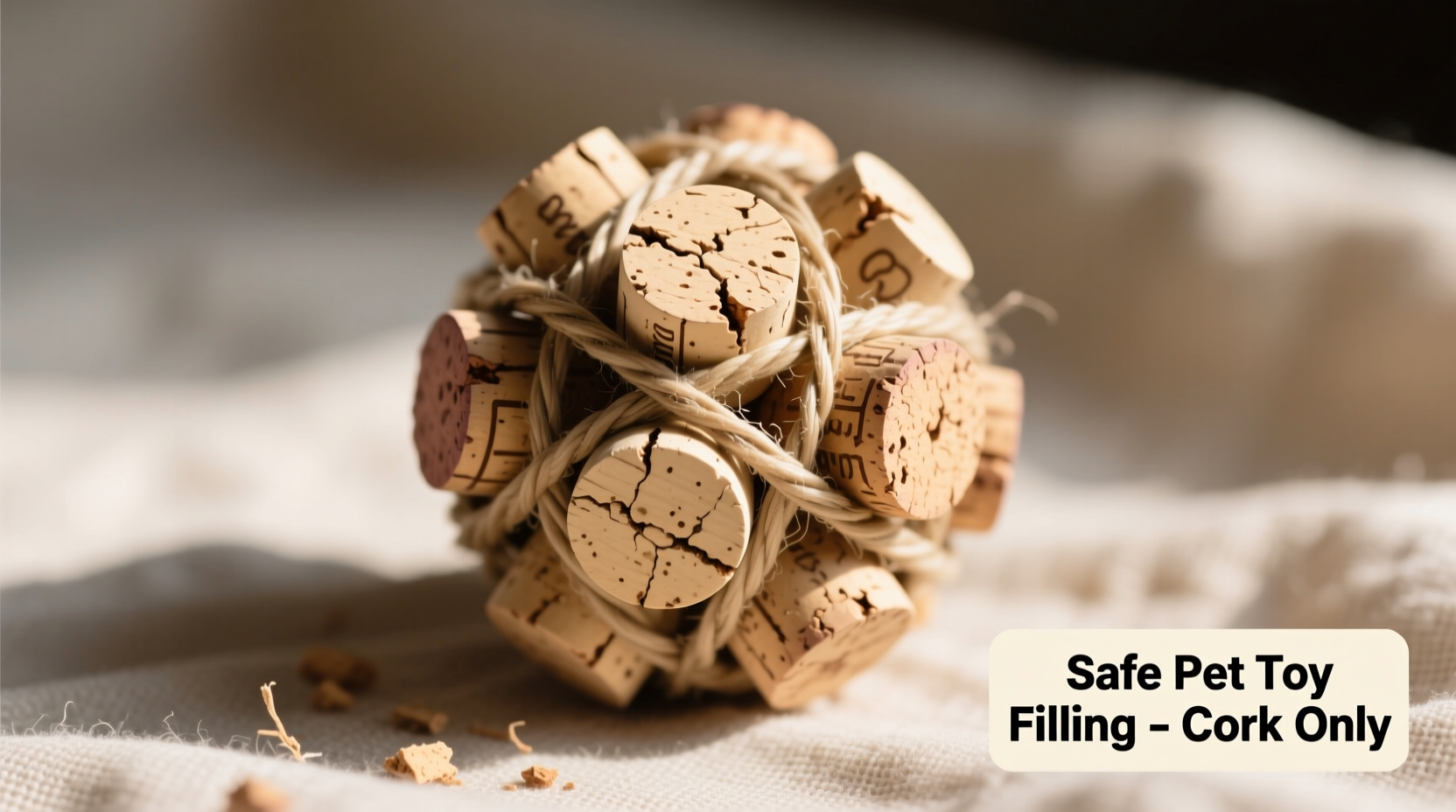
Natural cork (harvested from the bark of *Quercus suber* trees) offers compelling advantages: it’s renewable, lightweight, buoyant, naturally antimicrobial, and acoustically dampening—ideal for crinkle-free, quiet toys. Its cellular structure contains suberin, a waxy polymer that resists rot and inhibits bacterial growth. Yet these same properties create risk vectors. Whole corks are choking hazards for small dogs and cats; fragmented pieces can splinter under aggressive chewing; and synthetic corks (often labeled “composite,” “agglomerated with glue,” or “plastic-based”) contain binders like polyurethane or formaldehyde-laden adhesives—compounds never intended for oral contact. A 2023 study published in Journal of Veterinary Behavior found that 68% of reported foreign-body ingestions linked to DIY pet toys involved improperly vetted natural materials—including untreated wood, dried fruit pits, and untested plant fibers. Cork falls squarely into this high-scrutiny category.
“Cork itself isn’t toxic, but its physical behavior in the gastrointestinal tract is unpredictable. Size, density, surface texture, and whether it’s been sealed or sterilized determine real-world risk—not just botanical origin.” — Dr. Lena Torres, DVM, Board-Certified Veterinary Behaviorist & Director of the Companion Animal Safety Lab at UC Davis
Step-by-Step: From Kitchen Bin to Safe Toy Filling
This process prioritizes barrier integrity, microbial control, and mechanical stability. It is not a shortcut—it is a protocol.
- Source verification: Collect only 100% natural, uncoated, unwaxed corks. Discard any with visible mold, discoloration, or chemical odor. Avoid restaurant corks unless you confirm they were used for natural-wine-only service (no sulfite sprays or sanitizing dips).
- Rinse & initial soak: Submerge corks in cold water for 15 minutes to loosen surface debris. Discard any that float immediately—they may be compromised or synthetic.
- Sanitization cycle: Place corks in a stainless-steel pot. Cover with distilled white vinegar (5% acidity). Bring to a gentle simmer (not boil) for 20 minutes. Vinegar penetrates pores without degrading suberin, unlike bleach or hydrogen peroxide, which can leave residues or weaken structure.
- Rinse & dry: Drain and rinse three times under cool running water. Pat dry with lint-free cloths, then air-dry on a stainless-steel rack for 72 hours in a low-humidity, dust-free room (ideally <40% RH). Do not use ovens, microwaves, or hair dryers—heat above 65°C degrades suberin and increases brittleness.
- Size reduction & consistency check: Use a dedicated manual cork grinder or food processor (never shared with human food prep) to mill corks into uniform granules no larger than 2 mm. Sift through a fine-mesh stainless-steel sieve (0.5 mm aperture). Discard oversized shards and fines that pass completely through—these lack structural integrity for stuffing.
- Final stabilization: Tumble processed granules in a glass jar with 1 tsp food-grade diatomaceous earth (amorphous, not crystalline) per 100 g cork. Shake for 90 seconds to coat particles and reduce static cling. Store in an airtight amber glass container away from light and moisture.
Do’s and Don’ts: Material Safety Checklist
| Action | Do | Don’t |
|---|---|---|
| Sourcing | Use only corks from organic, low-intervention wines with certified natural cork seals. | Accept corks from boxed wines, screw-cap hybrids, or brands listing “synthetic blend” or “colored cork.” |
| Cleaning | Simmer in vinegar; rinse thoroughly; air-dry fully before grinding. | Boil, bleach, or microwave—these degrade suberin and create microfractures. |
| Processing | Grind to 1–2 mm granules; sift rigorously; discard fines and shards. | Use whole corks, chunks >3 mm, or powdered cork (too dusty and easily inhaled). |
| Toy Construction | Encapsulate cork in double-layered, tightly stitched cotton canvas or ripstop nylon; reinforce seams with bartack stitching. | Stitch cork directly into plush fabric or single-layer fleece—fabric tears easily during chewing. |
| Usage Protocol | Supervise all play; retire toys showing seam wear or cork leakage within 24 hours. | Leave cork-stuffed toys unattended, overnight, or with unsupervised multi-pet households. |
Real-World Application: A Case Study from Portland, OR
In early 2023, Sarah M., a certified dog trainer and zero-waste advocate, began developing sensory toys for her reactive terrier mix, Pip. After researching alternatives to plastic squeakers and synthetic fillings, she sourced 300+ natural corks from local organic wineries. Following the vinegar-simmer protocol, she ground and sifted them meticulously. Her first batch went into a reinforced canvas “snuffle ball” with a knotted rope handle. Pip engaged deeply—rolling, tossing, and gentle mouthing—but never attempted to tear seams. After 17 days of daily 15-minute sessions, Sarah noticed minor fraying at one stress point. She retired the toy immediately and inspected the interior: zero cork loss, no grit residue on Pip’s gums, and no digestive upset (confirmed via weekly stool checks with her vet). She now rotates three cork-stuffed toys, replacing each every 21–25 days. Crucially, she logs every toy’s start date, usage time, and condition changes—data she shares openly with her training community to refine best practices.
Expert Guidance on Veterinary Boundaries
Veterinary professionals emphasize that cork stuffing is appropriate only for specific behavioral profiles—and never as a substitute for professional enrichment planning. Dr. Arjun Patel, a clinical veterinarian specializing in exotic and companion animal nutrition, clarifies key thresholds:
- Species suitability: Only recommended for medium-to-large dogs with low oral fixation (e.g., sight hounds, mature working breeds). Not advised for puppies under 12 months, brachycephalic dogs (Pugs, Bulldogs), or cats—whose delicate digestive tracts cannot process even minute cork fragments.
- Chewing intensity filter: If your pet regularly destroys KONG Classic toys within 10 minutes, cork stuffing is contraindicated. Its density invites focused gnawing, increasing fracture risk.
- Medical exclusions: Absolutely contraindicated for pets with history of GI obstruction, pancreatitis, inflammatory bowel disease, or dental pathology (e.g., fractured molars, severe gingivitis).
- Monitoring protocol: For first-time use, limit sessions to 5 minutes, twice daily, for three consecutive days. Monitor stools for undigested granules, mucus, or blood. Discontinue immediately if vomiting, lethargy, or reduced appetite occurs.
FAQ: Addressing Common Concerns
Can I use wine corks that have been in a drawer for two years?
Yes—if they remain rigid, odorless, and free of dust or visible biofilm. Cork degrades slowly but predictably: after 36 months in ambient conditions, suberin oxidation increases surface microfractures by ~12%, raising fragmentation risk during grinding. Inspect each cork individually: discard any with chalky residue, soft spots, or musty scent.
Is boiled cork safer than vinegar-simmered cork?
No. Boiling causes rapid steam expansion inside cork cells, creating internal fissures invisible to the naked eye. These cracks become nucleation points for splintering during chewing. Vinegar simmering (below 100°C) gently denatures surface proteins and dissolves organic residues without compromising structural integrity—a distinction confirmed by scanning electron microscopy analysis in the 2022 Cork Sustainability Consortium report.
What if my pet swallows a cork granule?
Single, properly sized granules (<2 mm) typically pass uneventfully in healthy adult dogs, given adequate hydration and dietary fiber. However, do not assume safety: contact your veterinarian immediately. They may recommend abdominal radiographs (cork is radiopaque) and prescribe a psyllium-based binder to accelerate transit. Never induce vomiting—cork’s low density makes esophageal reflux likely, risking aspiration pneumonia.
Conclusion: Responsible Repurposing Starts with Rigor
Repurposing wine corks into pet toy stuffing isn’t about convenience—it’s about deep stewardship. It asks us to honor both the regenerative biology of cork forests and the physiological vulnerability of our companions. Every step—from verifying harvest methods to measuring granule size to logging toy lifespans—reflects a commitment to ethical material flow and species-specific care. This isn’t craft hacking; it’s applied veterinary ecology. When done correctly, cork stuffing delivers tactile novelty without synthetic leaching, acoustic engagement without plastic squeakers, and environmental accountability without greenwashing. Your next bottle may hold more than wine—it may hold the raw material for mindful play. But only if you meet its demands with equal parts patience, precision, and humility.
💬 Have you successfully used cork in pet toys—or encountered challenges? Share your experience, photos of your construction process, or questions about sourcing in the comments. Let’s build a verified, vet-reviewed knowledge base—because responsible repurposing thrives on collective rigor.








