Merlot isn’t just a wine—it’s a cultural shorthand for sophistication, depth, and quiet confidence. Its rich, velvety tones—from plum-tinged ruby to near-black garnet—have long inspired fashion, interior design, and cosmetics. Yet few realize that selecting the *right* lipstick to echo your favorite merlot isn’t about copying its label photo or mimicking its bottle’s glossy finish. It’s about decoding pigment behavior under natural light, understanding how melanin and pH shift color on skin, and recognizing that merlot itself varies wildly across regions, vintages, and winemaking techniques. A Napa Valley merlot aged in new French oak reads as warm brick red with cedar notes; a cooler-climate Chilean bottling may lean violet-purple with juicy blackberry intensity. Your lipstick must respond to *that specific expression*—not a generic “wine red.” This guide bridges oenology and cosmetic chemistry to help you build intentional, harmonious pairings that elevate both your glass and your look.
Why Merlot Hues Are Uniquely Challenging (and Rewarding)
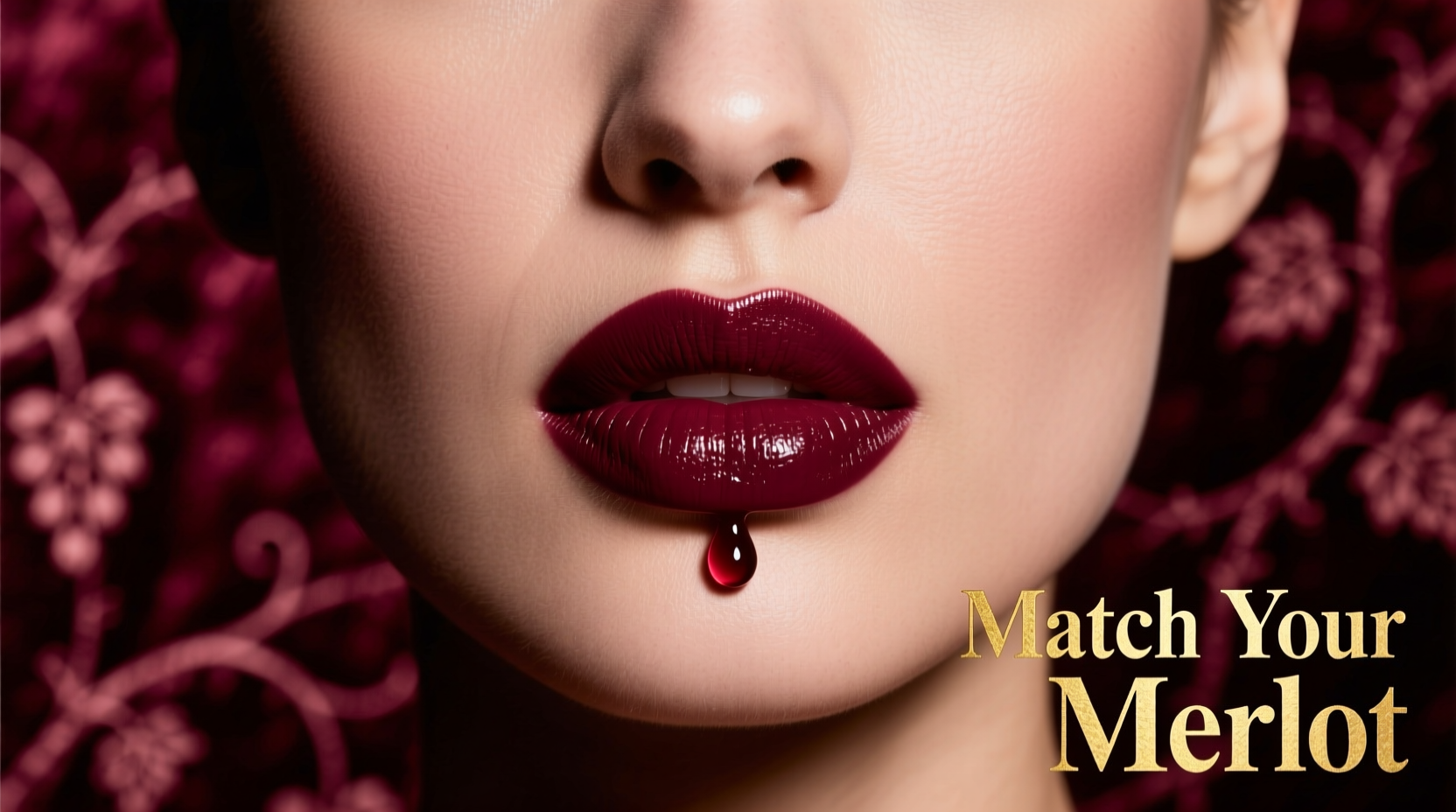
Unlike primary reds or cool-toned berries, merlot-derived shades occupy a dynamic middle ground: they’re neither purely warm nor definitively cool, but rather chromatically complex—layered with secondary pigments like anthocyanins (purple), tannin-derived browning compounds (brick, rust), and oxidation-driven amber highlights (tawny, mahogany). When translated to lipstick, this complexity means a single “merlot” swatch can appear burgundy on fair skin, plum on medium olive tones, and nearly black-brown on deep complexions—depending on formulation. Lipstick pigments behave differently than wine pigments: wine color comes from grape skins suspended in liquid ethanol and acid; lipstick relies on finely milled iron oxides, dyes like D&C Red No. 6, and pearlescent micas—all suspended in waxes and oils. That physical difference explains why a lipstick labeled “Merlot Velvet” may read too blue on your lips while your actual merlot glows with warmth. The key is matching *perception*, not pigment.
Tip: Swatch lipstick on your lower lip—not the back of your hand—and observe it under north-facing daylight (not LED or fluorescent) for 90 seconds. Skin temperature and pH will slightly oxidize the formula, revealing its true merlot alignment.Step-by-Step: Matching Your Lipstick to Your Specific Merlot
- Identify your merlot’s dominant undertone: Pour a small amount into a clear glass. Tilt it against white paper. Look at the rim (meniscus)—not the center. Is the edge bluish-purple? Warm brick-red? Brownish-amber? That’s your anchor.
- Determine your skin’s undertone response: Hold a pure silver and pure gold foil next to your bare jawline in natural light. Which metal makes your skin look more radiant and even? Silver favors cool undertones; gold favors warm. Neutral undertones often glow with both—but lean toward gold if veins appear greenish.
- Select a base category: Use the table below to cross-reference your merlot’s rim tone with your skin’s undertone.
- Test for oxidation shift: Apply the chosen lipstick, wait two minutes, then gently blot once with tissue. Reassess. Does the color deepen toward your merlot’s core hue—or drift away?
- Validate with context: Pair the lipstick with a neutral top (ivory, charcoal, oat) and hold your merlot glass beside your face. Do the two reds vibrate in unison—or compete?
Merlot Rim Tone × Skin Undertone Matching Guide
| Merlot Rim Tone | Cool Undertone Skin | Neutral Undertone Skin | Warm Undertone Skin |
|---|---|---|---|
| Blue-Purple Edge (e.g., young Bordeaux, high-altitude Argentina) |
Raspberry-plum with fine violet pearl Look for: D&C Violet No. 2 + Iron Oxide Red |
Blackcurrant with subtle silver shimmer Look for: High-pigment berry + mica blend |
Burgundy-rose with soft copper sheen Look for: Iron oxide-rich formula, no blue dyes |
| Brick-Red Edge (e.g., mature Napa, Washington State) |
Spiced cranberry with matte finish Look for: Low-blue, high-iron oxide |
Antique rose with satin luminosity Look for: Balanced oxide/dye ratio |
Terracotta-wine with golden microglitter Look for: Iron oxide + ferric ammonium ferrocyanide |
| Amber-Tawny Edge (e.g., extended barrel-aged, oxidative styles) |
Plum-brown with muted taupe shift Look for: Manganese violet + burnt sienna |
Chocolate-ruby with velvet texture Look for: Cocoa butter base + brown oxide |
Fig jam with antique gold flecks Look for: Iron oxide + bronze mica |
The Chemistry of Color Shift: Why Your Lipstick Changes on Skin
Lipstick doesn’t sit inertly on lips. Saliva pH (typically 6.2–7.6), local skin temperature (averaging 33°C on lips), and sebum composition interact with pigment carriers. Acidic saliva can brighten red dyes; alkaline conditions deepen them. Warmer skin accelerates wax crystallization, concentrating pigment density. This is why a “true merlot” lipstick may appear brighter on someone with low salivary pH and cooler lips—and richer, deeper on someone with higher pH and warmer surface temp. Winemakers understand this: they taste wine at 16–18°C because temperature alters volatile compound release and perceived color saturation. Likewise, test lipstick after sipping water (to normalize pH) and avoid applying immediately post-workout (when lip temperature spikes).
“Color is never static—it’s a dialogue between material, biology, and environment. A lipstick matched to merlot isn’t about duplication; it’s about resonance. The best pairings feel inevitable, like the first sip of a wine that tastes exactly how it looks.” — Dr. Lena Torres, Cosmetic Chemist & Oenologist, Institute of Pigment Science
Mini Case Study: Elena’s Cabernet-Merlot Blend Dilemma
Elena, 38, hosts monthly wine tastings and values aesthetic cohesion. She loved a 2020 Columbia Valley merlot-cabernet blend with an intense violet rim and smoky graphite finish—but every “merlot” lipstick she tried looked either too blue or too brown. She followed the step-by-step method: identified her merlot’s rim as blue-purple, confirmed her cool undertone via the foil test, and selected a raspberry-plum lipstick with violet pearl. But initial swatching felt off. Reviewing the oxidation step, she waited two minutes, blotted, and noticed the color softened into a seamless violet-burgundy—mirroring the wine’s evolution in the glass. She then validated contextually: wearing ivory silk, holding the glass beside her face, the lipstick didn’t mimic the wine—it *answered* it, like a harmonic interval in music. Her guests began asking, “What’s that lipstick? It makes the wine taste deeper.” That’s resonance—not replication.
5-Point Merlot-Lipstick Harmony Checklist
- ☑️ You’ve observed your merlot’s rim tone in natural light—not under bar lighting or phone flash.
- ☑️ You’ve tested lipstick on your lower lip (not hand) and waited 90 seconds for oxidation.
- ☑️ You’ve ruled out formulas with strong blue or orange dyes if your merlot leans neutral or amber.
- ☑️ You’ve verified the pairing works with your most-worn neutral top—not just in isolation.
- ☑️ You’ve noted whether your merlot tastes fruit-forward (favor brighter lip colors) or earth-driven (favor deeper, matte finishes).
FAQ: Real Questions from Wine & Beauty Enthusiasts
Does the alcohol content in wine affect how lipstick looks beside it?
No—alcohol itself is invisible and evaporates quickly. What matters is the wine’s *color saturation* and *light refraction*. Higher-alcohol wines (often 14.5%+ ABV) tend to have thicker, more viscous textures, which enhance color depth and slow pigment dispersion in the glass. This makes them visually richer, so your lipstick should match that density—not the ABV number. A thin, high-acid merlot at 13.5% ABV may need a lighter, more translucent lipstick than a dense, low-acid 14.2% version from the same vineyard.
Can I use the same lipstick with different merlots—or do I need a rotation?
You’ll need at least three core shades: one for cool-violet rims, one for warm-brick rims, and one for oxidative amber rims. Most serious collectors own merlots across these categories. Think of them like wardrobe basics: a versatile navy blazer works across seasons, but you wouldn’t wear it with summer linen and winter wool simultaneously. Your “cool merlot” lipstick will clash with an amber-rimmed aged bottling—it’ll read as dull or washed out. Rotation isn’t indulgence; it’s precision.
Why does my favorite merlot lipstick look perfect in-store but dull at home?
Store lighting is almost always high-CRI (Color Rendering Index) LED—designed to flatter reds and make products “pop.” Home lighting is rarely optimized: standard bulbs average CRI 80–85, muting reds by up to 30%. Worse, many kitchens and dining rooms use warm-white LEDs (2700K–3000K) that add yellow bias, shifting merlot hues toward brown. Solution: Install a 4000K daylight-balanced bulb (CRI ≥95) over your vanity or dining area. It won’t change the lipstick—but it *will* reveal its true relationship to your wine.
Conclusion: Beyond Aesthetics—The Ritual of Intentional Alignment
Matching lipstick to merlot is not about vanity—it’s about cultivating sensory literacy. It asks you to slow down, observe closely, and honor the subtle variables that shape perception: light quality, biological chemistry, regional terroir, and artisanal intent. When your lipstick echoes the precise violet rim of a high-elevation Argentine merlot, or deepens in sync with the amber glow of an oxidative Italian Riserva, you’re not just accessorizing. You’re participating in a centuries-old dialogue between land, craft, and human expression. That alignment creates quiet confidence—the kind that doesn’t shout, but settles. So open your next bottle mindfully. Examine its rim. Feel your lips’ temperature. Choose deliberately. Then raise your glass—not just to toast, but to witness the harmony you’ve curated. Your merlot deserves that attention. And so do you.
💬 Share your merlot-lipstick pairing success—or challenge—in the comments. Did a particular region or vintage surprise you? What shade finally clicked? Let’s build a living reference library, one thoughtful sip at a time.








