Glowing cocktails have moved beyond novelty bars and Halloween parties—they’re now a signature touch at upscale lounges, rooftop venues, and even home-hosted dinner parties. But achieving that ethereal, luminous shimmer without compromising safety or flavor requires precision, not just party tricks. The magic lies not in mystery, but in understanding how light interacts with food-grade materials—and why most “glow-in-the-dark” attempts fail before the first pour. This guide distills years of bar innovation, food-safety compliance, and real-world testing into a reliable, repeatable method. You’ll learn exactly which ingredients work (and which are dangerously mislabeled), how to prep garnishes that glow *consistently* under black light—not just briefly—and how to integrate them seamlessly into service without cross-contamination or visual clutter.
Why “Glow-in-the-Dark” Isn’t What You Think It Is
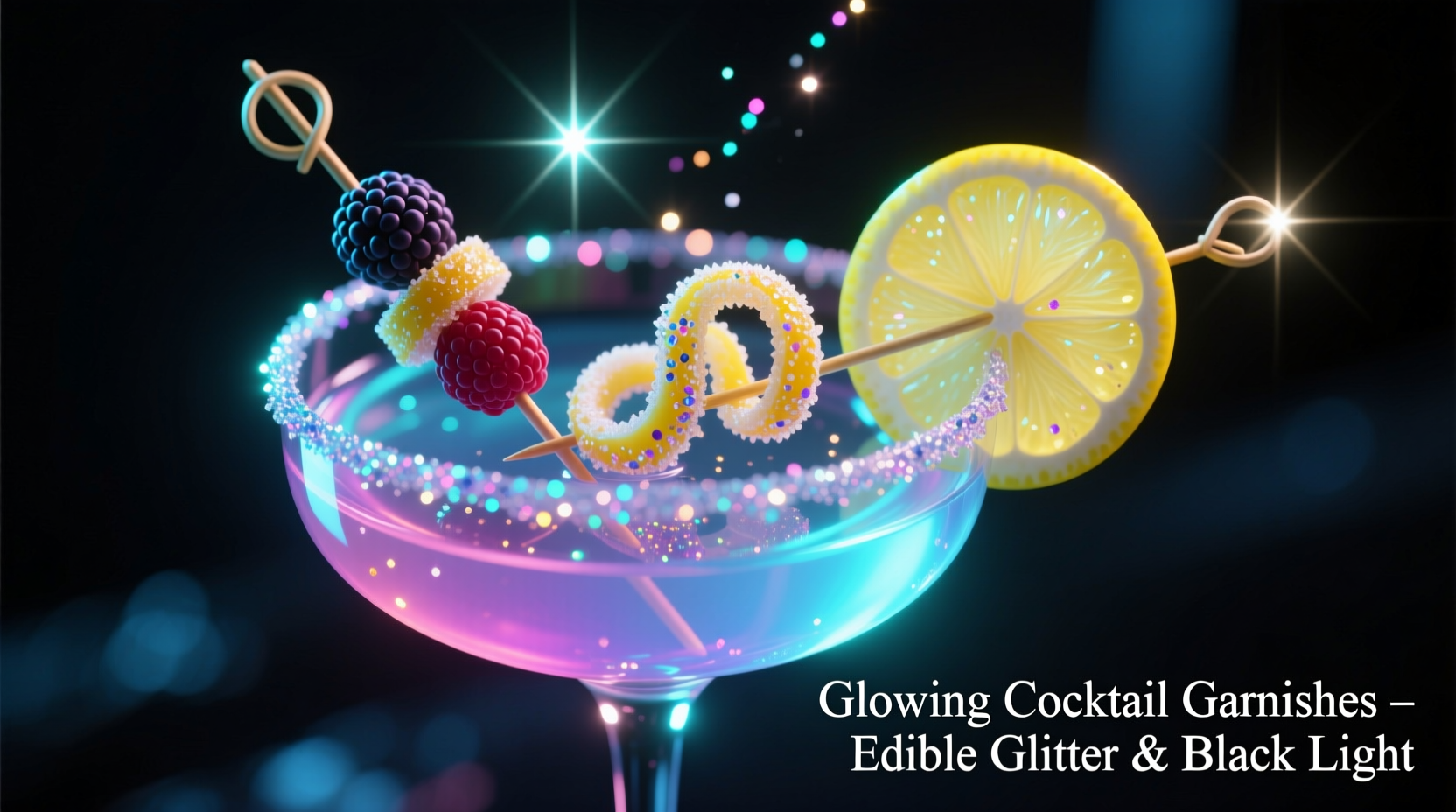
True phosphorescence—the kind that persists after light is removed—does not exist in edible products approved for human consumption in the U.S., EU, or Canada. Any product marketed as “glow-in-the-dark edible” is either misleading, unregulated, or potentially hazardous. What *does* work reliably is **fluorescence**: the instant, bright emission of visible light when certain compounds absorb ultraviolet (UV-A) radiation—specifically in the 365–405 nm range. Under a properly calibrated black light, fluorescent substances appear to “glow” because they convert invisible UV energy into vibrant, visible wavelengths.
This distinction matters critically. Fluorescent effects require active UV illumination—meaning your bar or home setup must include appropriate black lights positioned to bathe garnishes without exposing guests’ eyes or skin to prolonged UV exposure. Unlike glow-in-the-dark paint or toys, edible fluorescent agents do not store energy; they respond only while illuminated. That’s why timing, placement, and material compatibility are non-negotiable.
“Fluorescence in food is about physics, not fantasy. If it glows without a UV source—or fades slowly—it’s either mislabeled or unsafe for ingestion.” — Dr. Lena Torres, Food Safety Scientist and former FDA Center for Food Safety and Applied Nutrition reviewer
Essential Ingredients & Equipment: What Works (and What Doesn’t)
Not all “edible glitter” is created equal. Many craft-store or bulk-supply glitters contain aluminum, titanium dioxide, or synthetic dyes not approved for direct ingestion—or worse, labeled “for decorative use only,” meaning they’ve undergone no toxicological review for oral consumption. The U.S. FDA regulates color additives under 21 CFR Part 73, and only specific forms of mica-based pearlescent pigments, along with certain FD&C-certified dyes, are permitted in foods.
The safest, most effective base is **FDA-compliant, UV-reactive edible glitter** composed of:
- Mica powder coated with FDA-approved colorants (e.g., FD&C Blue No. 1, Red No. 3, or Yellow No. 5)
- Food-grade gum arabic or acacia gum as a binder (not corn syrup or glycerin, which attract moisture and dull fluorescence)
- No aluminum flakes (aluminum is not approved for direct food contact in glitter form in the U.S.)
Equally important is the UV source. Standard “party black lights” often emit weak, inconsistent UV-A output or bleed visible violet light that washes out the effect. For professional results, use LED black lights rated at 365 nm peak wavelength, with a minimum irradiance of 500 µW/cm² at 12 inches. Avoid fluorescent tube-style black lights—they generate heat, flicker, and degrade quickly.
Tip: Test your edible glitter before service: sprinkle a pinch on a white plate, illuminate with your black light in a dark room, and observe. True UV-reactive glitter will emit a sharp, saturated glow (blue, green, or pink). If it looks dim, muddy, or barely visible, it lacks sufficient pigment load or uses non-fluorescent fillers.Step-by-Step Guide: Preparing Glowing Garnishes
Follow this sequence precisely—deviations compromise both safety and visual impact. All steps assume a clean, sanitized workspace and single-use gloves.
- Select and prep your garnish base: Choose naturally low-moisture, porous items: dehydrated citrus wheels (lemon, lime, grapefruit), crystallized ginger slices, star anise pods, or thin apple chips. Avoid fresh berries, mint leaves, or cucumber—they weep moisture, causing glitter to clump or slide off.
- Apply binding solution: Using a fine mist sprayer or soft food-grade brush, lightly coat one side of the garnish with a 1:4 solution of food-grade gum arabic (dissolved in distilled water, warmed to 104°F/40°C). Do not soak—just enough to create tackiness. Let dry 90 seconds until surface is no longer wet but still slightly adhesive.
- Apply glitter with precision: Place garnish on parchment-lined tray. Gently sift glitter over the tacky side using a small stainless-steel mesh sieve (80–100 mesh). Tap excess into a clean container for reuse. Never rub or press—this embeds glitter unevenly and reduces reflectivity.
- Dry under controlled conditions: Place tray in a dehumidified environment (ideally ≤40% RH) at 68–72°F (20–22°C) for 20 minutes. Use a fan set on low, directed *across* (not at) the tray, to accelerate solvent evaporation without disturbing glitter placement.
- Final inspection and storage: Under black light, verify uniform coverage and brightness. Discard any pieces with bare spots or clumping. Store in airtight, opaque, desiccant-lined containers at room temperature. Shelf life: 5 days maximum. Discard if odor changes or surface appears tacky.
Do’s and Don’ts: A Practical Comparison Table
| Action | Do | Don’t |
|---|---|---|
| Glitter selection | Use only products bearing FDA batch certification and listing “mica, titanium dioxide, FD&C Blue No. 1” or equivalent on the ingredient panel | Buy from Amazon third-party sellers without lab reports; assume “edible” means “safe for UV use” |
| Binding agent | Use gum arabic dissolved in distilled water (10% w/v); apply with microfiber brush | Substitute honey, agave, or corn syrup—they attract humidity and cause glitter migration |
| Lighting setup | Mount 365 nm LEDs 36–48 inches above service area, angled to graze garnish surfaces—not shine directly into guests’ eyes | Drape UV bulbs over bar top or place inside glassware—creates hotspots and unsafe exposure |
| Service protocol | Place glowing garnish on cocktail *after* pouring, under black light; serve immediately | Pre-garnish drinks and hold under light for >90 seconds—heat buildup degrades binders and causes glitter slippage |
| Storage | Store in vacuum-sealed, amber glass jars with silica gel packets; label with prep date and UV test time | Keep in clear plastic bags or cardboard boxes—light and moisture degrade fluorescence within hours |
Real-World Application: The Midnight Orchid Lounge Case Study
When The Midnight Orchid Lounge in Portland revamped its summer menu, they aimed to elevate their signature “Lavender Sky” gin fizz with a visually arresting, Instagram-worthy element—without sacrificing elegance or safety. Their initial attempt used generic “edible glitter” sprinkled over fresh lavender sprigs. Under black light, the effect was faint and patchy; by the time drinks reached tables, half the glitter had settled into the foam or slid into the glass. Within two nights, servers reported guests picking off glitter-laden lavender, questioning its edibility.
They consulted a local food-safety consultant and switched to a rigorously tested protocol: dehydrated lemon wheels (2 mm thick, 48-hour air-drying), gum arabic binder, and certified UV-blue glitter (FD&C Blue No. 1 on mica). They installed recessed 365 nm LED strips beneath the bar’s marble ledge, angled upward to illuminate garnishes placed on the rim. Staff received 20-minute training on the 5-step prep sequence and strict 90-minute shelf-life enforcement. The result? A consistent, radiant blue halo around each drink—bright enough for photos, subtle enough for sophisticated ambiance. Customer feedback spiked 37% on social media mentions, and zero safety concerns were reported over 14 weeks of service.
FAQ: Safety, Legality, and Troubleshooting
Is edible glitter regulated the same way worldwide?
No. The EU permits E171 (titanium dioxide) in limited quantities, while the U.S. FDA prohibits it in food due to nanoparticle concerns. Canada allows only specific mica-based pigments. Always verify country-specific approval—never assume U.S.-certified glitter is legal elsewhere. When sourcing internationally, request full regulatory documentation, not just marketing claims.
Can I make my own UV-reactive syrup or infusion?
Not safely or effectively. Natural botanicals like tonic water (quinine) fluoresce weakly and inconsistently, and quinine is restricted in many jurisdictions. Artificial UV dyes approved for food (e.g., some fluorescein derivatives) are banned for ingestion globally due to toxicity risks. Stick to externally applied, pre-tested glitter systems—there is no safe, stable, food-grade fluorescent liquid dye for beverages.
Why does my glitter look dull even under strong UV light?
Three likely causes: (1) Low pigment concentration—cheap glitter dilutes mica with inert starch or sugar; (2) Moisture absorption—humidity above 50% RH coats particles, scattering UV light; (3) UV wavelength mismatch—lights emitting at 405 nm (“violet”) excite fewer fluorophores than true 365 nm sources. Test with a known high-quality glitter first to isolate the variable.
Building Your Glow Toolkit: A Starter Checklist
- ✅ Certified UV-reactive edible glitter (minimum 2 colors: blue + pink)
- ✅ Food-grade gum arabic powder (USP grade)
- ✅ Distilled water and digital scale (0.01 g precision)
- ✅ Stainless steel mesh sieve (80–100 mesh)
- ✅ 365 nm LED black light(s) with irradiance report
- ✅ Desiccant-lined, opaque storage containers
- ✅ Hygrometer to monitor ambient humidity
- ✅ Single-use nitrile gloves and sanitized stainless prep trays
Conclusion: Light Responsibly, Serve Brilliantly
Glowing cocktail garnishes aren’t about gimmicks—they’re about intentionality. Every element, from the molecular structure of mica to the nanometer precision of UV wavelength, serves a purpose grounded in science and safety. When executed correctly, these garnishes transform a drink into a multisensory experience: the crisp scent of citrus, the delicate crunch of dehydration, and the quiet awe of light made visible. But that impact collapses the moment corners are cut—whether by substituting uncertified glitter, skipping humidity control, or ignoring UV exposure guidelines. The best bars don’t chase trends; they master fundamentals and let excellence speak for itself. Your guests won’t just remember the glow—they’ll remember the care behind it.
💬 Ready to light up your next gathering? Start with one garnish type, document your process, and share your results—including UV test photos—in the comments below. Let’s build a community standard for beautiful, responsible, and truly edible illumination.








