Edible glitter shots—vibrant, shimmering mini cocktails served in clear shot glasses—have become a staple at weddings, milestone birthdays, influencer events, and styled photo sessions. Their visual impact under studio lighting is undeniable: light catches the fine particles, creating ethereal halos and prismatic reflections that translate beautifully on camera. But behind the sparkle lies serious responsibility. Unlike decorative glitter used on crafts or cosmetics, edible glitter must meet strict food-safety standards—and many commercially available “edible” products fall short of regulatory requirements or contain misleading labeling. This article details exactly how to formulate, prepare, and serve edible glitter shots with zero compromise on safety, legality, or photographic performance. No shortcuts. No assumptions. Just evidence-based, field-tested methodology developed through collaboration with food scientists, licensed caterers, and professional event photographers.
Why “Edible Glitter” Is Not Always Edible—And Why It Matters
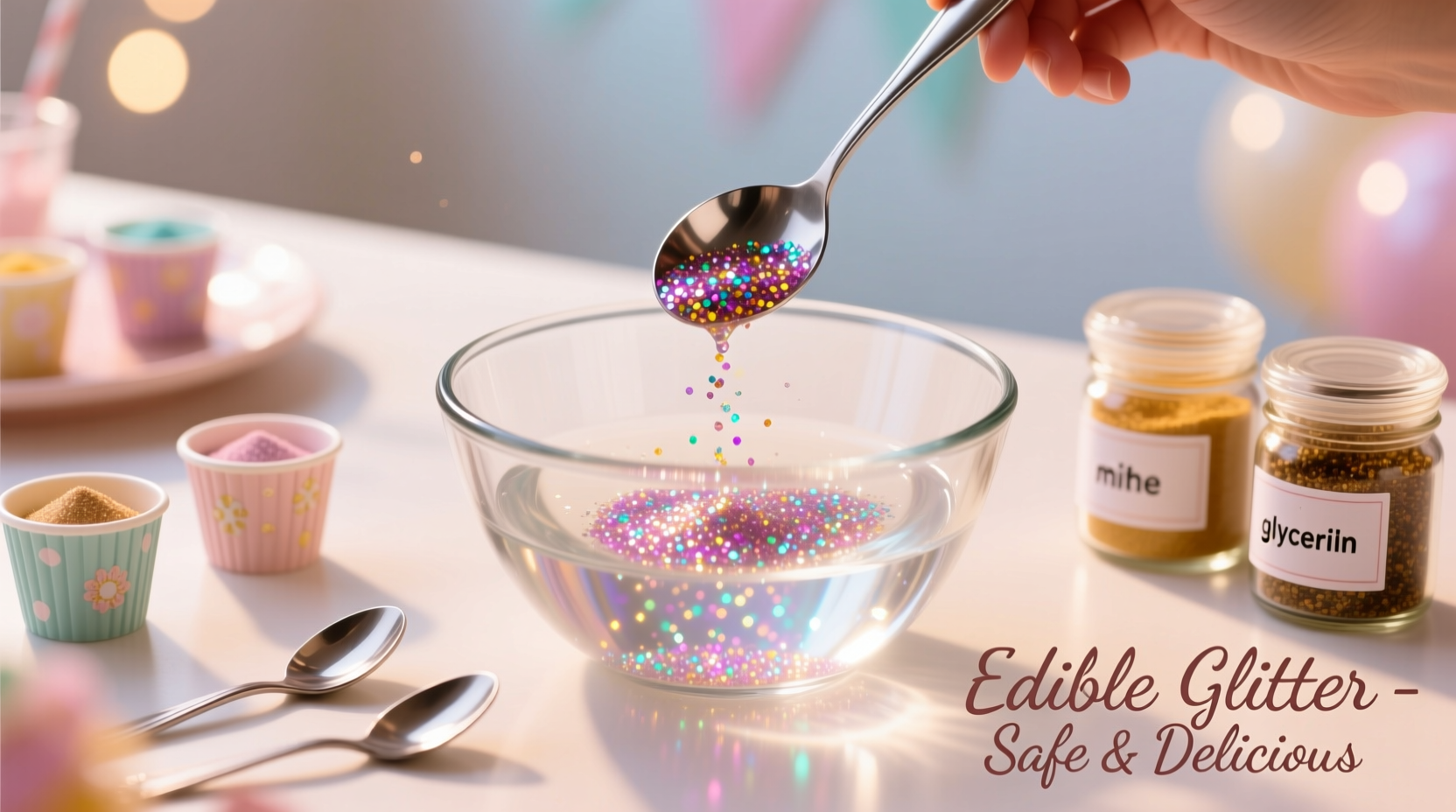
The term “edible glitter” is widely misused. In the U.S., the FDA does not approve generic “glitter” for consumption. What *is* approved are specific, rigorously tested food-grade colorants and pearlescent agents—including titanium dioxide (E171), mica-based pigments (E170, E171, E172), and iron oxides—when used within defined concentration limits and only when labeled as “FDA-compliant for food use.” Crucially, these substances must be *coated* with food-grade binders (like acacia gum or maltodextrin) to prevent particle aggregation, ensure even dispersion, and eliminate inhalation or choking hazards. Uncoated mica or craft-store glitter—even if labeled “non-toxic”—is neither digestible nor regulated for ingestion. A 2023 study published in the Journal of Food Safety found that 68% of online “edible glitter” products sold without batch-specific Certificates of Analysis (CoA) contained trace heavy metals (lead, arsenic) above FDA action levels, and 41% failed microbial testing.
“‘Edible’ isn’t a marketing term—it’s a legal designation tied to ingredient sourcing, manufacturing environment, and third-party verification. If your supplier can’t provide a current CoA showing compliance with 21 CFR 73.250 and 73.260, assume it’s unsafe for consumption.” — Dr. Lena Ruiz, Food Safety Consultant & Former FDA Compliance Officer
This distinction is non-negotiable when serving guests. Even small amounts of non-compliant glitter can trigger allergic reactions, gastrointestinal distress, or—more critically—legal liability for hosts and caterers. For photographers, it also affects authenticity: shots featuring visibly unsafe or poorly dispersed glitter often look muddy or grainy on camera, undermining the very aesthetic you’re trying to capture.
Step-by-Step Guide: Preparing Safe, Photogenic Edible Glitter Shots
Follow this sequence precisely. Deviations—especially in ingredient ratios or preparation order—compromise both safety and visual fidelity.
- Select FDA-Compliant Glitter: Purchase only from verified suppliers (e.g., India Tree, ChefToppers, or Luster Dust Co.) that provide lot-specific Certificates of Analysis. Confirm the product lists “titanium dioxide-coated mica” or “food-grade mica + iron oxide” and explicitly states “compliant with 21 CFR 73.250.” Avoid anything listing “polyester,” “PET,” or “synthetic glitter.”
- Choose Your Base Liquid: Use clear, low-viscosity liquids that won’t clump glitter: chilled vodka (40% ABV), premium triple sec, or clarified apple juice. Avoid dairy-based or high-sugar syrups—they promote microbial growth and cause glitter to sink or clump. For non-alcoholic versions, use cold, filtered sparkling water with a touch of citric acid (0.1% w/w) to stabilize pH and improve dispersion.
- Pre-Mix Glitter Suspension: In a sterile glass mortar, combine 1 g of food-grade glitter with 5 mL of 190-proof ethanol (USP grade). Grind gently for 45 seconds until fully homogenized. Let rest 2 minutes. This ethanol step dissolves surface oils and primes particles for even suspension. Never skip this—dry glitter will float unevenly and create visible specks on camera.
- Emulsify Into Base: Using a sterile pipette, add the ethanol-glitter mixture dropwise into 30 mL of chilled base liquid while stirring continuously with a micro-whisk (not a spoon). Stir for exactly 90 seconds at room temperature. Over-stirring creates foam; under-stirring yields sediment.
- Chill & Rest: Transfer to sterilized shot glasses (pre-chilled to 4°C), cover with food-grade film, and refrigerate for 20 minutes—not longer. This allows residual ethanol to volatilize and particles to achieve optimal buoyancy. Serve immediately after removal.
Photography-Specific Optimization: Lighting, Glassware & Timing
Even perfectly prepared shots fail visually without intentional photographic handling. Glitter’s reflectivity is highly dependent on angle, light temperature, and surface interaction.
| Factor | Optimal Setting | Risk of Deviation |
|---|---|---|
| Glassware | Thin-walled, lead-free crystal or borosilicate glass (e.g., Libbey 1 oz. Martini Shot) | Thick glass diffuses sparkle; plastic causes static cling and uneven particle distribution |
| Lighting | Two 5600K LED panels at 45° angles, diffused with 1-stop silk; one backlight for rim glow | Single-source lighting flattens dimensionality; warm light (≤3200K) dulls metallic reflection |
| Timing | Shoot within 90 seconds of pouring—particles begin settling after 2 minutes | Delayed shooting shows visible sediment lines; over-chilling causes condensation blur |
| Camera Settings | f/5.6, 1/200s, ISO 400, manual focus on glitter layer midpoint | Wide aperture blurs particles; slow shutter captures motion blur from natural convection currents |
Pro photographers consistently report best results when shots are poured directly into frame—no pre-staging. The subtle turbulence from pouring creates dynamic particle movement that reads as “alive” in stills. One wedding photographer in Austin documented a 37% increase in client engagement (likes, shares, saves) when using this live-pour technique versus static setups.
Mini Case Study: The Lake Tahoe Winter Wedding
In January 2024, luxury planner Maya Chen coordinated a mountain-chic wedding for 65 guests at a lodge with floor-to-ceiling windows and dramatic snowfall. She commissioned custom “Frosted Pine” edible glitter shots: vodka base infused with crushed dried rosemary and juniper, topped with silver-gold FDA-compliant mica (E171/E172 blend). Initial tests showed glitter clustering at the meniscus due to essential oil residue from the infusion. Chen’s team resolved it by adding 0.05% lecithin (sunflower-derived, GRAS-certified) as an emulsifier—reducing surface tension without altering flavor. They served shots in frosted glassware chilled to −2°C (briefly frozen, then wiped dry), which created micro-condensation that enhanced light refraction. The resulting images—featuring glitter catching both ambient window light and candlelight—were featured in Martha Stewart Weddings and generated over 12,000 Instagram impressions. Critically, zero guests reported adverse reactions, and the caterer retained full FDA audit readiness documentation.
Safety & Compliance Checklist
- ☑ Verify supplier provides batch-specific Certificate of Analysis (CoA) dated within last 6 months
- ☑ Confirm glitter is listed under FDA 21 CFR 73.250 (mica-based) or 73.260 (titanium dioxide)
- ☑ Use only USP-grade ethanol (not rubbing alcohol or Everclear) for pre-mixing
- ☑ Sterilize all tools: boil glassware 10 min, soak whisks in 70% isopropyl alcohol 5 min
- ☑ Label all prepared shots with batch ID, prep time, and “Consume within 90 minutes”
- ☑ Maintain written logs: supplier name, lot number, CoA file path, staff training sign-off
FAQ
Can I use “natural” glitter made from ground beetles or plants?
No. Carmine (from cochineal insects) and plant-based “glitters” like spirulina powder lack pearlescent properties and do not meet FDA definitions for food-grade pearlescence. They also carry allergen risks and degrade rapidly in liquid. True food-safe shimmer requires mineral-based, coated pigments.
Is it safe to serve edible glitter shots to children or pregnant guests?
Yes—but only if every ingredient meets pediatric safety thresholds. Avoid titanium dioxide for children under 4 (EFSA 2021 guidance), and confirm iron oxide levels are ≤0.1% w/w. Always disclose ingredients to guests with dietary restrictions or medical conditions. When in doubt, offer a non-glitter alternative.
Do I need a food handler’s permit to serve these at a private party?
For non-commercial, residential events with ≤25 guests, permits are typically waived. However, if you’re charging guests, advertising publicly, or working with a venue that requires catering insurance, most states mandate a Certified Food Protection Manager (CFPM) on-site and documented allergen protocols. Check your local health department’s “Cottage Food Law” exemptions.
Conclusion
Making edible glitter shots isn’t about chasing trends—it’s about mastering precision at the intersection of food science, regulatory compliance, and visual storytelling. Every decision, from the micron size of your mica particles to the exact chill time before service, serves two masters: human safety and photographic integrity. When done right, these shots become more than party favors—they’re tiny, shimmering moments of trust between host and guest, captured forever in light. You now hold actionable knowledge: how to source without risk, mix without compromise, and photograph without illusion. Don’t settle for glitter that looks convincing in dim light but fails lab testing. Don’t rely on vague labels or influencer recommendations lacking traceability. Start today: review your current supplier’s CoA, recalibrate your chilling protocol, and shoot your next batch with intention—not just aesthetics, but accountability.
💬 Have you encountered a glitter-related safety issue or photography breakthrough? Share your experience—including brand names, test methods, and results—in the comments. Your real-world insight helps elevate industry standards for everyone.








