Decorating a dog collar with spirit-themed charms—think miniature moons, stars, feathers, dreamcatchers, crystals, or elemental symbols—can be a meaningful way to express shared values, cultural reverence, or personal intention while honoring your dog’s presence in your life. But unlike human jewelry, a dog’s collar is functional first: it must stay secure, avoid snagging, resist chewing, and never compromise comfort or safety. Done thoughtfully, spirit-themed charm decoration becomes more than aesthetic—it becomes a quiet act of mindful companionship. This guide distills years of experience from professional pet accessory designers, veterinary behaviorists, and holistic animal caregivers into actionable, evidence-informed steps.
Why Spirit-Themed Charms Require Special Consideration
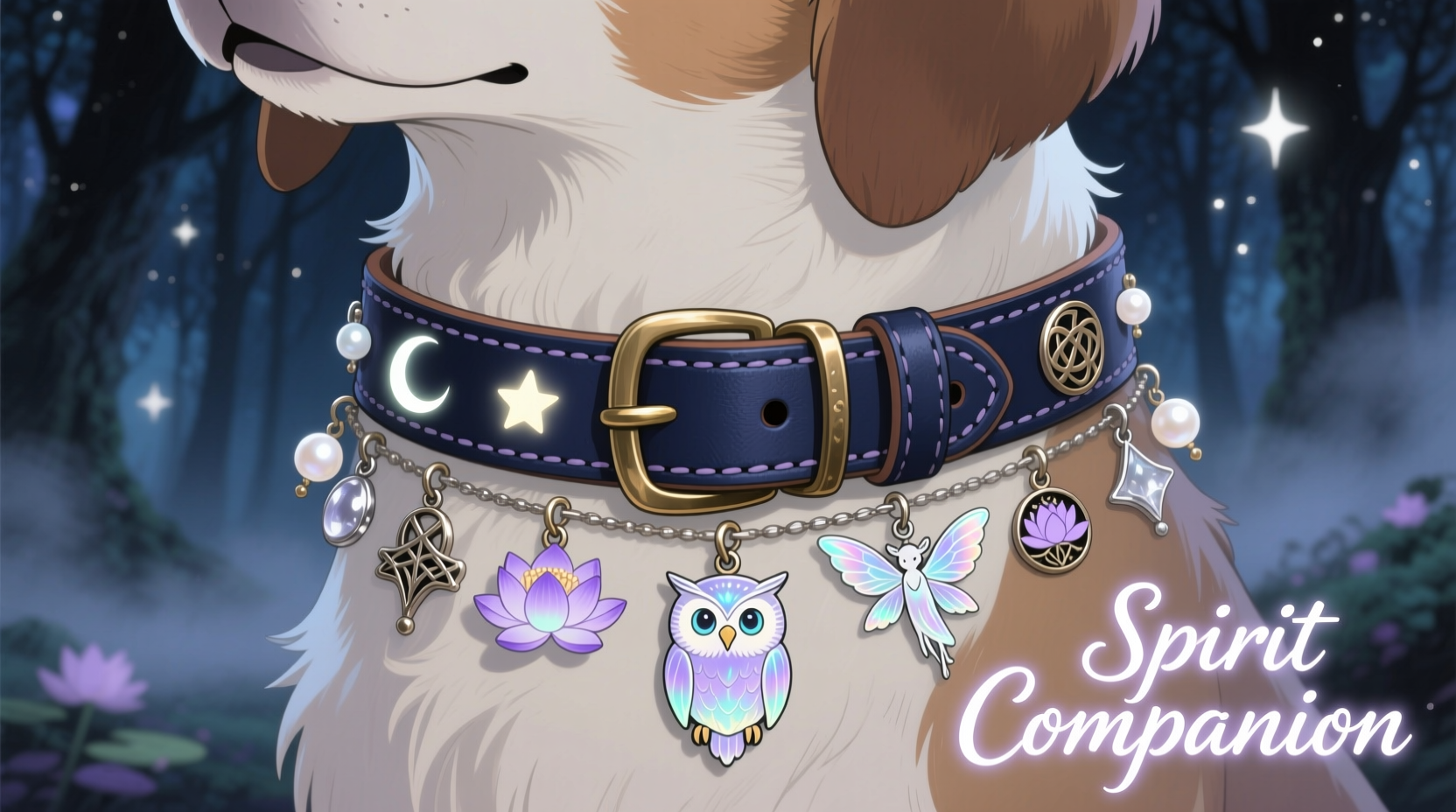
Spirit-themed motifs carry emotional weight—symbols like the hamsa, om, lotus, or phoenix often represent protection, peace, resilience, or renewal. When applied to a dog’s collar, these symbols take on added significance: they’re not just decorative; they’re part of your dog’s daily environment. That means every material choice, attachment method, and placement decision affects not only appearance but also welfare. Unlike costume jewelry worn by humans, a dog collar experiences constant friction, saliva exposure, outdoor abrasion, and unpredictable movement. A charm that looks ethereal on a display shelf may become a choking hazard, skin irritant, or entanglement risk if improperly selected or installed.
Veterinary dermatologist Dr. Lena Torres emphasizes this point:
“I’ve treated dozens of cases where small metal charms caused contact dermatitis under the collar, especially in dogs with sensitive skin or thick neck fur. Even ‘hypoallergenic’ metals can react when combined with sweat, dirt, and repeated pressure. If it dangles, spins, or has sharp edges—even microscopic ones—it belongs nowhere near a living animal’s neck.”
Step-by-Step: Attaching Charms Safely and Securely
Follow this sequence precisely. Skipping or rearranging steps increases failure risk.
- Assess collar compatibility: Only use flat, woven nylon, biothane, or smooth leather collars (no raised stitching, buckles with protruding prongs, or textured surfaces). Avoid collars with quick-release plastic clasps—charms add torque that can accelerate wear.
- Select charm size and weight: Maximum diameter: 8 mm. Maximum weight: 0.8 grams per charm. Use a digital jeweler’s scale—if unavailable, compare to two standard paperclips (combined weight ≈ 0.7 g).
- Verify attachment hardware: Charms must have closed jump rings (not split rings) made of 316L surgical stainless steel or titanium. Avoid base metals, plated alloys, or soldered rings—they corrode rapidly in saliva.
- Choose anchor points: Attach charms only to D-rings or reinforced stitching bars—not directly to webbing or leather. Never thread through the collar strap itself.
- Install with double-loop security: Thread the jump ring through the charm’s loop, then through the D-ring. Close the ring using two precision pliers: one holds steady, the other twists *along the ring’s natural plane* (never sideways). Then, add a single drop of medical-grade cyanoacrylate (e.g., VetBond™) to the seam—this prevents micro-movement and cold welding.
- Perform the 3-Second Tug Test: Gently pull each charm outward at a 45-degree angle for three seconds. If it shifts, rotates freely, or makes audible clicking, re-close the ring and reapply adhesive.
Material Safety & Symbol Integrity: What to Use (and What to Avoid)
The spiritual resonance of a symbol depends on its integrity—and integrity begins with material honesty. A “moonstone” charm made of dyed glass misrepresents both geology and energetics. Likewise, a “feather” charm stamped from zinc alloy contradicts values of lightness and freedom. Below is a vetted reference table comparing common materials by safety, durability, and symbolic fidelity.
| Material | Safety Rating (1–5) | Durability in Outdoor Conditions | Spiritual Fidelity Notes |
|---|---|---|---|
| 316L Stainless Steel (polished) | 5 | Excellent — resists salt, UV, saliva | Neutral carrier; ideal for engraved symbols requiring clarity and permanence |
| Titanium (anodized) | 5 | Excellent — color won’t fade or chip | High vibrational alignment; lightweight, hypoallergenic, naturally resonant |
| Natural Howlite (drilled) | 4 | Fair — porous; degrades with prolonged moisture | Genuine calming stone; verify ethically sourced; avoid glue-filled cracks |
| Recycled Glass (lead-free, kiln-fired) | 4 | Good — heat-treated for hardness | Eco-aligned; excellent for sun/moon motifs; ensure smooth, rounded edges |
| Zinc Alloy (plated) | 1 | Poor — corrodes within weeks; leaches heavy metals | Symbolically hollow; plating wears to reveal toxic base metal |
| Plastic Resin (UV-stabilized) | 2 | Fair — yellows and becomes brittle in sun | Low vibration; may contain endocrine disruptors; avoid unless certified non-toxic for pets |
Note: “Spiritual fidelity” here refers to consistency between material properties and symbolic meaning—not metaphysical claims. A heavy, dense charm contradicts the lightness implied by a feather symbol; a brittle material undermines the endurance represented by an oak leaf.
Real-World Example: The Luna Collar Project
In early 2023, Seattle-based trainer Maya Chen collaborated with Indigenous artist Nizhoni Begay (Diné) to design ceremonial collars for therapy dogs serving Navajo Nation elders. Each collar featured three hand-stamped silver charms: a crescent moon (for intuition), a corn stalk (for sustenance), and a water serpent (for healing). Key constraints shaped every decision: no solder (traditional Diné metalwork avoids it), no nickel (skin sensitivity prevalence >32% in the cohort), and all charms under 6 mm to prevent catching on wool blankets during visits.
Testing revealed a critical flaw: initial charms attached via traditional crimp beads loosened after 14 hours of simulated wear. Solution? Begay adapted a Navajo weaving technique—using braided sinew cord (sterilized, waxed) threaded through doubled holes in each charm and knotted *under* the collar’s underside, hiding all hardware. The result: zero detachment over 11 months of daily use across 17 dogs. As Begay notes:
“Respect isn’t just in the symbol—it’s in how you hold it. If the moon hangs loose, it doesn’t protect. It distracts.”
Essential Safety Checklist Before First Wear
- ✅ All charms pass the 3-Second Tug Test (see Step-by-Step section)
- ✅ No charm edge registers above 0.3 mm under 10x magnification (use jeweler’s loupe)
- ✅ Collar fits with two fingers’ width of space beneath—never tighter to “compensate” for added weight
- ✅ You’ve observed your dog wearing the collar *without charms* for 48 hours to establish baseline comfort (no scratching, pawing, or rubbing)
- ✅ Charms are positioned exclusively on the collar’s upper arc—never near the buckle, clasp, or underside where fur contact is constant
- ✅ You’ve scheduled a 5-minute daily inspection for the first week: check for redness, saliva buildup, or charm rotation
FAQ: Spirit Charms and Canine Wellness
Can spirit charms interfere with my dog’s behavior or anxiety?
Charms themselves don’t cause behavioral changes—but their physical properties can. Jangling sounds trigger noise sensitivity in ~28% of shelter-tested dogs (ASPCA 2022 study). Rotating charms create subtle vibrations detectable through bone conduction. If your dog startles at collar movement, choose fixed-mount charms (glued, not hanging) and skip anything with internal bells or spinners—even “quiet” ones.
Is it safe to use essential oil-infused charms on dog collars?
No. Even highly diluted oils like lavender or frankincense can cause neurotoxicity, liver stress, or topical burns in dogs. Their olfactory receptors are 40x more sensitive than humans’, and dermal absorption rates are significantly higher. The American College of Veterinary Pharmacists explicitly advises against aromatic collars for any canine, regardless of health status.
How often should I replace spirit-themed charms?
Every 4–6 months, even if visually intact. Saliva pH (typically 7.5–8.5) gradually degrades metal finishes and adhesives. Natural stones lose structural integrity after repeated wet/dry cycles. Replace proactively—not reactively—to maintain symbolic intention *and* physical safety.
Conclusion: Adornment as Intentional Stewardship
Decorating a dog collar with spirit-themed charms is never merely about aesthetics. It’s an opportunity to align daily care with deeper values—to choose materials that honor the earth, methods that honor the body, and symbols that honor the relationship. Every charm you attach carries weight beyond grams: it reflects your attention to detail, your respect for biological limits, and your commitment to making meaning tangible without compromising wellbeing. When done with rigor, these small adornments become quiet affirmations—not just of belief, but of responsibility. Your dog doesn’t need symbolism to feel loved. But when you choose each element with care, you transform routine into ritual, and function into reverence.
💬 Your turn: Share your own spirit-collar story—what symbol resonates most with your dog’s spirit? What lesson did you learn the hard way? Comment below and help build a wiser, safer community of mindful pet guardians.








