Many cat owners, adopters, and animal enthusiasts believe that a cat’s coat color—particularly whether it is ginger (orange) or black—can predict its temperament. This idea has deep roots in folklore, anecdotal evidence, and even some scientific studies. But how much of this belief holds up under scrutiny? Are ginger cats truly more affectionate and bold, while black cats more aloof or mysterious? Understanding the behavioral nuances between ginger and black cats isn’t just about dispelling myths—it’s essential for responsible pet ownership, adoption decisions, and reducing bias based on appearance. This article examines the science, genetics, social perceptions, and real-world observations that shape our understanding of these two widely recognized feline coat types.
Definition & Overview
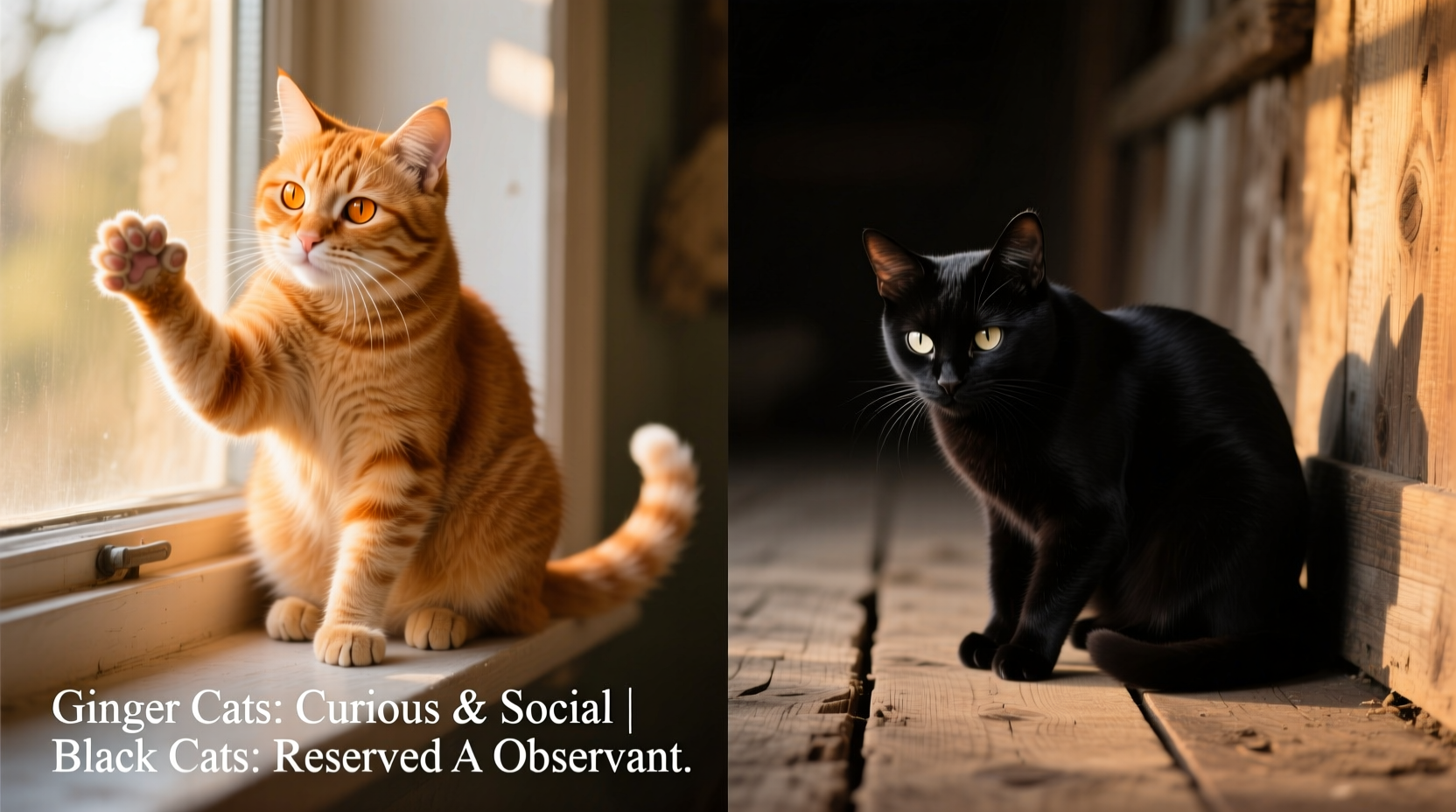
Ginger (or orange/ginger tabby) and black cats are two of the most common coat color variations in domestic cats (*Felis catus*). While both can appear in various breeds and mixed backgrounds, their coloration stems from specific genetic pathways that influence not only pigmentation but potentially linked behavioral traits through pleiotropy—the phenomenon where a single gene affects multiple characteristics.
The ginger coat is caused by a sex-linked recessive allele on the X chromosome affecting the production of red-yellow pheomelanin. Because males have only one X chromosome, they are more likely to express the ginger trait if they inherit the gene. Black coats result from a dominant mutation in the *MC1R* gene, leading to an overproduction of dark eumelanin pigment, which masks other patterns unless modified by additional genes.
Beyond genetics, cultural narratives play a significant role in shaping human expectations of cat behavior. Ginger cats are often portrayed as friendly, loud, and food-motivated in popular media—from Garfield to Puss in Boots. Black cats, meanwhile, carry centuries of superstition, ranging from symbols of bad luck to revered protectors in different cultures. These associations subtly influence how people interpret feline behavior, sometimes creating self-fulfilling prophecies in interactions with pets.
Key Characteristics
| Characteristic | Ginger Cats | Black Cats |
|---|---|---|
| Coat Color Genetics | X-linked recessive (O/o gene); more common in males | Dominant extension gene (E/e); affects eumelanin expression |
| Common Temperament Labels | Sociable, bold, vocal, affectionate | Calm, independent, reserved, intelligent |
| Human Perception Bias | Often seen as approachable and humorous | Frequently stereotyped as aloof or mystical |
| Adoption Rates | Generally higher due to positive stereotypes | Lower, especially around Halloween; prone to longer shelter stays |
| Vocalization Level | Tend to be more talkative; frequent meowers | Typically quieter; communicate more through body language |
| Energy & Playfulness | High energy; playful into adulthood | Moderate; bursts of activity followed by rest |
Note: While trends exist, individual personality varies significantly based on early socialization, environment, and breed—not solely coat color.
Practical Usage: Interpreting Behavior for Caregivers
Understanding perceived behavioral tendencies helps caregivers tailor their approach to feeding, training, enrichment, and bonding. However, it's crucial to avoid assumptions based purely on color. Instead, use general tendencies as starting points for observation rather than rigid expectations.
For example, many ginger cats exhibit strong food motivation—a trait useful for positive reinforcement training. Offering small treats during litter box training or recall practice can yield faster results. Their tendency toward vocalization also means they may demand attention more overtly. Responding consistently reinforces trust and reduces stress-related yowling.
Black cats, often described as more observant and cautious, may take longer to adjust to new environments. When introducing a black cat to a home, prioritize slow acclimation: start with one quiet room, minimize sudden movements, and allow them to initiate contact. Their independence should not be mistaken for disinterest—they often form deep bonds, expressed subtly through slow blinks, gentle head bumps, or following at a distance.
In multi-cat households, ginger cats may assume dominant roles due to their assertiveness, while black cats might prefer vertical spaces like shelves or cat trees to observe without direct confrontation. Providing separate resources (food bowls, litter boxes, resting areas) prevents tension regardless of coat type.
“While coat color correlations exist in aggregate data, I’ve seen shy ginger cats and outgoing black ones. Early handling before 8 weeks is far more predictive than fur.” — Dr. Lena Tran, DVM, Feline Behavior Specialist
Variants & Types
Neither “ginger” nor “black” describes a breed but rather a coat phenotype that appears across numerous lineages. Recognizing the variants within each category improves accuracy in interpreting behavior.
Ginger Cat Variants
- Classic Orange Tabby: Striking M-marking on forehead, swirling stripes; most common ginger pattern. Often highly interactive.
- Red Smoke or Red Silver Tabby: Lighter base with dark tips; less common. May display reserved tendencies if from Persian lineage.
- Flame Point (Colorpoint): Siamese-type cats with ginger extremities. Extremely vocal and social, inheriting breed-specific traits.
Black Cat Variants
- Solid Black Shorthair: Most prevalent. Often mixed-breed; adaptable and intelligent.
- Black Panther Type (Melanism): Not true melanism (as in wildcats), but dense pigmentation. Seen in breeds like Bombay, bred to mimic panthers. Known for dog-like loyalty.
- Shaded or Cameo Black: Tips of fur are colored over a pale base; rare. Often found in Angoras or Exotics. Tend to be gentle and sensitive to noise.
Tip: Look beyond color. A black cat from a Bengal cross may be energetic and water-loving, while a ginger Domestic Longhair could be calm and lap-oriented. Breed heritage and individual history matter more than hue alone.
Comparison with Similar Coat Types
To contextualize ginger and black cat behaviors, compare them with other common coat-color-associated temperaments:
| Coat Type | Perceived Traits | Contrast with Ginger | Contrast with Black |
|---|---|---|---|
| Tuxedo (Black & White) | Balanced, intelligent, communicative | Less impulsive than ginger; more structured | More expressive vocally than solid black |
| Tortoiseshell/Calico | \"Tortitude\"—feisty, strong-willed, protective | More territorial than typical ginger cats | Higher reactivity than most black cats |
| Gray/Blue | Calm, easygoing, low-demand | Less food-driven than ginger | Similar ease but often more openly affectionate than black |
The contrast reveals that while ginger cats stand out for extroversion and black cats for subtlety, neither fits a monolithic mold. Tortoiseshells challenge assumptions about female cats being passive, while tuxedo cats often bridge the gap between boldness and composure.
Scientific Research & Behavioral Studies
A 2015 study published in *Anthrozoös* surveyed over 1,000 cat owners and found statistically significant links between coat color and reported aggression levels. Participants rated orange cats as the friendliest toward humans, while black-and-white and gray-and-white cats were seen as more aggressive in certain contexts (handling, veterinary visits).
Another longitudinal analysis from UC Davis noted that male ginger cats were more likely to approach strangers during shelter assessments, suggesting a correlation between the O-gene and sociability. However, researchers emphasized that environment accounted for nearly 60% of behavioral variance, dwarfing genetic contributions.
Genetically, the link may stem from shared developmental pathways. The same region influencing melanin production also affects neural crest cell migration during embryogenesis—cells involved in stress response and temperament. This biological overlap offers a plausible mechanism for color-behavior associations, though not deterministic ones.
Practical Tips & FAQs
Do ginger cats really love humans more?
On average, yes—many show higher affiliation scores in behavioral tests. But this doesn’t mean every ginger will be cuddly. Individual upbringing plays a larger role than genetics.
Are black cats harder to adopt?
Yes. Known as “black cat syndrome,” they often stay longer in shelters and face higher euthanasia rates, particularly around October. Advocacy campaigns like “Adopt a Black Cat Month” aim to counteract this bias.
Can you train a black cat effectively?
Absolutely. Though less food-motivated than some gingers, black cats respond well to clicker training using toys or praise. Their observational nature makes them quick learners when engaged properly.
Is there a health difference?
Some evidence suggests black-furred cats may have increased resistance to viral infections due to the *MC1R* gene’s role in immune modulation. Conversely, light-eyed ginger cats may be slightly more prone to UV-induced skin cancer on ears and nose if exposed to sun.
How do I bond with a shy black cat?
- Use silent presence: Sit nearby without eye contact.
- Offer high-value treats rolled gently toward them.
- Introduce interactive toys like feather wands to build confidence.
- Respect retreats—do not force interaction.
- Establish routines so they know what to expect.
Why are male cats more often ginger?
The orange gene (O) is located on the X chromosome. Males (XY) need only one copy to express orange fur, whereas females (XX) require two—one from each parent—to be fully ginger. Females with one O gene become tortoiseshell instead.
Checklist: Before assuming personality based on color:
- Ask about early socialization history
- Observe behavior over several days
- Consider breed mix (if known)
- Evaluate current stressors (noise, other pets)
- Consult shelter staff or breeder notes
Summary & Key Takeaways
The notion that ginger and black cats behave differently contains kernels of truth rooted in genetics, perception, and limited research. Ginger cats are frequently described as outgoing, vocal, and affectionate, supported by both owner reports and biological plausibility. Black cats are often viewed as more reserved or introspective, though this may reflect human projection more than inherent disposition.
However, no cat should be judged—or treated—based solely on coat color. Individual experiences, early handling, health, and environment shape personality far more profoundly than pigmentation. Responsible caregiving means observing each cat as a unique individual, using broad tendencies only as initial guides.
Dispelling myths benefits all cats, especially those facing adoption barriers like black cats stigmatized by superstition. By focusing on proven factors—socialization, enrichment, consistent care—we foster deeper human-feline relationships grounded in empathy, not appearance.
Next time you meet a ginger or black cat, resist the urge to label. Spend ten minutes watching, listening, and letting them reveal who they truly are. You might discover that the quiet black cat is your most loyal companion, or that the boisterous ginger secretly craves solitude after playtime. In the end, every cat defies simple categorization—and that’s what makes them endlessly fascinating.









