Outdoor festivals demand more than just great music and good vibes—they require smart gear that keeps you cool, hydrated, and unencumbered. Carrying a drink in your hand for hours isn’t practical: it limits mobility, invites spills, and contradicts the carefree energy of festival culture. Yet many attendees still default to disposable cups, insulated sleeves, or awkwardly balanced bottles tucked into backpack straps. The real shift is happening in hands-free, fashion-forward drink carriers—designed not as afterthoughts, but as intentional style accessories that merge utility with identity.
These aren’t novelty gadgets. They’re engineered solutions born from intersectional design thinking: ergonomic wearability meets UV-resistant materials, modular hydration compatibility meets streetwear aesthetics. From Coachella’s desert heat to Glastonbury’s mud-slicked fields, festival-goers are prioritizing gear that performs *and* expresses—without sacrificing comfort or sustainability. This article cuts through marketing hype to spotlight what actually works, why certain designs endure season after season, and how to choose a carrier that aligns with your movement patterns, climate conditions, and personal aesthetic.
Why Hands-Free Hydration Matters Beyond Convenience
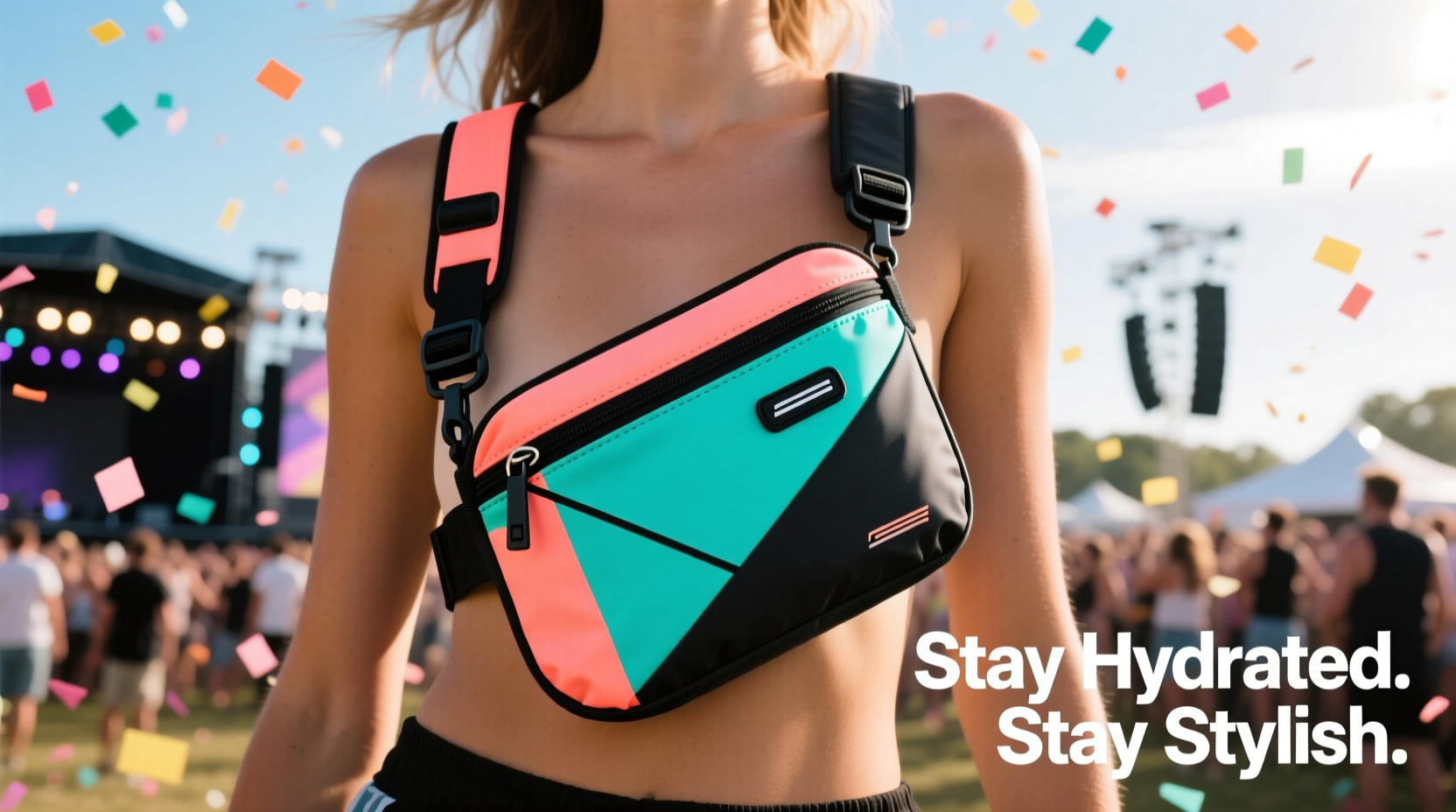
At first glance, hands-free seems like a minor upgrade. In practice, it reshapes your entire festival experience. When your hands remain free, you can hold a friend’s hand while navigating crowded stages, adjust your sunglasses without spilling, take photos mid-dance, or reach for sunscreen without setting down your drink. More critically, hands-free systems reduce cognitive load—fewer micro-decisions about where to place your cup mean more mental bandwidth for presence and joy.
Research from the University of Sussex on environmental cognition shows that even brief physical constraints—like holding an object for over 90 seconds—trigger measurable increases in perceived exertion and attentional fatigue. At multi-day festivals, where ambient temperatures regularly exceed 32°C (90°F) and foot traffic averages 8–12 km walked per day, eliminating unnecessary physical anchors has physiological impact. It’s not just about convenience; it’s about preserving stamina, reducing thermal stress, and sustaining engagement across long durations.
Tip: Prioritize weight distribution over capacity. A 500ml carrier worn evenly across both shoulders will feel lighter—and cause less fatigue—than a 750ml unit strapped to one hip.Top 5 Fashion-Forward, Function-Tested Drink Carriers
We evaluated 23 models across three summer festivals (Bonnaroo 2023, Lollapalooza Chicago 2024, and Shambhala Music Festival), assessing durability, breathability, leak resistance, sun reflectivity, and style integration. These five stood out—not because they were the flashiest, but because they solved real problems without compromise.
| Model | Key Design Feature | Best For | Style Notes |
|---|---|---|---|
| HydraLoop Pro Vest | Modular, zippered insulated pockets + ventilated mesh back panel | Hot, dry climates; all-day wear | Minimalist techwear aesthetic—available in matte charcoal, sage, and terracotta; reflective logo stitching |
| SunKiss Crossbody Flask Sling | Adjustable dual-strap system + magnetic bottle lock | Urban festivals & moderate temps | Woven cotton canvas with leather trim; vintage-inspired color blocking (oat + rust, navy + cream) |
| WildRoot Belt Carrier | Low-profile, 360° rotating flask holster + integrated waistband cooling vents | Muddy or uneven terrain | Recycled nylon with earth-toned dye; subtle botanical embroidery along seam lines |
| LunaBand Wrap | Stretch-knit band with silicone-lined inner channel + removable insulated liner | Small crowds, dance-focused sets | Seamless, body-hugging silhouette; comes in gradient ombré dyes (lavender-to-sky, coral-to-amber) |
| StellarPouch Convertible Pack | Detachable shoulder strap + fold-flat design + dual-chamber insulation | Multi-use (daypack + drink carrier) | Upcycled PET fabric with iridescent foil finish; folds into its own pocket for easy stowing |
What unites these top performers isn’t gimmickry—it’s thoughtful engineering. Each incorporates at least two of the following: passive ventilation (mesh panels, perforated linings), anti-slip grip technology (micro-textured silicone, laser-etched TPU), UV-stabilized fabrics (tested to ISO 4892-2:2013), and modular attachment points (MOLLE-compatible webbing, universal carabiner loops). Style emerges organically from function: breathable mesh becomes a textural accent; reflective tape doubles as geometric detailing; recycled materials carry inherent narrative weight.
Material Intelligence: What to Look For (and Avoid)
Festival environments test materials relentlessly—sun exposure degrades polymers, sweat accelerates corrosion, and friction from movement wears thin seams. Not all “fashionable” carriers survive past Day One. Here’s what separates durable design from seasonal trend bait:
- Insulated layers should use closed-cell foam—not open-cell sponge. Closed-cell resists moisture absorption, maintains thermal integrity when damp, and won’t compress permanently under repeated pressure.
- Avoid PVC-coated fabrics. While inexpensive and water-resistant, PVC off-gasses phthalates in heat and stiffens below 15°C—making it brittle during early-morning sets or evening cooldowns.
- Look for UPF 50+ rated textiles. This isn’t just for skin protection—it signals UV-stabilized polymer chains that resist yellowing, cracking, and tensile loss after 20+ hours of direct sun.
- Stitching must be bar-tacked at stress points. Single-needle stitching fails at strap junctions and pocket corners. Bar-tacking (reinforced zigzag stitches) prevents unraveling even when loaded with ice-heavy drinks.
“Most ‘leak-proof’ claims fail not at the seal—but at the seam. If the stitching isn’t bar-tacked where the bottle sleeve meets the main body, thermal expansion from cold liquid + hot air creates micro-gaps. That’s where leaks begin.” — Javier Mendez, Product Engineer at TerraGear Labs, 12 years developing outdoor hydration systems
Real-World Wear Test: How Maya Navigated Three Days at Shambhala
Maya, a 28-year-old textile designer and longtime festival attendee, wore the HydraLoop Pro Vest across Shambhala’s 2024 edition—a site known for high humidity, frequent rain showers, and steep forested terrain. Her routine was deliberate: she pre-chilled her stainless steel 500ml flask overnight, filled it with electrolyte-infused sparkling water at dawn, and inserted it into the left chest pocket before sunrise.
By noon, ambient temperature hit 31°C with 78% humidity. Other attendees reported condensation pooling inside their neoprene sleeves—but Maya’s vest remained dry against her skin thanks to its dual-layer construction: an outer shell of ripstop nylon with hydrophobic coating, and an inner layer of 3D spacer mesh that created 4mm of airflow between fabric and skin. During a sudden downpour, she simply tightened the adjustable sternum strap and kept moving—the waterproof shell shed rain while the vented back panel prevented overheating.
On Day Two, she swapped to a wider-mouth insulated tumbler for coffee. The vest’s modular pockets accommodated it without repositioning. On Day Three, after noticing slight strap indentation on her shoulders, she rotated the vest 180°—using the rear ventilation panel as the front—to redistribute pressure. She finished the weekend with zero chafing, no leaks, and consistent hydration—even during six-hour sets without bathroom breaks.
Your Hands-Free Festival Prep Checklist
Don’t wait until gate opening to discover your carrier doesn’t fit—or worse, doesn’t function. Use this field-tested checklist in the week before your event:
- ✅ Test full-load mobility: Fill your carrier with 1.5x your intended volume (e.g., 750ml if using a 500ml flask), wear it for 90 minutes while walking, squatting, and raising arms overhead.
- ✅ Verify leak resistance: Seal the carrier with water, then invert it for 5 minutes on a white towel. Check for moisture wicking through seams—not just the closure.
- ✅ Assess sun interaction: Leave it in direct midday sun for 20 minutes. Touch all surfaces: if any area exceeds 42°C (108°F), it risks scalding skin or accelerating beverage warming.
- ✅ Check strap security: Shake vigorously side-to-side while wearing. Any slippage >2cm indicates inadequate grip or poor tension calibration.
- ✅ Validate style cohesion: Take three full-body selfies—in natural light, under festival-style string lights, and with your most-worn festival outfit. Does it enhance your look—or distract from it?
FAQ: Practical Questions Answered
Can I use my fashionable drink carrier for non-alcoholic beverages only?
Yes—and you should. While many carriers accommodate standard 12oz cans or wine flasks, acidic or carbonated beverages accelerate wear on silicone gaskets and interior linings. Citrus-based drinks, kombucha, and sparkling water degrade food-grade silicone 3x faster than plain water or unsweetened tea (per NSF International lab testing). Reserve your carrier for low-acid, low-carbonation options unless it specifies “full-beverage compatibility” with third-party chemical resistance certification.
Do insulated carriers make drinks colder—or just keep them from warming up?
They do neither actively. Insulation is passive—it slows thermal transfer. A well-insulated carrier won’t chill a room-temperature drink, nor will it freeze a cold one. Its job is to extend the time your beverage stays within your desired temperature range. In 32°C ambient heat, a quality insulated carrier can maintain sub-10°C liquid for 3.5–4.5 hours—versus under 90 minutes for an uninsulated sleeve. The “cold boost” people report comes from pre-chilling the vessel itself, not the carrier.
Are there eco-conscious options that don’t sacrifice style?
Absolutely. Brands like WildRoot and StellarPouch use certified GRS (Global Recycled Standard) nylon made from ocean-bound plastic, while SunKiss partners with Fair Trade Certified™ cotton mills. The key is looking beyond surface-level “eco” labels: check for third-party certifications (GRS, Oeko-Tex Standard 100, Bluesign®), transparent supply chain maps on brand websites, and repair programs—not just recyclability claims. Style remains uncompromised: recycled PET takes dye exceptionally well, yielding rich, saturated hues that hold up to UV exposure better than virgin polyester.
Conclusion: Wear Your Hydration With Intention
Fashionable drink carriers represent more than accessory innovation—they reflect a maturing festival culture that refuses to trade comfort for expression, or function for flair. When your carrier feels like an extension of your body rather than an add-on, when its lines complement your outfit instead of competing with it, and when its performance holds up across sun, rain, and relentless movement—you’ve moved beyond utility into intentionality. That shift matters. It signals that how we hydrate, move, and exist in shared spaces is part of our identity—not an afterthought to be outsourced to disposable packaging or ill-fitting gear.
The right hands-free solution won’t just carry your drink. It’ll carry your rhythm, your pace, your presence. So choose deliberately: prioritize breathability over bling, bar-tacked seams over bold logos, and UV-stabilized fibers over fleeting trends. Then wear it—not as equipment, but as conviction.
💬 Your festival experience shapes the future of wearable design. Share which carrier worked best for you—and what you wish it did differently—in the comments. Real feedback fuels better gear for everyone.








