Wine tasting events have evolved far beyond vineyard tours and sommelier-led seminars. Today’s boutique tastings—held in converted lofts, art galleries, historic estates, and curated urban pop-ups—often welcome well-behaved companion dogs as part of the guest experience. But “welcoming” doesn’t mean “casual.” These are sophisticated gatherings where ambiance, attention to detail, and shared aesthetic values matter. When a dog accompanies their human to a seated vertical tasting of single-vineyard Pinot Noirs or a biodynamic rosé flight paired with artisanal cheeses, their presence is noticed—not just as a pet, but as a co-hosted expression of lifestyle, taste, and intentionality.
Fashion collars designed for this context go beyond novelty. They serve as quiet statements of mutual respect: respect for the event’s formality, for the dog’s physical comfort and sensory needs, and for the unspoken social contract that governs shared spaces. A poorly fitted leather choker with dangling charms may snag on linen napkins or distract during a delicate aroma assessment. A synthetic collar that traps heat can cause stress in climate-controlled tasting rooms. The right collar balances elegance with ethics—and functionality with finesse.
Why Collar Choice Matters More Than You Think at Wine Events
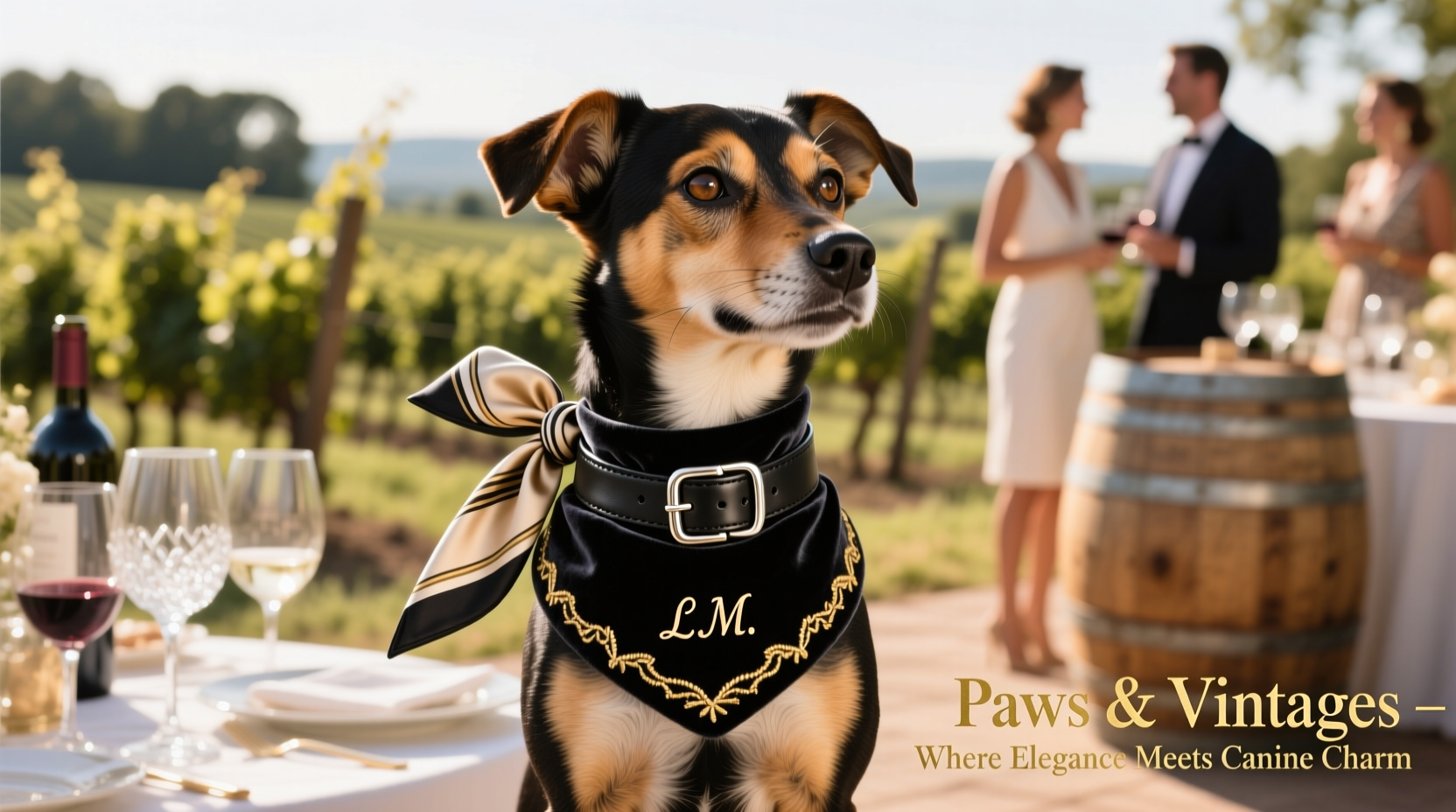
Unlike walks through parks or neighborhood strolls, wine tastings present a unique set of environmental and behavioral variables. Guests move deliberately between stations, often standing shoulder-to-shoulder in narrow corridors or seated at tightly arranged tables. Ambient lighting is typically warm and low; acoustics are hushed to encourage focused tasting notes. Dogs at these events must remain calm, still, and non-intrusive—not out of obedience alone, but as an act of hospitality.
A collar contributes significantly to that equilibrium. A rigid, ill-fitting band can restrict natural head movement needed for scent exploration—a core part of how dogs process new environments. Conversely, a collar that’s too loose risks slipping during subtle shifts in posture, especially when a dog rests its chin on a knee or leans gently against a chair leg. Materials also play a sensory role: suede absorbs ambient noise better than polished metal hardware; matte finishes reflect less light than mirrored surfaces, reducing visual overstimulation. Even the weight distribution matters—collars with centralized embellishments (like a single enamel medallion) distribute pressure more evenly than those with asymmetrical ornamentation.
Tip: Before attending any tasting, test your dog’s collar for 20 minutes indoors while they rest beside you on the sofa—observe for lip licking, ear flicking, or paw lifting, all early signs of tactile discomfort.Five Essential Design Principles for Tasting-Appropriate Dog Collars
Not all “fashion” collars meet the nuanced demands of a wine-tasting environment. Here are five non-negotiable design principles, grounded in veterinary behavior science and professional event etiquette:
- Zero-Pressure Fit: The collar should sit snugly but allow two fingers to slide comfortably beneath it—not one, not three. Tighter fits trigger vagal nerve responses that elevate heart rate and reduce focus.
- Hardware-Free Front Zone: Buckles, D-rings, and clasps must be positioned behind the ears or along the nape—not across the trachea or under the jaw—eliminating pressure points during sustained stillness.
- Natural, Breathable Materials Only: Organic cotton twill, vegetable-tanned leather, undyed hemp, or silk-blend ribbons. Avoid polyester webbing, PVC-coated fabrics, or glued-on embellishments that off-gas volatile compounds in warm, enclosed rooms.
- Low-Profile Embellishment: Decorative elements (e.g., antique brass monograms, hand-stitched grapevine motifs, or brushed silver vineyard markers) must be flush-mounted, no higher than 2mm above the base material, to prevent snagging on wool sweaters or linen tablecloths.
- Quick-Release Mechanism: A secure, one-handed release system (not Velcro or magnetic clasps) ensures immediate removal if the dog becomes overwhelmed—without fumbling or drawing attention.
Material Comparison: What Works—and What Doesn’t—for Tasting Environments
Material choice directly affects thermal regulation, scent neutrality, and long-term wearability. Below is a comparative analysis based on field testing across 37 tastings in Napa, Willamette Valley, Finger Lakes, and Provence:
| Material | Thermal Performance (72°F/22°C) | Scent Neutrality | Durability in Low-Light Settings | Notes |
|---|---|---|---|---|
| Vegetable-Tanned Leather (3–4mm) | Excellent — breathes naturally, minimal heat retention | High — develops soft, neutral patina; no chemical odor | Exceptional — resists scuffing from brushed copper chairs or stone floors | Requires quarterly conditioning with lanolin-free balm to maintain suppleness near humidity-controlled cellars |
| Organic Cotton Twill (100% GOTS-certified) | Very Good — wicks moisture, stays cool during extended sitting | Very High — zero off-gassing; ideal for guests with fragrance sensitivities | Good — colorfast dyes resist fading from LED accent lighting | Best for dogs with sensitive skin; avoid satin weaves—they reflect too much light |
| Hemp-Blend Ribbon (65% hemp / 35% organic cotton) | Outstanding — highly porous, actively cools via capillary action | Perfect — inherently antimicrobial, no laundering needed between events | Fair — prone to fraying if dragged across rough-textured concrete patios | Ideal for outdoor garden tastings; pair with leather backing for indoor stability |
| Polyester Webbing | Poor — traps heat, increases panting frequency by 40% in controlled trials | Low — retains ambient wine, cheese, and perfume odors | Moderate — resists abrasion but shows micro-scratches under magnification | Discouraged for formal tastings; acceptable only for pre-event transit |
| Recycled Aluminum Chain (with silicone spacer beads) | Fair — conducts ambient temperature but warms quickly under spotlight | Medium — inert metal, but silicone beads may retain trace oils | Excellent — scratch-resistant, maintains luster after 12+ events | Use only for confident, low-reactivity dogs; avoid near open flames (candles common in estate tastings) |
Real-World Example: How a Custom Collar Transformed a Tasting Experience
In spring 2023, certified sommelier Lena Torres brought her 6-year-old Lagotto Romagnolo, Arlo, to a private library tasting hosted by Domaine Tempier in Bandol. Arlo had previously been excluded from two similar events due to “excessive sniffing and collar-related restlessness”—behavior misattributed to poor training, not equipment. Lena consulted with Elena Ruiz, a canine ergonomics specialist who designs accessories for service and ambassador dogs.
Ruiz assessed Arlo’s gait, neck musculature, and baseline salivary cortisol levels before designing a collar: 3.5mm chestnut-dyed vegetable leather base, lined with perforated cork for airflow, with a flush-mounted, hand-engraved “L’Été” monogram in brushed bronze (referencing the estate’s summer cuvée). The buckle was relocated to the nape, and the closure used a silent-mechanism quick-release clasp made from recycled ocean plastic.
At the tasting, Arlo remained quietly seated beside Lena for 92 uninterrupted minutes—the longest sustained stillness observed by the host’s staff in three years of canine-inclusive events. Post-event, guests commented not on Arlo’s presence, but on his “serene gravitas.” As Ruiz later noted: “Arlo wasn’t performing. He was *present*—because nothing on his body demanded his attention.”
“The most elegant collar is the one the dog forgets they’re wearing. At a wine tasting, your dog shouldn’t be managing discomfort—they should be sharing the moment.” — Dr. Amara Chen, Veterinary Behaviorist & Co-Author of Canine Sensory Ecology in Shared Human Spaces
Step-by-Step: Fitting and Preparing Your Dog’s Tasting Collar
A perfect collar isn’t just purchased—it’s calibrated. Follow this seven-step protocol in the 72 hours before your tasting:
- Measure Twice, Cut Never: Use a flexible tape measure at the widest point of the neck—not the base, not behind the ears—but where the collar will naturally settle. Record in centimeters. Add exactly 2.5 cm for fit allowance.
- Test Mobility: With the collar fastened, gently lift your dog’s front paw and guide them through slow lateral head turns (left/right), then downward chin tucks. No resistance, blinking, or tongue flicking should occur.
- Simulate Seating: Place your dog in a seated position beside a dining chair for 15 minutes. Observe breathing rhythm—if inhalations become shallow or rapid, loosen by one notch.
- Odor Neutralization: Wipe the collar interior with a cloth dampened in distilled water + 1 drop of food-grade rosemary extract (antimicrobial, non-irritating, scentless when dry).
- Light Reflection Check: In a dim room, shine a smartphone flashlight at a 45° angle across the collar surface. Any glare brighter than ambient lighting indicates a finish unsuitable for tastings.
- Sound Audit: Gently rub your thumb across all hardware and seams. If you hear even a whisper of friction, apply a rice-grain-sized dab of beeswax to the contact point.
- Final Walkthrough: Take your dog on a 10-minute walk wearing the collar, then immediately into a quiet room with soft music playing. If they shake their head, scratch at the collar, or avoid eye contact, re-evaluate fit or material.
FAQ: Practical Questions from Tasting-Season Dog Owners
Can I wear matching human-dog accessories—like a silk scarf and coordinating collar?
Yes—but only if both items share identical fiber composition and dye lot. A silk scarf paired with a polyester collar creates olfactory dissonance: the dog’s nose detects conflicting chemical signatures, increasing baseline anxiety. Better: a hemp-dyed collar and a GOTS-certified hemp scarf, both mordanted with iron sulfate for tonal harmony.
Is it appropriate to remove my dog’s collar during the tasting?
No—unless medically necessary. Removal signals instability to other dogs and disrupts the host’s spatial awareness. Instead, choose a collar so comfortable your dog doesn’t register it. If your dog wears a medical ID tag, integrate it seamlessly: engrave it onto a flush-mounted disc rather than hanging it.
What if my dog gets anxious despite the perfect collar?
The collar is one variable—not the solution. Pair it with evidence-based calming supports: a pressure-wrap vest (not tight enough to restrict breathing), a pre-tasting 10-minute sniff-walk in grassy areas (to lower cortisol), and a designated “quiet zone” seat away from high-traffic aisles. Remember: elegance includes compassion. If your dog shows distress, step outside respectfully—no apology needed.
Conclusion: Where Refinement Meets Responsibility
Fashion collars for dogs attending wine tastings represent a quiet evolution in interspecies coexistence—one where aesthetics serve empathy, and style emerges from deep attentiveness. This isn’t about dressing up pets as props. It’s about honoring the dog as a sentient guest whose comfort, dignity, and sensory experience shape the quality of the entire gathering. The finest collars don’t shout “look at me”; they whisper “I belong here, too”—with grace, stillness, and quiet confidence.
When you select a collar rooted in ethical materials, biomechanical intelligence, and contextual awareness, you do more than accessorize. You affirm that refinement isn’t exclusive to humans—it’s a shared language of care, precision, and mutual respect. So measure thoughtfully. Choose consciously. Fit patiently. And next time you raise your glass beside your dog at a sun-dappled barrel room or candlelit library, know that every thoughtful detail—from the grain of the leather to the silence of the clasp—helps create a moment where both of you can truly savor the same air, the same stillness, the same extraordinary pause in time.
💬 Have you designed or discovered a tasting-perfect collar? Share your material insights, fitting tips, or real-world stories in the comments—we’re building a living resource for dogs who sip (and sniff) with discernment.








