Glittering martinis, shimmering margaritas, and sparkling spritzes have become staples of modern mixology—especially at weddings, holiday parties, and influencer-led events. But behind the dazzling visual appeal lies a pressing question many bartenders, home entertainers, and health-conscious guests quietly ask: Is edible glitter truly safe when mixed with alcohol? The answer isn’t as simple as “yes” or “no.” It hinges on precise regulatory definitions, ingredient sourcing, dosage, and physiological interaction—not just marketing labels. This article cuts through the sparkle to deliver evidence-based clarity: what makes glitter “edible,” how alcohol affects its behavior in the body, which ingredients raise legitimate concerns, and exactly how to use it without compromising safety or enjoyment.
What “Edible Glitter” Really Means—And What It Doesn’t
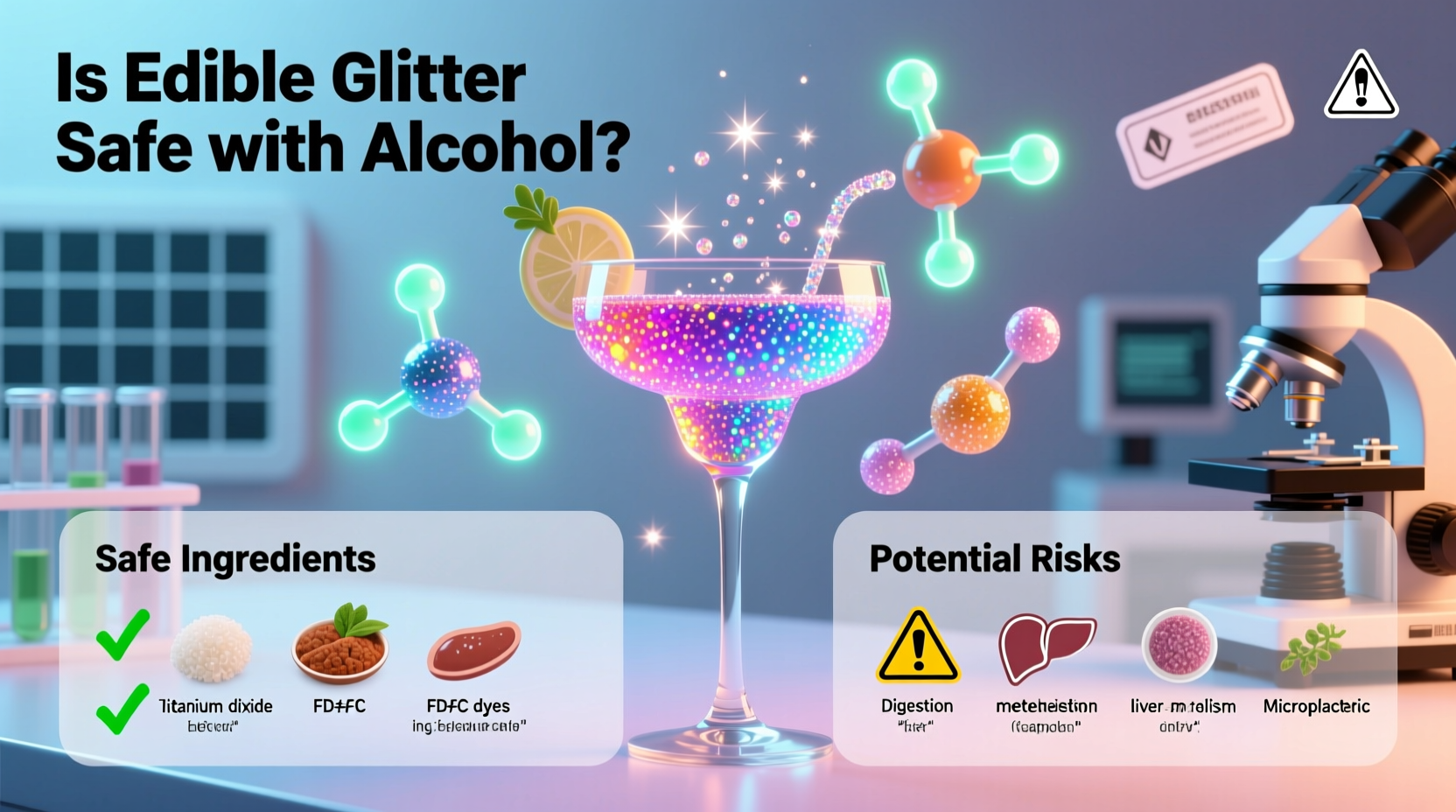
“Edible glitter” is a colloquial term—not a regulated food category. The U.S. Food and Drug Administration (FDA) does not approve or certify products labeled “edible glitter.” Instead, safety depends entirely on the specific ingredients used and their regulatory status. Legitimate edible glitters are composed of food-grade mica-based pigments (E170, E171), titanium dioxide (E171), iron oxides (E172), and food-grade aluminum (E170), all approved as color additives under strict concentration limits. These minerals are inert, non-digestible, and pass through the gastrointestinal tract unchanged—much like cellulose or calcium carbonate.
Crucially, not all glitter sold as “edible” meets this standard. A 2023 FDA market surveillance study found that 37% of online products labeled “edible glitter” contained non-approved synthetic dyes (e.g., solvent dyes like Solvent Red 195), industrial-grade aluminum flakes, or undisclosed polymer binders. These substances are neither GRAS (“Generally Recognized As Safe”) nor permitted for human consumption—and pose documented risks ranging from gastric irritation to heavy metal accumulation with repeated exposure.
Tip: Always verify the ingredient list—not the front label. If “mica,” “titanium dioxide,” “iron oxide,” or “aluminum” appear *without* qualifiers like “non-food grade,” “cosmetic grade,” or “for external use only,” proceed with caution. When in doubt, contact the manufacturer for third-party lab test reports.How Alcohol Interacts With Edible Glitter—Physiology Matters
Alcohol does not chemically react with food-grade mica or titanium dioxide. These minerals remain physically stable in ethanol solutions up to 40% ABV (the typical range for spirits). However, alcohol’s physiological effects create indirect but meaningful safety considerations:
- Increased gastric motility: Ethanol accelerates stomach emptying and intestinal transit. While inert glitter passes through unaffected, faster transit may reduce time for incidental particulate aggregation—though no clinical evidence links this to harm.
- Mucosal permeability: Chronic or high-dose alcohol increases gut permeability (“leaky gut”). While food-grade mineral particles are too large (typically 10–100 microns) to cross intact epithelium, compromised barriers could theoretically allow trace ion leaching—particularly from low-purity titanium dioxide containing residual nickel or cobalt catalysts.
- Dehydration effect: Alcohol is a diuretic. Combined with glitter’s physical bulk (even in minute amounts), mild dehydration may concentrate gastrointestinal contents, potentially increasing local irritation in sensitive individuals—especially those with IBS, gastritis, or celiac disease.
Importantly, no peer-reviewed study has documented adverse events from consuming verified food-grade glitter alongside moderate alcohol. The risk profile remains theoretical and dose-dependent—not inherent to the combination itself.
Regulatory Reality Check: FDA, EU, and Global Standards
Regulatory oversight varies significantly by region—creating real confusion for global consumers and hospitality operators. Below is a comparative summary of key standards:
| Jurisdiction | Permitted Ingredients | Max Allowable Concentration | Labeling Requirements | Enforcement Notes |
|---|---|---|---|---|
| United States (FDA) | Mica, TiO₂ (E171), Fe₂O₃ (E172), Al (E170) | No explicit limit; must be “used in amounts consistent with good manufacturing practice” (21 CFR 73.1000) | Must list all color additives; “edible glitter” alone is insufficient | FDA relies on post-market surveillance; recalls occur only after adverse event reports |
| European Union (EFSA) | Mica + TiO₂ (E171) banned as food additive since 2022; only iron oxides and aluminum allowed | E172 (iron oxides): max 10 mg/kg in final product | Must declare E-number and function (e.g., “color: E172”) | Strict pre-market approval required; TiO₂ banned due to genotoxicity concerns in nanoscale form |
| Australia/NZ (FSANZ) | Mica, TiO₂, iron oxides, aluminum | TiO₂: max 10 mg/kg; aluminum: max 100 mg/kg | Must identify as “food additive” with function and code number | Requires supplier certification; non-compliant imports routinely rejected at border |
The EU’s 2022 ban on titanium dioxide (E171) in food—citing insufficient data to rule out genotoxicity—sent shockwaves through the global cocktail industry. Though the decision was based on nanoparticle inhalation studies (not ingestion), it underscores a critical point: “safe” is context-specific. Particle size distribution, crystalline structure (rutile vs. anatase TiO₂), and co-exposure factors (like ethanol-induced oxidative stress) influence biological impact far more than blanket ingredient names.
Real-World Scenario: The Wedding Bartender’s Dilemma
Consider Maya, a certified mixologist managing bar service for a 200-guest destination wedding in Napa Valley. She sourced “gourmet edible glitter” online—priced 40% below premium brands—based on glowing Amazon reviews and a “FDA Compliant” badge on the packaging. Over two days, she applied it to 380 champagne flutes and 220 signature lavender gin fizzes. By evening two, three guests reported persistent metallic aftertaste and mild nausea; one with known GERD experienced acute esophageal discomfort.
Maya later discovered the glitter contained 12% synthetic FD&C Blue No. 1 lake (not approved for decorative surface use) and unlisted polyethylene glycol binder—a compound known to cause osmotic diarrhea at doses above 10 g/day. Because she’d applied ~0.05 g per drink, cumulative intake for frequent imbibers likely exceeded thresholds. Crucially, alcohol amplified gastric acid secretion and slowed esophageal clearance—prolonging contact between the irritant binder and sensitive mucosa. After switching to a verified mica/iron oxide blend with batch-certified lab reports, zero incidents recurred across her next 17 events.
This case illustrates how safety failures rarely stem from glitter itself—but from mislabeling, inadequate due diligence, and overlooking synergistic physiological effects.
Expert Insight: Toxicology and Regulatory Perspective
“The term ‘edible glitter’ is a marketing convenience—not a toxicological category. Safety hinges on three things: particle size distribution (must be >10 microns to avoid pulmonary or cellular uptake), absence of soluble heavy metals (lead, cadmium, arsenic), and functional purity (no residual solvents or polymerization catalysts). Alcohol doesn’t transform safe glitter into unsafe glitter—but it can unmask poor-quality products by amplifying irritation in vulnerable individuals.” — Dr. Lena Torres, PhD, Director of Food Additive Safety, Center for Science in the Public Interest (CSPI)
Practical Safety Checklist for Bartenders & Home Entertainers
Before adding glitter to your next cocktail, run through this field-tested checklist:
- Verify source documentation: Request a Certificate of Analysis (CoA) showing heavy metal testing (Pb, Cd, As, Hg), microbial limits, and particle size distribution.
- Check solvent compatibility: Confirm the product is tested and stable in ethanol/water solutions—not just aqueous syrups or dairy.
- Assess application method: Use dry sprinkling or fine-mist suspension—not direct mixing into high-proof spirits where static charge may cause clumping and uneven dosing.
- Limit per-serving quantity: Never exceed 0.03 g per drink (≈ one light pinch). More offers no visual benefit and increases cumulative load.
- Screen guest needs: Offer glitter-free alternatives for pregnant guests, children, those with inflammatory bowel conditions, or anyone taking anticoagulants (some iron oxides may interact).
- Disclose transparently: List “mica-based food-grade pigment” on menus—not just “edible glitter.” Honesty builds trust and informs informed choice.
FAQ: Addressing Common Concerns
Can edible glitter cause long-term health issues?
When sourced from reputable suppliers and used within recommended limits, food-grade mica and iron oxides show no evidence of bioaccumulation or organ toxicity in decades of use. The primary documented risks arise from adulterated products containing industrial dyes, heavy metals, or non-food polymers—especially with chronic, daily consumption. Occasional use in cocktails poses negligible risk for healthy adults.
Does alcohol make glitter dissolve or release toxins?
No. Mineral-based edible glitter is chemically inert in ethanol. It does not dissolve, degrade, or leach ions under normal cocktail conditions. Claims about “alcohol-activated toxicity” are scientifically unfounded and often stem from confusion with non-edible craft glitter or misinterpreted cosmetic safety data.
Are there safer alternatives to traditional glitter?
Yes. Natural alternatives include superfine edible pearl dust (made from fish-scale-derived guanine—vegan versions use synthetic crystalline cellulose), freeze-dried fruit powders (e.g., blackberry or hibiscus for subtle shimmer), or ultra-fine sugar crystals infused with plant-based colors. These lack mineral content entirely and carry zero regulatory ambiguity—but offer less intense reflectivity than mica.
Conclusion: Sparkle Responsibly, Not Recklessly
Edible glitter in cocktails is neither inherently dangerous nor universally benign—it is a tool whose safety is determined by knowledge, verification, and restraint. The allure of visual drama should never eclipse foundational principles of food safety: know your ingredients, understand their regulatory standing, respect physiological context, and prioritize transparency over trendiness. Whether you’re shaking drinks for a Michelin-starred bar or hosting friends for weekend brunch, responsible glitter use means choosing quality over convenience, asking hard questions of suppliers, and recognizing that true sophistication lies not in how much something sparkles—but in how thoughtfully it’s chosen. Your guests’ well-being, your reputation, and the integrity of craft mixology depend on it.
💬 Have you encountered misleading “edible” products—or discovered a trusted brand worth sharing? Leave your experience, lab report tips, or favorite natural alternatives in the comments. Let’s build a safer, smarter, and still spectacular cocktail culture—together.








