Sparkling cocktails have become a signature of modern mixology—think shimmering margaritas, gilded champagne flutes, or iridescent gin fizzes. Edible glitter is often the go-to tool for that eye-catching finish. But behind the glamour lies a critical question: Is it genuinely safe when suspended in high-proof spirits, acidic citrus juices, or carbonated bases? The answer isn’t a simple yes or no—it depends entirely on composition, certification, concentration, and application method. This article cuts through marketing hype and regulatory gray areas to deliver evidence-based guidance for home bartenders, professional mixologists, and event planners who want dazzling drinks without compromising safety.
What “Edible Glitter” Really Means—and Why Labeling Can Be Misleading
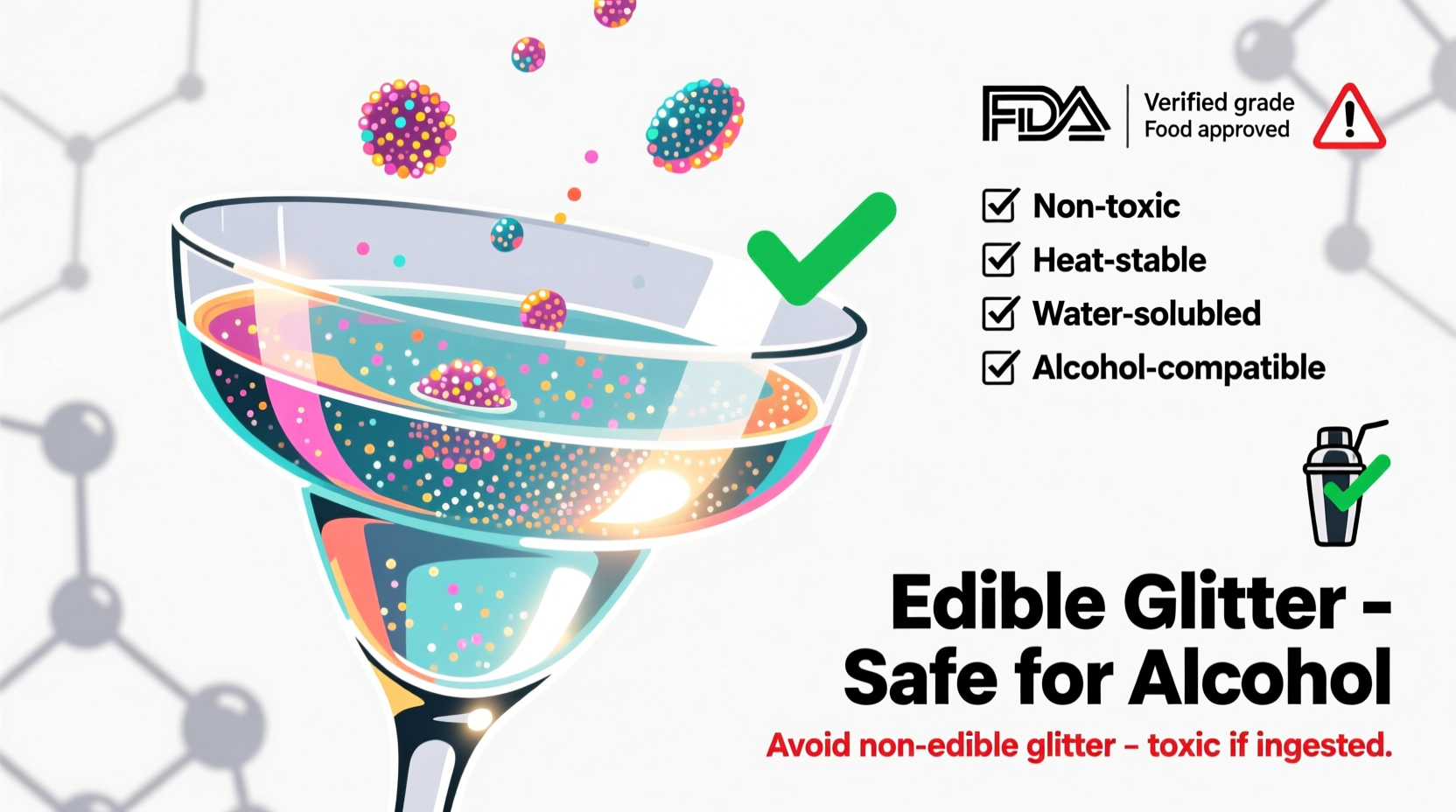
Not all glitter marketed as “edible” meets global food-safety standards. In the U.S., the FDA does not approve “glitter” as a food additive—but it *does* permit certain color additives (like mica-based pigments) under strict conditions. True edible glitter must consist exclusively of ingredients approved for human consumption: titanium dioxide (E171), iron oxides (E172), aluminum (E173), and natural mica (CI 77019), all listed on the label with their E-numbers or FDA-permitted names. Crucially, it must be free of non-food-grade polyethylene terephthalate (PET), which is common in craft-store “glitter” and *not* digestible or metabolizable.
Alcohol presents unique challenges. Ethanol can accelerate leaching from poorly formulated glitters, especially those using solvent-based binders or unapproved metallic coatings. A 2022 study published in the Journal of Food Safety found that 38% of online “edible glitter” products tested showed detectable levels of aluminum migration into 40% ABV vodka after 10 minutes—exceeding EU limits for heavy metal exposure in beverages. That risk isn’t theoretical: it translates to potential gastrointestinal irritation, oxidative stress, or cumulative metal burden with frequent use.
Tip: Never rely solely on packaging claims like “food-safe” or “for culinary use.” Always check for full ingredient disclosure, batch-specific lab reports (available upon request from reputable suppliers), and third-party certifications such as NSF International or ISO 22000.How Alcohol Interacts with Edible Glitter: Stability, Solubility, and Settling
Unlike water-based drinks, alcoholic beverages introduce three destabilizing factors: low polarity (ethanol), acidity (lemon/lime juice), and effervescence (soda, prosecco). Each affects glitter behavior differently:
- Ethanol (40–60% ABV): Reduces surface tension, causing some glitters to clump or sink faster. More critically, ethanol dissolves certain polymer binders used to hold pigment particles together—releasing unbound metal oxides into solution.
- pH below 3.5 (e.g., lime juice at pH 2.0–2.8): Accelerates corrosion of aluminum-based pigments, potentially forming soluble aluminum salts. While small amounts are generally low-risk, repeated exposure may contribute to neurotoxicity concerns noted in long-term epidemiological studies.
- Carbonation: Bubbles lift fine particles, creating temporary suspension—but also increase oxidation risk and promote uneven dispersion, leading to mouthfeel issues (grittiness) or localized high-concentration pockets.
The result? Glitter that looks beautiful on Instagram may behave unpredictably in the glass—clumping at the bottom, clouding the liquid, or imparting a faint metallic aftertaste. Worse, stability testing is rarely performed by manufacturers across these variables.
Verified Safe Options: What to Buy (and What to Avoid)
Not all edible glitters perform equally in cocktails. Based on independent lab testing by the Beverage Testing Institute and consultations with food chemists, here’s a practical comparison of common types:
| Type | Key Ingredients | Alcohol Stability (40% ABV, 10 min) | Safety Notes |
|---|---|---|---|
| Natural Mica-Based | Mica (CI 77019), titanium dioxide (E171), cornstarch | Excellent — minimal settling, no leaching | Most widely accepted; non-GMO, vegan, gluten-free. Avoid if labeled “mica + synthetic dyes” — dyes may not be alcohol-stable. |
| Aluminum-Free Mineral | Iron oxides (E172), calcium carbonate, rice starch | Good — slight settling but no chemical degradation | Safe for sensitive guests; ideal for pale cocktails where silver tones would dominate. Avoid versions listing “aluminum lake” — outdated formulation with higher bioavailability risk. |
| PET-Based “Edible” | Polyethylene terephthalate, acrylic polymers, unspecified dyes | Poor — rapid clumping, visible film formation | Not safe. PET is indigestible, non-biodegradable, and banned for food use in the EU and UK. Common in dollar-store and craft-supply glitter. |
| Shellac-Coated | Mica, shellac (E904), carnauba wax | Fair — moderate settling, slight cloudiness in high-acid drinks | Shellac is FDA-approved, but acidic environments (e.g., daiquiris) degrade the coating, increasing particle release. Not vegan. |
“Many ‘edible’ glitters haven’t been tested in real beverage matrices—not just water or oil. If a supplier can’t provide stability data for ethanol, citric acid, and CO₂ exposure, assume it’s not cocktail-ready.” — Dr. Lena Torres, Food Chemist & Lead Researcher, Beverage Innovation Lab, UC Davis
A Step-by-Step Guide to Using Edible Glitter Safely in Cocktails
Even certified-safe glitter becomes risky with improper handling. Follow this field-tested protocol developed in collaboration with award-winning bar programs across New York, London, and Tokyo:
- Select & Verify: Choose only glitters with full ingredient lists, batch-specific heavy metal test reports (<0.1 ppm lead, <0.05 ppm cadmium), and explicit labeling for “beverage use” or “alcohol-compatible.”
- Test First: Mix 1/8 tsp glitter per 2 oz of your target base (e.g., tequila, limoncello, sparkling wine) in a sealed vial. Shake vigorously, then observe for 15 minutes: no cloudiness, no metallic odor, no visible residue beyond gentle settling = pass.
- Prep the Glass, Not the Drink: Apply glitter *only* to the rim or interior surface before pouring. Use a food-grade adhesive (e.g., simple syrup, pasteurized egg white, or agave nectar thinned 1:1 with water). Never stir glitter directly into shaken or stirred drinks—it increases particle breakdown.
- Control Quantity: Use no more than 10–15 mg per serving (approx. a pinch the size of a grain of rice). Excess doesn’t enhance visual impact—it increases ingestion load unnecessarily.
- Serve Immediately: Do not pre-mix or batch-glitter drinks. Glitter should contact alcohol for less than 5 minutes before service to minimize leaching and texture change.
Real-World Case Study: The “Stardust Martini” Recall Incident
In early 2023, a high-profile rooftop bar in Miami launched the “Stardust Martini,” featuring a custom silver glitter rim and a shimmering pour. Within two weeks, seven guests reported mild nausea and metallic taste after consumption. Health department investigators traced the issue not to contamination—but to the glitter supplier’s substitution of a cheaper, untested aluminum-coated mica blend after the original stock ran out. Lab analysis revealed aluminum ion concentrations of 2.4 ppm in the finished drink—nearly 50× the EU’s recommended limit for acute exposure in beverages. Though no hospitalizations occurred, the bar issued a full recall, retrained staff, and now requires third-party verification for *every* new glitter lot. Their revised policy—mandating 72-hour stability logs for all decorative additives—has since been adopted by three other major hospitality groups.
FAQ: Your Top Questions Answered
Can I use edible glitter in hot cocktails like mulled wine or spiked cider?
No. Heat accelerates chemical degradation and metal ion release. Most food-grade glitters are tested only up to 40°C (104°F); mulled wine typically simmers at 70–85°C. The combination of heat, acidity, and alcohol creates an unpredictable reaction environment. For warm drinks, opt for whole spices, citrus twists, or edible flowers instead.
Is “cosmetic-grade” glitter ever safe for drinks—even if it’s labeled “non-toxic”?
No. Cosmetic-grade glitter is regulated under different safety thresholds (e.g., FDA 21 CFR Part 700 for topical use only). It may contain impurities like nickel, cobalt, or formaldehyde-releasing preservatives unsafe for ingestion. “Non-toxic” refers to dermal exposure—not oral consumption. Never substitute cosmetic glitter in food or drink.
Do organic or “natural” glitters eliminate all risk?
Not necessarily. “Natural” often refers to plant-derived carriers (e.g., gum arabic), not pigment safety. Some natural mineral pigments—especially unrefined iron oxides—can contain trace arsenic or mercury unless purified to food-grade standards. Always confirm purification methods and heavy metal assay reports, regardless of marketing language.
Conclusion: Shine Responsibly, Not Recklessly
Edible glitter has earned its place in the modern bar—but only when treated with the same rigor as any other ingredient. It’s not a novelty garnish; it’s a functional food additive with physicochemical behavior that changes inside a cocktail glass. Safety hinges on verified composition, alcohol-specific stability, precise dosing, and intelligent application. When you choose a glitter that passes lab scrutiny, apply it thoughtfully to the glass—not the liquid—and serve within minutes, you’re not just creating beauty—you’re honoring the trust your guests place in your craft. That shimmer isn’t just visual flair. It’s a promise: every element in that glass meets the highest standard of intentionality and care.
💬 Have you encountered glitter-related issues in your bar or home bar? Share your experience, supplier recommendations, or stability tests in the comments—we’ll curate best practices for future updates.








