Potty training a puppy is one of the most critical yet challenging phases of early dog ownership. Success hinges on consistency, supervision, and creating an environment that supports learning. Two common tools used during this phase are dog crates and playpens. While both serve valuable purposes in managing a puppy’s space, they function differently—and their effectiveness in potty training can vary significantly depending on the situation. Understanding the strengths and limitations of each helps pet owners make informed decisions tailored to their lifestyle, home setup, and puppy’s temperament.
Understanding the Purpose of Confinement in Potty Training
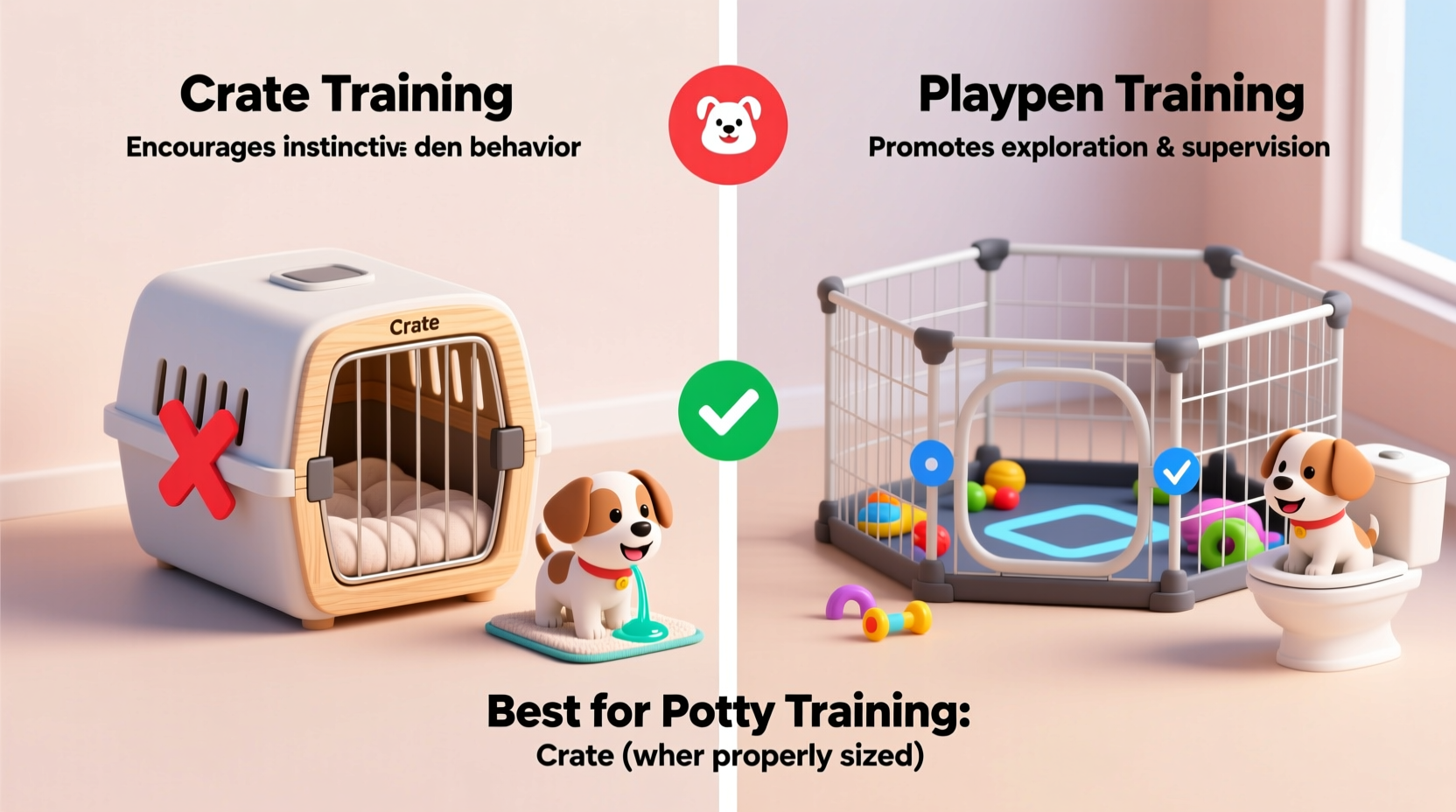
Before comparing crates and playpens, it’s essential to understand why confinement plays such a central role in successful potty training. Puppies have limited bladder control and lack the instinct to avoid soiling where they sleep or rest—unless guided otherwise. The principle behind effective housebreaking relies on leveraging a dog’s natural denning instinct: dogs generally avoid eliminating in close proximity to their sleeping and eating areas.
Confinement tools like crates and playpens help establish boundaries, prevent accidents from going unnoticed, reduce destructive chewing, and create a predictable routine. However, how these tools implement confinement differs dramatically, affecting their suitability for potty training goals.
“Puppies thrive on structure. A well-managed confinement strategy reduces confusion and accelerates learning by aligning with their innate preferences.” — Dr. Karen Becker, DVM and Animal Wellness Advocate
Dog Crates: Structure, Security, and Success
A dog crate is typically a wire, plastic, or fabric enclosure designed to mimic a den. When used appropriately, it becomes a safe haven for the puppy—a place to rest, retreat, and feel secure. In the context of potty training, the crate serves as a powerful behavioral aid because its size limits the puppy’s ability to eliminate nearby without discomfort.
The ideal crate is just large enough for the puppy to stand up, turn around, and lie down comfortably—but not much more. This size restriction discourages elimination inside since puppies naturally resist soiling their immediate sleeping area. Over time, this builds self-control and reinforces the habit of holding it until taken outside.
Tip: Never use a crate that's too large. If necessary, partition a bigger crate to match your puppy’s current size.Crate training also supports schedule-based feeding and bathroom breaks. Owners can predict when a puppy will need to go (after waking, eating, or playing) and take them directly outside. Immediate praise and rewards upon outdoor elimination reinforce positive behavior.
However, misuse of crates can backfire. Extended confinement beyond what’s developmentally appropriate (e.g., leaving a young puppy crated for 6+ hours) leads to stress, physical discomfort, and learned soiling if accidents occur. Crating should never be used as punishment or long-term containment without adequate exercise and socialization.
Pros of Using a Crate for Potty Training
- Leverages natural denning instinct to discourage indoor elimination
- Easy to transport and use across environments (home, travel, vet visits)
- Provides a consistent, secure space that reduces anxiety
- Supports structured routines crucial for fast potty training progress
- Helps prevent destructive behaviors when unsupervised
Cons of Using a Crate for Potty Training
- Requires strict adherence to time limits based on age and bladder capacity
- Some puppies may develop crate aversion if introduced improperly
- Limited space means no room for toys, water, or separate zones
- Not suitable for extended daytime use during work hours without breaks
Playpens: Freedom Within Boundaries
A playpen—often made of metal or plastic panels—creates a larger enclosed area than a crate. It allows the puppy freedom to move, play, stretch, and access multiple zones within a confined space. Many owners set up playpens with bedding, toys, food, water, and a designated potty area (such as pee pads or artificial grass).
This flexibility makes playpens appealing for households where someone is home frequently or for supplementing crate use during awake, supervised periods. They allow puppies to begin distinguishing between “living” and “bathroom” zones—an important cognitive step in full housebreaking.
However, this very advantage introduces a major drawback for potty training: because the space is larger, puppies often eliminate at one end while sleeping at the other, reinforcing indoor toileting habits. Unlike the crate, there’s no psychological pressure against soiling nearby. As a result, some puppies trained primarily in playpens take longer to generalize the rule that *all* indoor elimination is unacceptable.
Pros of Using a Playpen for Potty Training
- Offers more physical space for movement and activity
- Allows separation of sleeping, eating, and potty areas
- Ideal for daytime use when someone is home to supervise
- Easily customizable with gates, covers, and accessories
- Can accommodate multiple puppies or pets temporarily
Cons of Using a Playpen for Potty Training
- Risk of establishing indoor elimination habits if potty zone is included
- Larger size undermines natural inhibition to soil near sleeping area
- Less portable and harder to manage outside the home
- May encourage pacing or obsessive behaviors in anxious pups
- Not effective for overnight or long-duration confinement
Comparative Analysis: Crate vs Playpen for Potty Training
| Feature | Dog Crate | Playpen |
|---|---|---|
| Size & Space | Small, den-like; only enough room for basic movement | Large; allows running, playing, and zoning |
| Potty Training Effectiveness | High – discourages soiling due to proximity | Moderate to Low – enables zoning, which may delay full outdoor training |
| Bladder Control Development | Promotes holding through necessity and routine | May delay control if potty area is accessible indoors |
| Overnight Use | Ideal – supports uninterrupted sleep and accident prevention | Possible but less effective; risk of nighttime accidents |
| Supervision Required | Low during confinement; high during release | High – frequent monitoring needed to redirect behavior |
| Portability | High – easy to move and travel with | Low – bulky and complex to assemble/disassemble |
| Best For | Structured training, nighttime use, short absences | Daytime activity, multi-zone setups, homes with constant supervision |
Hybrid Approach: Combining Crate and Playpen Strategically
Many experienced trainers and veterinarians recommend a hybrid model that uses both tools appropriately. Rather than choosing one over the other, smart integration maximizes the benefits of each while minimizing drawbacks.
For example, a puppy might spend nights and nap times in a properly sized crate to build bladder control and prevent accidents. During waking hours when someone is home, the puppy transitions to a playpen with a separate sleeping mat and toy area—but initially, no indoor potty zone. Instead, the owner maintains a tight schedule of outdoor trips every 30–60 minutes after stimulation.
As the puppy matures and gains reliability, the playpen can optionally include a remote potty station (like a sod pad or litter tray), especially useful for bad weather or emergency situations. But this should only be introduced after the puppy has already learned to signal for outdoor elimination.
Step-by-Step Hybrid Routine (Weeks 1–8)
- Week 1–2: Use crate exclusively when unsupervised. Take puppy out every 30 minutes while awake.
- Week 3–4: Introduce playpen during daytime hours. No potty zone. Supervise closely and reward outdoor elimination.
- Week 5–6: Extend crate duration gradually (based on age: ~1 hour per month of age). Use playpen for active play sessions.
- Week 7–8: Begin phasing in indirect supervision using baby gates or leashed tethering indoors.
- Ongoing: Transition toward full house freedom only after 2+ weeks of zero accidents indoors.
Mini Case Study: Bella the Border Collie Mix
Bella, a 10-week-old Border Collie mix, was brought home by a first-time owner working from home. Initially, she was placed in a large playpen with a bed, water bowl, and pee pad in the corner. Within days, she began using the pad regularly—even shortly after being taken outside. Her owner assumed this was progress.
At six months, despite repeated attempts to switch her to outdoor-only elimination, Bella continued having accidents indoors whenever left alone. A professional trainer assessed the situation and identified the root cause: Bella had learned that eliminating inside was acceptable as long as it was in the \"designated\" zone.
The family switched to a strict crate-training protocol during sleep and absence, removed all indoor potty options, and re-established a timed outdoor schedule. Within three weeks, Bella was reliably signaling to go outside. The earlier reliance on the playpen had delayed her training by several months.
Frequently Asked Questions
Can I use a playpen instead of a crate for potty training?
You can, but with caution. Playpens work best when used for supervised daytime activity and not as a primary tool for teaching bladder control. Including an indoor potty area may hinder progress by normalizing indoor elimination. For optimal results, combine playpen use with scheduled outdoor breaks and reserve the crate for downtime.
How long can I leave my puppy in a crate versus a playpen?
Puppies should not be crated longer than their age in months plus one hour (e.g., a 3-month-old can handle ~4 hours max). Playpens allow longer awake confinement, but still require potty breaks every 1–2 hours. Neither replaces human interaction, exercise, or mental stimulation.
Is it cruel to crate a puppy at night?
No—if done correctly. A properly sized crate in a quiet bedroom helps puppies feel secure. Most adapt quickly and sleep through the night by 12–16 weeks. Ensure the crate includes comfort items and that the puppy has eliminated before bedtime.
Final Recommendation: Choose Based on Goals, Not Convenience
When evaluating dog crate vs playpen for puppy potty training success, the evidence strongly favors the crate as the superior foundational tool. Its ability to harness natural instincts, enforce routine, and prevent accidents makes it indispensable in the early stages.
The playpen has value as a secondary tool—ideal for daytime enrichment, socialization, and transitional spaces—but should not replace the crate in structured training. Relying solely on a playpen risks creating habits that are difficult to reverse later.
Ultimately, the goal isn’t just short-term management but long-term independence: a dog that chooses to wait and go outside, even when unattended. That outcome is far more likely when training begins with discipline, consistency, and the right tools.
💬 Ready to build a cleaner, calmer home with a well-trained pup? Start tonight by setting up a properly sized crate, removing indoor potty options, and committing to a predictable outdoor schedule. Small steps now lead to lifelong habits.








