Choosing between a covered and an open litter box is one of the most common dilemmas cat owners face. On the surface, it seems like a simple preference—privacy versus accessibility—but the decision impacts odor control, litter tracking, feline behavior, and long-term hygiene. While some believe a covered box contains smells better, others argue it traps odors and discourages use. The truth lies in understanding how cats interact with their environment and what each design offers in practice.
This guide examines both options from multiple angles: feline psychology, odor dispersion, cleanliness, and real-world usability. Whether you're dealing with a sensitive-nosed household member or a picky cat that avoids enclosed spaces, the right choice depends on more than just smell—it’s about balancing comfort, practicality, and health.
How Cats Use Their Litter Box: Behavior Matters
Cats are creatures of instinct and routine. Their natural behaviors—such as digging, covering waste, and seeking quiet spots—are rooted in survival. In the wild, cats avoid predators by eliminating away from their resting areas and burying their waste to mask their presence. A litter box should support these instincts while fitting into a modern home.
Privacy plays a key role. Many cats prefer a secluded spot to do their business, free from foot traffic or sudden movements. This is where covered litter boxes appear beneficial—they offer visual shielding and reduce distractions. However, not all cats respond well to enclosures. Some feel trapped or anxious when cornered, especially if the entrance is narrow or the space feels claustrophobic.
“Cats value predictability and control. A litter box should feel safe, but not confining.” — Dr. Lena Torres, Feline Behavior Specialist
Additionally, multi-cat households introduce competition. Dominant cats may guard covered boxes, while submissive ones avoid them altogether. Open boxes allow easier escape routes and clearer visibility, reducing stress for cautious felines.
Odor Control: Does Covering Trap Smells?
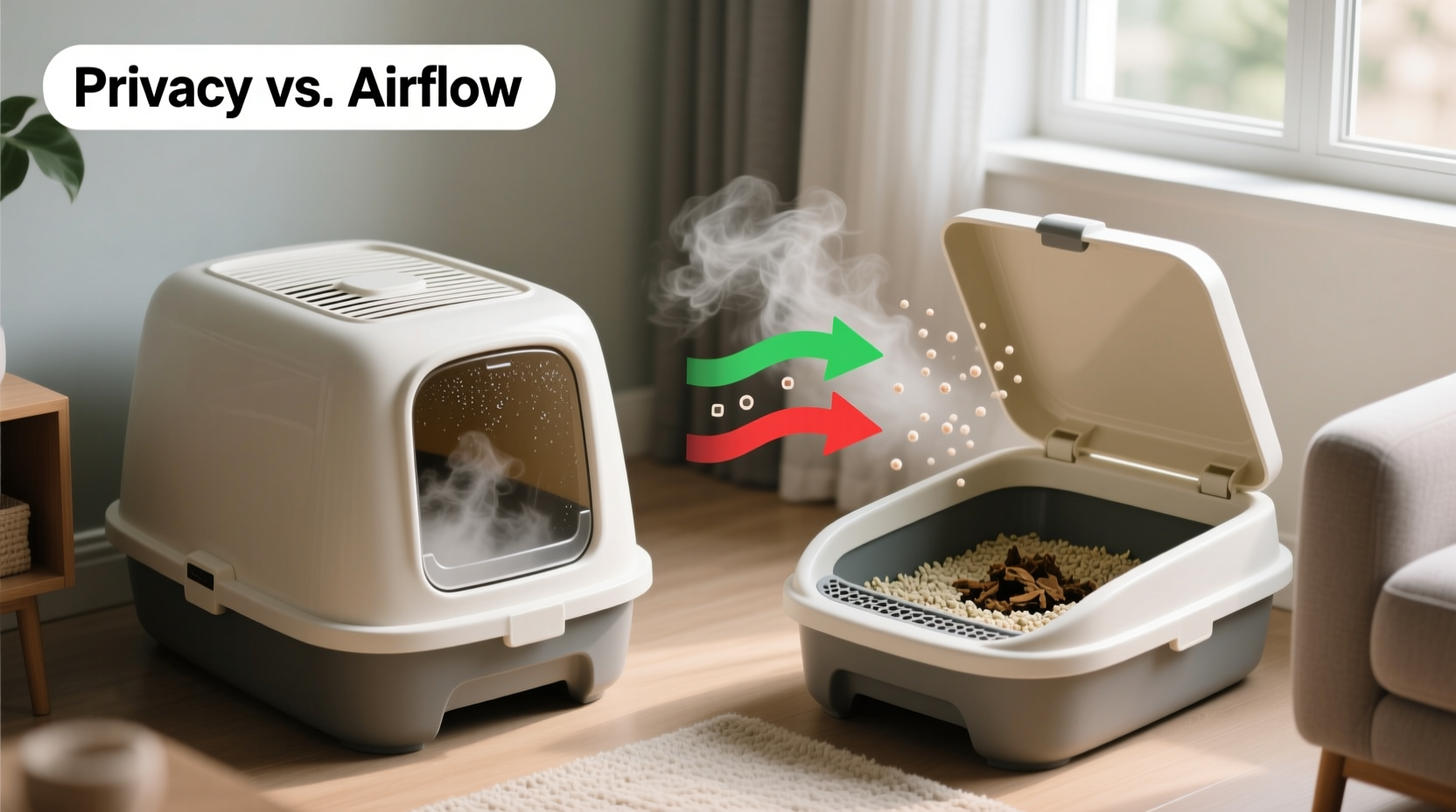
The assumption that covered litter boxes contain odors better than open ones is widespread—but often misleading. While a lid can block initial visual cues and prevent airborne particles from spreading, it also limits airflow. Without proper ventilation, ammonia and waste gases accumulate inside the enclosure, creating a concentrated stench that becomes overwhelming over time.
In contrast, open litter boxes allow odors to disperse gradually. When placed in a well-ventilated area, such as near a window or under an air purifier, they can actually minimize lingering smells through constant air exchange. The key difference is dilution: open boxes spread scent over a larger volume of air, while covered boxes concentrate it in a small, stagnant space.
Tip: If using a covered box, clean it daily and consider adding a small carbon filter fan to improve air circulation.Moreover, many covered boxes develop hidden odor pockets. Waste can stick to the inner walls or corners, especially if clumping litter sticks after scooping. These residues go unnoticed during routine cleaning but continue to emit strong odors. Open boxes make such buildup easier to spot and remove.
Comparison: Covered vs Open Litter Boxes
| Feature | Covered Litter Box | Open Litter Box |
|---|---|---|
| Odor Containment | Limited; traps smells inside unless ventilated | Better dispersion with airflow; less concentration |
| Litter Tracking | Reduced due to higher sides and top entry | Higher; litter sticks to paws and spreads easily |
| Cat Comfort | Preferred by shy cats; may stress others | More accessible; preferred by most cats |
| Cleaning Ease | Harder to reach corners; residue builds up | Easier to scoop and wipe down completely |
| Space & Placement | Bulkier; needs clearance for lid | Compact; fits in tighter spaces |
| Kitten/Senior Access | High门槛 (entry); difficult for older or arthritic cats | Low entry; easy access for all ages |
Real-World Example: The Case of Two Cats, One Box
Sarah adopted two rescue cats—Milo, a confident tabby, and Luna, a timid black cat with a history of anxiety. She started with a covered litter box, believing it would reduce odor in her small apartment. Within days, Milo used it regularly, but Luna avoided it entirely, opting instead to eliminate behind the couch.
After consulting a vet behaviorist, Sarah switched to an open box placed in a quiet corner. She added a privacy screen made of bamboo on one side, giving Luna partial cover without full enclosure. Within 48 hours, both cats were using the box consistently. Odor levels didn’t increase—in fact, she noticed the room smelled fresher because she could clean more thoroughly and detect issues earlier.
This case illustrates that perceived benefits like odor control must be weighed against actual usage. A litter box only works if the cat uses it. Forcing a design that causes avoidance leads to bigger problems than minor smell fluctuations.
Best Practices for Minimizing Odor Regardless of Design
Whether you choose a covered or open box, odor management comes down to consistent habits and smart accessories. Here’s a step-by-step guide to keeping your space fresh:
- Scoop daily: Remove solids and clumps every morning. Ammonia builds rapidly after 12–24 hours.
- Use high-quality clumping litter: Look for formulas with odor-neutralizing ingredients like activated charcoal or baking soda.
- Replace litter weekly: Even if it looks clean, old litter loses absorbency and holds residual smells.
- Wash the box monthly: Use mild dish soap and warm water. Avoid bleach unless necessary—it can linger and repel cats.
- Place in a ventilated area: Avoid closets or tight corners. Near a return air vent or under an air purifier helps cycle air.
- Add a deodorizer: Use pet-safe gels or powders designed for litter boxes—never plug-ins or sprays near the box.
- Consider a hybrid model: Some semi-covered boxes have front cutouts and mesh ventilation panels, offering balance.
Checklist: Choosing the Right Litter Box for Your Cat
- ✅ Is my cat comfortable entering enclosed spaces?
- ✅ Do I have kittens or senior cats who need low-entry access?
- ✅ Can I commit to daily scooping and weekly full changes?
- ✅ Is the location well-ventilated and away from loud appliances?
- ✅ Am I using a litter that controls odor effectively?
- ✅ Have I observed which type my cat naturally prefers?
- ✅ Am I willing to switch if the current setup isn’t working?
This checklist helps align your choice with both practical maintenance and your cat’s behavioral needs. Remember: no design compensates for poor cleaning habits.
Expert Insight: What Veterinarians Recommend
Many veterinarians and feline specialists lean toward open litter boxes for general use. They emphasize accessibility and ease of monitoring as critical factors in maintaining urinary health.
“Urinary tract issues are common in cats, and early detection saves lives. With an open box, you can immediately see changes in urine volume, color, or straining behavior. Covered boxes hide those signs until it’s too late.” — Dr. Alan Kim, DVM, Internal Medicine Specialist
He adds that while odor is a concern for humans, cats are far more sensitive to dirty conditions. A poorly maintained covered box may become so foul-smelling internally that even the most private cat refuses it. Cleanliness trumps containment every time.
Frequently Asked Questions
Do covered litter boxes really reduce smell?
Not necessarily. While they block immediate odor release, they often trap ammonia and moisture inside, leading to stronger smells over time. Without ventilation, the enclosed space becomes a breeding ground for concentrated odors. Regular cleaning and airflow matter more than a lid.
Why does my cat scratch at the walls of the covered box?
This behavior may indicate discomfort with confinement. Cats naturally dig and kick to cover waste, and high sides or close walls can frustrate this instinct. It may also signal that waste is sticking to the plastic, prompting attempts to bury it. Switching to an open box or switching litters may resolve this.
Can I use an air purifier to manage litter box odor?
Yes, but placement matters. Use a HEPA + carbon filter purifier near (not directly above) the litter box to capture dust and neutralize gases. Avoid ionic purifiers, which can produce ozone—a respiratory irritant for cats.
Conclusion: Prioritize Function Over Form
The debate between covered and open litter boxes isn’t about which looks neater or promises better odor control—it’s about what works for your cat and your lifestyle. Privacy matters, but not at the cost of usability or hygiene. Covered boxes can benefit certain cats, particularly in high-traffic homes, but they demand stricter cleaning routines and may backfire if ignored.
An open litter box, when placed thoughtfully and maintained diligently, often outperforms its covered counterpart in both odor management and feline acceptance. The freedom of movement, better visibility, and ease of cleaning make it the preferred choice among experts and experienced cat owners alike.
💬 What’s your experience? Did switching from covered to open (or vice versa) make a difference? Share your story in the comments—your insight could help another cat owner find the perfect solution.








