When shopping for a stick vacuum, one of the most critical performance factors is suction power—especially how consistently that suction holds up over time. While both cordless and corded stick vacuums have evolved significantly in recent years, their long-term suction strength diverges due to fundamental differences in power delivery, motor design, and wear patterns. Understanding these differences helps consumers make informed decisions based on real-world use, not just initial specs.
Cordless models offer unmatched convenience with their portability and freedom from outlets, but they rely on batteries that degrade over time. Corded vacuums, though tethered, draw continuous power directly from the wall, potentially offering more stable suction across years of use. But does that translate to better long-term performance? Let’s break it down.
How Suction Power Is Measured and Why It Matters
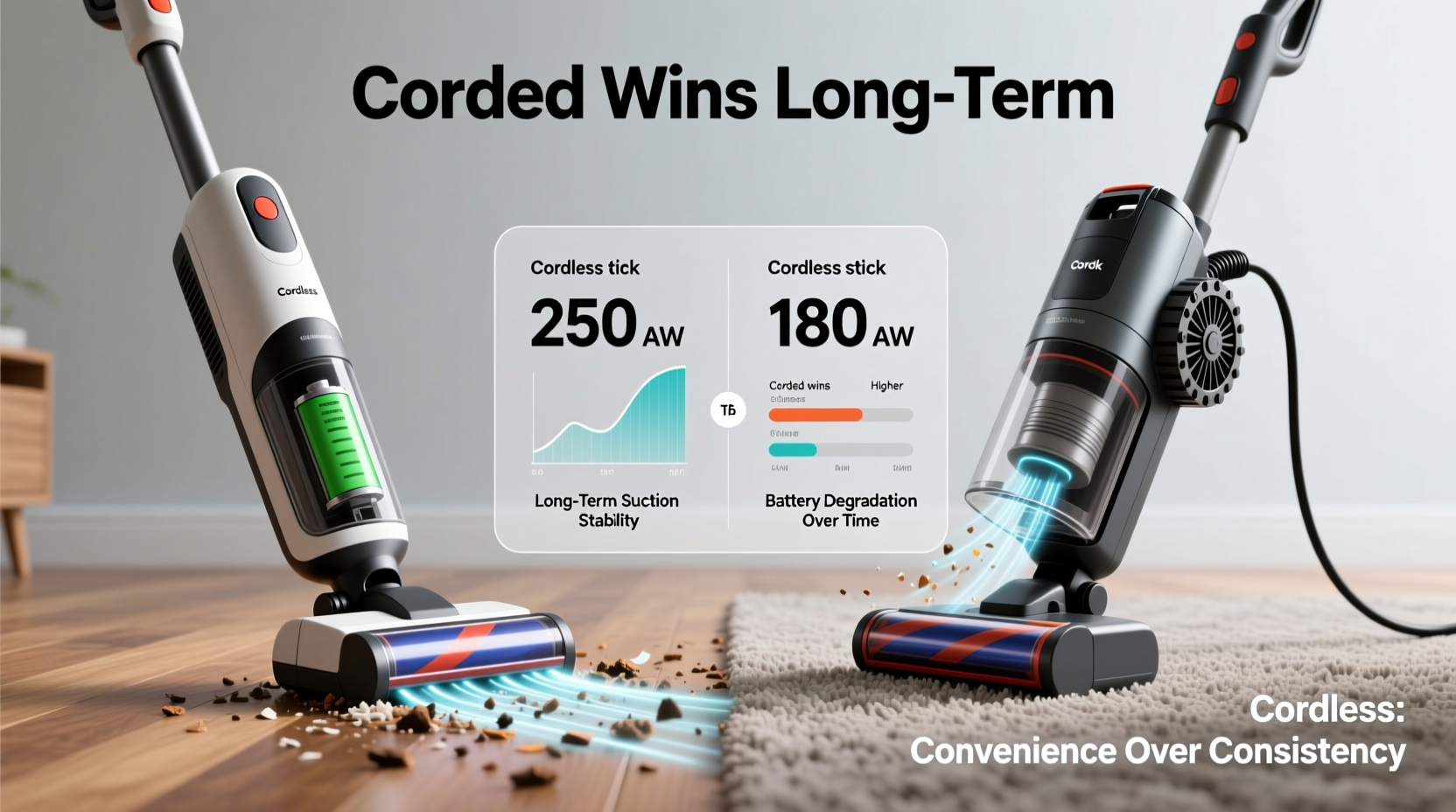
Suction in vacuums is typically measured in air watts (AW), cubic feet per minute (CFM) for airflow, and inches of water lift (inH₂O) for suction strength. While manufacturers often highlight peak suction at launch, what matters more for long-term cleaning effectiveness is sustained suction—the ability to maintain strong airflow under load, such as when dealing with carpets or full dustbins.
The key difference between cordless and corded models lies in energy consistency. A corded vacuum receives a constant 120-volt supply (in North America), allowing its motor to operate at full capacity indefinitely. In contrast, a cordless vacuum depends on a lithium-ion battery whose voltage drops as it discharges and degrades with each charge cycle. Over time, this affects not only runtime but also maximum motor output.
“Battery degradation is inevitable. Even with proper care, most lithium-ion packs lose 20–30% of their original capacity after 500 charge cycles.” — Dr. Alan Zhou, Battery Technology Researcher, MIT Energy Initiative
Long-Term Suction Performance: Cordless vs Corded
In the first year of ownership, high-end cordless vacuums can rival or even exceed the suction of many corded models, thanks to advanced digital motors like those from Dyson or LG. However, as time passes, several factors begin to erode that performance:
- Battery aging: After 2–3 years, reduced voltage leads to lower motor RPMs, decreasing suction.
- Thermal throttling: To prevent overheating, motors may reduce power during extended use, especially on max mode.
- Filtration clogs: HEPA filters and pre-motor screens accumulate debris; if not cleaned regularly, airflow drops significantly.
Corded vacuums face fewer of these issues. Since they don’t rely on batteries, their motors run at consistent speeds regardless of usage duration. There’s no thermal throttling under normal conditions, and while filter maintenance still matters, the direct power supply ensures recovery of full suction after cleaning components.
Tip: For cordless users, replacing the battery every 3–4 years can restore near-original suction levels—though replacement costs can be high.Comparative Analysis: Real-World Longevity of Suction
To illustrate the divergence in long-term suction, consider two scenarios using popular models:
| Feature | Cordless Vacuum (e.g., Dyson V15 Detect) | Corded Stick Vacuum (e.g., Shark Vertex Pro) |
|---|---|---|
| Initial Suction (Air Watts) | 170 AW | 160 AW |
| Power Source | Lithium-ion battery (36V) | AC mains (120V) |
| Average Runtime at Max Power | 12 minutes | Unlimited |
| Expected Battery Life | 3–5 years (500–800 cycles) | N/A |
| Suction Retention After 3 Years | ~75% (with degraded battery) | ~95% (assuming regular filter cleaning) |
| Maintenance Impact on Suction | High (clogs + battery decay compound loss) | Moderate (primarily filter-related) |
| Replacement Part Cost | Battery: $80–$120 | Filter: $15–$25 |
The data shows that while cordless vacuums start strong, their dependence on battery health creates a downward suction trajectory. Corded models, though slightly less powerful out of the box in some cases, maintain performance far more reliably over time.
Mini Case Study: Two Homes, Five Years Later
Consider two households with similar flooring and pet ownership:
- Household A purchased a premium cordless vacuum in 2019. By 2022, they noticed reduced pickup on rugs and shorter cleaning sessions before shutdown. They replaced the battery in 2023, restoring performance temporarily—but by 2024, the new battery showed early signs of decline.
- Household B bought a mid-tier corded stick vacuum the same year. Despite daily use, they report “still works like new” in 2024. The only maintenance was washing the filter monthly and clearing the brush roll twice a year.
This reflects a broader trend: corded vacuums age more gracefully when it comes to core performance metrics like suction stability.
Factors That Influence Long-Term Suction Beyond Power Type
While power source is central, other elements affect how well suction holds up over time:
Motor Design and Build Quality
Digital motors in cordless vacuums spin faster than traditional AC motors but generate more heat. Over thousands of cycles, this thermal stress can wear bearings and reduce efficiency. High-end brands mitigate this with cooling systems and durable materials, but cheaper models often lack such protections.
Corded vacuums typically use brushed or brushless AC motors designed for continuous operation. These are bulkier but more resilient to long-term wear.
Filtration System Maintenance
A clogged filter can cut suction by up to 40%, regardless of power type. However, cordless users may overlook maintenance because the symptom—reduced runtime—is often mistaken for battery issues. In reality, a dirty filter forces the motor to work harder, draining the battery faster and increasing heat buildup.
Tip: Clean your vacuum’s filter every 1–2 months, or more frequently in homes with pets or allergies.Dustbin Capacity and Cyclonic Separation
Full dustbins restrict airflow. Cordless models often have smaller bins to save weight, requiring more frequent emptying. If neglected, suction drops rapidly. Corded vacuums usually feature larger bins and more robust cyclonic systems that maintain airflow even when half-full.
Step-by-Step Guide to Maximizing Suction Longevity
Whether you own a cordless or corded stick vacuum, follow this routine to preserve suction strength for years:
- After Every Use: Empty the dustbin completely. Shake out fine dust clinging to walls.
- Weekly: Inspect the brush roll for tangled hair or fibers. Cut away obstructions with scissors.
- Monthly: Wash the foam and HEPA filters (if washable). Allow 24 hours to dry fully before reinserting.
- Every 3 Months: Check hoses and wand connections for blockages. Use a long, flexible tool to clear debris.
- Annually: Lubricate brush roll bearings (if accessible) and inspect seals for cracks or warping.
- For Cordless Models Only: Store with 40–60% battery charge. Avoid leaving on the charger indefinitely.
“Most suction loss isn’t due to hardware failure—it’s preventable buildup. Ten minutes of maintenance a month can extend peak performance by years.” — Lena Patel, Appliance Engineer at Consumer Reports
Checklist: Choosing Based on Long-Term Suction Needs
Use this checklist to determine which type suits your priorities:
- ✅ Do you clean large areas (>1,500 sq ft) daily? → Corded preferred
- ✅ Do you prioritize convenience and quick cleanups? → Cordless suitable
- ✅ Are you willing to replace the battery in 3–5 years? → Yes: cordless okay; No: lean corded
- ✅ Do you have thick carpets or heavy pet hair? → Corded provides more consistent deep-cleaning power
- ✅ Is outlet access limited in your home? → Cordless offers necessary flexibility
- ✅ Do you want minimal long-term maintenance cost? → Corded generally cheaper to maintain
Frequently Asked Questions
Can I restore suction on my cordless vacuum?
Yes, in part. Cleaning filters, clearing blockages, and replacing a worn battery can significantly improve suction. However, even with a new battery, motor wear over time means it may never match day-one performance exactly.
Do corded vacuums ever lose suction?
All vacuums lose suction if poorly maintained. But corded models are less prone to irreversible decline. As long as the motor, seals, and filters are in good condition, they retain most of their original power for a decade or more.
Are newer cordless models solving the suction decay issue?
Improvements in battery chemistry (like lithium iron phosphate) and smarter motor regulation are helping. Some 2024 models include adaptive suction that adjusts based on floor type, preserving battery and reducing strain. However, physics limits remain—batteries will always degrade faster than wall outlets.
Conclusion: Making the Right Long-Term Choice
The question isn't just which vacuum has stronger suction today—it's which will still deliver strong suction five years from now. Cordless vacuums excel in convenience and modern features, but their reliance on batteries introduces an unavoidable decline in performance over time. Corded stick vacuums, though less trendy, offer superior consistency, durability, and value when long-term suction strength is the priority.
If your home demands deep, daily cleaning on carpets or you prefer a set-it-and-forget-it appliance, a corded model remains the more reliable investment. For smaller spaces, hard floors, or users who prioritize speed and mobility over raw power longevity, a cordless vacuum still makes sense—provided you accept the need for eventual battery replacement and slight performance tapering.
🚀 Ready to test your vacuum’s true suction? Try the tissue test: hold a single-ply tissue against the nozzle. If it sticks firmly—even on low setting—your suction is healthy. If not, check filters and bin. Share your results or tips in the comments below!








