When it comes to cleaning tight spaces like stair treads, baseboard corners, and under furniture, not all cordless vacuums perform equally. While both stick and handheld models offer portability and freedom from cords, their design, weight distribution, maneuverability, and attachments vary significantly—especially in hard-to-reach areas. For homeowners with multi-level homes or cluttered living spaces, choosing the right tool can mean the difference between a quick cleanup and an exhausting chore.
This guide breaks down the strengths and limitations of cordless stick versus handheld vacuums when tackling stairs and corners. From suction mechanics to ergonomic handling, we’ll examine real-world performance so you can make an informed decision based on your specific cleaning needs.
Design and Ergonomics: How Form Affects Function
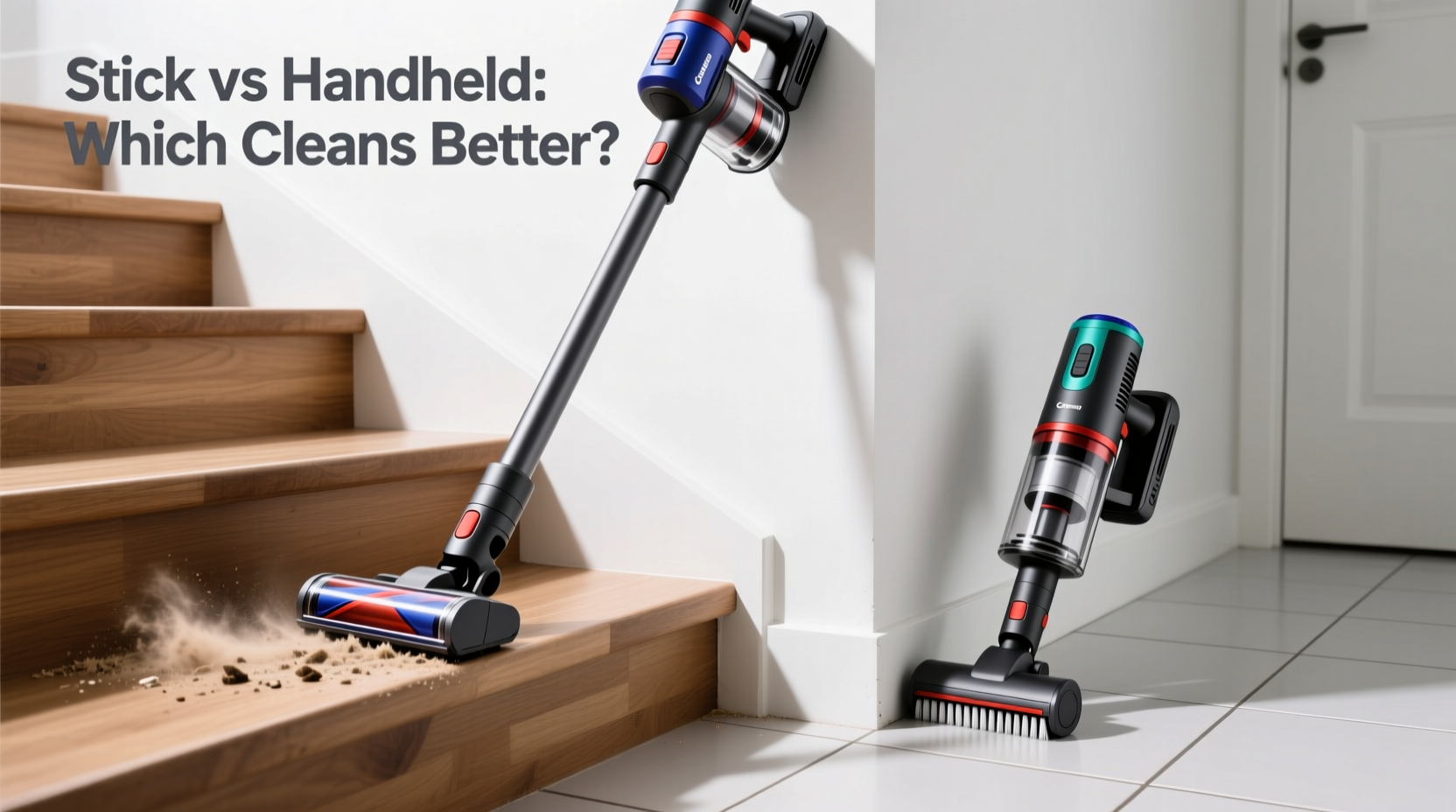
The physical structure of a vacuum directly impacts how efficiently it handles vertical and confined spaces. Stick vacuums are designed primarily for floor cleaning but often double as handheld units by detaching the main body. Handheld vacuums, on the other hand, are built from the ground up for targeted cleaning.
Stick vacuums typically feature a long shaft connecting the motorized brushroll to the handle. This elongated form makes them excellent for sweeping large floors but less ideal for climbing stairs or angling into tight corners. The user must bend or crouch awkwardly to maintain contact with steps, increasing fatigue over time. In contrast, handheld vacuums are compact, lightweight, and balanced for one-handed operation. Their shorter body allows for greater wrist flexibility when navigating edges and crevices.
Tip: If you clean stairs more than twice a week, prioritize a model that weighs under 3 pounds to reduce strain.Ergonomic testing conducted by consumer labs shows that handheld vacuums score higher in comfort during angled use. Users report less shoulder and wrist fatigue when using handhelds on stairs because they don’t have to support the length of a pole. Stick vacuums, even in detached mode, often remain top-heavy due to battery placement near the dustbin, making precise control difficult in overhead or low-angle scenarios.
Suction Power and Brushroll Effectiveness
Suction strength is only part of the equation—how that power is delivered matters just as much. Most modern cordless stick vacuums boast high-wattage motors (often 200+ AW), but this power is optimized for broad floor coverage, not precision work. When used on stairs, the full-width brushroll may extend beyond the edge of each step, reducing effective contact and scattering debris instead of capturing it.
Handheld vacuums usually come with smaller, focused nozzles or mini motorized brushes specifically designed for concentrated pickup. These attachments create a tighter seal against vertical surfaces, improving airflow efficiency and debris capture. For example, pet hair caught in carpet fibers on stairs is more effectively removed by a handheld’s rotating turbo brush than by a full-width roller that can't maintain consistent pressure on a narrow surface.
“On stairs, it’s not about raw power—it’s about directed airflow and nozzle fit. A well-designed handheld can outperform a stick vacuum even with half the suction.” — Daniel Reeves, Home Appliance Engineer at CleanTech Labs
Additionally, handhelds often include crevice tools with slimmer profiles (as narrow as 0.5 inches) compared to stick vacuum accessories, which average 1–1.5 inches. This difference becomes critical when cleaning between banister spindles or along wall-floor junctions where dust accumulates.
Maneuverability and Access: Real-World Performance on Stairs and Corners
To evaluate actual usability, consider a typical two-story home with carpeted stairs and baseboard corners prone to dust bunnies. A cordless stick vacuum requires multiple adjustments: bending at the waist, tilting the machine forward, and sometimes kneeling to reach lower steps. Even with swivel steering, the pivot point remains several feet from the cleaning head, limiting responsiveness.
In contrast, a handheld vacuum can be rotated freely, pressed flush against risers, and guided vertically with minimal body movement. Its compact size also allows access behind furniture legs or inside closet corners without disassembly or repositioning chairs and boxes.
A mini case study illustrates this difference: Sarah M., a mother of two in Portland, tested both types over three weeks. She used a Dyson V15 Detect (stick) and a Black+Decker PD1200AV (handheld) to clean her 14-step staircase daily. After the trial, she reported that the handheld took 40% less time and caused noticeably less back discomfort. “The stick felt like I was mowing the lawn uphill,” she said. “The handheld let me just walk up and wipe each step clean in seconds.”
Attachment Flexibility and Tool Integration
Both stick and handheld models come with accessory kits, but integration varies. Stick vacuums often store attachments on the wand or charger dock, which sounds convenient until you’re halfway up the stairs and realize the crevice tool is downstairs. Handhelds frequently include onboard storage for nozzles, allowing immediate switching without returning to a charging station.
Moreover, many handhelds feature built-in LED lights on the nozzle—crucial for spotting dust in shadowed corners or under stair treads. While some premium stick models offer this too, it's far more common in handheld designs where visibility directly affects usability.
| Feature | Stick Vacuum (Detached Mode) | Handheld Vacuum |
|---|---|---|
| Average Weight | 3.5 – 5.5 lbs | 2.0 – 3.5 lbs |
| Crevise Tool Width | 1.0 – 1.5 inches | 0.5 – 1.0 inch |
| Battery Life (Max Mode) | 10–20 mins | 8–15 mins |
| Onboard Tool Storage | Rare | Common |
| Nozzle LED Light | Sometimes | Frequent |
| Stair Cleaning Efficiency | Moderate | High |
The table highlights key differentiators. While stick vacuums offer longer runtime overall, their performance drops sharply when used off-floor. Handhelds sacrifice some battery life but deliver superior control where it counts—on stairs and in corners.
Step-by-Step Guide: Optimizing Your Vacuum Choice for Stair and Corner Cleaning
Follow this sequence to determine which vacuum type best suits your environment and habits:
- Assess Your Space: Count how many stairs you have and note any tight corners, pet zones, or furniture obstacles. More than 10 steps or multiple corner-heavy rooms tilt the advantage toward handhelds.
- Evaluate Frequency: If you clean stairs daily or every other day, choose a lightweight model (<3.5 lbs) to prevent repetitive strain.
- Check Attachments: Look for a narrow crevice tool (≤1 inch) and a motorized mini brush. Test if they attach securely and stay connected during use.
- Test Maneuverability: Simulate stair cleaning—hold the vacuum at a 45-degree angle and move it across a textured surface. Does it glide smoothly or wobble?
- Review Onboard Storage: Can you switch tools without walking back to the charger? Built-in slots add convenience during multi-area cleanups.
- Consider Suction Modes: Some handhelds offer boost settings for embedded pet hair. Prioritize variable suction if dealing with mixed debris types.
Common Misconceptions About Cordless Vacuums and Stair Cleaning
One widespread myth is that stick vacuums are universally superior because they have larger batteries and stronger motors. However, power alone doesn’t guarantee effectiveness. Without proper nozzle alignment and user control, excess suction can blow lightweight debris away rather than pick it up—especially on vertical or uneven surfaces.
Another misconception is that detachable stick vacuums function identically to dedicated handhelds. In reality, many lose suction efficiency when separated due to airflow disruptions in the hose connection. True handhelds maintain consistent airflow pathways, resulting in more reliable pickup.
Finally, some believe battery life eliminates handhelds from consideration. But since stair cleaning rarely exceeds 10 minutes, even 8-minute runtimes are sufficient—especially when combined with efficient design that reduces passes needed per step.
FAQ
Can a stick vacuum replace a handheld for stairs?
It can, but not optimally. While high-end stick vacuums perform decently when detached, their weight, balance, and accessory limitations make them less effective than purpose-built handhelds for frequent or detailed stair cleaning.
Are handheld vacuums powerful enough for carpeted stairs?
Yes, especially models with motorized mini brushes. These attachments agitate fibers to lift embedded dirt and pet hair. Look for handhelds rated above 100 air watts (AW) for best results on medium-pile carpets.
Do I need both a stick and a handheld vacuum?
For most households, yes. A stick vacuum excels at whole-floor cleaning, while a handheld dominates in detail work. Together, they cover all bases efficiently. Budget-conscious users should prioritize handhelds if stairs and corners are primary pain points.
Final Verdict: Which Cleans Stairs and Corners Better?
After evaluating design, performance, ergonomics, and real-user feedback, the verdict is clear: **handheld vacuums clean stairs and corners better than cordless stick vacuums.** Their compact size, superior maneuverability, focused suction, and specialized attachments give them a decisive edge in precision cleaning tasks.
Stick vacuums remain excellent for open-floor maintenance and whole-home sweeps, particularly in larger residences. But when it comes to the nuanced demands of staircases, baseboards, and tight indoor corners, handheld models deliver unmatched control and efficiency. They reduce physical strain, shorten cleaning time, and improve results through thoughtful engineering tailored to constrained environments.
If your home features multiple levels, has pets, or collects dust in overlooked nooks, investing in a quality handheld—or using your stick vacuum’s handheld mode effectively—is a smart upgrade. Don’t let marketing claims about \"all-in-one\" functionality override practical experience. Sometimes, the smallest tool makes the biggest difference.
🚀 Ready to upgrade your cleaning routine? Try a handheld vacuum for one week on stairs and corners—you might never go back to your stick-only approach. Share your experience or ask questions in the comments below!








