In homes where every square foot counts—especially in apartments, studios, or multi-pet households—furnishing for cats becomes a balancing act between enrichment and spatial efficiency. The debate between traditional cat trees and wall-mounted shelves isn't just about aesthetics; it's fundamentally about how to support feline well-being without sacrificing usable floor area. As vertical living gains popularity among urban pet owners, understanding the real differences in space usage, functionality, and long-term value is essential.
Cats are natural climbers and observers. They seek high vantage points to monitor their environment, rest securely, and engage in playful bursts of activity. Meeting these instinctual needs doesn’t have to come at the cost of cramped rooms or obstructed furniture layouts. This article compares cat trees and wall-mounted shelves across key dimensions—floor footprint, structural requirements, adaptability, safety, and behavioral benefits—to help you make an informed decision based on your living space and your cat’s personality.
Floor Space Impact: The Core Difference
The most immediate distinction lies in floor occupancy. A standard cat tree, even a compact one, typically occupies between 1.5 and 4 square feet of floor space. Larger models with multiple levels, condos, and dangling toys can take up significantly more, often anchoring themselves in corners or against walls but still consuming valuable ground area.
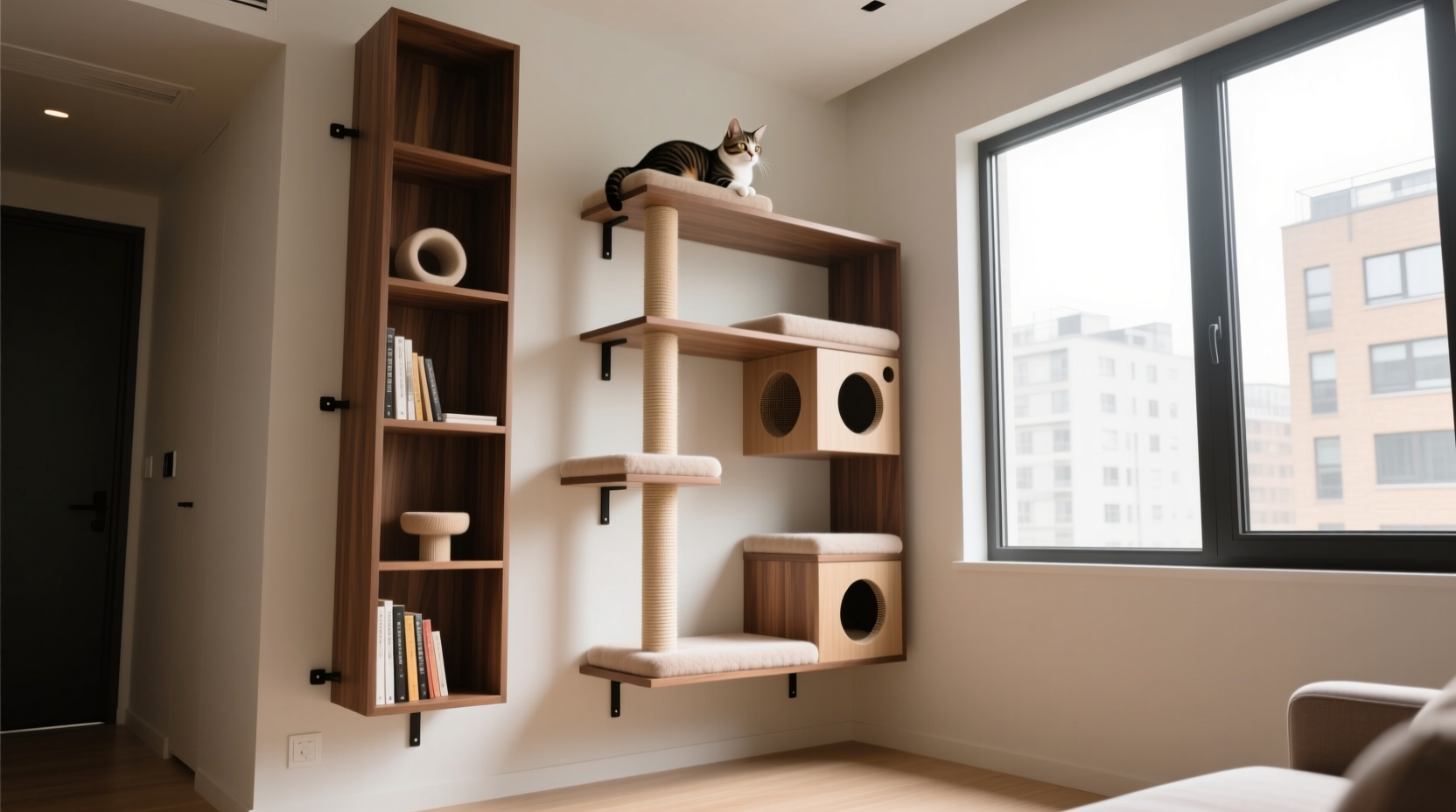
In contrast, wall-mounted shelves attach directly to studs in the wall and extend outward, usually 10 to 16 inches. Their base contact with the floor is nonexistent. While some configurations include small posts or corner supports for stability, the majority of the structure operates independently of floor space. This makes them inherently superior in terms of space conservation.
Tip: For maximum space savings, install floating shelves at staggered heights along perimeter walls, leaving central floor areas completely clear.Consider this practical comparison: a full-size cat tree might allow three resting zones but occupy a 2' x 2' zone permanently. A series of wall shelves covering the same vertical climb could offer four to five perches while using zero floor space. The latter enables easier room navigation, cleaning access, and flexible furniture arrangement.
Structural and Installation Considerations
While wall-mounted shelves win on paper for space efficiency, they require more involved installation. Proper mounting demands locating wall studs, using heavy-duty anchors or lag screws, and ensuring level alignment. A poorly installed shelf—even if it looks secure—can collapse under a cat’s weight, posing serious injury risks.
Cat trees, by contrast, are plug-and-play. Most come fully assembled or require minimal setup and stand independently. They’re ideal for renters who can’t drill into walls or those who prefer temporary solutions. However, their stability depends on weight distribution; taller models may tip if a cat jumps aggressively onto an upper platform.
“Wall-mounted systems, when properly anchored, provide safer and more stable climbing routes than freestanding units over 3 feet tall.” — Dr. Lena Ruiz, Feline Behavior Consultant
Another factor is ceiling height. High ceilings (9 feet or more) favor wall systems, allowing for dramatic vertical pathways that mimic natural climbing environments. In lower-ceilinged spaces, cat trees may be more practical, as wall routes could feel truncated or awkwardly spaced.
Functional Comparison: Features and Flexibility
Each option offers distinct functional advantages. Cat trees often bundle features: scratching posts, enclosed condos, hammocks, and hanging toys—all integrated into a single unit. These multifunctional designs cater to various feline behaviors in one footprint.
Wall shelves tend to focus on perching and movement. While modular systems allow customization, adding scratching elements requires separate installations like sisal-wrapped posts or angled scratch panels mounted nearby. This modularity is both a strength and a limitation: you can tailor the layout precisely, but you’ll likely need additional components to meet all behavioral needs.
Adaptability over time also differs. With wall shelves, reconfiguration means unmounting and reinstalling—a moderate effort. But this allows evolving the layout as your cat ages or your room use changes. Cat trees are generally static; moving them frequently risks wear on carpet or floors and may deter cats from using them consistently.
- Assess your cat’s habits: Does your cat prefer cozy enclosures or open sunbathing spots?
- Evaluate wall integrity: Are there accessible studs in desired locations?
- Plan traffic flow: Will floor-based furniture interfere with play paths?
- Consider multi-cat dynamics: Do cats need separate zones to avoid conflict?
- Budget for total cost: Include tools, hardware, and potential wall repair.
Space-Saving Showdown: A Comparative Table
| Feature | Cat Tree | Wall-Mounted Shelves |
|---|---|---|
| Floor Space Used | 1.5 – 4+ sq ft | 0 sq ft (if fully suspended) |
| Installation Effort | Low (assemble & place) | High (drilling, leveling, anchoring) |
| Scratching Integration | Built-in posts common | Requires add-ons |
| Customization | Limited to model design | Highly modular and scalable |
| Portability | Moderate to high | Low (permanent fixtures) |
| Ideal For | Renters, temporary setups, multi-feature needs | Small homes, permanent residences, vertical explorers |
Real-World Example: A Studio Apartment Transformation
Sophie, a graphic designer in Seattle, lives in a 450-square-foot studio with two active rescue cats, Milo and Juno. Her original freestanding cat tree occupied a prime corner near the window but blocked access to storage cabinets and made vacuuming difficult. After researching alternatives, she removed the tree and installed a U-shaped track of wall-mounted shelves along two adjacent walls, starting 18 inches off the floor and ascending to within 12 inches of the ceiling.
The new system used no floor space, allowed her to reclaim the corner for a reading chair, and gave the cats a continuous climbing loop. She added a standalone sisal post in another area for scratching. Within days, both cats adapted—Juno especially enjoyed the highest perch, which overlooked the street below. Cleaning became easier, and the room felt visibly larger despite adding more cat infrastructure.
This case illustrates a critical insight: space-saving isn’t just about removing objects—it’s about redistributing utility vertically and intelligently.
Step-by-Step: Choosing and Installing Wall-Mounted Shelves
If you're leaning toward wall shelves for maximum floor clearance, follow this proven process:
- Map your cat’s movement patterns: Observe where they jump, rest, and watch from. Identify natural pathways.
- Select shelf type: Choose between wooden ledges, corner mounts, or modular kits with connectors. Ensure depth (minimum 10\") suits your cat’s size.
- Plan the route: Start low (12–18\"), then alternate left/right placement every 12–18\" upward. Include landings near windows or doorways.
- Locate studs: Use a stud finder to mark positions. Shelves must anchor into wood or metal studs—not drywall alone.
- Install with proper hardware: Use lag bolts or heavy-duty toggle anchors. Double-check level and torque.
- Test stability: Apply force equivalent to 1.5x your cat’s weight before allowing use.
- Introduce gradually: Place treats or toys on lower shelves. Encourage use with praise or catnip.
Frequently Asked Questions
Can wall-mounted shelves support large or heavy cats?
Yes, provided they are properly anchored into wall studs using appropriate hardware. Most quality shelves support 30–50 pounds. Always verify manufacturer weight limits and err on the side of over-engineering, especially for cats over 15 pounds.
Are cat trees obsolete in small spaces?
No. While less space-efficient, cat trees remain valuable for cats that prefer enclosed spaces or enjoy interactive toys. Compact \"condo-style\" trees designed for corners can still fit well in studios or bedrooms without dominating the room.
Do wall shelves damage walls?
Installation requires drilling, which leaves holes. However, these can be patched easily when removed. The trade-off is often worth it for long-term space optimization. Use painter’s caulk and touch-up paint for clean removal later.
Final Verdict: Which Saves More Floor Space?
The answer is unequivocal: wall-mounted shelves save significantly more floor space than cat trees. By shifting the climbing environment from the ground plane to the vertical surface, they free up entire zones for human use, improve cleaning access, and create dynamic, engaging routes for cats.
That said, the best solution often combines both. A minimalist wall pathway can be paired with a small, low-profile scratching post or condo tucked beside a sofa or closet. This hybrid approach maximizes behavioral fulfillment while minimizing spatial impact.
The goal isn’t just to save space—it’s to design a home where both people and cats thrive. When vertical real estate is leveraged wisely, even the smallest apartment can offer a rich, stimulating environment for feline life.
“The future of cat-friendly design is vertical. We’re seeing a shift from bulky furniture to integrated, architectural solutions that respect shared living.” — Marcus Lin, Pet Habitat Designer at UrbanPaws Studio
Take Action Today
Look at your living room, bedroom, or hallway with fresh eyes. Trace the empty vertical planes—those blank walls are untapped territory. Whether you start with a single ledge by a sunny window or plan a full climbing circuit, every inch moved upward is floor space reclaimed.
Measure your walls, study your cat’s habits, and commit to one upgrade. Install a shelf, remove a bulky unit, and experience the difference. Your cat will adapt quickly; you’ll gain space, simplicity, and a smarter home.
💬 Have you switched from a cat tree to wall shelves? Share your experience, layout tips, or lessons learned in the comments—your story could inspire another cat owner to rethink their space!








