
Alcohol is a volatile compound with a distinct, pungent odor—especially ethanol, the type found in beverages, hand sanitizers, and many household products. Humans can detect it at concentrations around 20–30 parts per million (ppm). Dogs, however, can smell ethanol at roughly 0.05 ppm. That’s over 400 times more sensitive than we are. Cats, though less studied, possess olfactory capabilities estimated at 9–16 times greater than ours—and their sensitivity to alcohols like isopropanol (rubbing alcohol) is particularly acute. So yes: your dog likely knows you’ve had a glass of wine before you’ve even uncorked the second bottle. Your cat may have already judged you from across the room. But the real question isn’t whether they smell it—it’s what that detection means for their health, your relationship, and your household habits.
How pets’ noses outperform ours—biologically
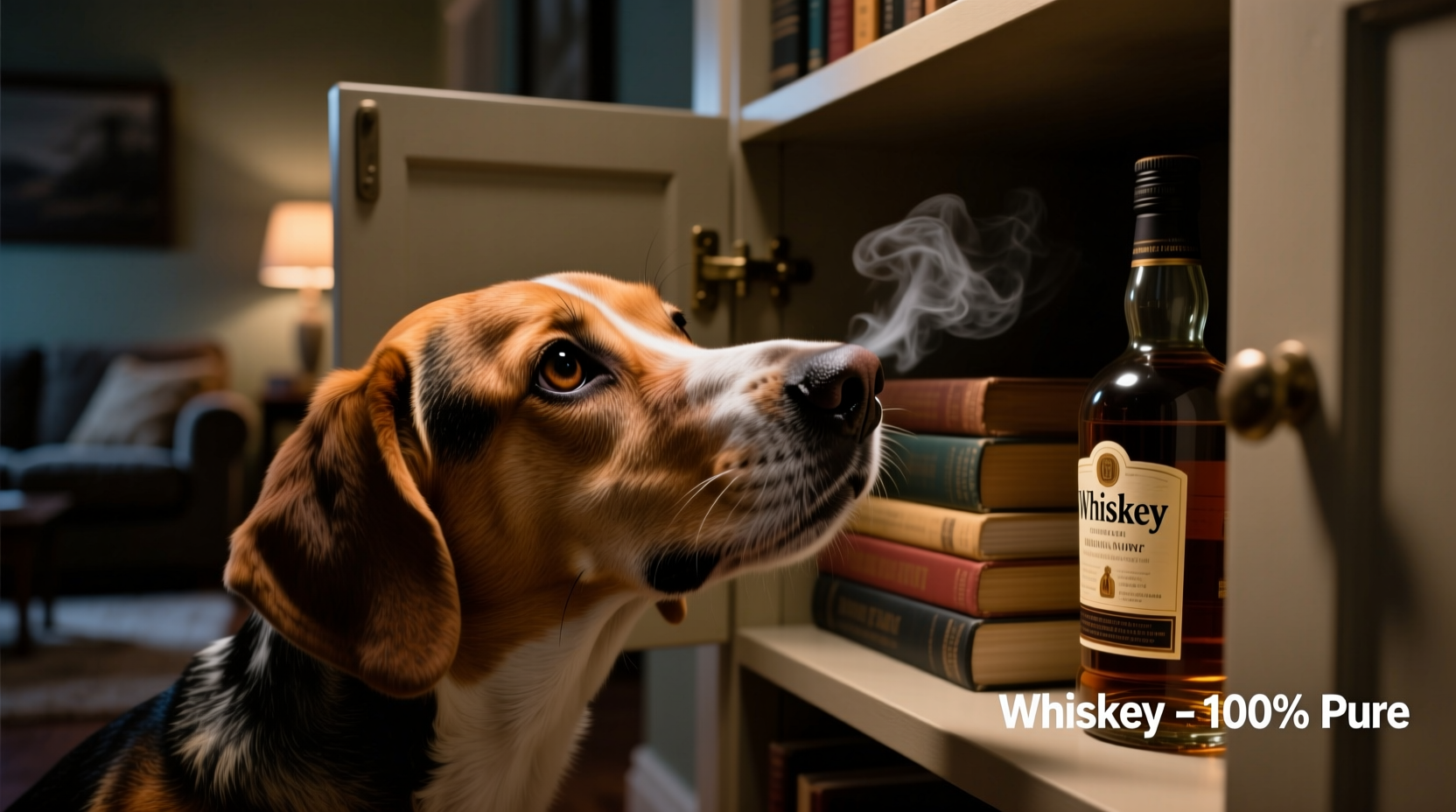
Mammalian olfaction relies on olfactory receptor (OR) genes. Humans have approximately 400 functional OR genes. Dogs have over 800; some breeds, like Bloodhounds, approach 1,200. Their nasal cavity contains up to 300 million scent receptors (versus our 6 million), and a larger portion of their brain—about 40 times more relative volume—is dedicated to processing odors. When ethanol evaporates, it releases airborne molecules that bind to these receptors. Dogs don’t just “smell alcohol”—they parse its concentration, age, source (beer vs. vodka vs. hand sanitizer), and even associated compounds like hops, congeners, or preservatives.
Cats lack the same breadth of OR genes as dogs but compensate with extraordinary sensitivity to specific volatile organic compounds—including alcohols and ketones produced during fermentation or oxidation. Their vomeronasal organ (Jacobson’s organ) further amplifies detection of pheromone-like molecules, which may include metabolites exhaled after alcohol consumption.
This isn’t speculation. In controlled studies, dogs trained to detect ethanol vapor achieved 97% accuracy identifying breath samples from individuals with blood alcohol concentrations (BAC) as low as 0.02%—well below the U.S. legal driving limit of 0.08%. Untrained pets display behavioral cues—whining, pawing, increased alertness, or sudden avoidance—when exposed to alcohol vapors, especially near spilled liquids or open containers.
Why “hiding your stash” is medically unwise—and often counterproductive
The instinct to conceal alcohol from pets usually stems from embarrassment, habit, or concern about judgment. But in practice, hiding doesn’t reduce risk—it obscures it. Alcohol is toxic to animals at very low doses. For dogs, ingestion of just 0.5 g/kg of ethanol (roughly one standard drink for a 10 kg / 22 lb dog) can cause lethargy, vomiting, ataxia, and respiratory depression. As little as 1–2 ml/kg of 40% spirits can be fatal without prompt veterinary intervention. Cats are even more vulnerable due to deficient alcohol-metabolizing enzymes (low gastric ADH activity and reduced hepatic ALDH).
Hiding alcohol in unconventional places—under couch cushions, inside snack jars, behind cereal boxes—increases accidental exposure. Pets investigate novel scents with their mouths. A curious Labrador may nose open a half-zipped tote bag containing a flask; a cat may lick residual sanitizer off a countertop where you hastily wiped your hands. The danger isn’t that they’re “catching you”—it’s that they’re encountering toxins in unpredictable contexts.
Tip: Never store alcohol in containers that resemble food or water vessels—even if sealed. Pets associate shape and location with safety. A repurposed Gatorade bottle filled with vodka is a high-risk hazard.What pets actually detect—and how they react
Pets don’t interpret alcohol odor through human social frameworks (“They’re drinking again”). They respond biologically and behaviorally:
- Dogs may exhibit increased salivation, whining, or persistent nudging—often misread as “begging.” In reality, this can signal nausea or anxiety triggered by ethanol’s irritant effect on mucous membranes.
- Cats frequently withdraw, flatten ears, or engage in excessive grooming—classic stress responses. Some hiss or swat when approached post-consumption, likely reacting to altered body chemistry, unfamiliar breath odor, or subtle changes in gait or vocal pitch.
- Birds and small mammals (e.g., rabbits, ferrets) are exceptionally sensitive to airborne ethanol. Even ambient vapor from an open bottle can cause respiratory distress in enclosed spaces.
A 2022 observational study published in Journal of Veterinary Behavior tracked 87 households with dogs and regular alcohol use. Researchers found that 68% of dogs displayed measurable behavioral shifts within 90 seconds of owner alcohol consumption—including pacing, increased proximity-seeking, or sudden vigilance. Notably, these behaviors correlated more strongly with ethanol concentration in breath than with owner mood or volume of intake—suggesting detection is sensory, not emotional inference.
“Pets aren’t judging your choices—they’re responding to biochemical signals. Ethanol alters your skin pH, breath composition, and even sweat metabolites. To them, it’s like walking into a room smelling of smoke or spoiled meat: a clear, urgent cue demanding attention.” — Dr. Lena Torres, DVM, DACVB, Veterinary Behaviorist, University of Pennsylvania School of Veterinary Medicine
Practical safety checklist: protecting pets while living realistically
You don’t need to eliminate alcohol to coexist safely with pets. You do need intentionality. Use this evidence-based checklist:
- Store all alcohol—and alcohol-containing products—in secured, pet-inaccessible cabinets. This includes mouthwash, liquid medications, cooking extracts (vanilla, almond), and hand sanitizers.
- Wipe spills immediately with unscented, pet-safe cleaners. Avoid vinegar-based solutions near cats (they dislike acetic acid), and never use bleach—its fumes react with ethanol to form chloroform.
- Never leave drinks unattended—even for “just a minute.” Dogs can lap 30 ml (1 oz) in under 5 seconds.
- Choose low-odor alternatives when possible. Opt for fragrance-free hand sanitizers (ethanol-based, not isopropanol) and avoid spritzing perfumes or colognes directly before interacting closely with pets.
- Monitor your pet’s behavior post-exposure. Lethargy, disorientation, vomiting, or slow breathing require immediate veterinary contact—even if ingestion seems unlikely.
Real-world scenario: When “hiding” backfired
Mark, a graphic designer in Portland, kept a small flask of whiskey in his work bag for “stress relief” during long freelance deadlines. He’d sip discreetly in his home office, then tuck the flask deep into a padded laptop sleeve. His 3-year-old Golden Retriever, Jasper, began following him obsessively between rooms and would sit rigidly beside the bag, nose twitching. One afternoon, Mark left the bag unzipped on the floor while taking a call. Jasper pried it open, bit through the silicone seal, and ingested ~15 ml of 40% whiskey. Within 22 minutes, he was unsteady, drooling excessively, and unable to stand. Emergency vet treatment included IV fluids, activated charcoal, and 12 hours of monitoring. Bloodwork revealed mild metabolic acidosis—fully reversible, but preventable. Mark now uses a lockbox mounted inside his desk drawer and switched to non-alcoholic herbal tonics. Jasper’s vigilance wasn’t suspicion—it was early detection of a toxin he couldn’t yet identify.
Do’s and Don’ts: Alcohol and Pet Safety
| Action | Do | Don’t |
|---|---|---|
| Storage | Use childproof latches on cabinets; store bottles upright away from edges | Leave in reusable grocery bags, backpacks, or open drawers—even “out of reach” |
| Spills & Residue | Clean with diluted hydrogen peroxide (3%) or pet-safe enzymatic cleaner | Use essential oil diffusers nearby—many oils (e.g., tea tree, eucalyptus) are toxic and mask ethanol odor without neutralizing risk |
| Post-Consumption Interaction | Wash hands thoroughly; wait 15+ minutes before close face-to-face contact | Kiss your pet or let them lick your face—saliva transfers residual ethanol and bacteria |
| Emergency Response | Call ASPCA Animal Poison Control (888-426-4435) or your vet immediately—even if symptoms seem mild | Induce vomiting unless explicitly instructed—ethanol causes rapid gastric irritation and aspiration risk |
FAQ: Addressing common concerns
Can my pet get “drunk” from smelling alcohol?
No—not from passive inhalation alone. Ethanol must be ingested or absorbed through mucous membranes (e.g., licking skin or surfaces) to cause intoxication. However, prolonged exposure to high-concentration vapors (e.g., in poorly ventilated spaces with open industrial solvents) may cause transient drowsiness or respiratory irritation in sensitive animals.
What if my pet licks hand sanitizer off my skin?
Most consumer hand sanitizers contain 60–70% ethanol or 70–95% isopropanol. A single lick delivers negligible dose—but repeated licking (e.g., during cuddling) risks toxicity. Isopropanol is especially dangerous: it metabolizes into acetone, causing rapid-onset vomiting, disorientation, and hypothermia. Rinse skin with water before petting if sanitizer was recently applied.
Are “pet-safe” alcoholic treats really safe?
No product marketed as “dog beer” or “cat wine” containing ethanol is safe. These items typically use barley grass, brewer’s yeast, or hop-free infusions—but even trace ethanol carries risk, especially for puppies, seniors, or animals with liver/kidney disease. The ASPCA explicitly advises against any intentional ethanol exposure. Flavorings like xylitol (common in “non-alcoholic” pet treats) are also highly toxic.
Step-by-step: Securing your home for alcohol safety
- Inventory: List every alcohol-containing item in your home (beverages, cleaners, cosmetics, medications).
- Relocate: Move all items to cabinets with functioning childproof latches—or install magnetic locks if your pet is latch-savvy.
- Contain: Store opened bottles in sealed, opaque containers (e.g., stainless steel flasks or amber glass carafes) rather than original packaging.
- Designate: Choose one consistent, elevated surface (e.g., kitchen island center) for temporary drink placement—never countertops, tables, or sofas.
- Sanitize: After each use, wipe surfaces with a 1:10 dilution of white vinegar and water (safe for dogs/cats) or a certified pet-safe enzymatic spray.
- Train: Teach “leave it” using positive reinforcement—not to suppress curiosity, but to build reliable impulse control around novel scents.
Conclusion: Prioritize welfare over secrecy
Hiding alcohol from pets isn’t a privacy issue—it’s a safety oversight. Their extraordinary sense of smell isn’t a surveillance tool; it’s an evolutionary adaptation honed over millennia to detect spoilage, toxins, and environmental threats. When your dog stares intently at your wine glass, they aren’t compiling evidence for a moral audit. They’re reading chemical data your own nose misses—and sometimes, sounding the earliest alarm for a hazard you haven’t yet recognized. Responsible pet ownership means accepting that our habits ripple into their world, often in ways we underestimate. You don’t need to abstain. You do need to steward your shared environment with the same care you’d apply to a toddler’s nursery: secure, predictable, and grounded in evidence. Start tonight. Check your cabinets. Wipe that counter. And next time your pet sniffs your breath with quiet intensity—pause. Thank them. Then act.
💬 Your experience matters. Have you noticed behavioral shifts in your pet after alcohol use? What safety strategies work in your home? Share your insights in the comments—your story could help another pet parent prevent an emergency.








