Alcohol consumption is a common part of adult social life—but when you return home after a drink or two, your pet may react in ways you’ve never considered. Dogs nudge your face, cats retreat abruptly, or rabbits freeze mid-hop. These aren’t coincidences. Pets possess sensory capabilities far exceeding human limits—particularly in olfaction—and alcohol’s volatile compounds are unmistakable to them. Yet few owners recognize that the scent alone can trigger physiological stress, altered interaction patterns, or even unintentional reinforcement of anxiety. This article draws on veterinary ethology, canine olfactory science, and clinical behavior observations to explain *how* pets perceive alcohol, *why* their responses vary by species and individual history, and—most importantly—what you can do to maintain trust, safety, and emotional stability in your shared environment.
How pets’ noses outperform ours—especially for alcohol detection
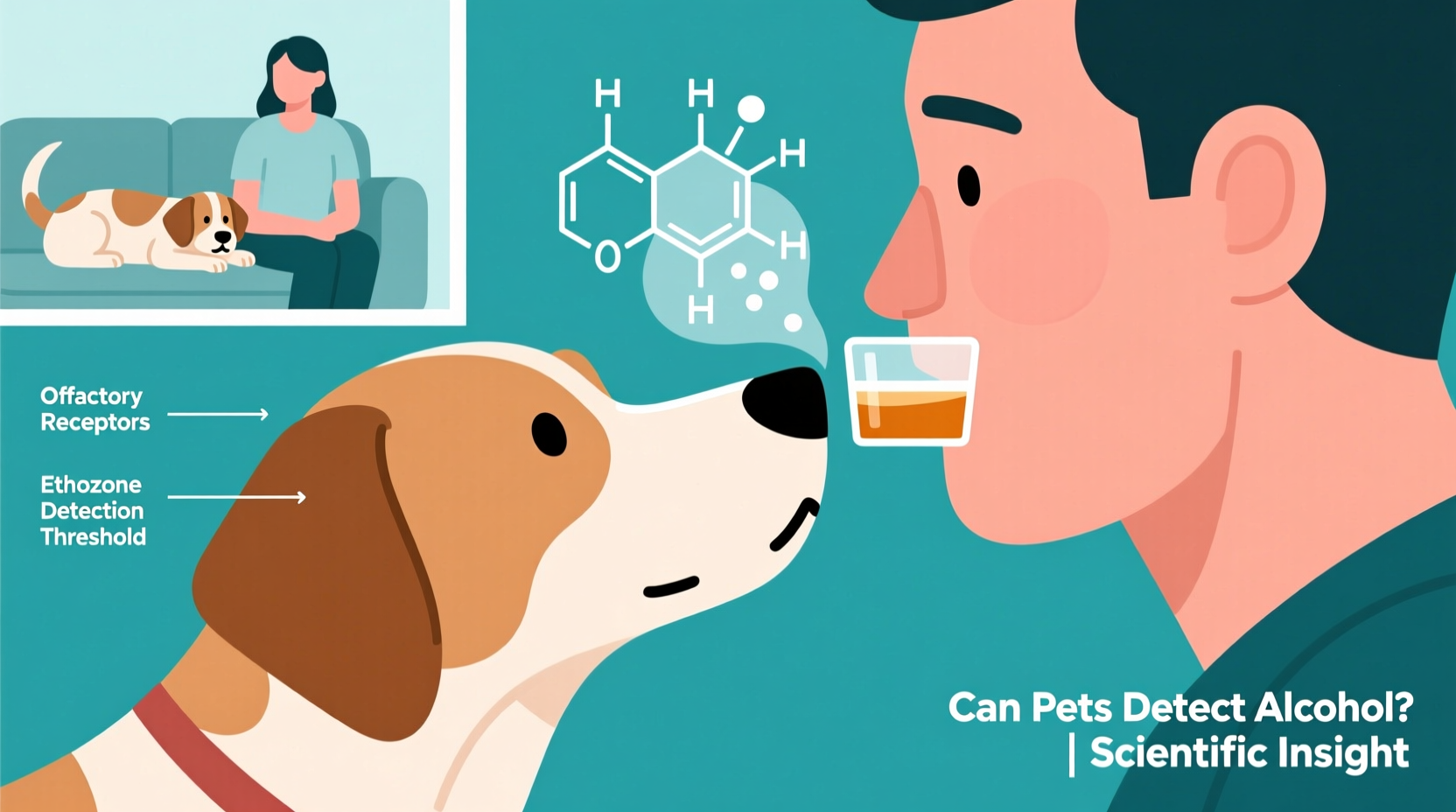
Humans have roughly 6 million olfactory receptors. Dogs? Between 220 million and 300 million—depending on breed. Bloodhounds top the scale at nearly 300 million; even a modest family terrier carries over 125 million. Cats follow closely with 45–80 million receptors, while rabbits—often underestimated—have around 100 million. Alcohol (ethanol) is highly volatile: it evaporates rapidly from saliva and mucosal surfaces, releasing distinct ester and aldehyde byproducts like acetaldehyde and ethyl acetate. These compounds carry sharp, sweet, or pungent notes easily distinguishable in complex odor matrices—even at concentrations as low as 0.001 parts per trillion.
Veterinary neurologist Dr. Lena Torres explains:
“Dogs don’t just ‘smell alcohol’—they parse its metabolic signature. Acetaldehyde, for instance, signals recent ingestion and liver processing. That’s why a dog may react more strongly to someone who’s had three drinks an hour ago versus someone who drank the same amount four hours prior. Their nose reads biochemistry, not just chemistry.” — Dr. Lena Torres, DVM, PhD, Behavioral Neurology, Cornell University College of Veterinary Medicine
This sensitivity isn’t abstract. In controlled trials, dogs reliably alerted to ethanol vapor diluted to 100 picograms per liter—equivalent to detecting one drop of alcohol in an Olympic-sized swimming pool. Their olfactory bulb occupies 40 times more relative brain volume than humans’, and scent information routes directly to the amygdala—the brain’s emotional center—bypassing conscious interpretation. For pets, alcohol on breath isn’t a neutral cue. It’s an immediate, emotionally charged signal.
Species-specific behavioral responses—and what they really mean
Not all pets react the same way—and misreading those reactions can damage your bond. Below is a comparative summary of typical behaviors across common companion species, along with their likely underlying drivers:
| Species | Common Behavior | Probable Interpretation | Risk Level |
|---|---|---|---|
| Dog | Nudging face, licking lips, whining, tail-wagging with stiff posture | Conflicted arousal: attraction to novel scent + uncertainty about owner’s altered state | Moderate (may escalate if owner responds inconsistently) |
| Cat | Avoidance, flattened ears, slow blinking, hiding, or sudden grooming | Stress displacement: scent disrupts environmental predictability; grooming masks anxiety | Low-moderate (chronic exposure may increase baseline cortisol) |
| Rabbit | Freezing, thumping hind legs, rapid breathing, refusal to approach | Prey-species alarm: ethanol mimics fermentation odors associated with spoilage or decay | High (acute stress can trigger GI stasis or cardiac events) |
| Bird (e.g., cockatiel, budgie) | Feather-picking, excessive vocalization, panting, regurgitation attempts | Hypervigilance + disrupted flock signaling: birds rely heavily on subtle chemical cues for group cohesion | High (respiratory sensitivity makes ethanol vapors potentially irritating) |
| Guinea Pig | Increased vigilance, reduced feeding, teeth chattering, huddling | Social stress response: altered scent impairs recognition of colony members and safety cues | Moderate-high (GI stasis risk similar to rabbits) |
Note: Individual temperament, early socialization, and prior experiences weigh heavily. A rescue dog who endured neglect during intoxicated episodes may exhibit fear-based aggression—not because of the scent itself, but because it predicts unpredictability. Conversely, a puppy raised in a household where moderate drinking occurred calmly may show no reaction at all.
Real-world impact: A case study from veterinary behavior practice
In spring 2023, Dr. Aris Thorne, a board-certified veterinary behaviorist in Portland, OR, treated “Mochi,” a 4-year-old neutered male Japanese Chin referred for escalating nighttime reactivity. Mochi would bark frantically between 9:30–10:00 p.m., pace, and attempt to bite his owner’s hands when she sat on the couch. Initial assessment ruled out pain, separation anxiety, and cognitive decline. Video review revealed a consistent pattern: the barking began precisely when the owner returned from her evening walk—during which she occasionally stopped for a single glass of wine at a neighborhood café.
Dr. Thorne conducted a controlled scent test using sterile gauze pads: one wiped across the owner’s cheek immediately after wine consumption, another after water-only consumption. Mochi oriented, sniffed intently, then displayed lip-licking and low whines only toward the alcohol pad—no reaction to the control. Over two weeks, the owner eliminated evening alcohol intake. Mochi’s nocturnal reactivity resolved entirely by day 11. Follow-up saliva cortisol testing confirmed a 37% average reduction in evening stress markers. As Dr. Thorne notes:
“This wasn’t ‘bad behavior.’ It was communication. Mochi wasn’t objecting to wine—he was expressing distress at the sudden, unexplained shift in his primary caregiver’s neurochemical signature. Once we restored predictability, his nervous system relaxed.”
Actionable steps to minimize disruption and support pet well-being
You don’t need to abstain—but you *can* make small, evidence-informed adjustments that honor your pet’s sensory reality. The following checklist is grounded in applied ethology and veterinary behavior guidelines:
Tip: Wait at least 20 minutes after drinking before close face-to-face contact—this allows ethanol concentration on breath to drop significantly and gives your pet time to process the change without pressure.- Hydrate and rinse: Drink water alongside alcohol and rinse your mouth thoroughly before interacting. Saliva dilution reduces volatile compound release.
- Change clothing if needed: Ethanol absorbs into fabrics. If you spilled or wore a garment while drinking, change before cuddling or sleeping near your pet—especially small mammals and birds.
- Observe body language first: Before initiating contact, pause 5 seconds. Does your pet lean in, blink slowly, or remain still? Or do they turn away, flatten ears, or tense? Let their choice guide your next move.
- Never force proximity: Pulling a cat onto your lap or holding a rabbit tightly after drinking amplifies stress. Respect withdrawal as valid communication.
- Reinforce calm alternatives: Offer a favorite chew (for dogs), a new cardboard box (for cats), or fresh hay (for rabbits) *before* you sit down—creating positive associations independent of your scent state.
What science says about long-term exposure—and when to seek help
Occasional, low-level exposure poses minimal risk for healthy adult pets. Chronic, high-concentration exposure—such as daily heavy drinking in confined spaces—is different. Studies tracking household pets in homes with alcohol use disorder (AUD) reveal measurable impacts: elevated baseline cortisol in dogs, decreased exploratory behavior in cats, and increased incidence of stress-related alopecia in guinea pigs. Critically, repeated association between alcohol scent and owner unpredictability (slurred speech, delayed responses, sudden movements) can erode secure attachment. This doesn’t mean pets develop “addiction” to alcohol scents—but they may develop conditioned anxiety responses that generalize to other stimuli.
If your pet consistently exhibits any of the following, consult a veterinarian *and* a certified veterinary behaviorist (DACVB or CAAB):
- Refusal to enter rooms where alcohol is consumed—even when owner is absent
- New onset of destructive chewing, vocalization, or inappropriate elimination linked to your drinking routine
- Physical symptoms like vomiting, diarrhea, or lethargy occurring within 1–2 hours of your alcohol consumption (rare, but possible via secondary exposure or stress-induced illness)
Importantly, these signs reflect your pet’s experience—not a moral judgment. They’re data points indicating a mismatch between environmental input and your pet’s capacity to cope. Addressing it strengthens your relationship far more effectively than ignoring it.
FAQ: Clarifying common misconceptions
Can my pet get drunk from smelling my breath?
No. Ethanol absorption through inhalation at ambient concentrations—even after heavy drinking—is negligible in pets. The blood-brain barrier and respiratory physiology prevent intoxication from passive scent exposure. However, direct ingestion (e.g., a dog drinking from a forgotten glass) is extremely dangerous and requires immediate veterinary care.
Do pets associate alcohol with punishment or danger?
Only if alcohol has been repeatedly paired with negative outcomes—like yelling, rough handling, or abandonment. In most households, pets associate the scent with mild unpredictability, not threat. But for animals with trauma histories, the link can form rapidly. Consistency in your behavior—sober or not—is the strongest predictor of their sense of safety.
Is it safe to use alcohol-based hand sanitizers around pets?
Topical use is generally safe once fully dry. However, avoid applying near your face before petting, and never use near birds or reptiles—their respiratory systems are exceptionally sensitive to airborne volatiles. For small mammals, prefer fragrance-free, ethanol-free alternatives (e.g., benzalkonium chloride-based gels).
Conclusion: Building awareness, deepening connection
Recognizing that your pet detects alcohol—not as a vague “smell,” but as a rich, biologically meaningful signal—changes everything. It transforms seemingly odd behaviors from quirks into coherent communication. It shifts responsibility from “my dog is acting up” to “my dog is telling me something important about his perception of safety.” You don’t need to eliminate alcohol to be a compassionate guardian. You simply need to acknowledge the profound asymmetry in sensory experience—and meet your pet where they are, chemically and emotionally. Start tonight: take one extra minute to rinse, observe, and respond—not to the scent, but to the being who relies on you for stability. That small act of attention reinforces trust more powerfully than any treat or toy. And when you share this understanding with fellow pet owners—whether in conversation, online, or through quiet example—you help normalize empathy rooted in science, not assumption.
💬 Have you noticed your pet reacting to alcohol—or other subtle scent changes? Share your observation in the comments. Real stories deepen our collective understanding—and might help another owner decode their pet’s silent language.








