Dogs don’t just detect alcohol—they perceive it with extraordinary sensitivity, often before humans notice a whiff of beer on breath or spilled wine on carpet. Their olfactory system is not merely more acute than ours; it operates on a different biological scale entirely. Yet while their ability to smell ethanol (the primary psychoactive compound in alcoholic beverages) is well-documented, the emotional and behavioral responses that follow are far more nuanced—and frequently misunderstood. This isn’t about dogs “getting drunk” from proximity to alcohol, nor is it simply curiosity. It’s a layered interplay of neurobiology, associative learning, evolutionary history, and individual temperament. In this article, we unpack the science behind canine olfaction of alcohol, examine real-world behavioral patterns observed by veterinarians and behaviorists, and clarify common myths—so you can respond thoughtfully when your dog reacts to alcohol in your home, car, or social environment.
How Strong Is a Dog’s Sense of Smell—Especially for Alcohol?
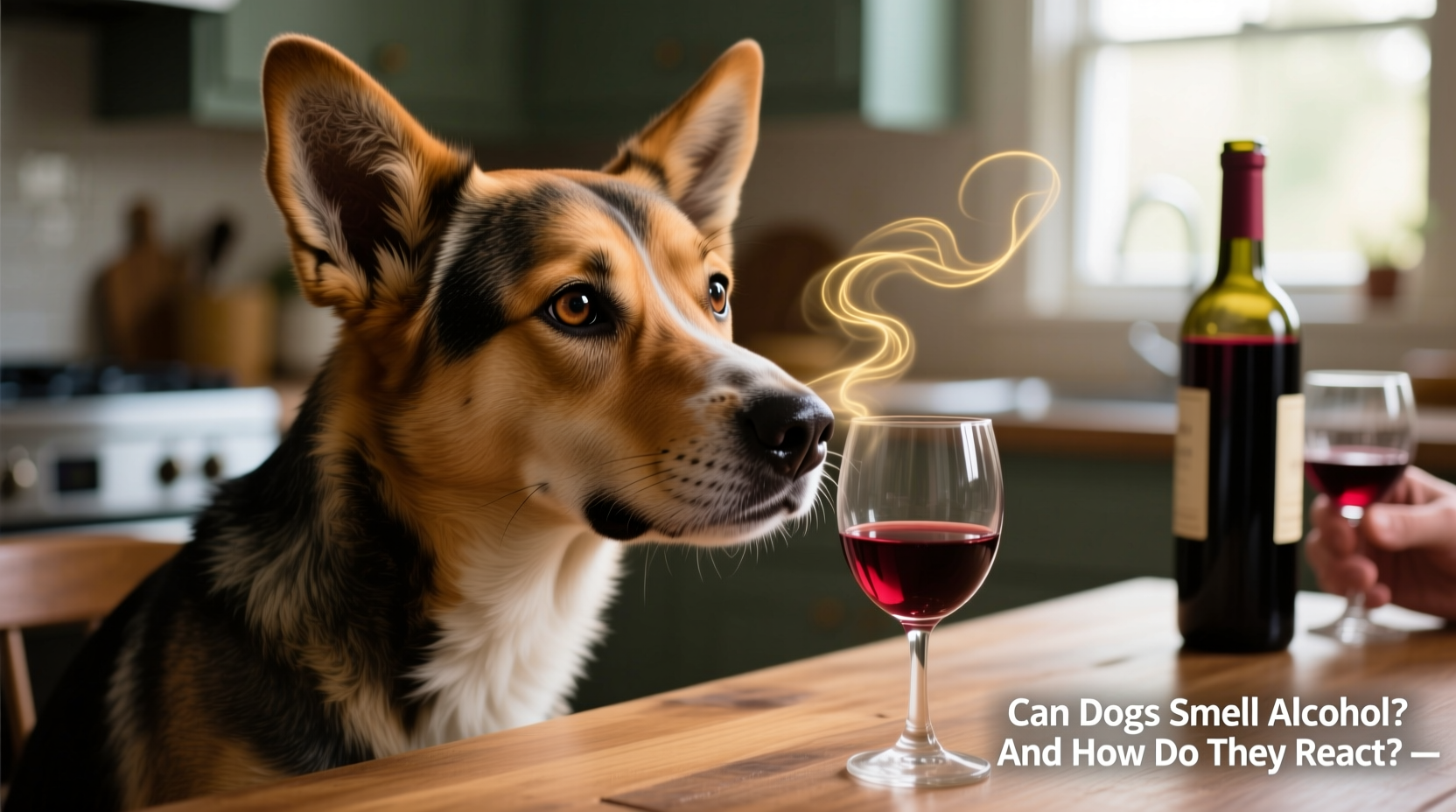
A dog’s nose contains up to 300 million olfactory receptors—compared to roughly 6 million in humans. But raw receptor count only tells part of the story. The olfactory bulb, the brain region dedicated to processing scent, is proportionally 40 times larger in dogs than in people. When it comes to volatile organic compounds like ethanol, dogs can detect concentrations as low as 1–2 parts per trillion. To put that in perspective: imagine diluting a teaspoon of alcohol into enough water to fill 20 Olympic-sized swimming pools—and your dog could still identify the presence of that single teaspoon.
Alcohol doesn’t exist in isolation in real-world settings. Ethanol emits a distinct, sharp, slightly sweet-and-pungent odor profile, but dogs also detect its breakdown products—acetaldehyde (fruity, green apple-like), esters (fruity or floral), and fusel oils (spicy, solvent-like)—which together create a complex “alcohol signature.” This multi-compound detection allows dogs to distinguish between types of alcohol: fermented beverages (beer, wine) versus distilled spirits (whiskey, vodka), and even between fresh and oxidized samples.
Importantly, dogs don’t just smell alcohol *in the air*. They detect residual traces on skin, clothing, breath, furniture, and floors—even after cleaning. A 2022 study published in Chemical Senses found that trained detection dogs reliably identified ethanol-contaminated cotton swabs exposed to human breath after consumption of just one standard drink—despite the swab being wiped and left for 90 minutes.
Tip: If you’ve consumed alcohol and plan to interact closely with your dog—especially puppies, seniors, or medically fragile dogs—rinse your mouth with water and wash your hands thoroughly. Residual scent cues can trigger unintended stress or confusion, particularly in dogs with anxiety histories.What Emotional and Behavioral Responses Do Dogs Show?
Dogs rarely display a single, universal reaction to alcohol scent. Instead, their response depends on three key variables: context, past experience, and individual neurochemistry. A dog who associates the smell of beer with weekend barbecues and relaxed play may wag and nudge a cooler. Another dog who once witnessed an intoxicated person yell or stumble may freeze, retreat, or bark defensively—even at the faintest trace.
Veterinary behaviorists categorize common responses into four evidence-based patterns:
- Investigative curiosity: Sniffing intently, head tilting, approaching slowly with loose body posture. Most frequent in confident, socially curious dogs encountering alcohol in neutral contexts (e.g., unopened bottle on counter).
- Alert vigilance: Ears forward, weight shifted, sustained gaze, tail held horizontally or slightly raised. Often seen when alcohol scent coincides with unfamiliar people, raised voices, or sudden movements.
- Anxiety displacement: Lip licking, yawning, turning away, scratching, or sniffing the floor excessively. Signals internal discomfort—not boredom or indifference.
- Protective reactivity: Stiffening, low growl, standing between owner and source, or barking sharply. Typically rooted in learned associations where alcohol preceded unpredictability or perceived threat.
Crucially, none of these responses indicate that the dog understands alcohol as a “substance” or comprehends human intoxication. They’re interpreting scent + context + past outcomes—just as they would with the smell of smoke, thunder, or a stranger’s cologne.
Do Dogs Experience “Intoxication” from Smelling Alcohol?
No. Simply smelling alcohol does not cause physiological intoxication in dogs. Ethanol must be ingested, inhaled in concentrated vapor (e.g., rubbing alcohol fumes), or absorbed through skin in significant quantities to affect the central nervous system. Casual olfactory exposure poses no toxic risk.
However, accidental ingestion remains a serious concern. Even small amounts of ethanol can cause life-threatening toxicity in dogs: vomiting, ataxia (loss of coordination), depression, hypothermia, metabolic acidosis, and respiratory failure. As little as 0.5 mL/kg of 40% ethanol (e.g., one shot of whiskey) can induce clinical signs in a 10 kg (22 lb) dog.
This distinction matters: a dog’s intense sniffing at spilled wine isn’t “enjoyment”—it’s high-fidelity data collection. And if they lick it up? That shifts instantly from sensory exploration to medical emergency.
“Dogs don’t ‘like’ the smell of alcohol any more than they ‘like’ the smell of rotting meat. They’re exquisitely tuned to biologically relevant volatiles—ethanol signals fermentation, spoilage, or human physiological change. Their reaction is functional, not hedonic.” — Dr. Lisa M. Radosta, DVM, DACVB, Board-Certified Veterinary Behaviorist
Real-World Case Study: The Weekend Host and Her Rescue Dog
Sarah, a 34-year-old graphic designer, adopted Leo, a 3-year-old mixed-breed rescue, six months before hosting her first post-pandemic dinner party. Leo had shown mild separation anxiety and was sensitive to loud noises. During the gathering, Sarah poured red wine for guests. Within minutes, Leo began pacing near the dining table, repeatedly sniffing the air, then retreating under the sofa—only to emerge and stare fixedly at Sarah’s husband, who’d had two glasses and was laughing more loudly than usual.
When a guest dropped a wine glass, Leo startled violently, then barked three times at the sound—not at the shards, but at the man who’d laughed moments earlier. Sarah assumed Leo disliked wine. But after consulting a certified behavior consultant, she realized Leo wasn’t reacting to the *scent* alone. He was responding to the *cluster*: the sharp ethanol aroma + elevated vocal pitch + increased movement speed + unpredictable laughter. For Leo, that combination mirrored past experiences with raised voices and instability.
The solution wasn’t banning alcohol—it was predictability. Sarah introduced a “calm protocol”: offering Leo a stuffed Kong before guests arrived, designating a quiet room with his bed and favorite blanket, and ensuring at least one adult remained attentive to his body language. Within three gatherings, Leo chose to nap in the quiet room rather than monitor the dining area. His emotional baseline had shifted—not because the smell changed, but because the meaning of the scent changed through consistent, safe context.
Practical Guidance: What to Do (and Not Do) When Your Dog Reacts
Understanding your dog’s reaction is only useful if paired with actionable steps. Below is a step-by-step guide grounded in applied behavior analysis and veterinary guidance:
- Observe without interference: Note exact triggers (e.g., uncorking a bottle vs. someone breathing near their face), duration of response, and physical cues (panting? trembling? tail position?). Avoid comforting or scolding mid-response—it can reinforce the behavior unintentionally.
- Remove immediate access: If alcohol is spilled or left within reach, clean thoroughly with enzymatic cleaner (not vinegar or bleach, which can leave residual odors dogs find aversive). Secure bottles and glasses out of reach—even if your dog has never shown interest before.
- Decouple scent from stress: In calm, neutral settings, briefly expose your dog to the *empty* wine glass or beer bottle (washed and dry), pairing it with low-value treats. Repeat for 30 seconds, 2x daily for one week. Goal: shift association from “potential threat” to “neutral object.”
- Manage high-risk environments: At parties, use baby gates or crates with enrichment toys. Never force interaction. If your dog hides, let them—this is a healthy coping strategy, not disobedience.
- Consult professionals early: If reactions include aggression, freezing, or self-harm (e.g., chewing paws during parties), seek help from a veterinarian and a fear-free certified trainer—not just obedience classes.
Do’s and Don’ts: Managing Alcohol Exposure Around Dogs
| Action | Do | Don’t |
|---|---|---|
| Storing alcohol | In closed cabinets above counter height; wipe spills immediately with pet-safe cleaner | Leaving open containers on low tables, countertops, or coffee tables—even “just for a minute” |
| Post-consumption interaction | Rinsing mouth, washing hands, and speaking in calm, steady tones before greeting your dog | Kneeling to hug or kiss your dog immediately after drinking—this delivers concentrated breath scent directly to their sensitive nose |
| Training response | Using positive reinforcement to build calm associations with alcohol-related objects (e.g., empty bottle + treat) | Punishing sniffing, barking, or retreating—this increases anxiety and erodes trust |
| Medical awareness | Knowing symptoms of ethanol toxicity (vomiting, disorientation, slow breathing) and having your vet’s number and nearest ER saved | Assuming “a little sip won’t hurt”��there is no safe threshold for intentional ingestion |
FAQ: Clarifying Common Misconceptions
Can dogs tell if a person is drunk—or just smelling alcohol?
They detect the *olfactory signature* of recent alcohol consumption—but cannot infer cognitive impairment. What they *do* interpret is secondary behavioral cues: slurred speech, unsteady gait, erratic movement, louder voice, or inconsistent commands. These combined signals often trigger vigilance or anxiety, especially in dogs accustomed to routine and predictability.
Why does my dog lick my lips or hands after I’ve had a drink?
Licking serves multiple functions: gathering scent information (taste reinforces smell), seeking salt or sugar residues, or attempting to “groom” you—a sign of bonding and care. However, if licking escalates to obsession or occurs alongside other stress signals (whining, pawing), it may reflect uncertainty about your altered state—not affection alone.
Are some breeds more sensitive to alcohol scent than others?
Not inherently—but working detection breeds (Bloodhounds, German Shepherds, Labrador Retrievers) have been selectively bred for olfactory stamina and focus, making them more likely to fixate on and track alcohol vapors. That said, any dog with intact olfaction—including toy breeds and seniors—can detect it. Sensitivity is less about breed and more about individual neural wiring, health status, and prior learning.
Conclusion
Dogs smell alcohol not as a novelty, but as meaningful data—a chemical whisper carrying information about human physiology, environmental safety, and social predictability. Their emotional reactions aren’t irrational; they’re adaptive, evolved, and deeply personal. Dismissing a dog’s anxious retreat as “overreaction” or misreading investigative sniffing as “curiosity” misses the nuance of their perception. What they need from us isn’t correction—but clarity, consistency, and compassionate observation. Next time you pour a glass of wine, pause for two seconds: notice how your dog watches you, how their nose twitches, how their posture shifts. That moment isn’t about alcohol. It’s about relationship. It’s about trust built across species through attention to detail most humans never perceive. Start there—and let that awareness guide your choices, your boundaries, and your care.
💬 Have you noticed your dog reacting uniquely to alcohol scent? Share your observation—including context, behavior, and how you responded—in the comments. Real experiences help others recognize patterns, reduce anxiety, and deepen mutual understanding.








