
Every year, millions of pets go missing. For dog owners, the fear of a lost pet is real—and often preventable with modern tracking technology. Today, two primary solutions dominate the market: smart collars and standalone GPS tags. While both aim to keep dogs safe, they differ significantly in design, functionality, and reliability. Choosing between them isn't just about price—it's about understanding how each system works, what it offers beyond location tracking, and which one aligns best with your dog’s lifestyle and your peace of mind.
Understanding the Basics: What Are Smart Collars and GPS Tags?
Before comparing, it's essential to clarify what each product actually is.
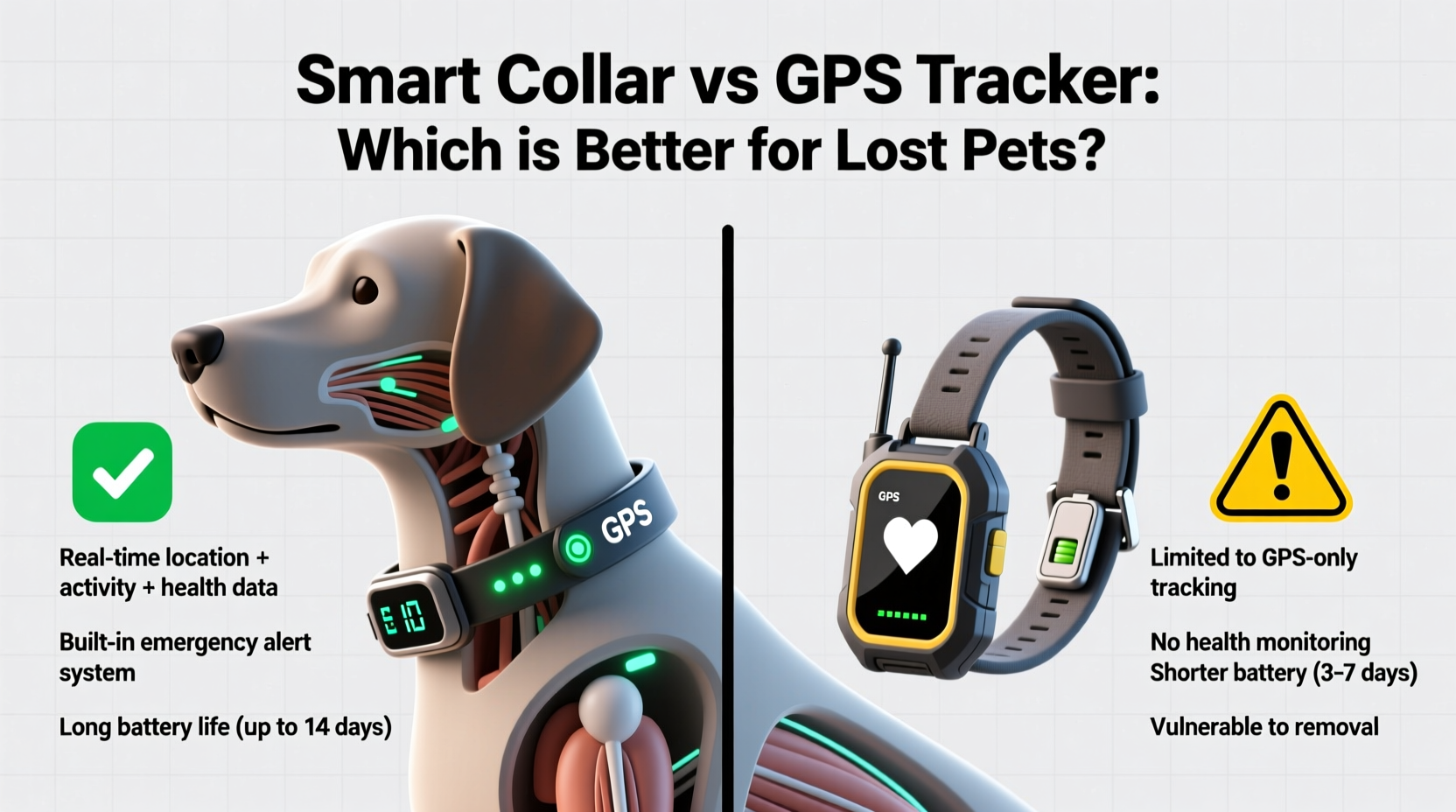
Smart collars are integrated devices built into a dog collar. They combine GPS tracking with additional features like activity monitoring, health alerts, geofencing, and sometimes even bark detection or temperature sensors. Brands like Fi, Whistle, and Link AKC offer models that sync with smartphone apps, providing real-time updates on your dog’s location and behavior.
GPS tags, on the other hand, are small, attachable devices—often resembling key fobs—that clip onto an existing collar. Examples include Trackimo, Tractive GPS, and Apple AirTag (though not specifically designed for pets). These focus primarily on location tracking using GPS, cellular networks, or Bluetooth signals.
The core difference lies in integration versus modularity. Smart collars replace your dog’s standard collar with a multifunctional unit. GPS tags are add-ons to your current setup, offering targeted tracking without overhauling your gear.
Comparing Key Features: Performance, Battery Life, and Reliability
To determine which solution is better, let’s examine five critical factors: tracking accuracy, battery longevity, connectivity, durability, and extra features.
| Feature | Smart Collars | GPS Tags |
|---|---|---|
| Tracking Accuracy | High (dual-mode GPS + Bluetooth) | Varies (AirTag struggles outdoors; cellular-based tags more reliable) |
| Battery Life | 5–14 days (non-replaceable batteries common) | 3–30 days (AirTag: ~1 year; cellular tags: 3–7 days) |
| Connectivity | Wi-Fi, Bluetooth, LTE (on premium models) | Bluetooth (AirTag), LTE (Tractive), or hybrid |
| Durability | Weather-resistant, chew-resistant materials | Smaller units may detach or break under stress |
| Additional Features | Activity tracking, health insights, escape alerts | Limited to location; no behavioral data |
From this comparison, smart collars emerge as more comprehensive tools. Their strength isn’t just in pinpointing location—it’s in offering context. A sudden spike in movement at 2 a.m. might indicate anxiety or escape behavior, allowing proactive intervention before a dog goes missing.
Tip: If your dog is a frequent escape artist, prioritize a device with geofencing and instant alert capabilities—features more consistently found in smart collars.Real-World Use Case: Finding Max the Hound
Consider the case of Sarah, owner of Max, a 3-year-old Bluetick Coonhound known for chasing scents into the woods behind her Tennessee home. One afternoon, Max slipped out through a broken fence panel. Sarah had recently attached a Tractive GPS tag to his collar. She opened the app and saw Max moving rapidly along a wooded trail 0.8 miles from home.
The tag provided location updates every 10 seconds thanks to its LTE connection, but offered no insight into why Max was running or whether he was injured. It took Sarah and a neighbor nearly 40 minutes to locate him—tired but unharmed—in a creek bed.
Had she used a smart collar like the Fi Series 3, she would have received an automatic escape alert the moment Max crossed her custom geofence. The app would also have shown his activity level, heart rate estimate (via motion algorithms), and real-time path history. This contextual data could have helped predict his trajectory and expedite recovery.
This scenario illustrates a crucial point: GPS tags answer “Where is my dog?” Smart collars begin to answer “Why did he leave, and how urgent is this?”
Expert Insight: What Veterinarians and Trainers Say
“While any tracking device is better than none, I recommend integrated smart collars for high-energy breeds or dogs with anxiety-related roaming behaviors. The ability to monitor stress patterns and receive instant alerts gives owners a strategic advantage.” — Dr. Lena Patel, DVM, Veterinary Behavior Consultant
Dr. Patel emphasizes that prevention is more effective than reaction. Devices that only activate *after* a dog is lost miss opportunities to intervene earlier. For instance, increased nighttime pacing detected by a smart collar could signal separation anxiety—a known precursor to escape attempts.
Similarly, professional dog trainer Marcus Reed notes: “I’ve seen clients rely on AirTags, only to find the tag chewed off or stuck in brush while the dog ran further. A well-built smart collar stays secure and functions as both tracker and safety gear.”
Step-by-Step: How to Choose the Right Device for Your Dog
Selecting between a smart collar and a GPS tag shouldn’t be arbitrary. Follow this practical decision-making process:
- Assess your dog’s risk profile: Is your dog prone to bolting? Do they roam in rural areas or near traffic? High-risk dogs benefit more from real-time alerts and LTE connectivity.
- Evaluate your current collar setup: Will adding a bulky tag compromise fit or comfort? Small or sensitive-necked dogs may react poorly to dangling accessories.
- Check network coverage: GPS tags relying on LTE require strong cellular service. Rural users should verify provider maps before purchasing.
- Consider battery habits: Can you remember to charge a device weekly? If not, opt for longer-lasting models or those with low-power modes.
- Determine desired features: Do you want health monitoring, social features (like pack tracking), or simple location checks? Prioritize accordingly.
- Test durability needs: For outdoor, rugged dogs, choose devices rated IP67 or higher for water and dust resistance.
- Budget for long-term use: Some services require monthly subscriptions ($10–$20). Factor this into your total cost of ownership.
When GPS Tags Make Sense (And When They Don’t)
Despite their limitations, GPS tags have valid use cases.
They’re ideal for owners who already have a trusted, comfortable collar and only want basic location backup. Apple AirTags, while not designed for pets, can work well in urban environments where Bluetooth crowdsourcing (via the Find My network) increases recovery odds. If your dog gets lost in a neighborhood with many iPhone users, an AirTag might be spotted quickly—even if it lacks GPS.
However, in rural or low-population areas, AirTags become far less effective. Without nearby devices to detect the Bluetooth signal, the tag is essentially blind. Additionally, AirTags lack waterproofing and shock resistance compared to purpose-built pet trackers.
Cellular-based GPS tags like Tractive or Garmin Delta Smart offer stronger outdoor performance but come with recurring fees and shorter battery life. They’re suitable for occasional hikers or travelers who need global coverage but don’t want to replace their entire collar system.
Tip: Never rely solely on Bluetooth-based trackers (like AirTag) for off-leash adventures in remote areas. Pair them with a GPS-enabled device for redundancy.Checklist: Essential Features to Look For
- ✅ Real-time GPS tracking with map integration
- ✅ Geofencing with push notifications
- ✅ Long battery life (minimum 5 days under normal use)
- ✅ Water and dust resistance (IP67 rating or higher)
- ✅ Secure attachment (no dangling parts, tamper-proof design)
- ✅ No contract or affordable subscription model
- ✅ Activity and health monitoring (optional but valuable)
- ✅ Offline tracking mode or last-known location storage
Common Misconceptions About Pet Tracking Devices
Several myths persist about these technologies, potentially leading to poor choices.
Myth 1: All GPS devices work the same way.
Reality: Some use satellite GPS only, others combine Wi-Fi triangulation, Bluetooth, and LTE for faster fixes. Urban canyon environments (dense buildings) can block signals—hybrid systems perform better.
Myth 2: More expensive means better.
Not always. Some premium smart collars offer social features or sleek design at the cost of battery efficiency. Focus on core functionality first.
Myth 3: Once tagged, recovery is guaranteed.
No device ensures 100% recovery. Terrain, weather, battery failure, and human error all play roles. Devices increase odds—but aren’t foolproof.
Frequently Asked Questions
Can I use an AirTag instead of a paid GPS tracker?
You can, but with caveats. AirTags work best in cities with dense Apple device networks. They don’t have GPS or cellular, so if no iPhone detects the tag, you won’t get location data. Also, Apple does not recommend AirTags for tracking animals due to lack of animal-specific design.
Do smart collars hurt my dog’s neck?
No, not when properly fitted. Most smart collars use lightweight, breathable materials similar to standard nylon or silicone collars. Ensure the collar sits snugly but allows two fingers beneath it. Avoid leaving any device on 24/7 without checking for chafing or irritation.
Is subscription pricing worth it?
For most users, yes. Subscription plans typically unlock real-time tracking, cloud storage, and emergency support. Free tiers often limit update frequency (e.g., once per hour), which is too slow during active escapes. Consider the fee as part of responsible pet ownership—comparable to insurance.
Conclusion: Which Is Better?
The answer depends on your priorities—but overall, smart collars offer superior value for most dog owners. They integrate seamlessly into daily life, provide richer data, and actively help prevent loss rather than just respond to it. Their combination of real-time alerts, behavioral insights, and durable design makes them a more holistic safety tool.
That said, GPS tags still have a place. For budget-conscious owners with low-risk dogs, or as secondary backups, they’re useful. Some professionals even recommend using both: a smart collar as the primary tracker and a Bluetooth tag as a fallback in case the main device fails.
Ultimately, the best device is the one that fits your dog’s lifestyle, your environment, and your ability to maintain it. Technology reduces risk, but vigilance, training, and secure fencing remain irreplaceable layers of protection.
🚀 Take action today: Evaluate your dog’s current collar and tracking setup. If you're relying on nothing or a single-point-of-failure device, upgrade to a system that gives you real-time awareness and peace of mind. Your dog’s next adventure doesn’t have to end in panic.








