
Retractable leashes are popular among dog owners for their convenience and flexibility. They allow pets more freedom to explore during walks while still remaining under control—on the surface. But when small children or other dogs enter the picture, that extra range can quickly turn from a benefit into a hazard. The question isn't just about whether these leashes work—it's about whether they work safely in high-risk environments.
While many pet owners use retractable leashes without incident, emergency veterinarians, trainers, and child safety advocates consistently raise concerns about their use near vulnerable individuals. Burns, entanglement, loss of control, and sudden lunges are all documented risks. Understanding when and how these dangers arise is essential for making informed decisions about your dog’s walking gear.
The Mechanics of Retractable Leashes: How They Work and Why That Matters
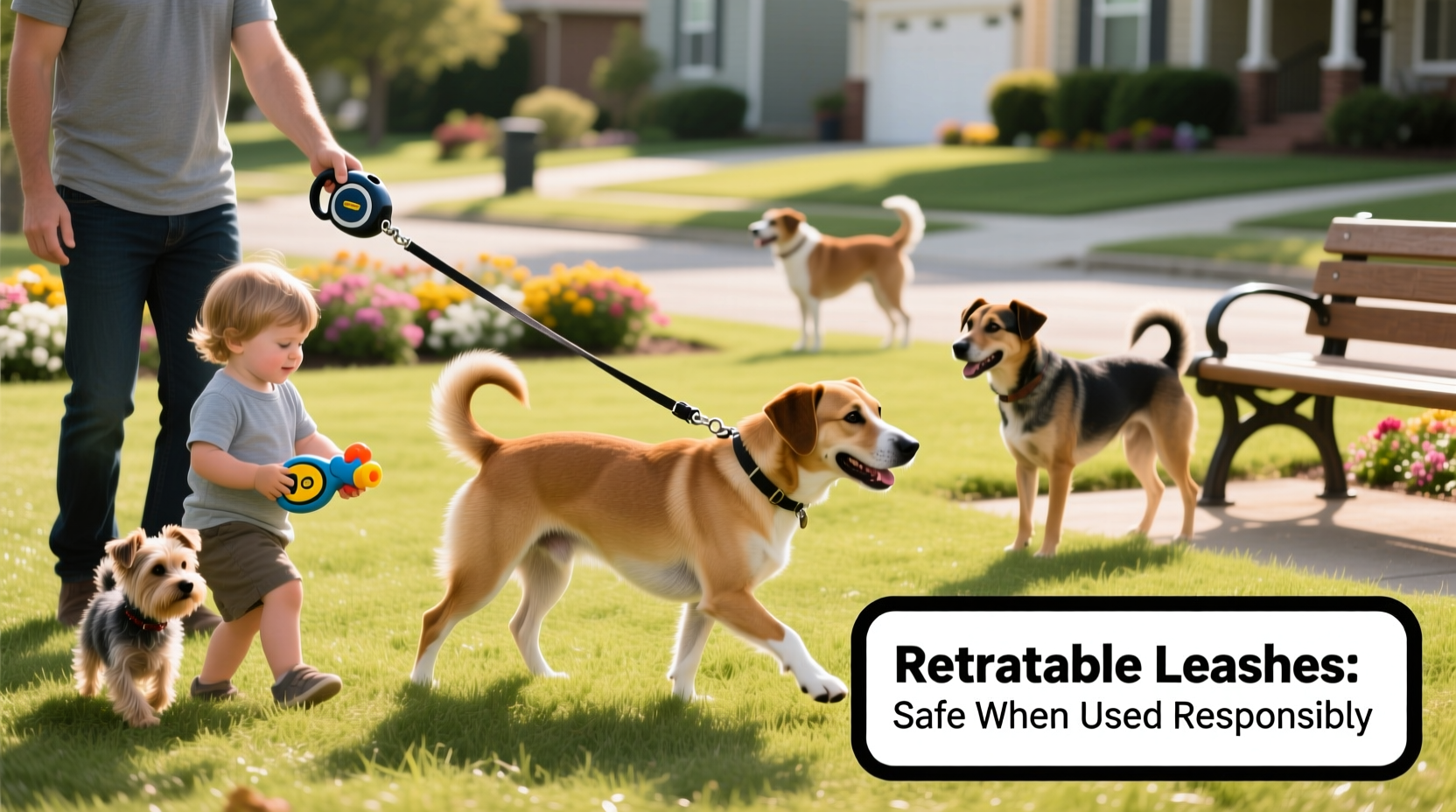
A retractable leash consists of a thin cord or tape wound inside a plastic housing with a spring-loaded mechanism. When released, the dog can move forward up to 16–26 feet, depending on the model. A brake button locks the cord in place when needed. This design allows freedom but introduces several mechanical and behavioral challenges.
The long span means the dog can reach speeds and distances that make correction difficult. If a dog suddenly bolts toward another animal or a child, the delay in reeling in the line or engaging the brake can be critical. Additionally, the cord itself—often made of nylon-coated steel or similar materials—can cause serious injury if it wraps around limbs or necks.
Unlike standard 4–6 foot fixed leashes, retractable models shift control dynamics significantly. Owners may feel less connected to their dogs, reducing their ability to anticipate behavior or enforce commands promptly.
Tip: Always keep the handle close to your body and avoid wrapping the leash around your hand, wrist, or any part of a child’s body.Risks Around Small Children: A Hidden Danger Zone
Children under the age of 10 move unpredictably. They run, squeal, wave arms, and often approach dogs without understanding boundaries. When a dog on a retractable leash has 20+ feet of range, even a momentary distraction can result in a close encounter.
One major concern is tripping. A low-to-the-ground cord can easily snag a child’s ankle, causing falls that lead to cuts, bruises, or worse. In some reported cases, children have been pulled down by excited dogs yanking on extended lines. The force generated by even a medium-sized dog at full sprint can exceed what an adult can counteract.
Burns are another real danger. If a child accidentally grabs the cord as it zips back into the housing, friction can cause severe rope burns. There are documented cases of children requiring medical treatment after grabbing a retracting line out of curiosity.
“Retractable leashes create a false sense of control. With kids nearby, that illusion can become dangerous very quickly.” — Dr. Laura Bennett, DVM and Canine Behavior Consultant
Real-Life Scenario: Playground Incident
In a suburban neighborhood park last summer, a woman walked her golden retriever using a 20-foot retractable leash. Her dog was friendly and well-trained, so she allowed him to roam slightly ahead. A 5-year-old boy ran across the path chasing a ball. The dog, excited by the movement, lunged forward just as the boy passed within three feet.
The mother reacted instantly, hitting the brake—but not before the cord snapped taut across the boy’s shins. He fell hard, scraping both knees and crying from shock. Though no permanent injury occurred, the parents filed a complaint with local authorities, and the dog owner was advised against using the leash in public spaces moving forward.
This case illustrates how even a non-aggressive dog can inadvertently cause harm when given too much range. The presence of children amplifies the risk exponentially.
Dangers Around Other Dogs: Escalation and Entanglement
Dog parks, sidewalks, and trails are common places where interactions occur. Retractable leashes complicate these encounters in multiple ways.
First, the extended length often places your dog outside your immediate control zone. If another dog approaches aggressively—or playfully—your ability to step between them or redirect your pet is severely limited. By the time you lock the line and reel it in, the situation may already be escalating.
Second, entanglement is a frequent issue. Two dogs on retractable leashes can easily wrap their cords around each other, poles, or nearby people. Once tangled, stress levels rise, space shrinks, and fights become more likely. Even experienced handlers struggle to disentangle cords calmly while managing excited animals.
Finally, the constant tension and jerking motion of a retractable leash can trigger reactivity in otherwise calm dogs. The unpredictable pull-and-release pattern mimics inconsistent handling, which some dogs interpret as anxiety-inducing or confrontational.
| Situation | Risk with Retractable Leash | Safer Alternative |
|---|---|---|
| Walking near playgrounds | Tripping hazard; sudden lunges toward children | Standard 6-foot leash |
| Encountering another leashed dog | Entanglement; delayed reaction time | Shorter leash with quick-release clip |
| Dog shows excitement or fear | Loss of control over distance | Fixed-length leash with harness |
| Crowded sidewalk or trail | Cord wraps around pedestrians or objects | Hands-free belt leash or compact model |
Expert Recommendations: What Trainers and Vets Say
Professional dog trainers overwhelmingly discourage the use of retractable leashes in dynamic environments. Their reasoning centers on predictability, control, and communication.
“Leash pressure is part of canine communication,” explains Carlos Mendez, certified professional dog trainer (CPDT-KA). “With a retractable leash, the feedback is inconsistent. One second there’s slack, the next there’s a sharp tug. Dogs don’t learn boundaries well this way.”
Veterinarians add that injuries aren’t limited to others—dogs themselves are at risk. Sudden stops at the end of a long cord can cause tracheal damage, especially in small breeds. Neck injuries, paw abrasions from dragging, and even severed fingers (in rare cases involving human contact with the cord) have been reported.
The American Veterinary Medical Association (AVMA) does not explicitly ban retractable leashes but advises caution, particularly in areas with high pedestrian traffic or young children. Many cities and parks have begun restricting or banning their use outright due to liability concerns.
Step-by-Step Guide: Transitioning Away from Retractable Leashes
If you’ve relied on a retractable leash and want to switch to a safer option, follow this gradual process:
- Assess Your Walking Environment: Identify routes with heavy foot traffic, children, or off-leash dogs. These are high-risk zones where fixed leashes are mandatory.
- Invest in a Quality Fixed Leash: Choose a 4–6 foot nylon or biothane leash. Consider a hands-free waist belt for better balance and mobility.
- Use a Front-Clip Harness: This gives you more control and reduces pulling, making short leashes easier to manage.
- Practice Loose-Leash Walking: Train your dog to walk beside you using positive reinforcement. Start in quiet areas and gradually increase distractions.
- Retire the Retractable in Public: Keep it only for controlled backyard use or large, empty fields where no people or animals are present.
- Educate Family Members: Ensure everyone who walks the dog understands why the retractable isn’t safe around kids or other pets.
When Are Retractable Leashes Acceptable?
No tool is inherently evil, but context determines safety. There are limited scenarios where a retractable leash might be used responsibly:
- Large, Open Fields: Where no children, cyclists, or other animals are present, and you maintain visual and verbal control.
- Supervised Training Drills: Some advanced recall exercises use long lines (not retractables), but those are thicker, tangle-free ropes designed for safety.
- Backyard Use: For brief supervised outdoor time, though a tie-out stake with proper padding is often safer.
Even in these situations, vigilance is key. Wind, terrain changes, and unexpected visitors can turn a safe setting hazardous in seconds.
Frequently Asked Questions
Can I use a retractable leash if my dog is well-behaved?
Even well-trained dogs can react instinctively to stimuli like squirrels, loud noises, or fast-moving children. Obedience doesn’t eliminate environmental risk. A fixed leash ensures you can intervene instantly, regardless of your dog’s temperament.
Are certain breeds more at risk with retractable leashes?
Strong, energetic breeds (e.g., Huskies, Shepherds, Labs) generate more force and are harder to stop once moving. Small dogs are also vulnerable—their necks can be injured by sudden tension—and their size makes them more likely to dart into danger unnoticed.
What should I do if someone near me uses a retractable leash around children?
Politely express concern. You might say, “I’ve read that those leashes can be risky around kids—have you considered a shorter one?” Avoid confrontation, but advocate for safety. If in a public space governed by rules, notify park staff or management if necessary.
Checklist: Safer Leash Practices for Families with Dogs and Kids
- ✅ Use only 4–6 foot fixed leashes in public spaces
- ✅ Equip your dog with a front-clip harness to reduce pulling
- ✅ Teach children to ask permission before approaching any dog
- ✅ Never wrap any leash around your hand or a child’s limb
- ✅ Practice emergency recall and redirection techniques regularly
- ✅ Avoid retractable leashes entirely at parks, schools, and playgrounds
- ✅ Supervise all interactions between dogs and children closely
Conclusion: Prioritizing Safety Over Convenience
Convenience should never outweigh safety—especially when children and animals are involved. Retractable leashes offer the illusion of freedom but often compromise control, predictability, and immediate response capability. In environments where split-second decisions matter, that trade-off can lead to preventable accidents.
Choosing a standard leash isn’t a step backward—it’s a commitment to responsibility. It strengthens communication with your dog, enhances public safety, and reflects thoughtful pet ownership. Whether you’re walking near a sandbox or passing another dog on a trail, being prepared means being in control.
💬 Your choices influence others. Share this article to help dog owners make safer decisions around children and fellow pets. Have experience with retractable leash incidents? Leave a comment and contribute to a safer community for all.








