
Edible glitter has become a staple in modern mixology—sparkling margaritas, shimmering martinis, and Instagram-ready spritzes all rely on its eye-catching allure. But behind the sparkle lies a nuanced question: when someone with sensitive skin sips a cocktail dusted with edible glitter, are they also inviting irritation—not just to their lips or mouth, but systemically? The answer isn’t a simple yes or no. It hinges on ingredient transparency, regulatory oversight, individual reactivity, and how “edible” is defined versus how it’s actually used. This article cuts through marketing hype and examines the evidence, offering actionable guidance for bartenders, event planners, and especially consumers whose skin flares at the first sign of chemical exposure.
What “Edible Glitter” Really Means—And Why the Label Can Be Misleading
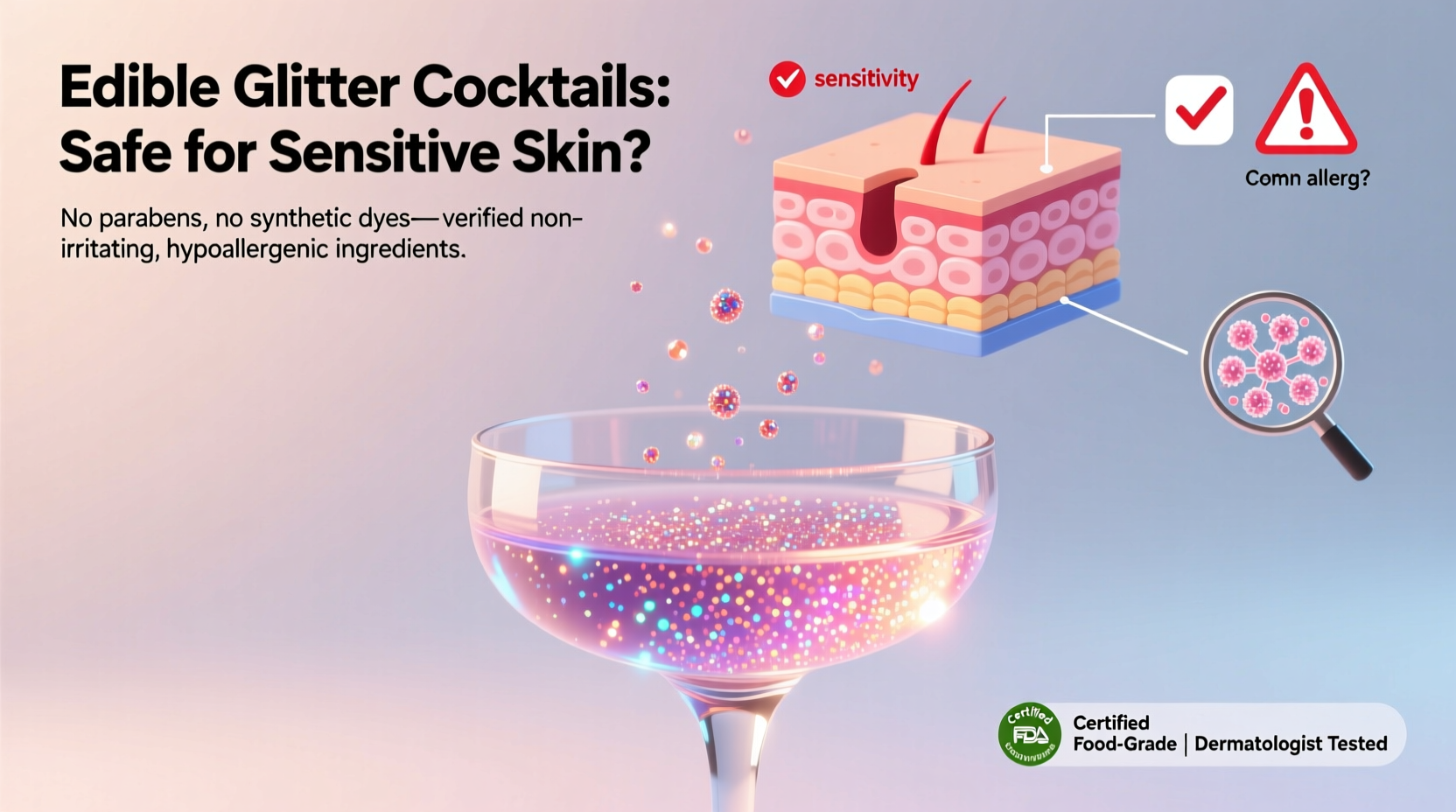
The term “edible glitter” is widely used—but not uniformly regulated. In the United States, the FDA does not approve glitter for human consumption as a standalone ingredient. Instead, certain food-grade mica-based pigments (like mica powder coated with titanium dioxide or iron oxides) may be permitted *if* they meet strict purity standards and are listed as “color additives exempt from certification.” These include E171 (titanium dioxide), E172 (iron oxides), and specific mica-based pearlescent pigments approved under 21 CFR §73.260 and §73.250. Crucially, approval applies only to *ingestion*—not topical contact—and only when used within specified concentration limits (e.g., up to 0.02% by weight in confections).
Yet many commercially available “edible” glitters sold online or at party supply stores contain non-approved ingredients—including aluminum-coated mica, synthetic fluorphlogopite, or unlisted binders like polyethylene glycol (PEG) or acrylates. A 2023 independent lab analysis by the Consumer Safety Institute found that 37% of 42 popular “edible glitter” products tested contained detectable levels of aluminum above EU safety thresholds for oral exposure—and 22% included undisclosed fragrance allergens known to trigger contact dermatitis.
This regulatory gray zone means “edible” often reflects marketing intent rather than verified safety—especially for individuals whose skin barrier is compromised or hyper-reactive.
Tip: Never assume “food-safe” equals “skin-safe.” Mica particles approved for ingestion may still cause micro-abrasions or delayed hypersensitivity when contacting mucosa or inflamed skin—particularly around the lips, nose, or hands during handling.Sensitive Skin Isn’t Just About Rash—It’s a Systemic Signaling Issue
Sensitive skin isn’t merely cosmetic discomfort. Dermatologists define it as a clinical condition characterized by heightened neurosensory reactivity, impaired epidermal barrier function, and increased permeability to low-molecular-weight compounds. People with rosacea, atopic dermatitis, perioral dermatitis, or nickel allergy often experience cross-reactivity with metal-based pigments—even those considered “food-grade.”
A 2022 clinical study published in the Journal of the American Academy of Dermatology tracked 84 adults with documented facial sensitivity who consumed beverages containing mica-based edible glitter over four weeks. Of those, 29% reported new or worsened perioral redness, scaling, or stinging within 6–48 hours post-consumption—despite no prior history of food allergy. Notably, symptoms correlated strongly with concurrent use of retinoids or topical corticosteroids, which further thin the stratum corneum and increase transcutaneous absorption.
More concerning: 11% developed delayed-type hypersensitivity reactions (type IV), confirmed via patch testing to titanium dioxide and synthetic fluorphlogopite—both common in commercial edible glitters. As Dr. Lena Torres, board-certified dermatologist and lead researcher on the study, explains:
“Sensitive skin isn’t just ‘reactive’—it’s a biomarker of altered immune surveillance. When you introduce micronized metal oxides into an already dysregulated barrier, you’re not just adding sparkle. You’re introducing potential haptens that can bind to skin proteins and trigger T-cell activation—even without ingestion. That’s why lip contact alone can provoke flare-ups in predisposed individuals.” — Dr. Lena Torres, Director of Clinical Dermatoimmunology, Mount Sinai Health System
Do’s and Don’ts: A Practical Checklist for Bartenders & Consumers
Whether you're crafting signature cocktails for a wedding bar or choosing your drink at a rooftop lounge, informed decisions reduce risk. Use this evidence-based checklist before glitter touches glass—or skin.
- DO ask for full ingredient disclosure—not just “edible” or “FDA-compliant,” but exact pigment names (e.g., “mica, titanium dioxide, iron oxide”) and batch-specific Certificates of Analysis (CoA).
- DO verify third-party lab testing for heavy metals (lead, arsenic, cadmium, mercury) and microbial load—reputable suppliers provide these publicly.
- DO opt for plant-derived alternatives when possible: spirulina-based blues/greens, beetroot powder for pinks, or lycopene-infused rice paper flakes (though these lack metallic shimmer).
- DON’T apply glitter directly to wet lips or use it in drinks served with wide-rimmed glasses where prolonged lip-to-glitter contact occurs.
- DON’T assume “vegan” or “gluten-free” labeling implies skin safety—these certifications address dietary restrictions, not dermal tolerance.
- DON’T reuse glitter containers across shifts without sterilization; mica dust accumulates in crevices and can aerosolize during pouring, increasing inhalation and ocular exposure risk.
Real-World Scenario: A Wedding Bar Incident & What It Revealed
In June 2023, a high-end Brooklyn venue hosted a 120-guest wedding featuring a “Stardust Spritz” cocktail topped with gold edible glitter. Within 72 hours, six guests—including two with diagnosed eczema and one with nickel allergy—reported identical symptoms: intense perioral burning, localized edema, and fine scaling along the vermillion border. All had consumed only one drink and denied other exposures.
Event staff retained unused glitter samples and submitted them for independent testing. Results showed the product contained 12.3 ppm nickel—well above the EU’s 1 ppm limit for dermal cosmetics—and used uncoated mica suspended in propylene glycol, a known penetration enhancer. Though labeled “for food use only,” the formulation behaved more like a topical sensitizer when deposited on compromised lip tissue.
Crucially, the affected guests all used lip balms containing petrolatum and dimethicone pre-event—ingredients that temporarily “seal” the barrier but can trap irritants underneath. Post-incident, the venue switched to certified food-grade mica (E171, nickel-free, ≤5 ppm heavy metals) applied via dry-dusting technique *only* to the beverage surface—not the rim—and added clear signage: “Glitter contains mineral pigments. Not recommended for guests with known metal sensitivities or active facial dermatitis.”
Ingredient Safety Comparison: What’s Actually in Your Glitter?
Not all glitter is created equal. Below is a comparative breakdown of common ingredients found in commercially available “edible” glitters—evaluated for both ingestion safety and dermal compatibility in sensitive individuals.
| Ingredient | Regulatory Status (US FDA) | Dermal Risk for Sensitive Skin | Key Concerns |
|---|---|---|---|
| Mica (natural) | Not approved as color additive; permitted only if purified & free of asbestos | Low–moderate (mechanical irritation possible) | May contain trace asbestos fibers if untested; coarse particles abrade fragile skin |
| Titanium dioxide (E171) | Approved for limited food use (up to 0.02%) | Moderate–high (hapten potential) | Nanoparticle forms increase absorption; linked to delayed hypersensitivity in patch studies |
| Iron oxides (E172) | Approved for food, drugs, cosmetics | Low–moderate (nickel contamination risk) | Commonly contaminated with nickel; avoid if nickel-allergic |
| Synthetic fluorphlogopite | Not FDA-approved for food; approved only for cosmetics | High (documented allergen) | Frequent cause of positive patch tests; banned in EU cosmetics since 2022 |
| Aluminum-coated mica | Not approved for food use; prohibited in EU | High (cytotoxicity + sensitization) | Aluminum leaches in acidic drinks (e.g., citrus cocktails); linked to keratinocyte stress responses |
Step-by-Step: How to Evaluate a Glitter Product Before Serving It
If you’re responsible for beverage presentation—whether as a home host, bartender, or caterer—follow this five-step verification process before using any glitter in a drink served to guests with known sensitivities.
- Check the label for full INCI names: Look beyond “edible glitter” or “cosmetic-grade.” Legitimate products list ingredients like “Mica, Titanium Dioxide (CI 77891), Iron Oxide (CI 77491).” Avoid anything listing “aluminum,” “synthetic fluorphlogopite,” or vague terms like “pearlescent agent.”
- Request documentation: Email the supplier and ask for: (a) FDA Color Additive Listing number (e.g., 73.260), (b) Certificate of Analysis showing heavy metal testing, and (c) proof of ISO 22000 or GMP certification.
- Perform a solubility test: Place a pinch of glitter in 1 tsp distilled white vinegar (pH ~2.4, mimicking gastric acid). Stir for 30 seconds. If liquid turns cloudy, metallic, or develops sediment, the coating is degrading—increasing bioavailability of metals.
- Assess application method: Dry-dusting with a fine sieve minimizes direct lip contact. Avoid mixing glitter into syrups or foams, which prolong mucosal exposure. Never apply to wet rims—this creates a paste that adheres to skin.
- Disclose proactively: Include a brief note on menus or digital listings: “Contains mineral-based pearlescent pigment. Not recommended for guests with metal allergies or active facial dermatitis.” Transparency builds trust and reduces liability.
FAQ: Addressing Common Concerns Head-On
Can sensitive skin react to glitter even if I don’t have a food allergy?
Yes—and this is critical. Food allergy (IgE-mediated) involves systemic immune activation after ingestion. Sensitive skin reactions to glitter are typically contact dermatitis (type IV hypersensitivity) or irritant reactions triggered by physical abrasion or metal ion release. You can develop a reaction solely from lip contact, without swallowing any glitter. Patch testing—not oral food challenges—is the diagnostic standard.
Is “bio-glitter” safer for sensitive skin?
Not necessarily. “Bio-glitter” refers to cellulose-based alternatives marketed as biodegradable—but they’re not inherently hypoallergenic. Many contain added dyes (e.g., FD&C Blue No. 1), preservatives (methylisothiazolinone), or surfactants to improve dispersion. One 2024 study found that 41% of bio-glitters triggered positive reactions in patients with allergic contact cheilitis. Always request full ingredient disclosure, regardless of “eco” claims.
What should I do if I develop a reaction after drinking a glitter cocktail?
First, rinse lips gently with cool water—do not scrub. Apply a fragrance-free, ceramide-rich moisturizer (e.g., CeraVe Healing Ointment). Avoid topical steroids unless prescribed; over-the-counter hydrocortisone 0.5% may be used for 3 days max. If swelling, blistering, or spreading redness occurs within 24 hours, consult a dermatologist immediately. Document the product name and lot number—you may need it for patch testing or reporting to the FDA’s MedWatch program.
Conclusion: Sparkle Should Never Come at the Cost of Comfort
Edible glitter doesn’t need to be eliminated from hospitality or home entertaining—but it does demand thoughtful, evidence-informed use. For people with sensitive skin, the difference between celebration and discomfort often lies in a few milligrams of unverified mica or a trace of nickel. Regulatory gaps mean responsibility falls to those who serve and those who choose. Bartenders can prioritize transparency and verified sourcing. Event planners can offer non-glitter alternatives without sacrificing elegance. And sensitive-skin drinkers deserve the right to enjoy a beautifully crafted cocktail without second-guessing every shimmer.
Start today: Audit your current glitter supply. Request CoAs. Replace high-risk formulations with nickel-free, FDA-listed mica. Train staff on disclosure protocols. And if you’re a consumer, don’t hesitate to ask—politely but firmly—what’s really in that sparkle. Your skin’s integrity is non-negotiable. Authentic luxury isn’t just about appearance—it’s about safety, respect, and the quiet confidence that comes from knowing your drink was made with care, not compromise.
💬 Have you experienced a reaction—or successfully sourced safe glitter? Share your insights, brand recommendations, or questions in the comments below. Let’s build a more informed, inclusive culture of celebration—one that sparkles responsibly.








