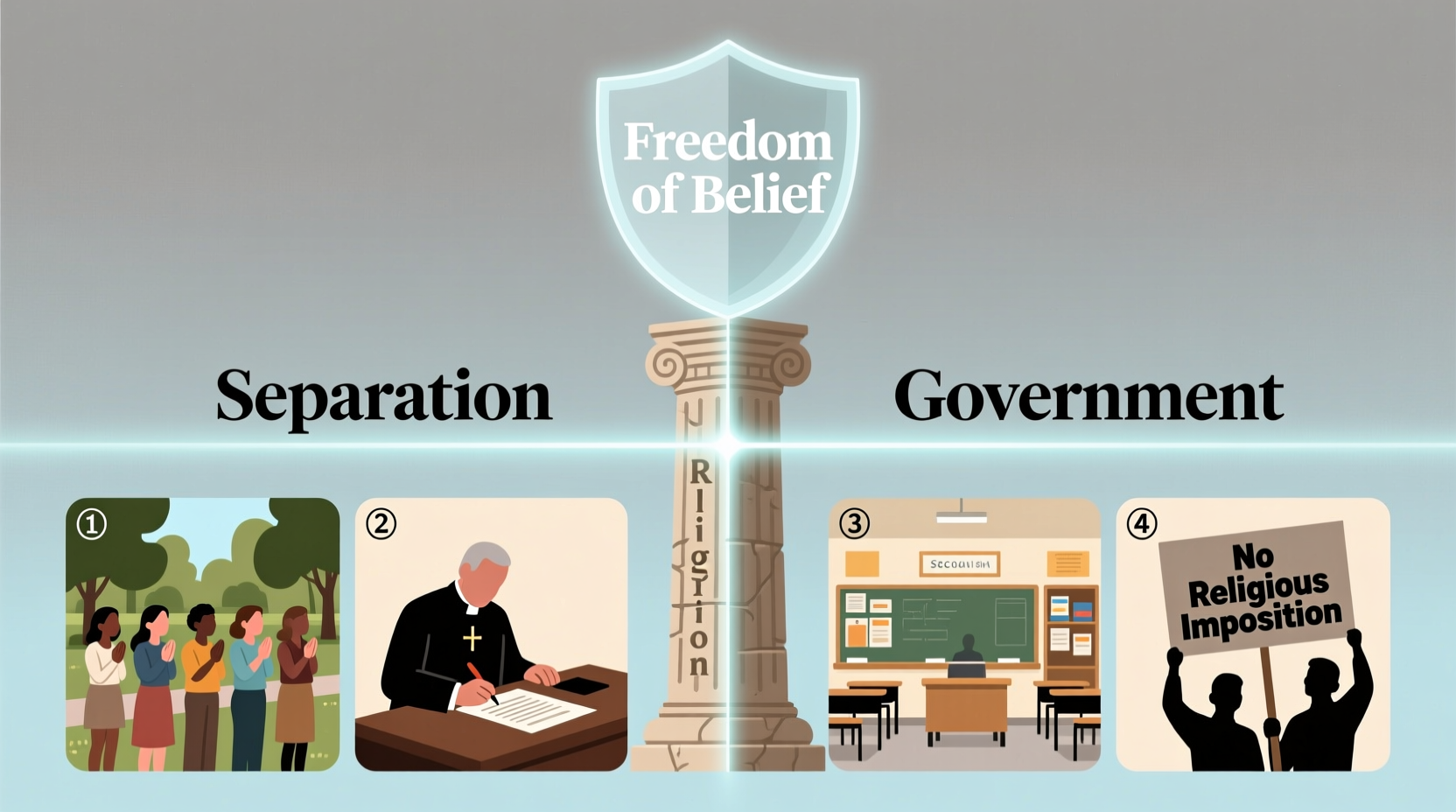
In modern democracies, few principles are as foundational—and as frequently misunderstood—as the separation of church and state. This concept does not imply hostility toward religion. Instead, it ensures that government remains neutral in matters of faith, protecting both religious freedom and civic equality. As societies grow more diverse and complex, understanding why this separation is essential becomes increasingly urgent.
The principle originated in Enlightenment thinking and was codified in the First Amendment of the U.S. Constitution: \"Congress shall make no law respecting an establishment of religion, or prohibiting the free exercise thereof.\" Yet its relevance extends far beyond American borders, influencing legal systems and public policy across liberal democracies. Below are key reasons why maintaining a clear boundary between religious institutions and governmental authority is vital for a just and functional society.
Protects Religious Freedom for All
At its core, the separation of church and state exists to safeguard individual liberty of conscience. When government aligns with a particular religion, it risks privileging one belief system over others—or over non-belief. This creates pressure on citizens to conform, either socially or legally, to dominant religious norms.
True religious freedom means individuals can practice their faith—or choose not to—without fear of discrimination or coercion by the state. For example, in countries where a single religion is officially endorsed, minority faiths often face restrictions on worship, education, or public expression. The United States’ historical commitment to disestablishment has allowed for an unprecedented diversity of religious practice, from Orthodox Jewish communities to Buddhist temples and Muslim mosques flourishing side by side.
Tip: Religious freedom is only meaningful when no single faith holds institutional power over public policy.Prevents Government Overreach and Theocracy
History offers stark warnings about what happens when religious doctrine shapes law. From medieval Europe’s Inquisition to contemporary regimes where blasphemy laws carry severe penalties, the fusion of religious authority and state power often leads to repression.
A secular government acts as a check against dogma-driven legislation. It prevents religious leaders from wielding unchecked influence over education, healthcare, or criminal justice. Consider debates over reproductive rights or LGBTQ+ protections—when religious beliefs become law without broad consensus, they infringe upon personal autonomy and civil rights.
“Government has no business telling people how to pray, and religion has no right to dictate who can marry or access medical care.” — Dr. Lena Patel, Constitutional Scholar, Georgetown University
Ensures Equal Treatment Under the Law
One of the most compelling arguments for separation is equity. A secular state treats all citizens equally, regardless of their beliefs. Public institutions—schools, courts, legislatures—must operate on principles accessible to everyone, not just those who share a specific theology.
When religious symbols, prayers, or teachings are embedded in government functions, it sends a message of exclusion to non-adherents. For instance, mandatory prayer in public schools, even if “nondenominational,” alienates students from different faiths or none at all. Similarly, allowing religious exemptions from anti-discrimination laws undermines equal protection.
| Scenario | With Separation | Without Separation |
|---|---|---|
| Public School Curriculum | Teaches evolution, history, and science based on evidence | May include creationism or religious doctrine as fact |
| Marriage Recognition | Civil unions based on legal criteria, not religious approval | Only marriages recognized by certain religions are valid |
| Healthcare Access | Patients receive care based on medical need, not moral doctrine | Hospitals deny services (e.g., contraception) due to religious affiliation |
Promotes Social Cohesion in Diverse Societies
Modern nations are increasingly pluralistic. In the U.S., over 30% of adults identify as religiously unaffiliated, while immigrant communities bring a wide array of spiritual traditions. A secular government provides a neutral platform where all voices can participate without requiring adherence to any creed.
When the state remains neutral, it fosters mutual respect. Citizens may disagree on theological matters but still agree on shared civic values like justice, fairness, and human dignity. This common ground enables cooperation across lines of faith and philosophy.
Conversely, blurring the line between religion and governance fuels division. Politicized religion often becomes a tool for marginalizing opponents, branding them as morally deficient or unpatriotic. This dynamic weakens democracy by replacing reasoned debate with ideological purity tests.
Mini Case Study: Education Policy in a Pluralist District
In 2018, a school board in a mid-sized U.S. city proposed including a daily Christian prayer over the intercom. Parents from Muslim, Hindu, atheist, and Jewish backgrounds objected, arguing it violated their children’s sense of belonging. After months of tension, the board reversed the decision and adopted a moment of silence instead—a compromise that respected all beliefs.
This case illustrates how even well-intentioned religious expressions in public institutions can fracture community trust. A secular approach—not anti-religious, but inclusive—allowed peaceable resolution and preserved educational focus.
Strengthens Democratic Accountability
Democracies rely on open debate, evidence-based policymaking, and elected officials who answer to voters—not divine mandates. When leaders claim religious justification for decisions, they insulate themselves from scrutiny. “God told me” is not a verifiable policy rationale; it shuts down discussion.
Secular governance demands transparency. Laws must be justified through reason, data, and public consent. Whether debating climate change, public health, or economic reform, decisions should reflect collective welfare, not sectarian doctrine.
Moreover, separating church and state protects religious institutions themselves. When churches or mosques become entangled in political power, they risk losing moral credibility. Their role is to guide consciences, not command armies or draft budgets. Independence allows faith communities to serve as ethical watchdogs rather than partisan players.
Tip: A healthy democracy depends on institutions that can critique power—not merge with it.Checklist: Supporting Church-State Separation in Daily Life
- Educate yourself on constitutional principles regarding religious liberty
- Advocate for inclusive policies in schools and local government
- Respect others’ beliefs without demanding public endorsement of your own
- Oppose legislation that grants special privileges based on religion
- Support organizations defending civil liberties and secular governance
- Vote for candidates who uphold neutrality in religious matters
Frequently Asked Questions
Does separation of church and state mean religion has no place in public life?
No. It means the government cannot establish or favor any religion. Individuals are free to express their faith publicly—politicians can pray privately, religious groups can advocate for causes—but laws must be grounded in secular reasoning applicable to all citizens.
Isn’t America a “Christian nation”?
While many early settlers were Christian, the Founding Fathers deliberately rejected establishing a national religion. Thomas Jefferson coined the phrase “wall of separation” to describe the First Amendment’s intent. Official documents like the Treaty of Tripoli (1797) explicitly state: “The Government of the United States is not, in any sense, founded on the Christian religion.”
Can religious people still influence policy?
Absolutely. People of faith contribute to public discourse just like anyone else. They may argue for policies based on moral values derived from religion. However, for a law to be legitimate in a pluralistic society, its justification must appeal to shared civic principles, not solely to religious doctrine.
Conclusion: A Principle Worth Defending
The separation of church and state is not an attack on religion—it is a defense of both faith and freedom. It allows belief to flourish without corruption by power, and ensures governance remains accountable, inclusive, and rational. In an age of rising polarization, this boundary is not outdated; it is more necessary than ever.
From classrooms to courtrooms, from marriage licenses to medical ethics, keeping religion and government distinct protects the rights of the devout and the non-religious alike. It upholds the promise that no citizen will be advantaged or disadvantaged because of what they do or do not believe.
💬 What role should religion play in public life? Share your thoughts and help foster a respectful, informed conversation about one of democracy’s most enduring principles.