
Tesla stock (TSLA) has experienced a sharp decline in trading today, sparking concern among investors and analysts alike. After opening lower and continuing to trend downward, shares are down over 6% at midday—erasing billions in market capitalization. While volatility is not uncommon for Tesla, the magnitude of this drop raises questions about underlying causes. This article provides a detailed breakdown of the primary drivers behind today’s selloff, supported by expert insights, market data, and broader economic context.
1. Q3 Vehicle Delivery Numbers Missed Expectations
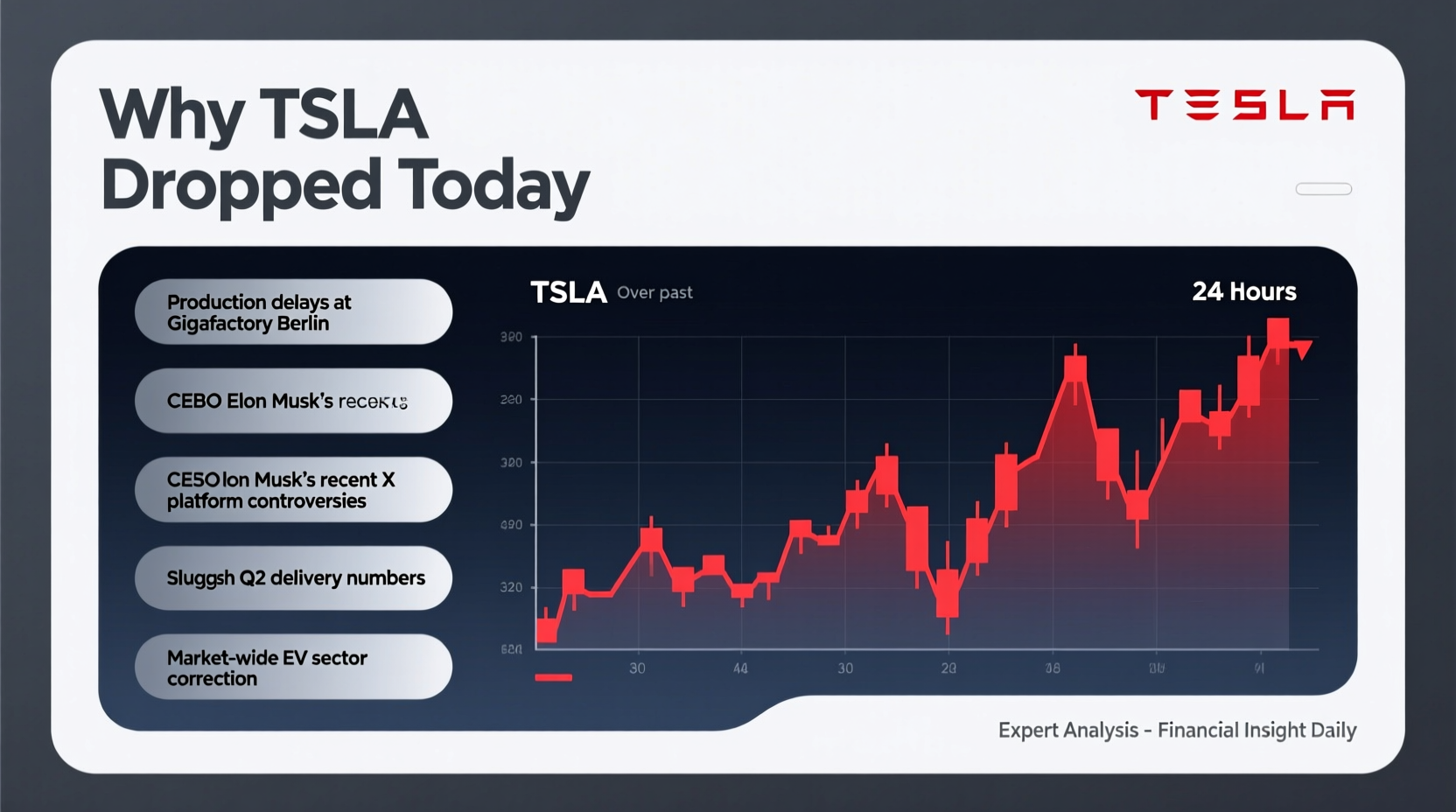
The most immediate catalyst for Tesla’s stock decline is its latest quarterly vehicle delivery report. For Q3 2024, Tesla delivered approximately 465,777 vehicles globally—a figure that falls short of analyst expectations of around 490,000 units. This marks the second consecutive quarter of declining deliveries and represents a year-over-year growth rate of just 3.6%, significantly below historical trends.
Notably, production of the Model Y and Model 3 declined due to factory upgrades at Gigafactory Shanghai and reduced demand in China and Europe. Meanwhile, ramp-up delays for the Cybertruck continue to limit high-margin revenue opportunities.
Tip: Always review Tesla's official delivery reports within 24 hours of release—market reactions are often swift and sustained.2. Rising Competitive Pressure in the EV Market
Tesla no longer dominates the electric vehicle landscape as it once did. Legacy automakers like Ford, Hyundai, and Volkswagen have launched compelling EVs with competitive pricing and improved range. Additionally, Chinese manufacturers such as BYD and NIO are gaining global traction with lower-cost models and faster innovation cycles.
BYD recently reported Q3 deliveries exceeding 300,000 units—surpassing Tesla in total EV sales when including plug-in hybrids. This shift signals growing competition in price-sensitive markets where Tesla’s premium positioning may be a liability.
Analysts note that Tesla’s average selling price (ASP) has declined by nearly 12% year-to-date due to aggressive price cuts aimed at boosting volume. However, these cuts have pressured margins without delivering proportional increases in demand.
“Tesla’s pricing strategy is now reactive rather than proactive. They’re fighting to maintain share in a market they helped create but no longer control.” — Sarah Chen, Senior Equity Analyst at Morningstar
3. Macroeconomic Headwinds and Interest Rate Environment
Broad market conditions are also contributing to Tesla’s downturn. The Federal Reserve has maintained higher interest rates through 2024 to combat persistent inflation, making auto loans more expensive. Higher borrowing costs disproportionately affect big-ticket purchases like electric vehicles, which often rely on financing.
Additionally, rising Treasury yields have made bonds and other fixed-income assets more attractive compared to high-growth, high-volatility stocks like Tesla. As a result, many institutional investors are rotating out of tech-heavy portfolios and into value sectors.
| Economic Indicator | Current Value | Impact on Tesla |
|---|---|---|
| Federal Funds Rate | 5.25%–5.50% | Reduces consumer EV affordability |
| 10-Year Treasury Yield | 4.62% | Makes growth stocks less appealing |
| U.S. Auto Loan APR (avg) | 7.1% | Discourages large vehicle purchases |
| CPI Inflation (YoY) | 3.7% | Limits Fed rate cuts in near term |
4. Leadership Concerns and Strategic Uncertainty
Investor unease has also been fueled by recent leadership changes and unclear timelines for next-generation products. Elon Musk’s increasing focus on other ventures—such as SpaceX, xAI, and X (formerly Twitter)—has raised questions about his availability and strategic attention on Tesla.
In August, Tesla announced the departure of key executives overseeing energy products and autonomous driving. Furthermore, the highly anticipated $25,000 compact car remains delayed, with no confirmed launch date beyond “2025.” Without a clear roadmap for mass-market expansion, investors are questioning Tesla’s long-term growth engine.
Autopilot and Full Self-Driving (FSD) updates have also faced regulatory scrutiny. The National Highway Traffic Safety Administration (NHTSA) expanded its investigation into FSD-related crashes last week, increasing legal and reputational risk.
Mini Case Study: The Investor Reaction Timeline
Consider the case of Maya Thompson, a portfolio manager at a mid-sized growth fund. On Monday morning, she held a 2.3% position in Tesla based on projected FSD monetization and Cybertruck scaling. By Tuesday afternoon, after reviewing the delivery miss and NHTSA update, she reduced her position by 60%.
“We still believe in Tesla’s technology,” she explained, “but the execution risks are piling up. When growth slows and leadership appears distracted, we have to reprice the risk.” Her decision mirrored that of several institutional holders, amplifying the sell-off.
5. Technical Indicators Signal Bearish Momentum
From a trading perspective, Tesla’s chart shows bearish technical patterns emerging. The stock has broken below its 200-day moving average ($248.50), a level many algorithmic and passive funds use as a sell signal. Volume today is nearly double the 30-day average, indicating strong distribution by large sellers.
Short interest in Tesla has risen to 4.3% of float—the highest level since early 2023—suggesting increased bearish sentiment. While not yet a short squeeze candidate, any further negative news could trigger additional downside.
Checklist: What Investors Should Monitor Next
- 🔍 Upcoming Q3 earnings call (scheduled for October 18, 2024) for margin guidance and product timelines
- 🚦 Regulatory developments on FSD and Autopilot from NHTSA and EU safety boards
- 📊 Monthly production and delivery reports—watch for signs of recovery in China and Europe
- 🔋 Progress on 4680 battery cell yield rates and structural pack integration
- 🌐 Expansion of charging network compatibility with non-Tesla EVs under the new U.S. infrastructure program
FAQ: Common Questions About Tesla’s Stock Drop
Is Tesla still profitable despite the stock drop?
Yes. Tesla remains profitable on a net income basis, though margins have contracted. In Q2 2024, gross margin fell to 17.6% from 19.3% the prior year, primarily due to price cuts and inflationary pressure on raw materials like lithium.
Should I buy Tesla stock now that it’s cheaper?
This depends on your investment horizon and risk tolerance. Long-term bulls cite Tesla’s brand strength, Supercharger network, and AI potential. However, near-term risks—including competition, execution challenges, and valuation—are real. Dollar-cost averaging may be a prudent approach rather than timing the bottom.
How does Tesla’s valuation compare to peers?
As of today, Tesla trades at approximately 65x forward earnings, significantly higher than legacy automakers (GM at 5x, Ford at 7x) and even some EV-focused peers like Rivian (20x). This premium assumes continued high growth, which the current delivery data does not support.
Conclusion: Navigating Volatility with Informed Strategy
Tesla’s stock decline today reflects a confluence of operational, competitive, and macroeconomic pressures. While the company remains a leader in EV innovation, its ability to sustain past growth rates is being challenged. Investors must weigh technological promise against tangible execution and evolving market dynamics.
Rather than reacting emotionally to daily swings, consider evaluating Tesla based on long-term fundamentals: battery advancements, software monetization, global manufacturing scalability, and leadership focus. The road ahead may be bumpier than expected—but informed investors can navigate it with clarity and confidence.
💬 What do you think is the biggest threat to Tesla’s future growth? Share your thoughts in the comments below—let’s discuss the real drivers shaping the EV revolution.