
Nature’s palette is vast, yet one color dominates the plant world: green. From towering oaks to tiny mosses, most plants wear a green hue so consistently it feels almost automatic. But why exactly do leaves look green? The answer lies not in artistry but in biology—specifically, in a remarkable molecule called chlorophyll. This pigment is central to life on Earth, enabling plants to harness sunlight and form the foundation of nearly every food chain. Understanding chlorophyll reveals more than just a color; it uncovers the mechanics of energy conversion that sustain ecosystems.
The Role of Light and Color Perception
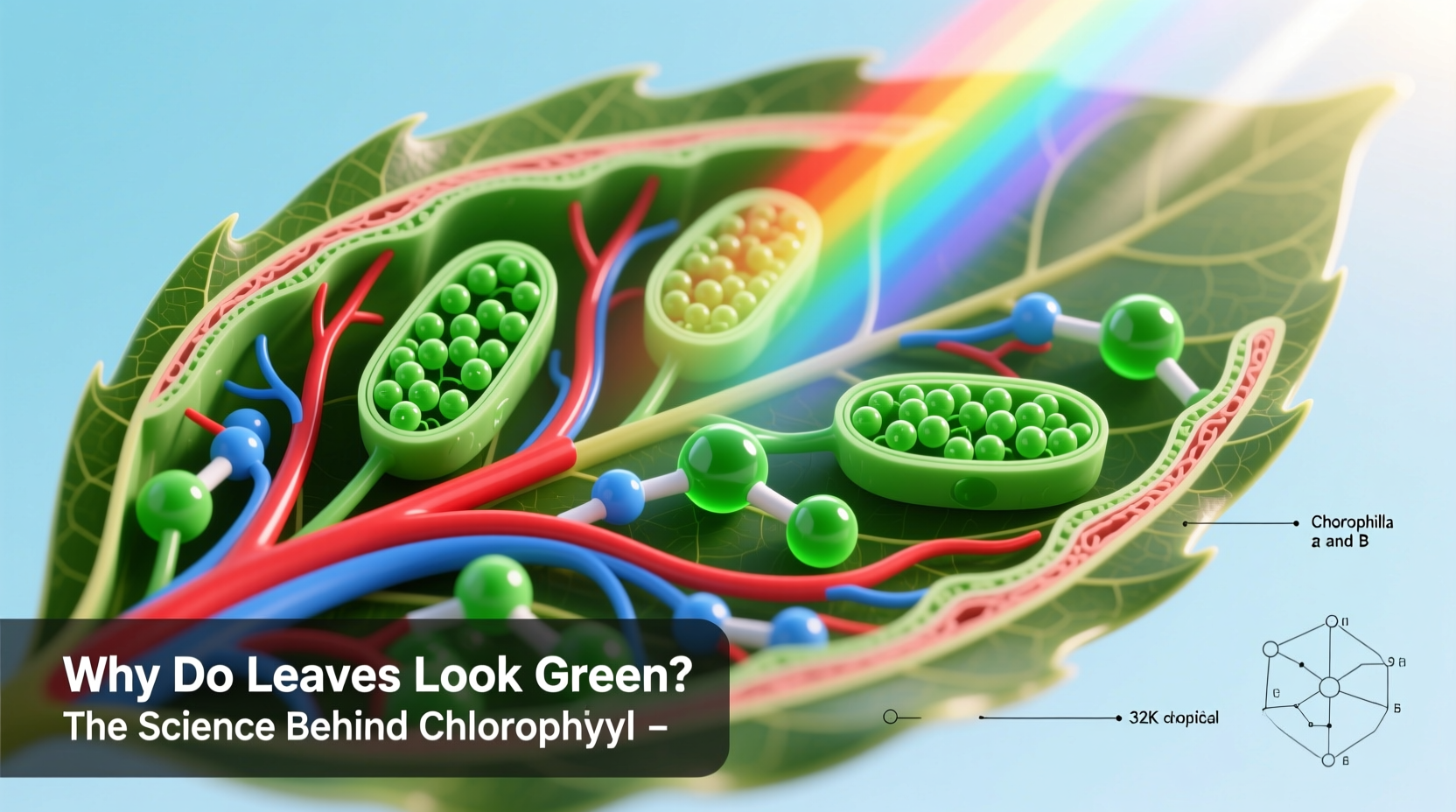
To understand why leaves appear green, we must first explore how human vision interacts with light. Sunlight appears white, but it contains a spectrum of colors, each corresponding to a different wavelength. When sunlight strikes an object, some wavelengths are absorbed while others are reflected. Our eyes detect the reflected wavelengths, which determine the color we perceive.
In the case of leaves, they absorb most wavelengths of visible light—especially blue and red—but reflect green light. This reflection is what our eyes register, making the leaf appear green. It may seem counterintuitive that plants don’t absorb green light, given its abundance in sunlight. However, this quirk is tied to the molecular structure of chlorophyll and the evolutionary path plants have taken.
Tip: Observe leaves under different lighting conditions—early morning or late afternoon sunlight can make their green tones appear richer due to changes in spectral composition.Chlorophyll: The Engine of Photosynthesis
Chlorophyll is not a single compound but a family of closely related pigments. The two primary forms in most green plants are chlorophyll a and chlorophyll b. Both are embedded in the thylakoid membranes of chloroplasts—the specialized organelles where photosynthesis occurs.
These pigments share a similar structure: a porphyrin ring with a magnesium ion at its center. This structure is ideal for capturing light energy. When a photon of light hits chlorophyll, it excites an electron, initiating a chain reaction that ultimately converts carbon dioxide and water into glucose and oxygen—a process known as photosynthesis.
Chlorophyll a is the primary driver of the light-dependent reactions, while chlorophyll b acts as an accessory pigment, broadening the range of light wavelengths the plant can use. Together, they maximize energy absorption from the sun, particularly in the blue (around 430–450 nm) and red (around 640–680 nm) regions of the spectrum.
“Chlorophyll is nature’s solar panel—efficiently converting light into chemical energy with minimal waste.” — Dr. Lena Patel, Plant Biochemist, University of California
Why Green? The Evolutionary Puzzle
If chlorophyll absorbs blue and red light so effectively, why does it reflect green? Scientists have long debated this question. One theory suggests that early photosynthetic organisms evolved in aquatic environments where blue-green light penetrated deeper into water. Over time, chlorophyll adapted to capture those available wavelengths efficiently.
Another hypothesis proposes that reflecting green light may actually be protective. Sunlight carries intense energy, especially in the green spectrum. By reflecting rather than absorbing green light, plants may avoid photodamage during peak daylight hours. This would represent a trade-off between energy capture and cellular protection.
Interestingly, not all photosynthetic organisms rely solely on chlorophyll. Algae and cyanobacteria use additional pigments like phycocyanin (blue) and carotenoids (orange/yellow), allowing them to thrive in diverse light conditions. Yet in terrestrial plants, chlorophyll remains dominant—proof of its evolutionary success despite its apparent inefficiency in using green light.
Pigment Dynamics Across Seasons
The green dominance of leaves isn’t constant throughout the year. In temperate climates, autumn brings dramatic color shifts as chlorophyll breaks down. As days shorten and temperatures drop, trees begin to reabsorb valuable nutrients from their leaves, including nitrogen and magnesium from chlorophyll molecules.
Once chlorophyll degrades, other pigments become visible. Carotenoids, which were always present but masked by green, produce yellow, orange, and brown hues. Anthocyanins, synthesized in fall, contribute vibrant reds and purples. These colors aren’t just decorative—they may protect leaves from excess light during nutrient recovery or deter pests.
This seasonal transformation underscores that greenness is not inherent to leaves themselves, but a temporary state dictated by chlorophyll activity and environmental cues.
| Pigment Type | Color Absorbed | Color Reflected | Function |
|---|---|---|---|
| Chlorophyll a | Blue, Red | Green | Primary photosynthesis driver |
| Chlorophyll b | Blue, Orange-Red | Yellow-Green | Supports light harvesting |
| Carotenoids | Blue, Green | Yellow, Orange | Photoprotection, accessory absorption |
| Anthocyanins | Green, Blue | Red, Purple | Stress response, UV protection |
Practical Insights: Observing Chlorophyll in Action
You don’t need a laboratory to witness chlorophyll at work. Simple experiments can reveal its properties and behavior:
- Leaf chromatography: Crush a green leaf in alcohol (like rubbing alcohol) and place a strip of coffee filter in the liquid. Over time, you’ll see distinct bands of color separate—proof of multiple pigments coexisting in one leaf.
- Light exposure test: Cover part of a leaf with aluminum foil for several days. Upon removal, the covered area will appear pale or yellow, showing that chlorophyll production requires light.
- Water spinach experiment: Place stems of spinach or lettuce in water near a sunny window. After a few hours, observe bubbles forming—these are oxygen molecules released during active photosynthesis.
Mini Case Study: Urban Trees and Light Pollution
In cities, artificial lighting extends beyond sunset, affecting tree physiology. A 2022 study in Berlin observed that linden trees exposed to streetlights retained their leaves up to three weeks longer than those in darker areas. The prolonged light exposure delayed chlorophyll breakdown, disrupting natural dormancy cycles. While this extended greenness might seem beneficial, it left trees more vulnerable to early frosts. This real-world example illustrates how deeply chlorophyll regulation is tied to natural light rhythms—and how human activity can unintentionally alter plant biology.
Frequently Asked Questions
Can plants survive without chlorophyll?
Most plants cannot survive without chlorophyll, as it is essential for photosynthesis. However, some parasitic plants like dodder (Cuscuta) lack chlorophyll and survive by extracting nutrients from host plants. These exceptions prove the rule—chlorophyll is indispensable for independent plant life.
Do all green plants have the same type of chlorophyll?
No. While most land plants contain chlorophyll a and b, other organisms differ. Marine algae often contain chlorophyll c or d, and certain bacteria use bacteriochlorophyll, which absorbs infrared light. These variations allow life to exploit diverse ecological niches.
Is chlorophyll good for human health?
Chlorophyll supplements are marketed for detoxification and anti-inflammatory effects, though scientific evidence remains limited. Structurally similar to human hemoglobin, chlorophyll has shown potential in animal studies for wound healing and odor reduction. However, consuming leafy greens provides chlorophyll naturally along with fiber, vitamins, and antioxidants.
Conclusion: Embracing the Green Principle
The green of leaves is far more than a visual trait—it’s a signature of life-sustaining chemistry. Chlorophyll transforms sunlight into nourishment, powers ecosystems, and even influences climate by sequestering carbon. Recognizing the science behind this everyday color deepens our appreciation for the quiet, continuous work happening in every leaf around us.
Next time you walk through a forest or glance at a houseplant, remember: that green isn’t just a color. It’s a sign of energy conversion, evolutionary refinement, and biological resilience. By understanding chlorophyll, we gain insight into the delicate balance that supports life on Earth—and a stronger motivation to protect the green world that sustains us all.
💬 What fascinates you most about plant biology? Share your thoughts or observations about seasonal leaf changes, gardening insights, or photosynthesis experiments—you might inspire someone else to look closer at the green world.