
The tomato hornworm (Manduca quinquemaculata) is one of the most destructive pests in home vegetable gardens, particularly targeting tomatoes, but also attacking peppers, eggplants, and other members of the nightshade family. Recognizing this insect at each stage of its development is essential for effective garden management. Understanding its life cycle allows gardeners and small-scale farmers to intervene at the most vulnerable points, reducing plant damage and avoiding unnecessary pesticide use. This detailed guide outlines the four primary stages in the development of a tomato hornworm—egg, larva (caterpillar), pupa, and adult moth—and provides practical insights into identification, ecological impact, and sustainable control strategies.
Definition & Overview
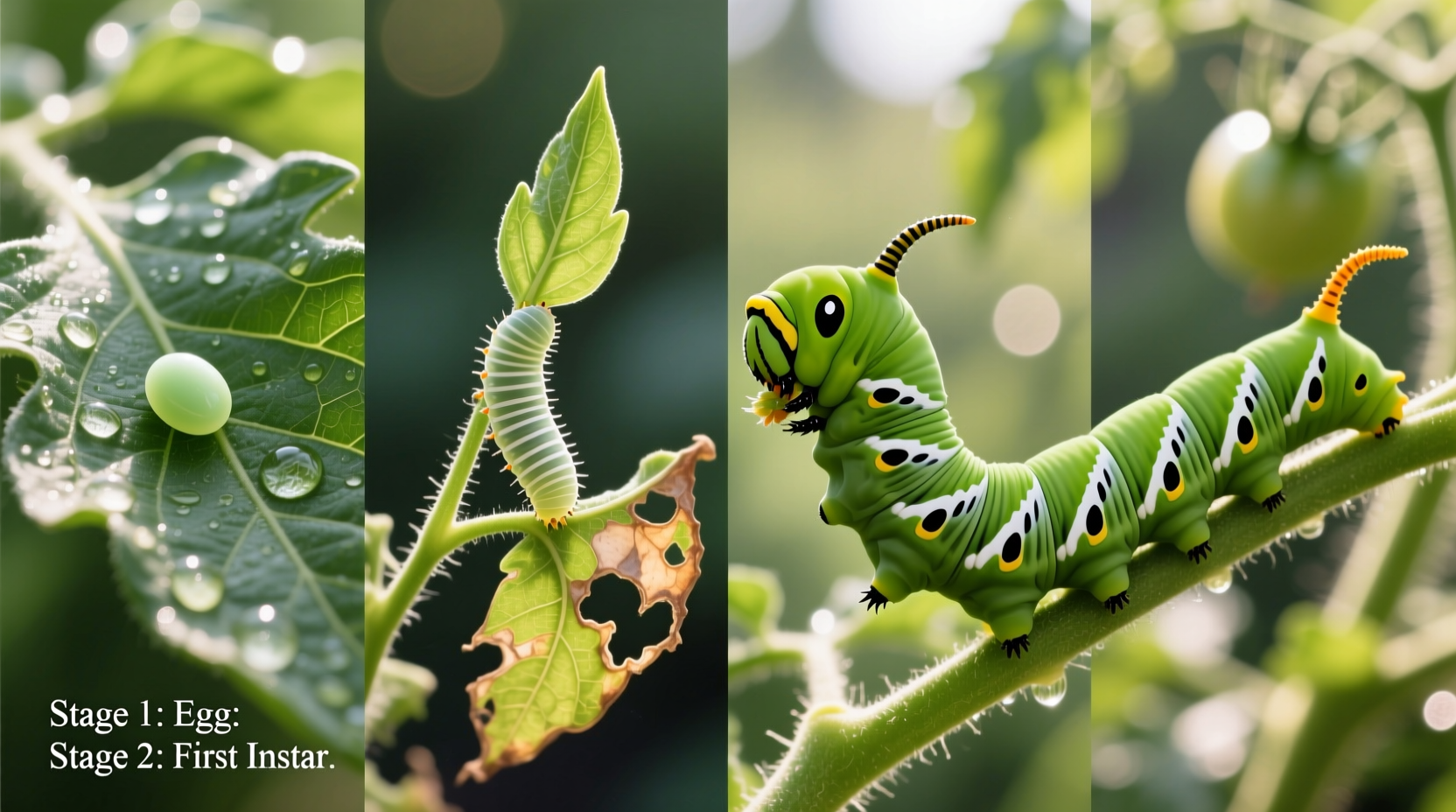
The tomato hornworm is the larval stage of a large nocturnal moth known as the five-spotted hawk moth or sphinx moth. Despite its name, it is not a worm but a caterpillar belonging to the Sphingidae family. The species is native to North America and thrives in temperate climates where solanaceous crops are grown. Its development follows a complete metamorphosis (holometabolous development), meaning it undergoes four distinct stages: egg, larva, pupa, and adult. Each phase plays a role in its survival, reproduction, and interaction with agricultural environments.
While often confused with the closely related tobacco hornworm (Manduca sexta), which has similar habits, the tomato hornworm can be distinguished by specific physical traits and host preferences. Both species cause significant defoliation, capable of stripping leaves and damaging fruit within days. However, their presence also supports biodiversity, serving as prey for beneficial insects and parasitoids such as braconid wasps.
Key Characteristics Across Life Stages
The appearance and behavior of the tomato hornworm vary dramatically between developmental stages. Below is a summary of key identifying features:
| Stage | Duration | Size | Color & Markings | Location | Behavior |
|---|---|---|---|---|---|
| Egg | 4–8 days | ~1 mm diameter | Translucent greenish-white, spherical | Underside of leaves | Passive; laid singly by adult moths |
| Larva (Caterpillar) | 3–4 weeks | Up to 4 inches long | Green with eight V-shaped white stripes; ends in a black \"horn\" | On host plants (tomato, pepper, etc.) | Highly active feeding; camouflaged among foliage |
| Pupa | 2–4 weeks (longer if overwintering) | 1.5–2 inches long | Brown, hard-shelled | Buried 3–5 inches in soil | Non-feeding; transformation occurs internally |
| Adult Moth | 7–10 days (adult lifespan) | Wingspan: 4–5 inches | Olive-gray body with five pairs of yellow spots on abdomen | Aerial; nocturnal | Nectar feeding; mates and lays eggs at night |
Stage 1: Egg
The life cycle begins when an adult female five-spotted hawk moth deposits eggs on the underside of host plant leaves, typically during late spring or early summer. These tiny, round, translucent spheres are pale green or whitish and measure about 1 millimeter in diameter. A single female can lay up to 1,000 eggs over her short lifespan, usually distributing them across multiple plants to increase offspring survival rates.
Eggs hatch within 4 to 8 days, depending on temperature and humidity. Warmer conditions accelerate development. Because they are so small and placed on leaf undersides, eggs are easily overlooked. Regular inspection of susceptible crops every few days during peak growing season is crucial for early detection.
Expert Tip: Use a magnifying lens when scouting for eggs. Look especially along midribs and near new growth, where moths prefer to lay. Removing infested leaves early prevents exponential population growth.
Stage 2: Larva (Caterpillar)
The larval stage is the most visible and damaging phase of the tomato hornworm’s life cycle. Upon hatching, the tiny caterpillar begins feeding immediately, starting with its own eggshell before moving to tender leaf tissue. Over the next three to four weeks, it passes through five or six instars (growth phases separated by molting), increasing in size from less than 1/10 inch to a full 4 inches in length.
Mature larvae are bright green with eight diagonal white V-shaped markings on each side—these distinguish them from the tobacco hornworm, which has straight white stripes. At the posterior end is a prominent curved spine or \"horn,\" typically black, which is harmless despite its intimidating appearance. This horn does not sting or inject venom.
Hornworms consume large quantities of foliage, often defoliating entire branches in a matter of days. They may also rasp into developing fruits, creating shallow, irregular scars that invite rot and secondary infections. Their green coloration provides excellent camouflage, making visual detection challenging until damage becomes severe.
\"One mature hornworm can eat more than its body weight in leaves daily. By the time you see noticeable defoliation, the damage is already extensive.\" — Dr. Elena Torres, Entomologist, Cornell University Cooperative Extension
In addition to direct feeding, signs of larval presence include dark, pellet-like frass (excrement) beneath affected plants and partially eaten leaves with clean edges—unlike the ragged holes made by beetles or slugs.
Identification Tips for Gardeners
- Look for black droppings on lower leaves or soil surface.
- Inspect plants at dusk or dawn using a flashlight—hornworms are more active during cooler hours.
- Use a UV blacklight after dark; some report that hornworms fluoresce slightly under ultraviolet light.
- Check for parasitized individuals (see below).
Stage 3: Pupa
When fully grown, the caterpillar descends from the plant and burrows into the soil, typically 3 to 5 inches deep, where it forms a pupal case. This J-shaped chamber houses the transformation into the adult moth. The pupa is brown, cylindrical, and approximately 1.5 to 2 inches long, resembling a oversized peanut shell. It is often mistaken for a seed pod or root nodule.
Pupal duration varies significantly based on environmental conditions. In warm climates or during mid-season generations, adults may emerge in as little as two weeks. However, late-season pupae frequently enter diapause—a state of suspended development—to survive winter. These overwintering pupae remain dormant until soil temperatures rise above 60°F (15.5°C) the following spring.
This underground stage makes chemical interventions ineffective unless systemic pesticides are used, which carry risks to pollinators and soil health. Cultural practices such as tilling in fall or spring can expose pupae to predators like birds, skunks, and beetles, helping reduce next season’s population.
Actionable Advice: Avoid deep tilling in established beds to preserve soil structure, but consider shallow cultivation (2–3 inches) in fallow garden areas to disrupt overwintering pupae. Pair this with crop rotation to minimize reinfestation.
Stage 4: Adult Moth
The adult form of the tomato hornworm is the five-spotted hawk moth (Manduca quinquemaculata), a robust, fast-flying insect with a wingspan reaching 4 to 5 inches. Its forewings are mottled gray-brown, providing excellent camouflage against tree bark, while the abdomen displays five pairs of distinctive yellow spots—hence the name. The moth is nocturnal, emerging at dusk to feed on nectar from deep-throated flowers such as moonflower, petunia, and evening primrose.
Unlike the destructive larva, the adult moth plays a beneficial ecological role as a pollinator. It hovers in front of flowers much like a hummingbird, using its long proboscis to extract nectar. However, it also reproduces rapidly: females begin laying eggs within 24 to 48 hours of emergence, ensuring the continuation of the life cycle.
In regions with long growing seasons (such as USDA Zones 7 and higher), there may be two or even three overlapping generations per year. The first appears in late spring, the second in midsummer, and occasionally a third in early fall. Monitoring moth activity with pheromone traps or simple light traps can help predict larval outbreaks.
Variants & Related Species
Two major hornworm species affect solanaceous crops in North America:
- Tomato Hornworm (Manduca quinquemaculata): Green body with V-shaped white markings, black horn, five pairs of abdominal spots on adult.
- Tobacco Hornworm (Manduca sexta): Green body with seven diagonal white stripes, red-tipped horn, six pairs of abdominal spots on adult.
Both share similar life cycles and host plants, though the tobacco hornworm shows a stronger preference for tobacco and certain ornamental nicotianas. Visually distinguishing them is important because biological controls may vary slightly in effectiveness.
| Feature | Tomato Hornworm | Tobacco Hornworm |
|---|---|---|
| Body Markings | Eight V-shaped white lines | Seven diagonal white stripes |
| Horn Color | Black | Red or reddish |
| Adult Abdominal Spots | Five pairs | Six pairs |
| Primary Host Preference | Tomato, pepper | Tobacco, tomato |
Comparison with Similar Pests
Several other caterpillars and pests may be mistaken for tomato hornworms:
- Cabbage Looper: Smaller, pale green, moves in a looping motion. Feeds on brassicas, not solanaceous crops.
- Armyworms: Darker, often with stripes, feed in groups. More common in grasses and grains.
- Dealfaced Hawkmoth Larvae: Other Manduca species, but lack the consistent V-markings and black horn.
- Japanese Beetles: Metallic green adults chew leaves skeleton-wise; larvae are white grubs in soil.
The sheer size and smooth, fleshy body of the hornworm make it unique among common garden pests. No other caterpillar reaches 4 inches while feeding exclusively on tomato plants.
Practical Tips & FAQs
How do I know if my plants have hornworms?
Look for sudden defoliation, black droppings beneath plants, and chewed stems or fruit. Inspect leaves thoroughly, especially in the morning and evening. Hornworms often remain motionless when disturbed, relying on camouflage.
Are natural predators effective against hornworms?
Yes. Braconid wasps (Cotesia congregata) are among the most effective biological controls. Female wasps lay eggs on hornworms; the emerging larvae feed externally, producing rice-like cocoons on the caterpillar's back. Infested hornworms eventually die. If you see these white cocoons, leave the host in place to allow wasps to complete development and disperse.
Can I use organic methods to control hornworms?
Organic options include:
- Hand-picking: Most effective for small gardens. Drop into soapy water.
- Bt (Bacillus thuringiensis var. kurstaki): A microbial insecticide safe for humans and pollinators. Spray early-stage larvae for best results.
- Neem oil: Disrupts feeding and molting but less effective on large caterpillars.
- Encourage biodiversity: Plant nectar-rich flowers to attract parasitic wasps and predatory insects.
Should I remove all hornworms?
Not necessarily. If you find a parasitized hornworm (with white cocoons), leave it on the plant. It will not survive, but its death will release multiple wasps that can attack others. This is nature’s built-in pest control.
Do hornworms harm humans?
No. The horn is not a stinger and poses no danger. Handling them is safe, though some people prefer gloves due to their size and texture.
How can I prevent hornworms next season?
Adopt integrated pest management (IPM) strategies:
- Rotate nightshade crops annually.
- Till soil in fall and spring to expose pupae.
- Use floating row covers early in the season to block egg-laying moths.
- Plant deterrent companion plants like basil, marigolds, or dill.
- Monitor with pheromone traps to detect adult activity.
Pro Tip: Interplant tomatoes with aromatic herbs such as basil or borage. Studies suggest these may mask host plant odors, reducing moth oviposition (egg-laying).
Summary & Key Takeaways
The tomato hornworm progresses through four biologically distinct stages—egg, larva, pupa, and adult moth—each with unique characteristics and implications for garden health. The larval stage causes the most damage, consuming vast amounts of foliage and compromising fruit quality. Early detection through regular scouting and understanding the life cycle enables timely, targeted intervention.
Effective management combines cultural, mechanical, and biological strategies. Hand removal, Bt applications, and conservation of natural enemies like braconid wasps offer sustainable solutions without harming beneficial insects. Recognizing the difference between tomato and tobacco hornworms improves accuracy in identification and treatment.
While often viewed solely as a pest, the tomato hornworm is part of a complex ecosystem. Its presence signals both vulnerability and opportunity—prompting smarter gardening practices and deeper engagement with natural processes. By mastering the stages in its development, gardeners gain not just protection for their crops, but insight into the delicate balance of backyard agriculture.
Take Action Today: Spend 10 minutes inspecting your tomato plants for signs of hornworms. Remove any you find, note evidence of parasitism, and plan a rotation strategy for next season. Small steps now prevent major losses later.