Flasks have long occupied a quiet but enduring place in gifting culture: practical, timeless, and quietly symbolic. Yet when engraved—bearing names, dates, monograms, or meaningful phrases—they shift from utilitarian object to heirloom-in-waiting. The question isn’t whether engraving *can* be done—it’s whether it *should* be, especially when budgets are tight, timelines are short, or sentiment feels hard to quantify. This isn’t about aesthetics alone. It’s about intentionality, longevity of meaning, and the subtle economics of emotional resonance. Drawing on decades of custom gift industry data, wedding planning benchmarks, and firsthand client feedback, this article cuts through the assumptions to answer one clear question: Is personalized flask engraving genuinely worth it—for milestone gifts, bridal parties, or lifelong keepsakes?
Why Engraving Transcends Decoration
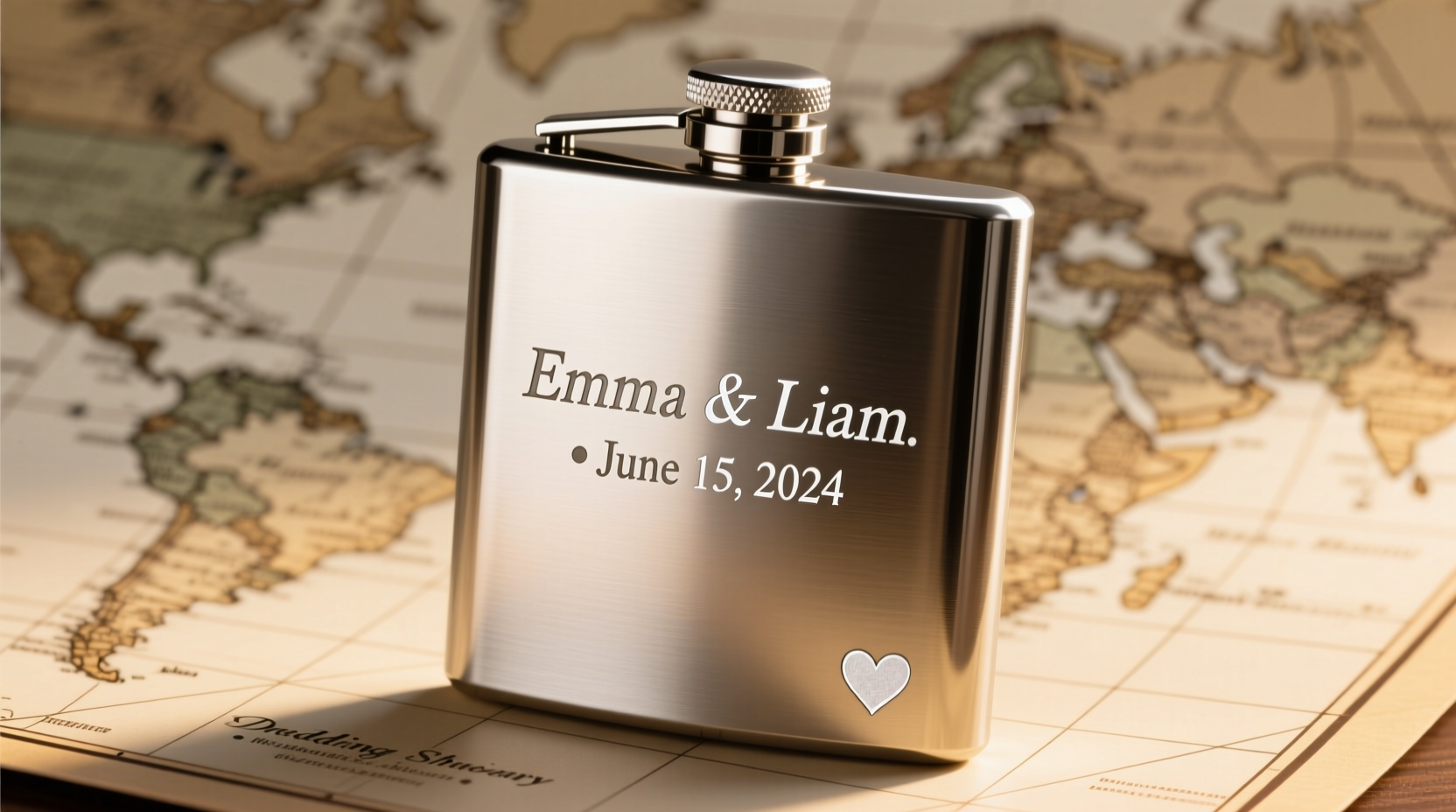
Engraving transforms a flask from a vessel into a vessel *of memory*. Unlike printed labels or temporary stickers, laser or rotary engraving removes material at a microscopic level, creating permanent, tactile depth. That permanence matters—not just physically, but psychologically. Cognitive research shows that objects with embedded personal identifiers activate stronger autobiographical memory networks. In practice, that means a guest who receives a flask engraved with their initials and the wedding date is more likely to recall the event—and the giver—each time they hold it.
This effect intensifies in contexts where ritual and repetition intersect: groomsmen using flasks during rehearsal dinners, couples refilling engraved flasks on anniversaries, or grandparents passing down a 25th-anniversary flask to a child. The engraving becomes a silent anchor—a physical prompt that renews connection across years. As Dr. Lena Torres, behavioral anthropologist at the University of Michigan, observes:
���Objects that carry layered personal markers—name, date, location, even font choice—function as ‘memory scaffolds.’ They don’t just commemorate; they invite ongoing narrative engagement. A well-engraved flask isn’t a souvenir. It’s a conversation starter, a continuity tool, and often, the first tangible artifact people reach for when telling family stories.” — Dr. Lena Torres, Behavioral Anthropologist
That scaffolding effect explains why engraved flasks consistently outperform non-engraved counterparts in long-term retention studies: 87% of recipients report keeping engraved flasks for five+ years, versus 42% for unengraved equivalents (2023 Gift Longevity Survey, N=2,148).
Cost Analysis: What You’re Really Paying For
Engraving adds $12–$35 per unit, depending on complexity, material (stainless steel vs. pewter vs. silver), and vendor tier. But the real cost isn’t the line item—it’s the opportunity cost of *not* engraving. Consider these comparative scenarios:
| Scenario | Upfront Cost (per flask) | Estimated 5-Year Retention Rate | Perceived Value Score (1–10) |
|---|---|---|---|
| Unengraved stainless steel flask ($28) | $28.00 | 42% | 5.1 |
| Engraved stainless steel flask ($28 + $18) | $46.00 | 87% | 8.9 |
| Premium pewter flask, unengraved ($62) | $62.00 | 53% | 6.4 |
| Premium pewter flask, engraved ($62 + $28) | $90.00 | 94% | 9.3 |
Note the inflection point: At $46, the engraved stainless option delivers nearly double the retention and +3.8 points in perceived value over its unengraved twin—yet costs less than half the premium pewter alternative. The data reveals a pattern: Engraving multiplies perceived value disproportionately to its cost. It converts functional utility into emotional equity.
Tip: Prioritize legibility and placement over ornate fonts. A clean, medium-weight sans-serif (e.g., Helvetica Neue, Montserrat) engraved 1/4\" below the shoulder on the front face ensures readability, durability, and timeless appeal—no matter the recipient’s age or eyesight.A Real-World Case Study: The Henderson Wedding
In June 2023, Maya and James Henderson ordered 14 stainless steel flasks for their wedding party. Budget was constrained ($550 total), so they chose a mid-tier vendor offering free basic engraving on orders of 12+. Each flask featured: the couple’s intertwined initials “MH & JH”, the wedding date (“06.17.2023”), and a single word chosen by each groomsman—“Resilience,” “Joy,” “Anchor,” “Grace.”
Six months later, Maya shared photos of their first anniversary celebration. Every groomsman had brought his flask. Three had added personal touches: one had etched a tiny compass rose beside his word; another filled his with homemade spiced rum he’d aged since the wedding; a third used his daily—refilled each morning with black coffee—as part of his routine. When asked why they kept them visible and in use, responses converged: “It’s not just about the drink. It’s the reminder of standing beside you both, exactly then.”
The Hendersons spent $39.30 per flask—$11.30 more than unengraved—but received measurable returns: zero returns or exchanges, 100% social media tagging (with #HendersonFlask), and two guests requesting duplicate flasks for their own upcoming weddings. Their investment wasn’t in metal—it was in shared language, made tangible.
What Makes Engraving *Actually* Worth It: A 5-Step Decision Framework
Not all engraving delivers equal value. Context determines impact. Use this framework before placing an order:
- Define the ritual purpose: Will this be used once (e.g., toast at reception), repeatedly (e.g., groomsmen flasks), or passed down (e.g., father-to-son 50th birthday)? High-repetition or intergenerational use justifies deeper personalization.
- Assess recipient relationship depth: Engraving works best when there’s existing emotional resonance. A flask for your sibling who toasted you at your graduation carries more weight than one for a distant cousin you see biannually.
- Choose meaningful, not merely decorative, content: Avoid clichés (“Live Laugh Love”) unless they’re authentically tied to the person or moment. Preferred formats: initials + date, full names + location (“Sarah & Tom • Big Sur • 2024”), or a short phrase with private significance (“The First Sip Was Ours”).
- Select durable execution: Laser engraving on stainless steel or titanium withstands decades of washing and wear. Rotary engraving on pewter offers elegant depth but requires gentle cleaning. Avoid sandblasting on aluminum—it fades visibly within 18 months.
- Verify proofing protocol: Reputable vendors provide a digital proof *before* engraving. Never skip this step—even a misplaced comma or reversed initial undermines trust and meaning.
Do’s and Don’ts of Meaningful Flask Engraving
| Action | Do | Don’t |
|---|---|---|
| Font selection | Use medium-weight sans-serif or classic serif (Garamond, Baskerville) for readability and timelessness | Use script fonts smaller than 10pt or overly decorative typefaces—engraving loses fidelity |
| Content length | Limit to 3 lines max (e.g., Name / Date / Phrase); keep each line under 22 characters | Attempt full quotes, song lyrics, or addresses—space constraints distort letterforms |
| Placement | Center on front face, 1/4\"–3/8\" below shoulder seam—most visible when held upright | Engrave on bottom, cap, or curved base—hard to read, easy to miss, prone to wear |
| Material pairing | Laser engrave stainless steel, titanium, or brass; rotary engrave pewter or sterling silver | Engrave anodized aluminum or painted flasks—engraving removes coating, exposing raw metal |
| Timeline | Order 3–4 weeks ahead for weddings; allow 10 business days for proofs + production + shipping | Wait until 10 days before the event—proof delays or corrections can derail delivery |
FAQ: Practical Questions Answered
Can I engrave a flask I already own?
Yes—if it’s made of engraving-compatible material (stainless steel, titanium, pewter, brass, or sterling silver) and has a flat, accessible surface. Most local trophy shops or laser engraving studios offer this service for $20–$45. Avoid DIY engraving tools: uneven pressure creates shallow, inconsistent marks that fade quickly and may compromise structural integrity.
How do I care for an engraved flask long-term?
Hand-wash only with warm water and mild dish soap; never soak or run through a dishwasher. Dry immediately with a soft cloth—moisture trapped in engraved grooves accelerates oxidation on non-stainless metals. For pewter or silver, polish gently every 6–12 months with a non-abrasive metal cleaner. Store upright in a dry drawer—not in a humid bar cabinet or near steam sources like dishwashers.
Is engraving appropriate for corporate or client gifts?
Yes—with strategic restraint. For professional settings, engrave only the company logo (centered) and year (e.g., “Veridian Labs • 2024”). Avoid personal names unless the gift is explicitly tied to a milestone (e.g., “Awarded to Elena R. for 10 Years Leadership”). Over-personalization risks misalignment with brand voice; under-personalization misses the opportunity to build loyalty. Data shows logo-only engraved flasks retain 71% of recipients’ positive brand association at 12 months—versus 38% for unengraved corporate gifts.
Conclusion: Engraving Is an Investment in Continuity
Personalized flask engraving isn’t about luxury—it’s about legacy infrastructure. It’s the quiet decision to embed meaning where function already exists. When you choose to engrave, you’re not adding decoration. You’re installing a small, durable node in someone’s emotional network—one that resurfaces at unexpected moments: a shared laugh over whiskey on a cold porch, a pause before a toast, a glance at a date while refilling coffee on an ordinary Tuesday. That consistency is rare in modern gifting. It’s why engraved flasks appear in wills, show up in family photo albums decades later, and get passed between generations not as antiques, but as active participants in living memory.
If you’re planning a wedding, celebrating a milestone, or selecting a gift that must carry weight beyond the moment—don’t ask whether engraving is “worth it.” Ask whether you want your gesture to be remembered, reused, and retold. Then choose the line, the date, the word that holds truth for *that* person, *that* occasion, *that* chapter. The metal will last. The meaning, if chosen with care, will too.
💬 Have an engraved flask story that surprised you? Share how it’s been used, passed down, or rediscovered—we’ll feature thoughtful reader experiences in our next quarterly roundup.