
Moonshine and legal corn whiskey share a common ancestry: both begin with a simple mash of at least 80% corn, fermented and distilled into clear, high-proof spirit. Yet one is often associated with backwoods stills, copper coils hidden in hollows, and cautionary tales; the other appears on bar shelves beside bourbon and rye, bearing government stamps and lab-certified proofs. The divergence isn’t merely historical—it’s chemical, regulatory, sensory, and profoundly consequential for human health. Understanding what separates them isn’t nostalgia or trivia. It’s essential knowledge for anyone who tastes, serves, or considers making high-proof corn spirits.
The Legal Line: Regulation as the First and Most Critical Divide
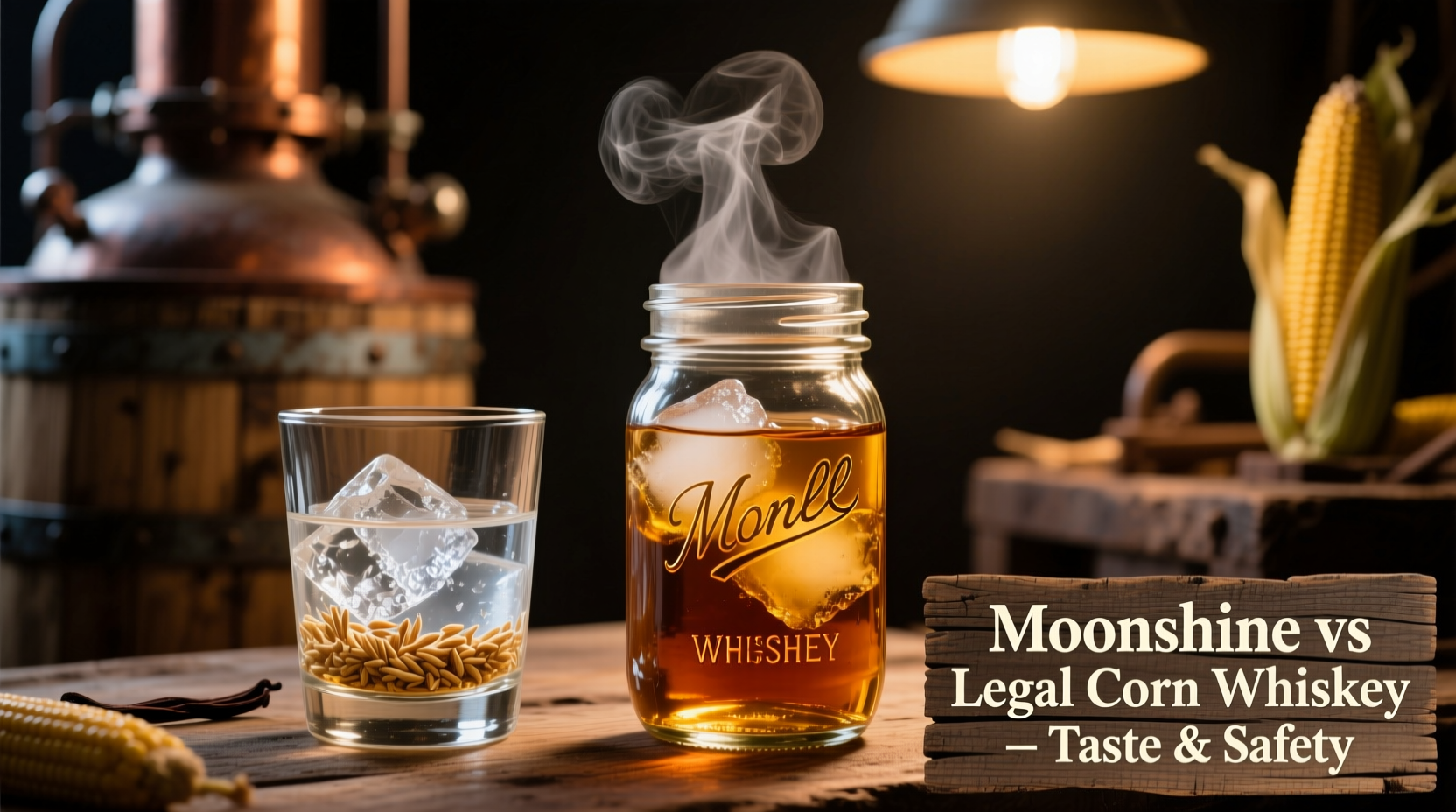
Legally, “corn whiskey” is defined under U.S. federal law (27 CFR §5.22) as a spirit made from a mash of at least 80% corn, distilled to no more than 160 proof (80% ABV), and aged—if at all—in uncharred or used oak barrels. Crucially, it must be produced at a federally licensed distillery, subject to rigorous oversight by the Alcohol and Tobacco Tax and Trade Bureau (TTB). Every batch undergoes mandatory laboratory analysis for methanol, fusel oils, heavy metals, and microbial contaminants before bottling and sale.
Moonshine, by contrast, has no legal definition in U.S. statute. Its meaning is cultural and operational: it refers to any unregulated, untaxed, and unlicensed distilled spirit—typically corn-based, but not exclusively. Historically, the term emerged from the practice of distilling “by the light of the moon” to evade revenue agents. Today, it persists in two distinct contexts: illicit production (still illegal without proper licensing and tax payment) and legally marketed “moonshine-style” products—often labeled as “unaged corn whiskey” or “white dog,” which are, in fact, legal corn whiskey sold without age statements or with deliberate rustic branding.
This regulatory chasm creates an irreversible divergence in accountability. A licensed distillery maintains full traceability—from grain source and water pH to yeast strain, fermentation time, copper contact duration, and precise cut points during distillation. Illicit operations lack these controls—and often the expertise, equipment, or intent to implement them.
Tip: If a product lacks a TTB-approved label with a DSP (Distilled Spirits Plant) number, a government health warning, and accurate alcohol-by-volume disclosure, it is not regulated—and cannot be verified for safety.Production Realities: Copper, Cuts, and Contamination Risks
Both legal corn whiskey and illicit moonshine begin similarly: cornmeal, water, and yeast ferment into a low-alcohol “beer” (typically 6–10% ABV). Distillation then concentrates ethanol—but also concentrates volatile compounds that vary dramatically in toxicity and flavor impact.
Copper plays a decisive role. In legal distilleries, copper pot stills or copper-lined column stills catalyze the removal of sulfur compounds and bind with volatile aldehydes. More critically, copper reacts with methanol—a naturally occurring byproduct of pectin breakdown in fruit and grain—converting it into less volatile, less toxic esters. Illicit stills frequently use aluminum, stainless steel without copper contact, or even lead-soldered radiators repurposed as condensers. Lead leaching and methanol retention become real, documented hazards.
Equally vital is the “cut”—the distiller’s judgment call separating the heads (early distillate, rich in acetone, acetaldehyde, and methanol), hearts (ethanol-rich, clean spirit), and tails (heavy fusel oils, fatty acids, and off-notes). Licensed distillers train for years to make precise cuts guided by temperature, time, sensory evaluation, and gas chromatography. Illicit operators often rely on rudimentary methods—like tasting the first drops or using a flame test—which cannot detect odorless, tasteless methanol or neurotoxic fusel oil concentrations.
“Methanol doesn’t announce itself. You won’t smell it in the glass, and you won’t taste its danger until your optic nerve begins to fail. That’s why cut integrity isn’t about flavor—it’s about physiology.” — Dr. Lena Torres, Toxicologist and former FDA Alcohol Safety Advisor
Taste Profile Comparison: Clarity, Complexity, and Intentionality
While both spirits are unaged and clear, their sensory profiles diverge sharply—not because of aging, but because of process discipline, raw material quality, and post-distillation handling.
| Characteristic | Legal Corn Whiskey | Illicit Moonshine |
|---|---|---|
| Grain Expression | Clean, sweet corn notes—buttered popcorn, roasted maize, honeyed cereal—with subtle herbal or earthy undertones from heirloom corn varieties and controlled fermentation. | Often muted or distorted by fermentation stress (excessive heat, poor yeast nutrition) or bacterial contamination (lactic acid bacteria producing sourness or vinegar notes). |
| Distillate Purity | Smooth mouthfeel; ethanol is dominant, with minimal solvent-like sharpness. Volatile congeners are balanced and integrated. | Frequent presence of harsh, burning heat; “nail polish remover” (ethyl acetate) or “rotten apples” (acetaldehyde) notes; metallic or medicinal off-notes from improper still materials. |
| Mouthfeel & Finish | Light to medium body; crisp entry, clean finish, sometimes with a faint vanilla or toasted grain linger from barrel contact (even if unaged, some rest in neutral oak). | Thin, watery, or viscous and oily; finishes with lingering bitterness, astringency, or numbing sensation—signs of fusel oil imbalance or residual cleaning agents. |
| Consistency | Batch-to-batch reliability within ±0.3% ABV and tightly controlled congener profile. Lab reports verify purity. | High variability—even within the same still run—due to inconsistent heat control, poor condensation, or rushed collection. |
Legal corn whiskey benefits from intentional refinement: charcoal mellowing (as in some Tennessee whiskeys), filtration through maple charcoal or activated carbon, and careful dilution with mineral-balanced water. Illicit producers rarely possess calibrated hydrometers, food-grade water sources, or filtration media—leading to unpredictable dilution and mineral-induced cloudiness or haze.
A Real-World Case: The 2019 Appalachian Outbreak
In early 2019, seven adults across rural Appalachia presented to emergency departments with sudden blurred vision, headache, nausea, and metabolic acidosis. All had consumed a locally distributed “wild cherry moonshine” sold from a converted garage still. Toxicology screening confirmed acute methanol poisoning in each case; three required hemodialysis. Investigation revealed the operator used overripe, mold-damaged corn (elevating pectin content and thus methanol potential), fermented at uncontrolled temperatures above 95°F (accelerating bacterial methanol production), and made no separation of heads—collecting the first 15% of distillate, where methanol concentrates.
Crucially, this was not “traditional” moonshine. It was preventable. Had the producer followed basic TTB guidance—using sound grain, maintaining fermentation below 85°F, discarding the first 5% of distillate, and verifying ABV with a certified hydrometer—the outcome would have differed. The incident underscored that risk isn’t inherent to corn whiskey—it’s inherent to the absence of verification, training, and accountability.
Safety First: A Step-by-Step Verification Guide for Consumers
You don’t need a chemistry degree to protect yourself. Apply this five-step verification process before purchasing or accepting any unaged corn spirit:
- Check the Label for Mandatory Elements: Look for a DSP number (e.g., “DSP-KY-123”), government health warning statement, net contents, and exact ABV. No exceptions.
- Verify the Producer: Search the TTB’s public database (ttb.gov) for the DSP number. Confirm active licensing and recent compliance history.
- Assess the Bottle Integrity: Sealed wax-dipped corks, hand-stamped bottles, or “small batch” claims mean nothing without regulatory backing. Prioritize consistent, professionally printed labels with batch numbers.
- Observe the Liquid: Hold to light. Legal corn whiskey is brilliantly clear. Cloudiness, sediment, or rainbow sheens indicate contamination, improper filtration, or adulteration.
- Smell and Sip Mindfully: Swirl gently. If you detect sharp acetone, bitter almond (cyanide precursor), or overwhelming nail polish scent—stop. Do not consume. Return or discard immediately.
FAQ: Clarifying Common Misconceptions
Is all moonshine dangerous?
No—but unregulated moonshine carries inherent, unquantifiable risk. Legally produced “moonshine-style” spirits sold by licensed distilleries (e.g., Ole Smoky, Midnight Moon) are safe, tested, and identical in composition to legal corn whiskey. Danger arises only when production occurs outside federal oversight, without analytical verification, or with improvised equipment.
Does aging make corn whiskey safer?
No. Aging in wood affects flavor and color—not toxicity. Methanol and fusel oils are formed during fermentation and distillation, not maturation. An improperly cut, unaged corn whiskey is no more dangerous than a poorly cut, aged one—if both originate from the same flawed process. Safety is determined at the still, not the barrel.
Can home distillation ever be safe?
Under current U.S. federal law, distilling alcohol for beverage purposes at home is illegal without a DSP permit—even for personal use. While small-scale brewing and winemaking are permitted, distillation requires facility inspections, bond posting, and ongoing tax reporting. Some states allow licensed “distiller’s apprentice” programs under strict supervision, but DIY stills remain unlawful and medically inadvisable.
Conclusion: Respect the Craft, Honor the Science
The distinction between moonshine and legal corn whiskey isn’t folklore versus factory—it’s intention versus improvisation, accountability versus anonymity, and science versus superstition. Legal corn whiskey represents generations of craft refined by regulation: copper stills engineered for congener management, yeast strains selected for clean fermentation, and quality control labs that screen for what the palate cannot detect. Illicit moonshine, however romanticized, operates without those safeguards—and every documented case of methanol blindness or fusel-induced illness traces back to gaps those safeguards were designed to close.
Taste can guide appreciation, but only verification ensures safety. Choose brands with transparent DSP numbers. Ask bartenders about sourcing. Support distilleries that publish third-party lab results. And if you hear someone praise “real moonshine” for its “authentic bite,” offer context—not judgment. Authenticity shouldn’t cost clarity of vision or peace of mind.
💬 Your experience matters. Have you tasted a standout legal corn whiskey—or encountered a concerning unregulated product? Share your observations in the comments to help build collective awareness and responsible enjoyment.