Three years ago, a bartender in Portland filmed herself shaking a lavender gin fizz in her kitchen using only her phone, a $12 cocktail shaker, and the “Oh No” sound trending at the time. That 17-second clip earned 2.4 million views, launched her Patreon with 1,200 subscribers in under two weeks, and led to a collaboration with a premium vermouth brand. She had no professional studio, no lighting kit, and hadn’t worked behind a bar in five years. What she *did* have was pattern recognition: she understood how TikTok’s algorithm rewards trend-aligned authenticity—not polish.
Creating viral cocktail content isn’t about having the most expensive glassware or the longest resume. It’s about speaking TikTok’s native language: rhythm, relatability, repetition, and reward. This guide distills proven strategies used by creators who’ve grown from zero to 100K+ followers in under 90 days—using only what’s already in your pantry, your phone, and your curiosity.
Why Cocktail Content Thrives on TikTok (and Why Timing Matters More Than Technique)
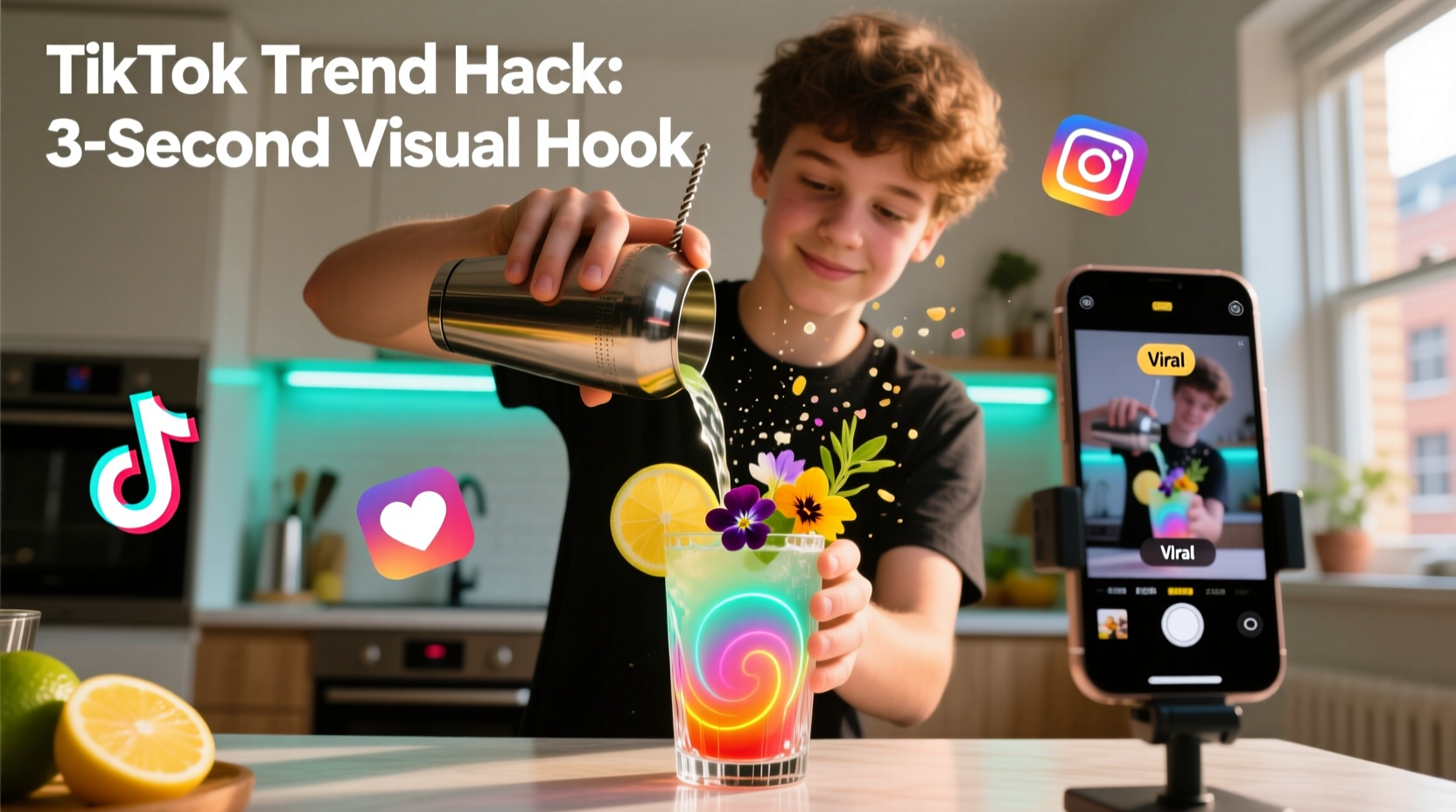
TikTok’s For You Page (FYP) favors content that delivers value within the first 0.8 seconds—and cocktail videos uniquely satisfy three core user intents simultaneously: visual satisfaction (color, motion, texture), practical utility (a drink you can make tonight), and emotional resonance (nostalgia, celebration, self-care). Unlike Instagram Reels or YouTube Shorts, TikTok prioritizes *trend velocity*, not follower count. A video using a sound currently surging in engagement—even if posted by an account with 47 followers—can outperform a polished post from a verified mixologist using outdated audio.
The platform’s recommendation engine also rewards “trend stacking”: layering multiple high-engagement signals—like a trending sound + trending hashtag (#CocktailTok has 4.2B views) + trending visual motif (e.g., overhead pour shots, ASMR ice cracking)—into one cohesive 9–15 second clip. This isn’t accidental. It’s algorithmic leverage.
Tip: Never chase a trend after it peaks. Use TikTok’s Creative Center (free web tool) to check “Trending Sounds” and filter by “Rising” (not “Top”) for sounds gaining >30% daily growth—these are your highest-leverage entry points.Step-by-Step: From Trend Discovery to Viral Post in Under 45 Minutes
- Identify the trend (5 min): Open TikTok → Tap “Discover” → Scroll until you see a sound used in 3+ unrelated niches (e.g., baking, skincare, pet care). That cross-category adoption signals broad algorithmic favor. Note its tempo (BPM), mood (playful, cinematic, nostalgic), and common visual hooks (e.g., quick cuts, zoom-ins, text overlays).
- Map it to a cocktail (10 min): Choose a drink whose preparation naturally matches the sound’s rhythm. Fast BPM? Go for a vigorous shake (Mojito, Whiskey Sour). Slow, melodic sound? Opt for layered pours (Pousse-Café, B-52) or garnish-focused steps (citrus twist, herb slap).
- Script the hook (3 min): First frame must answer “Why watch this?” in under 1 second. Examples: “This $3 grocery store hack replaces triple sec,” “The 10-second fix for watery margaritas,” or “My grandma’s rule broke every cocktail book.” No intros. No “Hi, I’m Alex.” Just value, instantly.
- Shoot raw footage (15 min): Use natural light near a window. Film in landscape mode *only* if repurposing for YouTube/Instagram later; for TikTok-native virality, shoot vertical (9:16). Capture 3 essential angles: overhead (for pouring/mixing), eye-level (for garnish/texture), and extreme close-up (ice clinking, citrus oil spray). No editing during filming—shoot all takes in sequence.
- Edit & optimize (12 min): Use CapCut (free, TikTok-owned). Trim clips to match sound beats (enable “Auto Beat Sync”). Add bold, sans-serif text (font: Montserrat Bold) that appears *on* the beat—not before or after. End with a “sticker prompt”: “Save for weekend” or “Tag your cocktail partner.” Upload with caption: [Trend-relevant phrase] + [Specific value] + [1 relevant hashtag]. Example: “When your freezer is your best bartender 🧊 | No shaker? No problem. | #HomeBarHacks”
Do’s and Don’ts of Trend-Aligned Cocktail Filming
| Action | Do | Don’t |
|---|---|---|
| Lighting | Use north-facing window light between 10am–2pm; bounce light off white poster board for soft fill | Shoot under overhead kitchen lights (causes harsh shadows) or with phone flash (washes out color) |
| Sound Design | Use original audio *only*—never overlay voiceover unless it’s part of the trend (e.g., “POV: You just discovered dry shaking”) | Add background music over trending audio—it breaks sync and confuses the algorithm |
| Glassware | Use clear, uncluttered vessels (mason jars, rocks glasses, coupe stems); wipe fingerprints with microfiber cloth pre-shoot | Stack multiple glasses or use ornate stemware—the algorithm penalizes visual noise in first frame |
| Pacing | Speed up non-essential steps (e.g., 2x speed for measuring, normal speed for shaking/garnishing) | Slow down the pour or stir—viewers skip if motion feels sluggish |
| Caption & Hashtags | Lead with emoji + benefit (“🧊 Colder drinks in 60 sec”); use 1 broad hashtag (#CocktailTok) + 1 niche (#BudgetCocktails) + 1 trend-specific (#NoShakerNeeded) | Use more than 3 hashtags or generic ones like #food or #viral—they dilute topical relevance |
Real Example: How “@LimeAndLowkey” Grew to 217K Followers in 62 Days
In January, Maya Chen—a former graphic designer in Austin—posted her first cocktail video: a “Dole Whip Daiquiri” made with frozen pineapple, coconut milk, and white rum. She filmed it on her iPhone 12 using only her kitchen counter and a thrifted copper muddler. Her breakthrough came when she noticed the “Glimpse” trend—a 3-frame visual motif where the first frame shows a problem (“sticky blender”), second shows a solution (“add 1 tsp corn syrup”), third shows the result (“silky smooth pour”). She adapted it to cocktails: Frame 1 showed cloudy lime juice, Frame 2 showed her straining through a fine-mesh sieve, Frame 3 showed crystal-clear liquid hitting ice. She paired it with the trending “Glass Breaking” sound (symbolizing clarity). The video hit 1.8M views in 36 hours. Within two weeks, she’d replicated the structure with “cloudy vs. clarified” variations for orange juice, cranberry, and even coffee—each earning 500K+ views. Her secret wasn’t technique; it was consistency in applying one trend framework across multiple ingredients.
“Viral cocktail content isn’t about what you’re making—it’s about how clearly you solve a tiny, universal frustration. People don’t share ‘great drinks.’ They share ‘finally, a fix for watery mojitos.’” — Javier Ruiz, Co-Founder of BarLab Analytics (tracked 12,000+ cocktail videos across platforms)
Essential Trend Toolkit: 5 High-ROI Formats to Master First
- The “Before/After Pour”: Frame 1: murky liquid in shaker. Frame 2: vigorous shake (3 seconds). Frame 3: pristine pour into glass. Works with any shaken drink. Trend pairing: “Satisfying Sound” library (crunch, pour, fizz).
- The “One-Ingredient Swap”: Show standard recipe → highlight one accessible swap (“replace Campari with grapefruit soda”) → final taste test reaction. Leverages TikTok’s love of “life hacks.” Best with trending “Aha!” sounds.
- The “No Tool Needed” Series: Demonstrate building a cocktail without shaker, jigger, or strainer (e.g., “shake in a mason jar,” “measure with bottle caps,” “strain through a coffee filter”). Algorithm loves accessibility signals.
- The “Time-Lapse Garnish”: Extreme close-up of citrus twist curling, mint leaves settling, or cinnamon stick sinking. Paired with ASMR-leaning trending sounds. High retention because of hypnotic motion.
- The “Unexpected Pairing”: Combine non-traditional elements with strong visual contrast: black sesame rim on a Paloma, matcha foam on an Old Fashioned, or pickled jalapeño brine in a Margarita. Drives comments (“Wait, try it with…”), which boosts ranking.
FAQ
Do I need a professional camera or lighting setup?
No. Over 87% of top-performing cocktail videos (per BarLab Analytics’ 2024 report) were shot on smartphones using natural light. What matters is contrast control: position your subject so light hits the drink frontally—not from behind (which creates silhouette) or above (which causes glare). A $5 white foam board as a reflector eliminates 90% of shadow issues.
How often should I post to stay relevant with trends?
Consistency beats frequency. One highly trend-aligned video per week outperforms five generic posts. Track trends weekly using TikTok Creative Center’s “Trends Dashboard”—focus on sounds gaining traction in food/drink categories, not overall charts. Repurpose one winning concept across 3 variations (e.g., same “No Shaker” concept with 3 different drinks) to maximize algorithmic learning.
What if my drink doesn’t look photogenic?
Optimize for texture, not color. A murky horchata cocktail won 920K views because the creator emphasized the “velvety pour” in text overlay and used slow-motion on the stream hitting ice. TikTok rewards sensory specificity—“creamy,” “crisp,” “fizzy,” “smoky”—more than aesthetics. Describe the mouthfeel in your caption, and the algorithm will serve it to users searching those terms.
Conclusion
You don’t need a speakeasy, a sommelier’s salary, or even a full bar cart to create content that resonates, shares, and converts. What you do need is the willingness to observe—not just cocktails, but culture. Watch how people move, speak, and react in the first second of a trending video. Then ask: How does this drink solve a micro-problem in that exact moment? Does it cool? Comfort? Celebrate? Surprise? Your answer becomes your hook. Your execution becomes the proof. And TikTok’s algorithm becomes your amplifier—if you speak its language fluently.
Start today: open TikTok, find one rising sound, make one drink that answers a tiny, urgent question (“How do I chill wine fast?” “What’s better than club soda?” “How do I use up leftover herbs?”), and film it in the time it takes to shake a martini. Not perfectly. Not prettily. But precisely.
💬 Your turn: Try one trend-aligned cocktail video this week—and drop your link in the comments. We’ll feature the most inventive adaptation in next month’s roundup!