Communicating effectively in American Sign Language (ASL) involves more than just learning individual signs—it’s about understanding context, facial expressions, and sentence structure. One useful phrase that often appears in casual and rhetorical conversations is “Why not?” Whether you’re expressing openness to an idea, challenging a limitation, or showing curiosity, knowing how to sign “Why not?” correctly enhances your expressive fluency. This guide breaks down the sign step by step, highlights common errors, and provides real-life usage examples to help you integrate it naturally into your signing.
Understanding the Components of “Why Not” in ASL
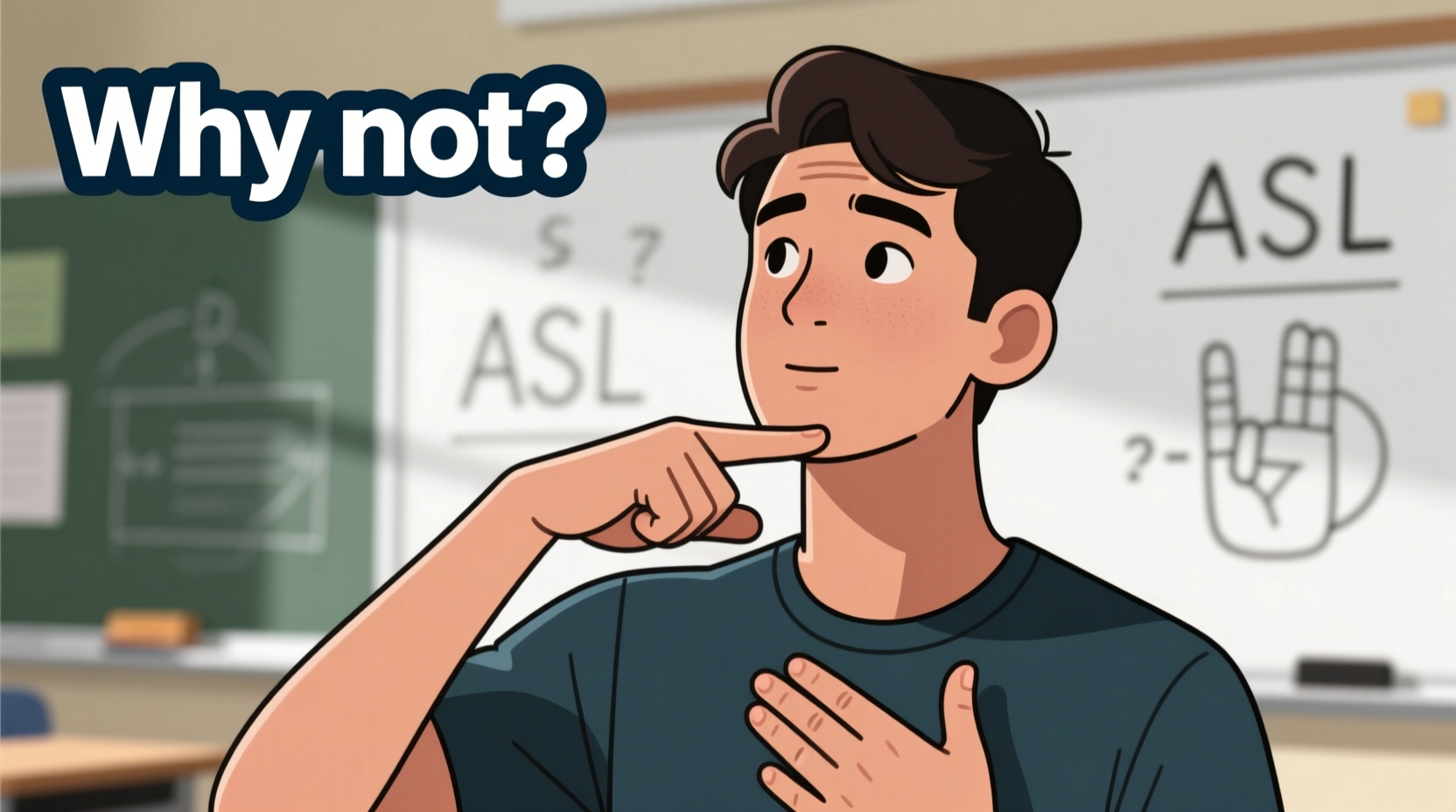
In ASL, “Why not?” is typically signed using two distinct components: the sign for “WHY” and the sign for “NOT.” Unlike English, where tone carries much of the rhetorical weight, ASL relies on facial grammar and movement to convey the full meaning of the phrase.
The word order follows English syntax in this case, but the delivery is uniquely visual. The combination of handshape, movement, and non-manual markers (facial expressions) determines whether the phrase sounds skeptical, encouraging, or genuinely curious.
Tip: Always pair your signs with appropriate facial expressions—raised eyebrows and a slight head tilt can turn a literal question into a rhetorical “Why not?”Step-by-Step Guide to Signing “Why Not”
- Start with “WHY”: Form the letter Y with one hand (thumb extended, pinky extended, others curled). Bring the tip of the thumb to touch near your chin or mouth area. Move the hand slightly forward while tilting your head up slightly. Your eyebrows should rise to signal a question.
- Transition smoothly to “NOT”: Without pausing too long, shift your dominant hand into the “NOT” sign. This uses an “A” handshape (fist with thumb across fingers). Place the thumb under your chin, then jerk it downward once in a quick motion.
- Synchronize facial grammar: Maintain raised eyebrows throughout both signs to emphasize the interrogative nature. A slight shrug of the shoulders can also reinforce the rhetorical or open-ended tone.
- Pace and flow: Don’t separate the signs too much. In natural conversation, “Why” and “Not” flow together with minimal pause, almost like a single unit of expression.
This sequence may feel stiff at first, especially coordinating facial expressions with hand movements. Practice in front of a mirror to observe how your face and hands work together to communicate intent.
Common Mistakes and How to Avoid Them
Even intermediate signers sometimes misapply non-manual signals or misplace emphasis. Here are frequent errors and corrections:
| Mistake | Why It’s Incorrect | Correction |
|---|---|---|
| Signing “WHY” without raised eyebrows | Flattens the tone; may be interpreted as a statement rather than a question | Always raise eyebrows during “WHY,” especially when asking open-ended questions |
| Using a flat palm instead of “A” hand for “NOT” | Can be confused with other signs like “NO” or “DON’T KNOW” | Ensure the thumb is tucked over fingers and the motion is sharp and downward |
| Pausing too long between “WHY” and “NOT” | Breaks the rhetorical flow and makes it sound like two separate questions | Keep the transition smooth and connected, almost like a single phrase |
| Lowering the head during the sign | Conflicts with the questioning expression and reduces clarity | Maintain eye contact and a neutral or slightly lifted head position |
Real-Life Usage: A Mini Case Study
Consider this scenario: Jamie, a Deaf college student, is discussing weekend plans with hearing friends who are hesitant to join a hiking trip due to fear of getting lost.
One friend says, “I don’t know… what if we can’t find the trail?”
Jamie signs: WHY NOT? GOOD MAP. SUNNY. FRESH AIR. She raises her eyebrows on “WHY NOT,” smiles slightly, and points toward the window to indicate the weather. Her tone is encouraging, not confrontational.
In this context, “Why not?” functions as a gentle challenge to negative assumptions. It opens space for possibility rather than shutting down discussion. Jamie’s use of facial grammar softens the question, making it inclusive rather than aggressive.
This example shows how “Why not?” isn’t just a translation—it’s a cultural tool for fostering optimism and collaborative thinking in ASL communities.
Expert Insight on Rhetorical Questions in ASL
“Rhetorical questions like ‘Why not?’ are powerful in ASL because they rely on timing and expression. The same signs can sound defiant, playful, or inviting based on how you move your face and body.” — Dr. Lillian Moore, Linguistics Professor and ASL Researcher at Gallaudet University
Dr. Moore emphasizes that mastering such phrases requires attention to prosody—the rhythm and intonation of signing. Just as vocal pitch shapes spoken language, facial expression and movement shape ASL’s emotional tone.
Do’s and Don’ts Summary
- DO use raised eyebrows and a forward head tilt to mark the question.
- DO keep the “WHY” and “NOT” signs close together in timing.
- DO practice with a fluent signer or video model to refine your expression.
- DON’T confuse “NOT” with “NO”—“NOT” is under the chin, “NO” is side-to-side head shake with palm-out “X” hand.
- DON’T sign aggressively unless that’s your intended tone.
- DON’T neglect context—“Why not?” can be sarcastic, hopeful, or challenging depending on setting.
Checklist: Mastering “Why Not” in ASL
Practice Checklist:- ✅ Can I form the “Y” handshape clearly for “WHY”?
- ✅ Am I placing the “NOT” sign correctly under the chin?
- ✅ Are my eyebrows raised throughout the entire phrase?
- ✅ Does the transition between signs feel natural and fluid?
- ✅ Have I practiced in front of a mirror or recorded myself?
- ✅ Can I use it appropriately in conversation with facial expression?
Frequently Asked Questions
Is “Why not?” signed differently in formal vs. casual settings?
Yes. In formal contexts, the signs may be slightly more deliberate and facial expressions more restrained. In casual conversation, especially among friends, the sign might be faster, accompanied by a smile or shoulder shrug to convey playfulness.
Can “Why not?” be used as a standalone response?
Absolutely. Like in English, it often serves as a concise, expressive reply. For example, if someone suggests trying a new restaurant, responding with “Why not?” (signed with a smile) shows willingness and openness.
Is there a difference between “Why not?” and “Why?” in ASL grammar?
Yes. While both use the “WHY” sign, “Why?” typically includes a furrowed brow and head tilt, signaling genuine confusion or request for explanation. “Why not?” uses raised eyebrows and a lighter tone, indicating possibility or challenge to hesitation.
Final Thoughts and Call to Action
Learning to sign “Why not?” goes beyond memorizing handshapes—it’s about embracing the expressive richness of ASL. When you combine accurate signs with authentic facial grammar, you’re not just communicating words; you’re conveying attitude, emotion, and invitation.
Whether you're a beginner building foundational skills or an intermediate signer refining nuance, this phrase is a small but powerful addition to your repertoire. Use it to encourage, to question, to inspire.
🚀 Ready to level up your ASL? Practice “Why not?” today in a conversation—whether with a friend, in front of a mirror, or during a language exchange. Share your experience or ask questions in the comments below. Let’s grow our signing community together.