Receiving a gift is often a joyful experience, whether it's cash for a birthday, a down payment assist from parents, or an inheritance advance. But many recipients wonder: could this gift trigger a tax bill? The good news is that in most cases, the person receiving a gift does not owe any taxes on it. However, understanding the underlying rules—especially those governing the giver—is essential to avoid surprises and plan wisely. This guide breaks down the current IRS gift tax regulations, annual exclusions, lifetime exemptions, and practical strategies to maximize tax-free gifting.
How Gift Taxes Work: The Basics
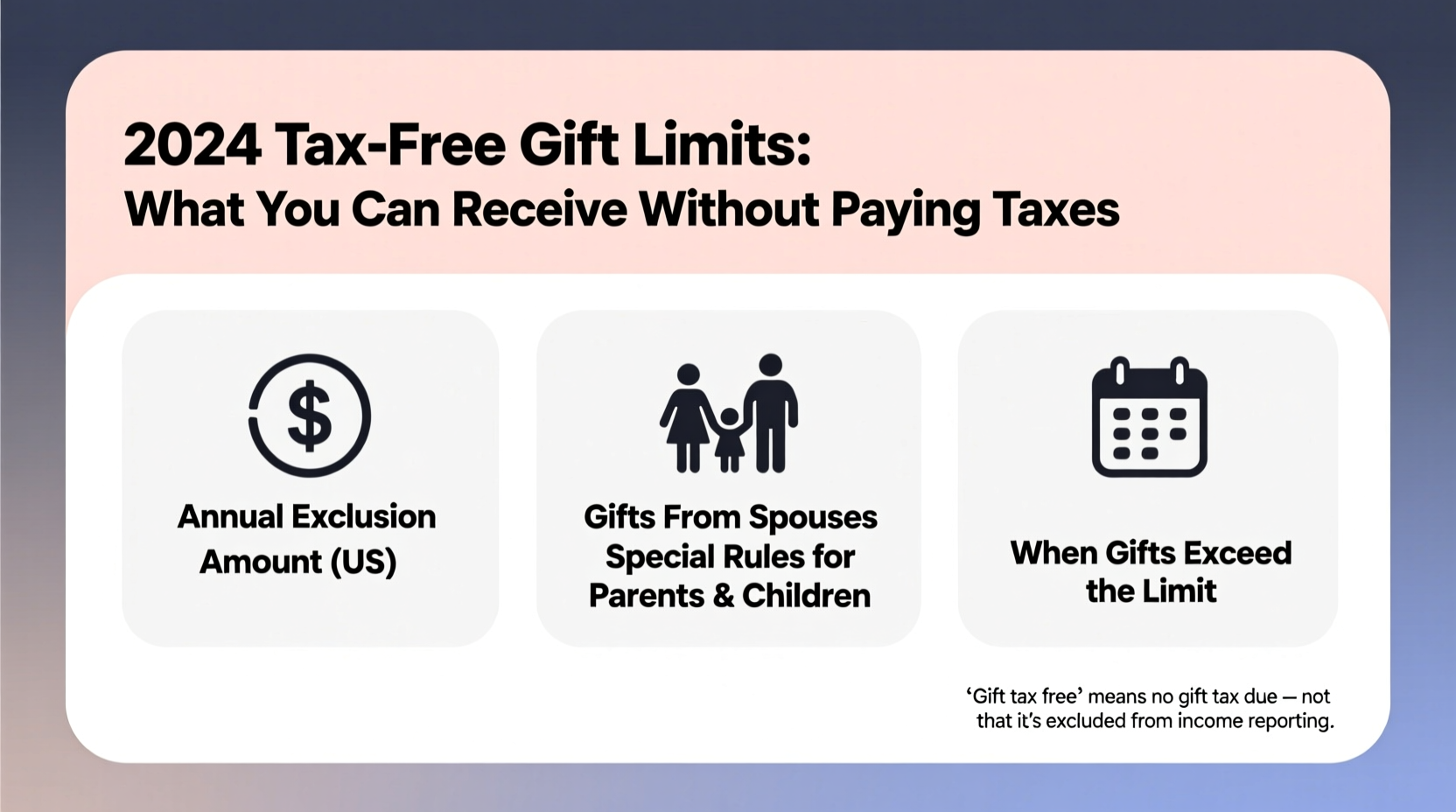
The U.S. federal gift tax applies to the transfer of property or money during someone’s lifetime when nothing (or less than full value) is received in return. Importantly, the tax responsibility lies with the donor—the person giving the gift—not the recipient. This means that if your parents give you $50,000 to buy a house, you don’t pay gift tax on that amount. Instead, they may need to file a gift tax return, depending on the size and frequency of the gift.
The Internal Revenue Service (IRS) allows individuals to make certain gifts each year without triggering tax liability or even reporting requirements. These are known as the \"annual exclusion\" and the \"lifetime gift and estate tax exemption.\"
“Most gifts are tax-free for both giver and receiver thanks to generous IRS exclusions. The key is knowing when to report and when to plan.” — Linda Chavez, Tax Policy Analyst
Annual Gift Tax Exclusion: How Much Can Be Given Tax-Free?
Each year, an individual can give up to a specific amount to any number of people without filing a gift tax return or using part of their lifetime exemption. For 2024, the annual exclusion is **$18,000 per recipient**. This means:
- You can give $18,000 to your child, $18,000 to your sibling, and $18,000 to a friend—all tax-free and without paperwork.
- A married couple can jointly gift $36,000 to one individual by splitting the gift ($18,000 each).
- If you exceed $18,000 to one person in a single year, the excess counts against your lifetime exemption (more on that below).
Married Couples and Gift Splitting
Spouses can elect to split gifts, effectively doubling the annual exclusion. For example, if one spouse gives a child $36,000 in 2024, they can treat it as two $18,000 gifts—one from each spouse—even if only one person provided the funds. This requires filing Form 709, but no tax is due unless the lifetime limit is exceeded.
Lifetime Gift and Estate Tax Exemption
Beyond the annual exclusion, the IRS allows a substantial lifetime exemption—the total amount you can give away over your life (or pass at death) without owing gift or estate tax. For 2024, this amount is **$13.61 million per individual**, or $27.22 million for a married couple.
This exemption covers both lifetime gifts above the annual exclusion and assets transferred at death. If a donor exceeds the annual exclusion, they must file IRS Form 709 (United States Gift (and Generation-Skipping Transfer) Tax Return), but they typically won’t owe tax until cumulative taxable gifts surpass $13.61 million.
| Year | Annual Exclusion (per recipient) | Lifetime Exemption (per person) |
|---|---|---|
| 2022 | $16,000 | $12.06 million |
| 2023 | $17,000 | $12.92 million |
| 2024 | $18,000 | $13.61 million |
The lifetime exemption is scheduled to drop significantly after 2025 under current law—potentially reverting to around $6 million (adjusted for inflation)—unless Congress acts to extend the higher limits. This makes strategic gifting before 2026 appealing for high-net-worth individuals.
Gifts That Are Always Tax-Free
Certain types of gifts are excluded from gift tax entirely, regardless of amount. These do not count toward the annual exclusion or lifetime exemption:
- Gifts to a spouse: Unlimited if the spouse is a U.S. citizen. Special rules apply for non-citizen spouses (annual limit of $185,000 in 2024).
- Payments for medical expenses: Direct payments to healthcare providers for someone else’s treatment are exempt.
- Tuition payments: Paying a school directly for someone’s tuition (not room and board) is not considered a taxable gift.
- Political contributions: Gifts to political organizations are not subject to gift tax.
- Charitable donations: Gifts to qualified nonprofits are tax-deductible for the donor and not treated as taxable gifts.
Real Example: Using Gifting to Help a Child Buy a Home
Samantha, age 58, wants to help her daughter purchase a home. The daughter needs $72,000 for a down payment. Samantha and her husband decide to use both the annual exclusion and gift splitting.
They each give $18,000 to their daughter and another $18,000 to her spouse (the son-in-law). This totals $72,000—$36,000 from each parent—and is fully within the $18,000 annual exclusion per recipient. Because they are splitting gifts, they file Form 709 to document the election, but no tax is due. By doing this annually, they could transfer significant wealth over time without eroding their lifetime exemption.
This approach not only helps the next generation but also reduces the parents’ taxable estate, potentially lowering future estate tax exposure.
Step-by-Step Guide to Making a Large Tax-Free Gift
- Determine the purpose and amount: Clarify why you’re gifting and how much is needed.
- Check the annual exclusion limit: For 2024, ensure gifts stay under $18,000 per recipient unless you’re willing to use part of your lifetime exemption.
- Consider gift splitting if married: Maximize the exclusion by treating joint gifts as coming equally from both spouses.
- Pay providers directly when possible: For tuition or medical costs, pay the school or hospital directly to avoid gift tax rules altogether.
- File Form 709 if required: You must file if you give more than $18,000 to one person and aren’t using an exclusion (e.g., medical or tuition).
- Track lifetime usage: Keep records of all taxable gifts to monitor how much of your $13.61 million exemption remains.
Frequently Asked Questions
Do I have to pay taxes on a gift I receive?
No. In the United States, the recipient of a gift never owes federal gift or income tax on the amount received. The donor is responsible for any potential gift tax.
What happens if my parent gives me more than $18,000?
If a parent gives you $25,000 in 2024, the first $18,000 is covered by the annual exclusion. The remaining $7,000 counts against their lifetime exemption. They must file Form 709 but likely won’t owe any tax unless they’ve already used up their $13.61 million exemption.
Can I give my house as a tax-free gift?
You can gift a house, but it may trigger gift tax reporting if its fair market value exceeds the annual exclusion. The entire value counts toward your lifetime exemption. Also, consider capital gains implications for the recipient if they later sell the home. Consult an estate attorney before transferring real estate.
Smart Gifting Checklist
- ✅ Confirm the 2024 annual exclusion is $18,000 per recipient
- ✅ Use gift splitting with your spouse to double the exclusion
- ✅ Pay tuition or medical bills directly to institutions
- ✅ File Form 709 for gifts exceeding the annual exclusion
- ✅ Document all gifts for future estate planning
- ✅ Consider gifting before 2026 while the lifetime exemption is high
- ✅ Consult a tax advisor for large or complex transfers
Conclusion: Plan Today, Protect Tomorrow
Understanding how much gift you can receive tax-free isn’t just about personal benefit—it’s part of a broader financial picture involving family support, estate reduction, and long-term planning. While recipients enjoy gifts without tax consequences, donors hold the responsibility of navigating IRS rules wisely. With smart use of the $18,000 annual exclusion, direct payments for education and health, and the generous $13.61 million lifetime exemption, families can transfer wealth efficiently and legally.
💬 Ready to make your first tax-smart gift? Review your options, talk to a financial advisor, and start building a legacy today. Share this guide with loved ones who might benefit from informed gifting decisions.