Moving abroad is more than a change of address—it’s a transformation of lifestyle, legal status, and daily routine. Whether relocating for work, retirement, or a fresh start, leaving the United States requires meticulous planning. Many underestimate the complexity of international relocation, only to face delays, penalties, or unexpected hurdles. Success lies not in haste but in preparation: understanding visa requirements, managing finances across borders, handling U.S. tax obligations, and emotionally preparing for cultural adjustment. This guide outlines the essential steps and insider strategies to ensure your move overseas is seamless and stress-free.
Step 1: Research Your Destination Thoroughly
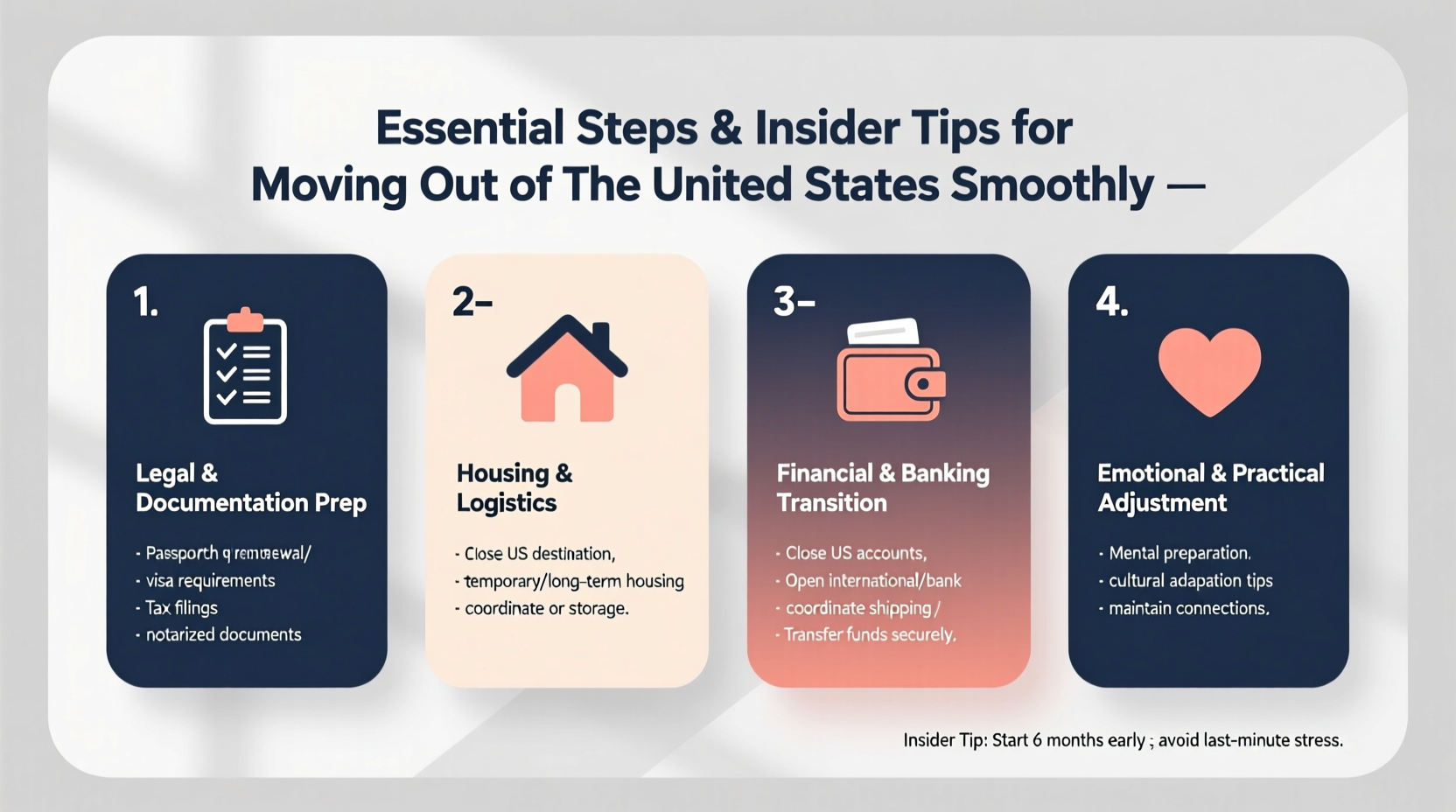
Before packing a single box, invest time in deep research about your target country. Beyond climate and cost of living, examine healthcare access, property laws, language barriers, and political stability. Some nations welcome expatriates with open arms; others impose strict residency caps or require proof of substantial income before issuing visas.
Countries like Portugal, Mexico, and Spain offer retirement or digital nomad visas that are relatively accessible. In contrast, nations such as Japan or Germany may require job offers or extensive documentation. Always verify information through official government immigration websites—not third-party blogs or forums.
Tip: Contact the embassy or consulate of your destination country early. They often provide detailed guides and can clarify visa processing times.Do’s and Don’ts When Choosing a Country
| Do | Don't |
|---|---|
| Check if your passport allows visa-free entry or long-term stays | Assume healthcare will be free or equivalent to U.S. standards |
| Research local banking requirements for foreigners | Overlook the cost of shipping pets or vehicles |
| Understand tax treaties between the U.S. and host country | Rely solely on tourist visits to judge long-term livability |
Step 2: Navigate Legal and Immigration Requirements
Securing the correct visa is non-negotiable. Tourist visas rarely permit extended stays or employment. Most long-term moves require applying for residency, work, or retirement permits well in advance—sometimes up to a year before departure.
Common pathways include:
- Work Visas: Often employer-sponsored (e.g., Germany’s EU Blue Card).
- Retirement Visas: Require proof of stable income (e.g., Panama’s Pensionado program).
- Investor Visas: Involve significant capital investment (e.g., Portugal’s Golden Visa).
- Family Reunification: Available if you have a spouse or parent who is a citizen.
Processing times vary widely. The Philippines, for example, may take 6–8 weeks for a retirement visa, while Canada’s Express Entry system can finalize applications in six months.
“Immigration success hinges on precision, not luck. One missing document can delay your application by months.” — Laura Mendez, International Immigration Consultant
Step 3: Manage Finances and U.S. Tax Obligations
Leaving the U.S. does not absolve you of tax responsibilities. The IRS taxes based on citizenship, not residence. Even as an expat, you may need to file annual returns and report foreign bank accounts (FBAR) if balances exceed $10,000 at any point.
Leverage key provisions like the Foreign Earned Income Exclusion (FEIE), which allows qualifying individuals to exclude up to $126,500 (2024) of foreign-earned income from U.S. taxation. However, eligibility requires either the Bona Fide Residence Test or Physical Presence Test (330 full days abroad in a 12-month period).
Open a local bank account early, but maintain a U.S. account for recurring bills, credit reporting, and emergencies. Consider freezing rather than closing credit cards to preserve credit history. Notify banks and lenders of your move to avoid flagged transactions.
Financial Checklist Before Departure
- File final state and federal tax returns
- Register with FATCA and submit Form 8938 if required
- Set up automatic payments for U.S.-based subscriptions
- Convert assets into liquid forms if needed
- Obtain international health insurance with global coverage
- Notify Social Security and Medicare offices of address change
Step 4: Handle Logistics: Shipping, Housing, and Belongings
Deciding what to take, sell, store, or donate is one of the most practical challenges. International movers charge by volume, not weight—shipping a full household container (20–40 ft) from the U.S. to Europe averages $4,000–$8,000.
Consider a hybrid approach: ship essentials and sentimental items, sell furniture locally, and purchase new appliances abroad. Use services like Craigslist, Facebook Marketplace, or estate sales to offload goods quickly.
For housing, short-term rentals (Airbnb, serviced apartments) allow time to explore neighborhoods before committing. Platforms like HousingAnywhere or local real estate agents can help secure long-term leases—but beware of scams. Always verify ownership and avoid wiring deposits without contracts.
Tip: Label boxes by room and include a manifest list inside each. Photograph high-value items before shipping for insurance claims.Real Example: Moving from California to Lisbon
Sarah Kim, a software developer from San Diego, relocated to Lisbon in 2023 under Portugal’s D7 Passive Income Visa. She sold her SUV and most furniture, shipped two containers of personal effects, and rented a furnished apartment for three months. By filing Form 2350 with the IRS, she secured an extension to establish foreign residency and qualify for FEIE. Within six months, she opened a Portuguese bank account, obtained a NIF (tax ID), and reduced her overall tax burden significantly. “The hardest part wasn’t the paperwork—it was letting go of ‘just in case’ items,” she said. “I now live with less, but I feel freer.”
Step 5: Prepare Emotionally and Culturally
Even with perfect logistics, culture shock is real. Adjusting to different communication styles, work rhythms, and social norms takes time. Language barriers can amplify feelings of isolation, especially in non-English-speaking countries.
Start learning the local language before arrival using apps like Duolingo or Babbel. Join expat communities on Facebook or InterNations to connect with others making similar transitions. Attend cultural orientation sessions if offered by employers or relocation agencies.
Maintain ties to home without anchoring yourself emotionally. Schedule regular calls with family, but also build routines in your new city—join a gym, take a class, volunteer. These small steps foster belonging faster than nostalgia ever could.
“Expatriation isn’t just a physical move—it’s psychological recalibration. Those who thrive are not the ones with the most money, but the most adaptability.” — Dr. Amir Hassan, Cross-Cultural Psychologist
Frequently Asked Questions
Do I need to renounce my U.S. citizenship to avoid taxes?
No. You can live abroad indefinitely without renouncing citizenship. The U.S. allows dual nationality, and most expats retain their passports while complying with tax filing requirements. Renunciation is irreversible and carries a $2,350 fee, plus potential exit taxes if you’re deemed a \"covered expatriate.\"
Can I keep my U.S. driver’s license and phone number?
You can keep your U.S. driver’s license for identification, but most countries require conversion after a certain period (often one year). For phone numbers, use VoIP services like Google Voice or Skype to maintain your number internationally, though call quality may vary.
What happens to my Social Security benefits when I move abroad?
In most cases, you can continue receiving Social Security payments overseas, especially in countries with payment agreements with the U.S. However, benefits are suspended in certain nations (e.g., North Korea, Vietnam) due to sanctions or administrative restrictions. Report address changes promptly via the SSA website or U.S. embassy.
Final Steps and Timeline Overview
Begin preparations at least 6–12 months in advance:
- Months 1–3: Research destinations, consult immigration experts, assess financial readiness.
- Months 4–6: Apply for visas, secure housing, begin downsizing belongings.
- Months 7–9: File tax forms, notify institutions, schedule movers.
- Months 10–12: Finalize travel plans, pack strategically, conduct medical checkups.
Conclusion
Moving out of the United States is a bold step toward a broader horizon. With careful planning, financial awareness, and cultural openness, the transition can be smooth and deeply rewarding. Avoid last-minute scrambles by starting early, trusting verified sources, and building a support network before departure. Every document filed, every box packed, brings you closer to a life designed on your own terms.
🚀 Ready to begin your international journey? Start today by downloading the U.S. Department of State’s pre-departure checklist or consulting a certified relocation specialist. Your next chapter awaits.