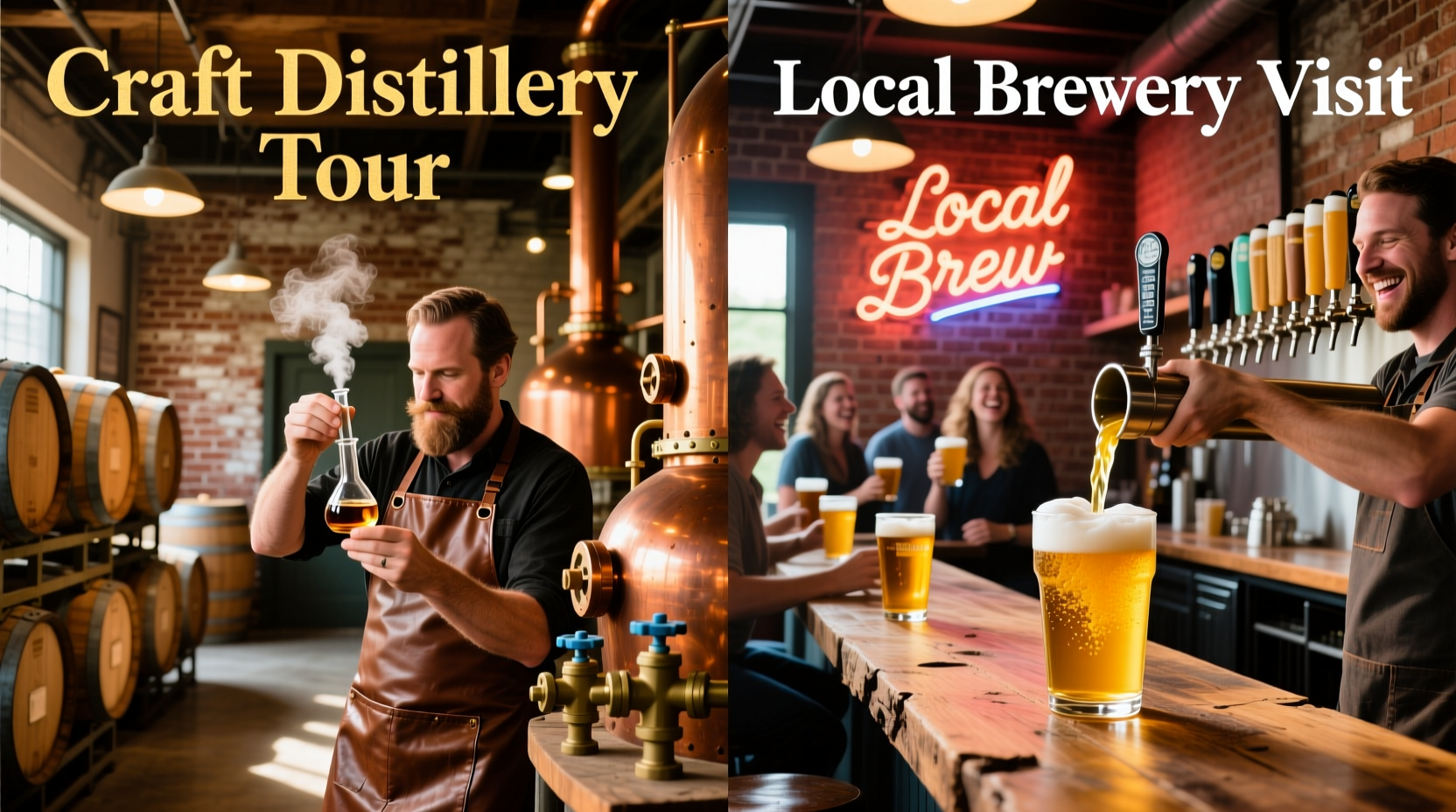
Choosing between a craft distillery tour and a local brewery visit isn’t just about picking a drink—it’s about selecting a cultural immersion. Both represent pillars of the American artisan beverage renaissance, yet they unfold in profoundly different ways. Distilleries operate with the patience of alchemists: aging spirits in oak for years, monitoring humidity and temperature like meteorologists, and coaxing complexity from grain, yeast, and time. Breweries move with the rhythm of the season—batching, fermenting, and packaging within days or weeks, responding to hop harvests, local water chemistry, and shifting palates. Neither is inherently “better.” But one may be richer for *you*—depending on what you value most: contemplative depth or communal immediacy, technical precision or creative spontaneity, legacy craftsmanship or collaborative energy.
1. The Sensory Architecture: Depth vs. Dynamism
A distillery tour engages the senses with layered intentionality. You’ll smell toasted oak barrels before you see them—vanilla, clove, dried cherry, and char cutting through the cool, damp air of the rickhouse. Tasting is measured and methodical: small pours of uncut whiskey at barrel strength, then diluted to reveal how water unlocks hidden florals or softens tannins. You’ll notice how a single batch evolves over three years—not as a linear progression, but as a conversation between wood, spirit, and environment. As master distiller Elena Ruiz of Copper Hollow Distillery explains:
“Whiskey doesn’t age in time—it ages in place. A barrel in Kentucky’s humid summers sweats spirit into the wood; in Scotland’s cool, salty air, it breathes slowly. That’s why terroir matters as much for spirits as it does for wine.”
Brewery visits, by contrast, emphasize vibrancy and volatility. The air hums with the sweet, bready aroma of fermenting wort and the sharp, citrusy punch of Citra or Mosaic hops. You’ll taste beer that’s still carbonating in the tank—bright, fizzy, and alive—with flavors that will mellow or fade within weeks. Sour beers evolve daily; hazy IPAs peak at 10 days old. This impermanence makes every pour feel urgent and personal. Where distilling rewards patience, brewing celebrates presence.
Tip: At a distillery, ask to smell the “angel’s share”—the evaporated portion from a barrel sample. At a brewery, request a “tank sample” straight from fermentation to taste beer before filtration or carbonation.2. Educational Rigor: Chemistry, Craft, and Time Scales
Distillery tours often function as immersive science seminars. You’ll learn why copper stills remove sulfur compounds, how column stills separate fractions by boiling point, and why new charred oak imparts vanillin while used bourbon barrels contribute coconut and caramel. Temperature-controlled rickhouses are discussed like climate-controlled libraries—each floor offering different microclimates that shape flavor. The math is precise: proof, ABV, barrel entry proof, and evaporation rates are all tracked, logged, and debated.
Brewery education leans toward applied biology and seasonal responsiveness. You’ll hear how water profile (calcium, sulfate, chloride ratios) dictates whether a pilsner tastes crisp or a stout feels silky. You’ll learn why lager yeast ferments cold and slow, while saison strains thrive at 85°F—and how wild microbes like Brettanomyces can transform beer over months in foeders. But unlike distilling, where variables are tightly controlled across years, brewing embraces controlled chaos: a single fermentation tank might host four different yeasts in one week, each producing distinct esters and phenols.
| Dimension | Craft Distillery Tour | Local Brewery Visit |
|---|---|---|
| Typical Time Horizon | Years (aging), decades (legacy stocks) | Days to weeks (fermentation), months (sours, barrel-aging) |
| Core Science Focus | Thermodynamics, wood chemistry, ethanol volatility | Microbiology, enzymology, water mineral balance |
| Key Equipment Insight | Reflux columns, hydrometers, barrel staves, humidity sensors | Conical fermenters, whirlpool tanks, hop dosers, pH meters |
| Learning Pace | Deliberate, cumulative, archival | Rapid, iterative, experimental |
3. Human Scale & Community Texture
Most craft distilleries remain deeply personal enterprises. In the U.S., fewer than 2,500 licensed craft distilleries operate—many run by couples or families who mill their own grain, hand-label bottles, and answer tasting room emails themselves. Tours often include the founder recounting the 3 a.m. still malfunction that nearly bankrupted them—or showing the original 50-gallon still now mounted on the wall like a family heirloom. You’re not just tasting whiskey—you’re witnessing resilience made liquid.
Breweries, especially neighborhood taprooms, cultivate a different kind of intimacy: the communal pulse of regulars. You’ll see the barkeep remember your name and your usual flight order. You’ll overhear brewers debating hop substitutions with a homebrewer at the next stool. Many breweries host weekly trivia, live acoustic sets, or “Brew & Draw” nights—events built less around the product and more around shared space. It’s less about lineage and more about belonging. As brewer Marcus Chen of Riverbend Tapworks puts it:
“Our taproom isn’t a retail outlet—it’s the third place between work and home. The beer matters, but the conversation matters more.”
4. Mini Case Study: Two Saturdays in Asheville, NC
In March, Sarah—a food writer and lifelong bourbon enthusiast—booked a Saturday morning tour at Highland Park Distilling Co., a 12-year-old operation housed in a renovated textile mill. She spent 90 minutes walking through the mash tun, watching copper stills gleam under skylights, then sat in the barrel room sampling a 4-year rye finished in maple syrup casks. She left with notes on tannin integration and a quiet reverence for time’s role in transformation.
That same afternoon, she visited Tupelo Honey Brewing Co., a taproom two miles away. There, she joined an informal “Meet the Brewer” session where head brewer Lena introduced a new kettle sour brewed with local blackberries. Sarah watched as Lena adjusted the pH meter mid-pour, explained why lactobacillus needed no oxygen, and passed around samples from three different fermentation vessels—all brewed the same day, tasting wildly different. She stayed for two hours, chatting with neighbors about composting programs and the city’s upcoming bike lane expansion.
Sarah later wrote in her newsletter: “The distillery gave me awe. The brewery gave me connection. One taught me how to listen to time. The other taught me how to listen to people.” Neither experience was richer in absolute terms—but their richness lived in different dimensions.
5. Practical Comparison: What to Expect & How to Prepare
Planning matters—especially because both experiences involve alcohol service, variable group sizes, and seasonal availability. Here’s how to optimize each:
Distillery Tour Checklist
- ✅ Book ahead: Most distilleries limit tours to 12–16 people and require reservations—even for walk-ins during peak season.
- ✅ Wear closed-toe shoes: Safety regulations apply near hot stills and wet floors in production areas.
- ✅ Bring water and snacks: Tastings often include high-proof spirits (110+ proof), and rickhouses can be physically taxing.
- ✅ Ask about barrel selection: Many distilleries let visitors choose their own barrel for private bottling—ask if this option exists.
- ✅ Request a “non-standard” sample: Instead of the standard flight, ask for a comparison—e.g., same whiskey at cask strength vs. 90 proof—to understand dilution’s impact.
Brewery Visit Checklist
- ✅ Check tap list online first: Breweries update taps daily. If you’re after a rare fruited sour or limited IPA, call ahead to confirm availability.
- ✅ Go early on weekends: Taprooms fill fast—especially when new releases drop on Friday afternoons.
- ✅ Ask about “cellar” or “library” offerings: Many keep older vintages (sours, barleywines, imperial stouts) for special requests—not listed on the board.
- ✅ Try a flight + one full pour: Flights teach breadth; a full pour lets you appreciate mouthfeel, carbonation, and finish without rushing.
- ✅ Engage the staff beyond beer: Ask about their favorite local coffee roaster, bike shop, or bookstore—their recommendations often reveal deeper community ties.
6. When Authenticity Meets Accessibility
Authenticity manifests differently. Distilleries often guard their processes closely—proprietary yeast strains, exact barrel rotation schedules, or custom-cut copper stills. Their “authenticity” lies in consistency, repeatability, and reverence for tradition—even when innovating. A distiller may spend six months perfecting a single mash bill, knowing it must perform identically across 500 barrels.
Breweries express authenticity through responsiveness. A true local brewery changes its menu monthly based on what’s fresh at the farmers’ market (think peach-lavender wheat in July, roasted beet porter in November) or what the homebrew club submitted for “Collab Night.” Their authenticity lives in impermanence—in the willingness to fail publicly with a hopped-up gose that flops, then pivot to a barrel-aged oatmeal stout by December.
This distinction shapes accessibility. Distilleries often charge $20–$35 for a guided tour with tasting—reflecting labor intensity, regulatory compliance, and long capital cycles. Breweries frequently offer free self-guided taproom access, with flights starting at $12–$16. That lower barrier invites broader participation: families with older kids, students, casual drinkers curious about process—not just connoisseurs.
7. FAQ: Clarifying Common Confusions
Is a distillery tour appropriate for someone who doesn’t drink whiskey?
Absolutely—if you appreciate craft, history, or food science. Many distilleries produce gin, vodka, or apple brandy with botanical-forward profiles. Others offer non-alcoholic “spirit alternatives” (like house-made shrubs or barrel-aged teas). More importantly, the story of grain-to-glass transformation holds universal appeal—especially when told by passionate makers.
Do breweries ever offer behind-the-scenes access like distilleries do?
Yes—but it’s rarer and often requires relationship-building. Some host “Brewer for a Day” events quarterly; others invite regulars to volunteer during grain-in or dry-hop sessions. Unlike distilleries, which rely on scheduled tours for safety and workflow, breweries integrate education organically—during slow weekday afternoons or post-shift “staff tastings” open to guests.
Which offers better value for learning about local ingredients?
Both excel—just differently. Distilleries highlight terroir through grain sourcing (e.g., heirloom corn from nearby farms, malted barley grown 20 miles away) and water filtration methods. Breweries spotlight hyperlocal inputs: foraged spruce tips, backyard honey, or spent grain donated to local bakeries. To maximize ingredient literacy, attend a distillery’s annual “Grain Day” or a brewery’s “Harvest Fest”—both celebrate origin stories with tangible, seasonal proof.
Conclusion
“Richer” isn’t a fixed metric—it’s a reflection of your values in that moment. Choose the distillery tour when you seek depth: the gravity of time, the poetry of transformation, the quiet pride of mastery honed over years. Choose the brewery visit when you crave resonance: the buzz of shared discovery, the joy of ephemeral creativity, the warmth of a community that treats you like a neighbor, not a customer. Neither diminishes the other. In fact, the most fulfilling beverage journeys often weave both threads—starting with a slow-sipped rye at a distillery’s tasting bar, then ending the evening with a hazy IPA poured by someone who knows your dog’s name and your favorite hiking trail.
Your palate, your curiosity, your sense of time and place—they all deserve experiences that honor their unique rhythm. So don’t settle for “which is better.” Ask instead: *What do I need to feel fully present today?* Then raise a glass—not just to the liquid, but to the life behind it.
💬 Have you experienced both? Share your “richer moment” in the comments—was it the silence of a rickhouse at dawn, or the laughter ringing off stainless steel during a taproom pour? Your story helps others find their perfect pour.