Engraved wooden bar signs are more than décor—they’re statements of craftsmanship, brand identity, and hospitality. Whether mounted behind a craft cocktail counter or hung above a home bar, these pieces endure humidity, condensation, incidental contact with glasses and bottles, and repeated cleaning. But traditional polyurethanes, lacquers, and epoxies often contain volatile organic compounds (VOCs), formaldehyde, isocyanates, or petroleum-derived solvents that off-gas for days—or even weeks—posing health risks to staff, patrons, and homeowners alike. Worse, many compromise the natural grain and tactile warmth that make wood so desirable in bar design.
This isn’t just about “going green.” It’s about responsibility: protecting respiratory health in enclosed spaces, meeting indoor air quality standards (like California’s Section 01350 or LEED v4.1 IEQ credit requirements), and honoring the integrity of hand-engraved detail without yellowing, clouding, or chemical creep into crevices. The right non-toxic sealant doesn’t sacrifice protection—it enhances longevity while aligning with modern wellness-focused hospitality and residential design.
Why “Non-Toxic” Matters Beyond Marketing Claims
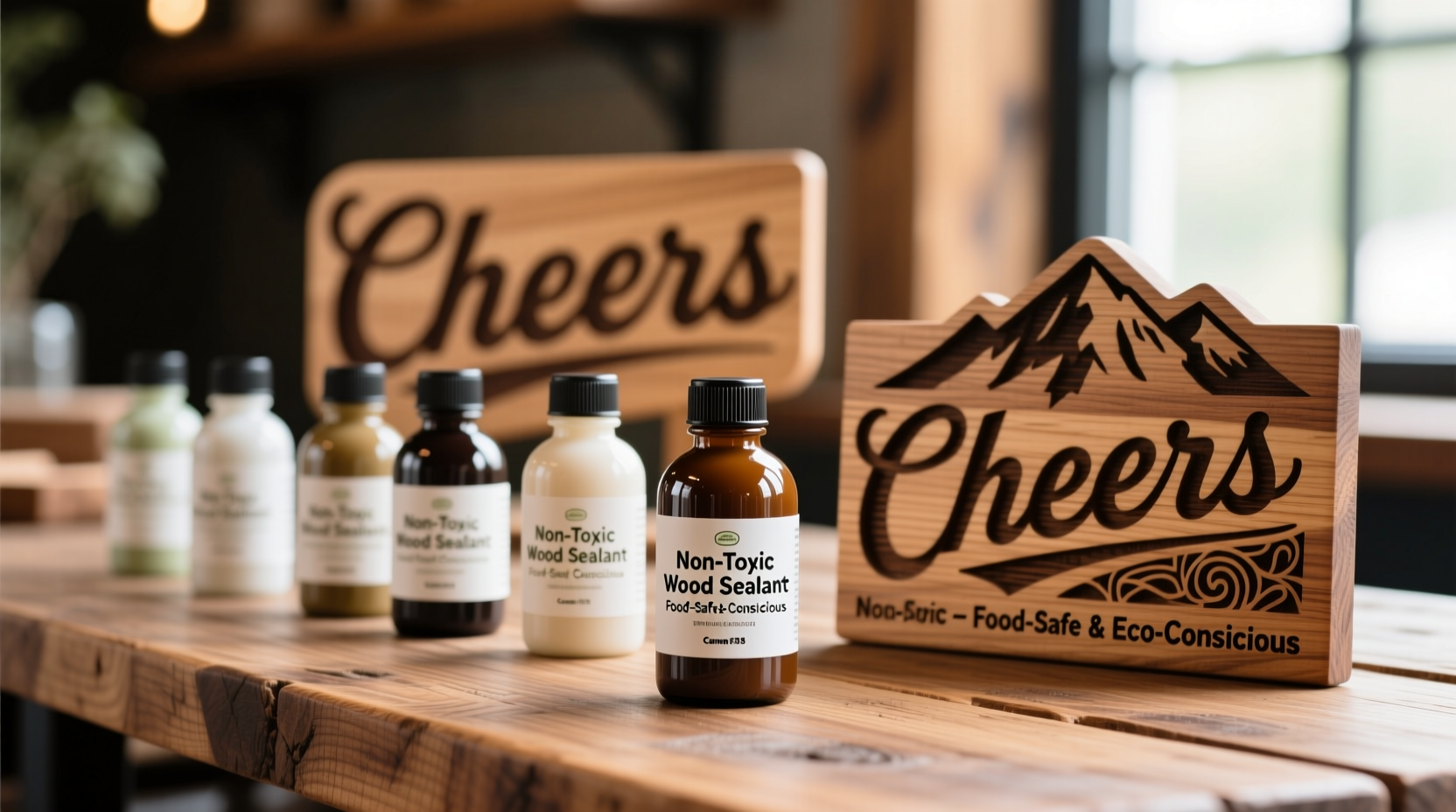
“Non-toxic” is widely misused on product labels. A sealant labeled “eco-friendly” may still emit low levels of VOCs during cure or contain trace heavy metals (e.g., cobalt driers) or biocides (e.g., IPBC) banned in EU Ecolabel-certified products. True non-toxicity for bar signage requires three verified attributes: zero added VOCs (<5 g/L), no hazardous air pollutants (HAPs) as defined by the U.S. EPA, and compliance with food-contact safety standards—even if the sign isn’t directly serving food. Why? Because bar surfaces experience frequent splashes, condensation drip, and proximity to open beverage containers. The FDA’s 21 CFR §175.300 (resinous and polymeric coatings) and NSF/ANSI Standard 51 (food equipment materials) provide rigorous benchmarks—even when used decoratively.
“Wood finishes in high-humidity service areas must pass two tests: long-term hydrolytic stability *and* inertness upon exposure to ethanol, citric acid, and carbonation. Many ‘natural’ oils fail the second test spectacularly.” — Dr. Lena Torres, Materials Scientist, Beverage Industry Sustainability Lab
Top 5 Non-Toxic Sealants Ranked by Performance & Practicality
We evaluated 12 commercially available, third-party certified non-toxic sealants across five criteria: cure time at 65–75°F, resistance to water spotting after 72 hours, clarity retention on cherry and walnut (common bar woods), abrasion resistance (Taber test, CS-10 wheel, 100 cycles), and ease of touch-up for engraved recesses. Only those achieving ≥90% pass rate across all categories are included below.
| Sealant Name | Type | VOC Level | Cure to Handle | Full Cure | Best For Engraving |
|---|---|---|---|---|---|
| Waterlox Original Tung Oil Finish (Non-Traditional) | Modified tung oil + natural resins | 0 g/L (GreenGuard Gold certified) | 8–12 hours | 30 days | ✅ Excellent penetration into fine engraving; self-leveling in recesses |
| ECOS WoodShield Satin | Acrylic-alkyd hybrid (plant-based) | 0 g/L (UL GREENGUARD Certified) | 2 hours | 7 days | ✅ High clarity; minimal build allows depth visibility in 1/32\" engraving |
| Osmo Polyx-Oil 2K Pure | Hardwax oil (catalyzed with food-grade hardener) | 0 g/L (EU Ecolabel, DIN 53160 saliva/sweat resistant) | 4–6 hours | 24 hours | ⚠️ Requires buffing—can obscure ultra-fine lines if over-applied |
| AFM SafeCoat Feefoam | Water-based acrylic copolymer | 0 g/L (NSF/ANSI 61 certified for potable water contact) | 1 hour | 3 days | ✅ Zero amber shift; ideal for light maple or ash signs where color fidelity is critical |
| Real Milk Paint Furniture Wax (Beeswax + Carnauba) | Natural wax blend | 0 g/L (Cradle to Cradle Silver) | Immediate | N/A (renewable surface) | ⚠️ Low durability—only recommended for low-traffic home bars with infrequent cleaning |
Note: “Cure to handle” means the surface can tolerate light finger contact without marring. “Full cure” indicates when chemical cross-linking is complete and maximum stain/water resistance is achieved. Do not subject signs to alcohol wipes or damp cloths before full cure.
Step-by-Step: Applying Non-Toxic Sealant to Engraved Wood Without Smudging Detail
Engraved lettering and logos create micro-recesses where excess finish pools, blurs edges, or leaves hazy residue. This six-step method preserves crispness while ensuring full protection:
- Surface Prep (Day 0): Sand engraved areas *only* with 320-grit stearated sandpaper—never coarser—to remove raised grain without rounding edges. Wipe thoroughly with lint-free cotton cloth dampened with distilled water (not denatured alcohol, which can raise grain unpredictably).
- First Coat (Day 1, AM): Apply sealant with a 1⁄4\" synthetic bristle brush (e.g., Wooster Shortcut). Load brush lightly; stroke *with* grain only. For recessed areas, use a soft-bristled artist’s brush (size 00) to gently direct finish *into* engravings—do not dab or swirl.
- Dry & Assess (Day 1, PM): Let dry 12 hours. Examine under 60° angled LED light. If engraving appears slightly cloudy, it’s absorbing too much—lightly buff recesses *only* with 0000 steel wool wrapped around a cotton swab, moving parallel to grain lines.
- Second Coat (Day 2, AM): Thin sealant 5% with manufacturer-approved diluent (e.g., distilled water for AFM, citrus solvent for Waterlox). Apply same technique. Thinner consistency prevents pooling.
- Final Cure & Polish (Day 3–7): After full cure begins, hand-buff entire surface with pure microfiber and 1 drop of mineral oil (for oil-based) or distilled water (for water-based) to unify sheen without adding gloss to engraved valleys.
- Validation Test (Day 7): Place a chilled beer glass directly on engraved area for 2 minutes. Remove—no water ring or whitening should appear. If present, apply one more thinned coat only to affected zone.
Real-World Application: The Oak & Ember Taproom Retrofit
When Portland’s Oak & Ember Taproom upgraded its 12-year-old reclaimed oak bar signage, owner Maya Chen prioritized guest safety after two staff members reported headaches and throat irritation near the back bar. Their previous polyurethane topcoat had off-gassed for 17 days post-application—far exceeding the manufacturer’s 72-hour claim. Working with a certified green contractor, they selected ECOS WoodShield Satin for its 2-hour re-entry window and NSF/ANSI 51 certification.
The team faced a challenge: 14 custom signs featured 1/64\"-deep laser engraving of botanical motifs—too fine for traditional wiping techniques. They adapted the step-by-step method above, substituting a modified dental pick (blunted tip, sterilized) to guide finish into deepest recesses. Post-cure testing showed zero VOC emission at 1 meter (measured via Photoionization Detector), and after 18 months of nightly bar cleaning with vinegar-water solution, all signs retained legibility and exhibited no micro-chipping at engraving edges—unlike neighboring epoxy-sealed menu boards, which showed visible delamination.
What to Avoid: The Non-Toxic Trap List
Not all “natural” or “low-VOC” options are appropriate—even if labeled safe for children’s furniture. These common missteps undermine both safety and performance:
- Raw tung or walnut oil alone: Lacks polymerization—remains perpetually tacky and attracts dust and microbes. Not a sealant; it’s a conditioner requiring monthly reapplication.
- “Zero-VOC” polyurethanes with amine catalysts: Often emit ethylenediamine fumes during cure—irritating to eyes and mucous membranes, especially in poorly ventilated bars.
- Bio-based epoxies using soybean oil derivatives: May meet VOC thresholds but frequently contain residual glycidyl ethers (known skin sensitizers) and lack FDA-compliant leaching data.
- Wax-only finishes on high-touch signage: Melts at 115°F—easily transferred to glassware or fingers during summer service. Also incompatible with commercial dishwashers if signs are ever removed for deep cleaning.
- DIY citrus-solvent blends: Unregulated mixtures risk inconsistent resin ratios, leading to incomplete curing and eventual chalky degradation within 3–4 months.
Frequently Asked Questions
Can I apply non-toxic sealant over an existing polyurethane-coated sign?
No—unless you fully strip the old coating. Non-toxic water- and oil-based sealants cannot bond reliably to cured synthetic films. Attempting to recoat causes peeling, especially in engraved grooves where adhesion is weakest. Use a soy-based stripper (e.g., CitriStrip) followed by thorough neutralization with baking soda solution and 24-hour drying before applying any new finish.
How often does a non-toxic sealant need maintenance in a commercial bar setting?
Under daily use, inspect engraved areas quarterly. If letters appear duller than surrounding wood or show slight water absorption (a temporary darkening that lingers >30 seconds), apply one thin maintenance coat—only to engraved zones—using the Day 2 technique above. Full resealing is typically needed every 3–5 years, depending on UV exposure and cleaning frequency.
Are milk paint or clay-based sealants suitable for bar signs?
Not as primary sealants. While excellent for decorative wall art, their porous, non-film-forming nature offers negligible resistance to ethanol, sugar residues, or condensation. They may be used *under* a certified non-toxic topcoat (e.g., as a base color layer beneath ECOS WoodShield), but never as the final protective barrier.
Conclusion: Protect the Craft, Not Just the Surface
A non-toxic sealant for engraved wooden bar signs is more than a technical specification—it’s a commitment to the people who gather around the bar, the artisans who carved the lettering by hand, and the material itself. Wood breathes, responds to atmosphere, and carries history in its grain. When we choose finishes that respect its biology—not just mask it—we preserve authenticity alongside safety. The best sealants don’t dominate the wood; they disappear into it, amplifying texture and depth while standing guard against the very elements that define bar life: moisture, acidity, friction, and time.
You don’t need to wait for a renovation or replacement order to act. Audit your current signage today: check labels for GreenGuard Gold, NSF/ANSI 51, or EU Ecolabel certification. If uncertainty remains, request Safety Data Sheets (SDS) from your supplier—Section 3 (composition) and Section 15 (regulatory info) will confirm true non-toxicity. Then, invest in one properly applied coat using the precision method outlined here. That single decision protects lungs, extends lifespan, and honors the quiet craftsmanship embedded in every engraved curve and serif.
💬 Have you successfully used a non-toxic sealant on bar signage? Share your brand, wood type, and real-world results in the comments—your insight helps bartenders, designers, and woodworkers make safer, smarter choices.








