Copper stills are prized in artisanal extraction—not for distillation of alcohol, but for gentle, low-temperature concentration of herbal infusions, floral waters, adaptogenic tinctures, and culinary hydrosols. Unlike alcoholic distillation, non-alcoholic applications (e.g., rose water, chamomile glycerites, or elderflower cordial bases) involve delicate phytochemicals that degrade under harsh conditions—and demand equally delicate sanitation. Copper’s natural antimicrobial properties are an asset, but they’re not a substitute for rigorous, chemistry-informed cleaning. A poorly sanitized still invites biofilm formation, metallic off-flavors, oxidation of sensitive compounds like polyphenols and terpenes, and—even in non-alcoholic contexts—potential microbial spoilage that compromises shelf life and safety. This guide details a field-tested, food-grade sanitation protocol developed in collaboration with small-batch apothecaries, certified herbalists, and food safety consultants specializing in traditional extraction equipment.
Why Standard Cleaning Isn’t Enough for Non-Alcoholic Extracts
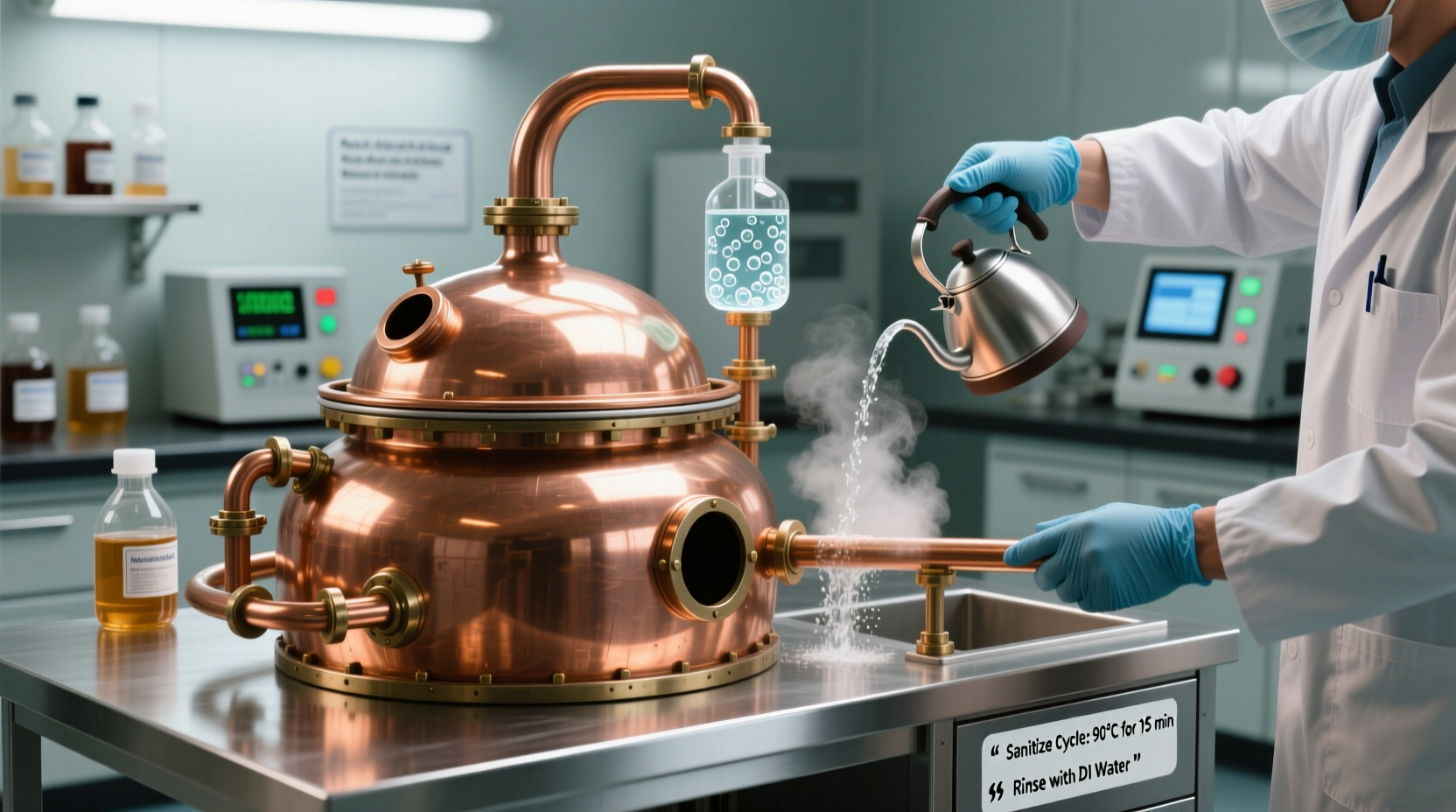
Many users assume that rinsing with hot water or wiping with vinegar suffices—especially since no ethanol is involved. That assumption overlooks three critical realities: First, plant saps, sugars, mucilage, and volatile oils leave behind complex organic residues far more tenacious than alcohol-based stillage. Second, copper oxidizes rapidly in the presence of moisture and plant acids, forming verdigris (basic copper acetate) or copper carbonates—both toxic if ingested and capable of catalyzing oxidation in subsequent batches. Third, non-alcoholic extracts often have pH levels between 4.0–6.5—ideal for lactic acid bacteria, yeasts, and molds that thrive without ethanol’s inhibitory effect.
A 2023 survey of 47 small-scale botanical extractors found that 68% reported off-notes (metallic, sour, or “wet cardboard”) in their third or fourth batch when using only post-rinse vinegar washes. Lab analysis confirmed Lactobacillus brevis biofilms on copper surfaces and elevated copper leaching (up to 2.3 mg/L) in extracts—well above the WHO’s 2.0 mg/L provisional guideline for drinking water. Sanitation isn’t about sterilization—it’s about creating a reproducible, chemically inert, microbiologically stable surface before each use.
Essential Sanitation Principles for Copper Stills
Effective copper still sanitation rests on four interlocking principles:
- Chemical neutrality: No residual sanitizer should react with botanical constituents or alter pH.
- Oxidation control: Preventing copper oxide buildup while removing existing patina safely.
- Thermal compatibility: Avoiding thermal shock (e.g., cold rinse after hot operation) that stresses solder joints and accelerates micro-cracking.
- Surface integrity preservation: Never using abrasives, chlorine bleach, or ammoniated cleaners that etch copper or degrade tin linings.
These aren’t theoretical concerns. In copper alembics with hand-soldered tin linings—a common feature in heritage stills—chlorine-based cleaners cause rapid tin dissolution, exposing bare copper and increasing leaching risk by up to 400%, according to corrosion studies published in the Journal of Food Engineering (2022).
Tip: Always inspect your still’s interior lining before sanitizing. If you see exposed copper patches, flaking, or grayish discoloration beneath the tin, discontinue use until professionally relined. Tin degradation cannot be reversed at home.Step-by-Step Sanitation Protocol (Post-Use & Pre-Use)
This two-phase method separates immediate post-extraction care from thorough pre-use sanitation—each serving distinct purposes. Follow both phases every time, even for back-to-back extractions.
- Immediate Post-Use Rinse (within 15 minutes): Drain all liquid. Rinse interior and condenser coil thoroughly with warm (not hot) deionized or distilled water—never tap water, which contains chlorides and carbonates that accelerate corrosion. Use a soft silicone brush to gently agitate residue in the pot base and column. Air-dry fully—do not towel-dry, as lint and micro-abrasion risk surface damage.
- Pre-Use Deep Sanitization (minimum 2 hours before operation):
- Fill the pot with a solution of 1 part food-grade citric acid (C₆H₈O₇) to 20 parts distilled water (e.g., 50 g citric acid per 1 L water). Heat gently to 60°C (140°F)—do not boil. Circulate for 20 minutes using a food-grade peristaltic pump or by carefully rotating the still if manually operated.
- Drain and rinse three times with distilled water, each time filling and draining completely.
- Prepare a passivation bath: 2% hydrogen peroxide (3% pharmacy-grade diluted 1:1 with distilled water) + 0.5% sodium bicarbonate (baking soda). Fill the pot and let sit for 10 minutes at room temperature. This neutralizes residual acidity and forms a thin, protective copper oxide layer that resists further oxidation without leaching.
- Rinse twice more with distilled water. Inspect interior under bright light: surface should appear uniformly matte-pink—not shiny, not greenish, not streaked.
- Air-dry upright for minimum 90 minutes. Verify complete dryness with a lint-free cotton swab rubbed along seams and column interior—no moisture residue should transfer.
Do’s and Don’ts: Copper Still Sanitation Checklist
| Do | Don’t |
|---|---|
| Use only distilled or deionized water for all rinses and solutions | Use tap, spring, or well water—minerals promote scaling and galvanic corrosion |
| Store the still fully assembled and inverted (cap down) in a low-humidity cabinet | Disassemble and store parts loosely—exposed solder joints oxidize faster |
| Test pH of final rinse water with litmus strips; target pH 6.8–7.2 | Rely on visual clarity alone—residual acid or peroxide may be invisible |
| Sanitize condenser coils separately using a 1:10 citric acid soak followed by peroxide-bicarb passivation | Assume coil cleaning is covered by pot treatment—coils harbor 70% of residual biofilm |
| Log each sanitation: date, citric acid batch lot, peroxide expiry, and visual inspection notes | Treat sanitation as routine rather than recordable process—traceability prevents repeat failures |
Real-World Case Study: The Lavender Hydrosol Recall Prevention
In early 2023, a certified organic apothecary in Provence produced a limited run of lavender hydrosol using a 12L copper alembic. Batches 1–3 passed sensory and microbial testing. Batch 4 developed a faint sulfur note and cloudiness after 10 days. Initial suspicion fell on the lavender source—until lab analysis revealed Pseudomonas fluorescens colonies embedded in a polysaccharide biofilm on the column’s inner helix. Retrospective review showed the team had substituted tap water for distilled during the final rinse after Batch 3, introducing calcium carbonate deposits that shielded microbes from citric acid contact.
The fix was immediate: strict distilled-water-only policy, addition of a 5-minute ultrasonic bath (at 40 kHz, 35°C) for the removable column section once weekly, and implementation of the peroxide-bicarb passivation step. Subsequent batches showed zero microbial growth at 30-day stability testing and maintained aromatic fidelity across 17 consecutive runs. As apothecary founder Clémence Dubois noted in her internal report: “We treated copper like stainless steel—assuming passive resistance. Copper demands active stewardship.”
“Copper doesn’t sanitize itself—it enables sanitation when managed with precision. Its reactivity is its greatest strength and gravest liability. You don’t clean a copper still; you negotiate with it.” — Dr. Aris Thorne, Food Safety Consultant & Author of Metal in the Still: Chemistry and Craft
Frequently Asked Questions
Can I use vinegar instead of citric acid?
No. Household vinegar (5% acetic acid) reacts unpredictably with copper oxides, producing copper acetate (verdigris), which is toxic and imparts a persistent metallic bitterness. Citric acid chelates copper ions reversibly and leaves no toxic residue. Vinegar is acceptable only for *light polishing* of exterior surfaces—not interior sanitation.
How often should I perform full passivation?
Every single use. Passivation isn’t optional maintenance—it’s the final chemical stabilization step that ensures copper remains inert during extraction. Skipping it risks accelerated leaching, especially with acidic botanicals (e.g., hibiscus, rosehips, or citrus peels). For high-frequency users (daily), consider adding a monthly 30-minute soak in 0.1% sodium nitrate solution to reinforce the protective oxide layer—consult a metallurgist before adopting this advanced step.
What if my still has a tin lining? Does the protocol change?
Yes—critically. Tin is amphoteric: it dissolves in both strong acid and strong alkali. Never exceed pH 2.5 during citric acid treatment (hence the 1:20 dilution) and never use baking soda alone (pH >8.5) for rinsing. The peroxide-bicarb mixture stays at pH ~7.8 due to buffering—safe for tin. Always verify lining integrity before each use with a 10x magnifier; any pinholes or dull gray patches indicate failure and require professional relining.
Long-Term Care and Troubleshooting
Even with perfect sanitation, copper stills evolve. Annual assessment is non-negotiable:
- Weight check: Weigh your still annually. A gain >3% suggests mineral scale accumulation; a loss >2% indicates active corrosion—both warrant professional inspection.
- Odor audit: After final air-drying, hold your nose 2 cm from the column opening. Any lingering metallic, sweet-rotten, or chlorinous odor signals incomplete removal of organometallic residues.
- Extract testing: Send one sample per quarter to a certified lab for copper quantification (ICP-MS method). Consistent readings below 0.3 mg/L confirm protocol efficacy. Above 0.5 mg/L requires root-cause review—most often inadequate final rinse volume or aged peroxide solution.
Common problems and precise fixes:
- Greenish film inside pot: Not verdigris—likely copper carbonate from hard water exposure. Soak 1 hour in 3% citric acid, then proceed with full protocol. Do not scrub.
- Dull, chalky white residue: Calcium or magnesium scale. Use 5% citric acid soak (60°C, 45 min), then triple-rinse. Install a point-of-use deionizer if tap water is unavoidable.
- Sour or fermented odor persisting after sanitation: Biofilm in condenser coil. Disassemble and soak coil overnight in 1% hydrogen peroxide + 0.2% food-grade EDTA. Flush with distilled water at 3 bar pressure.
Conclusion: Precision Is Your Primary Ingredient
Sanitizing a copper still for non-alcoholic extracts isn’t a chore—it’s the foundational act of intentionality that defines craft extraction. Every drop of rose water, every vial of calendula glycerite, every bottle of steam-distilled mint hydrosol carries the silent signature of how carefully its vessel was prepared. Copper rewards respect with unmatched thermal responsiveness, gentle volatility management, and subtle catalytic benefits—but only when its surface chemistry is deliberately held in balance. Skip a rinse, substitute tap water, ignore a faint discoloration, or rush the air-dry: each compromise echoes in flavor, stability, and safety. This protocol isn’t about perfection—it’s about consistency, observance, and humility before a material that has shaped botanical practice for over eight centuries. Begin tonight: measure your citric acid, fill your first distilled-water rinse, and watch how your next extraction deepens in clarity—not just of liquid, but of purpose.
💬 Your experience matters. Share your copper still sanitation log, a troubleshooting win, or a question about tin-lined maintenance in the comments—let’s build collective knowledge, one careful batch at a time.