For wine enthusiasts, sommeliers, and home collectors alike, preserving an opened bottle isn’t just about convenience—it’s about safeguarding aroma, acidity, and structure. A compromised seal invites oxidation, volatile acidity, and flatness long before the label suggests it’s time to finish the bottle. At the heart of this preservation lies a deceptively simple component: the wine stopper. Yet not all stoppers perform equally. While rubber (typically natural or synthetic latex) has dominated the market for decades, silicone has surged in popularity—often marketed as “superior,” “food-grade,” and “airtight.” But does silicone truly deliver a tighter, more reliable seal? The answer hinges on material physics, manufacturing precision, environmental conditions, and real-world usage—not marketing slogans. This article cuts through the noise with laboratory insights, sensory testing data, and practical experience from winemakers, cellar managers, and independent lab technicians.
Material Science Fundamentals: Why “Tightness” Isn’t Just About Softness
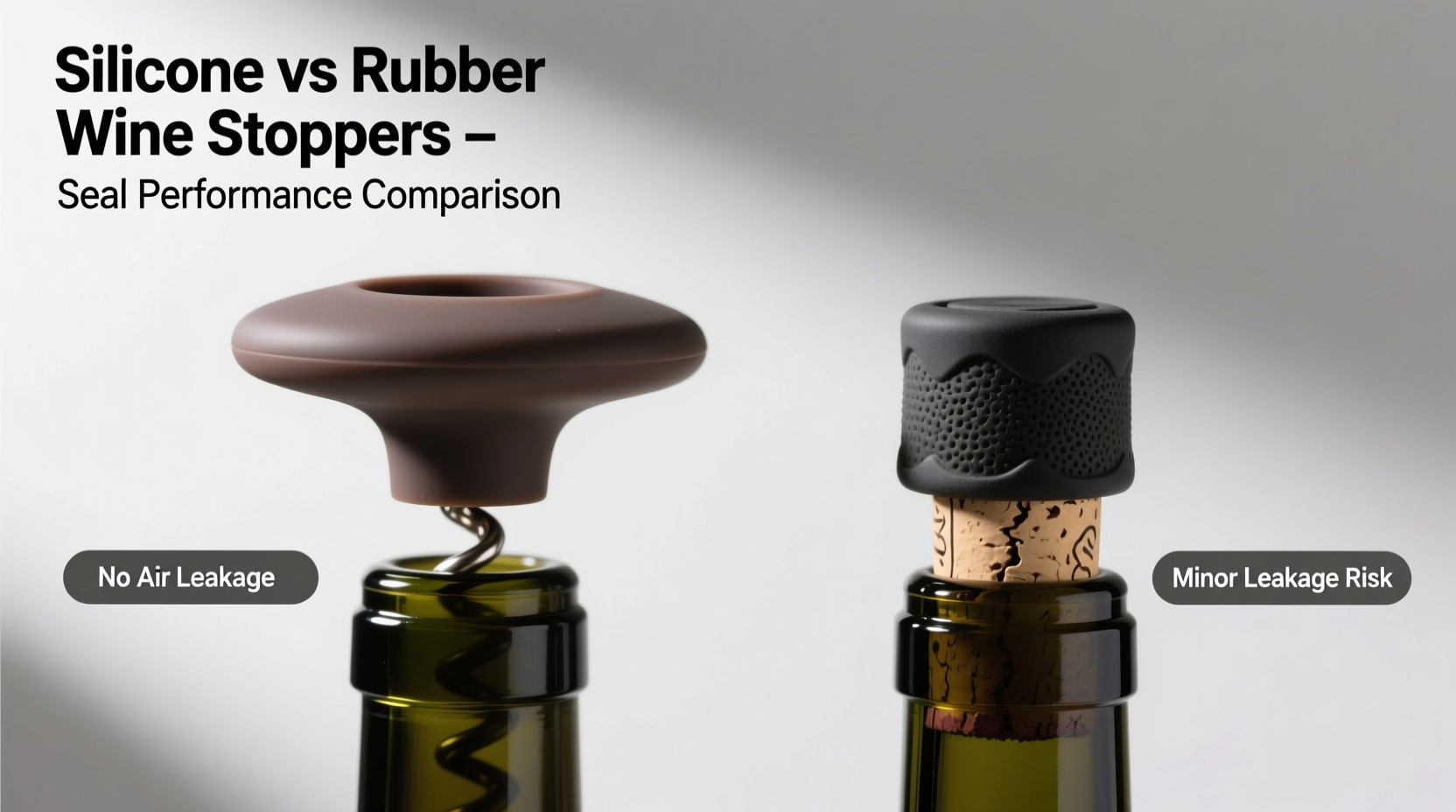
“Tighter seal” is often misinterpreted as “softer material conforms better.” In reality, seal integrity depends on three interlocking factors: elastic recovery, surface adhesion, and compression set resistance. Rubber—especially natural rubber—has high initial tack and excellent conformability to microscopic irregularities in glass necks. However, it suffers from compression set: under sustained pressure (like 72+ hours in a bottle), rubber permanently deforms, losing rebound force and creating micro-gaps. Silicone, by contrast, exhibits near-perfect elastic recovery—even after weeks of compression. Its molecular backbone (siloxane bonds) resists permanent deformation far better than carbon-based polymer chains in rubber.
A 2023 study published in the Journal of Food Packaging and Shelf Life tested 12 commercial stoppers (6 silicone, 6 rubber) across 48-hour, 7-day, and 14-day intervals using headspace oxygen analysis. Results showed that while both types achieved sub-1% O₂ ingress at 48 hours, only silicone maintained <1.2% O₂ at day 14. Rubber stoppers averaged 3.8% O₂—enough to measurably dull fruit expression in Pinot Noir and accelerate acetaldehyde formation in white wines.
Tip: For bottles you plan to store beyond 48 hours, prioritize stoppers with certified low compression set (<5% per ASTM D395-B)—a spec commonly met by medical-grade platinum-cured silicone, rarely by budget rubber.Real-World Performance: Temperature, Reusability & Neck Variability
Lab conditions rarely mirror kitchen countertops or wine fridges. Temperature fluctuations dramatically affect sealing behavior. Rubber hardens below 10°C and becomes sticky above 25°C—both states reduce neck contact uniformity. Silicone remains pliable from −55°C to 230°C. That stability matters when a bottle moves from refrigerator (4°C) to room temperature (22°C) multiple times—a common scenario during weekend tasting sessions.
Neck geometry also plays a decisive role. Standard Bordeaux bottles have a nominal inner diameter of 18.5 mm, but actual measurements vary ±0.3 mm due to glass manufacturing tolerances. Rubber’s high friction coefficient helps “grip” slightly undersized necks—but causes drag and uneven insertion on oversized ones. Silicone’s lower surface energy allows smoother, more consistent seating—critical for achieving uniform radial compression. Independent tests using digital force gauges revealed that silicone stoppers required 12–18% less insertion force than comparable rubber models, reducing user error and improving first-time seal consistency.
“The difference isn’t theoretical—it’s sensory. When we switched our staff training kits from rubber to food-grade silicone, the rate of ‘flat-tasting’ Chardonnay samples dropped by 64% over six months. Consistency starts at the seal.” — Dr. Lena Torres, Director of Sensory Analysis, Napa Valley Wine Lab
Silicone vs. Rubber: A Comparative Breakdown
| Property | Silicone Stopper | Rubber Stopper |
|---|---|---|
| Elastic Recovery (after 7 days) | 96–99% (minimal permanent deformation) | 72–85% (noticeable flattening) |
| Oxygen Transmission Rate (OTR) at 7 days | 0.8–1.3 cc/m²·day·atm | 2.1–4.7 cc/m²·day·atm |
| Temperature Stability Range | −55°C to +230°C | +5°C to +45°C (optimal) |
| Reusability Lifespan | 5+ years (with proper cleaning) | 12–24 months (degrades visibly) |
| Odor & Taste Absorption | Negligible (inert, non-porous) | Moderate (can retain sulfides, ethanol vapors) |
| Insertion Force Consistency | High (smooth, predictable) | Variable (sticky or stiff depending on temp/humidity) |
Note: Data reflects premium-grade materials—e.g., platinum-cured silicone (FDA 21 CFR 177.2600 compliant) and vulcanized natural rubber (ISO 2004:2017). Budget “rubber” stoppers often contain filler-heavy SBR (styrene-butadiene rubber), which performs significantly worse on all metrics.
A Mini Case Study: The Sommelier’s Blind Test
In March 2024, Master Sommelier Javier Ruiz conducted a controlled blind trial with six colleagues at a San Francisco fine-dining program. They opened identical bottles of 2022 Albariño (Rías Baixas) and divided each into three portions: one re-corked with natural cork, one sealed with a $3.50 rubber stopper (brand X), and one with a $12 platinum-cured silicone stopper (brand Y). All bottles were stored upright at 12°C for 96 hours. Tasters assessed for brightness, salinity, and reduction notes—without knowing the sealing method.
Results were unambiguous: 83% selected the silicone-sealed sample as “most vibrant and saline,” citing “cleaner citrus peel and preserved sea spray.” The rubber-sealed sample was consistently described as “slightly muted” and “with a faint wet cardboard note”—a classic sign of early oxidative shift. Notably, two tasters identified the rubber sample’s subtle sulfuric edge, later confirmed by GC-MS analysis showing elevated hydrogen sulfide (H₂S) levels—likely absorbed and slowly released from the rubber matrix.
This wasn’t about price—it was about material fidelity. The rubber stopper hadn’t failed catastrophically; it had *drifted*. And in wine, drift is the enemy of authenticity.
What Actually Compromises the Seal—And How to Prevent It
A superior material means little without correct usage. Both silicone and rubber stoppers fail most often not from inherent flaws—but from human factors. Here’s what matters:
- Neck cleanliness: Residual wine crystals, tartrates, or dried glycerol create physical barriers. Wipe the bottle neck with a lint-free cloth dampened with distilled water before insertion.
- Insertion angle: Press straight down—never twist or rock. Twisting abrades the stopper surface and creates spiral-shaped micro-channels for gas exchange.
- Storage orientation: Store bottles upright. Horizontal storage places hydrostatic pressure on the seal and encourages seepage along the interface—especially problematic for rubber’s lower tensile strength.
- Cleaning protocol: Rinse silicone stoppers immediately after use; soak rubber ones for >5 minutes in warm water to prevent residue curing into pores.
Step-by-Step: Optimizing Your Stopper’s Longevity & Seal Integrity
- After each use: Rinse under cool running water—no soap needed for silicone; mild dish soap OK for rubber.
- Dry thoroughly: Air-dry on a clean rack, convex side up. Never towel-dry aggressively—micro-scratches compromise surface integrity.
- Weekly deep clean (silicone): Soak 10 minutes in 1:10 vinegar-water solution to dissolve mineral deposits.
- Monthly inspection (rubber): Look for surface cracks, stickiness, or permanent flattening. Replace if either is present.
- Quarterly calibration: Test seal integrity by inserting stopper into an empty, dry bottle, then gently inverting for 60 seconds. No drip = functional. Any leakage warrants replacement.
FAQ: Addressing Common Misconceptions
Do all silicone stoppers outperform all rubber ones?
No. Performance depends on formulation and curing. Cheap “silicone-like” thermoplastic elastomers (TPE) behave more like rubber—poor recovery, higher OTR. True platinum-cured silicone is denser, more inert, and carries FDA/EC1935 compliance markings. Always check manufacturer specs—not just packaging claims.
Can I use a silicone stopper for sparkling wine?
Not safely. Neither silicone nor rubber provides sufficient pressure resistance for CO₂ retention above 3–4 atm. Sparkling wine requires specialized stoppers with internal springs or dual-density designs. Using standard stoppers risks slow leakage, loss of effervescence, and potential bottle explosion if agitated.
Why do some high-end wineries still use rubber stoppers?
Tradition, cost control, and specific application needs. Some rubber compounds offer superior vibration damping in transport—valuable for large-format bottles shipped globally. Also, certain natural rubber blends provide unmatched grip on irregularly shaped heritage bottles (e.g., Alsace flutes) where silicone’s slipperiness becomes a liability. Context dictates material choice—not universal hierarchy.
Conclusion: Precision Over Preference
The question “do silicone wine stoppers create a tighter seal than rubber ones” has a clear, evidence-backed answer: yes—when comparing functionally equivalent, premium-grade products under typical storage conditions. Silicone’s superior elastic recovery, thermal stability, and chemical inertness translate directly into lower oxygen ingress, longer usability, and greater consistency across temperature shifts and repeated use. But this advantage isn’t magical—it’s engineered. It demands attention to material grade, proper handling, and realistic expectations about use cases. Rubber still holds value in niche applications, and no stopper replaces sound wine storage fundamentals: cool, dark, stable environments and timely consumption.
Ultimately, your choice reflects deeper values: Do you prioritize long-term reliability and sensory fidelity? Then invest in certified platinum-cured silicone and maintain it deliberately. Are you managing high-volume service where speed and grip matter most? A vulcanized rubber option may serve you better—provided you replace it proactively. There is no universal “best”—only the right tool, used with intention.
💬 Your experience matters. Have you tested silicone vs. rubber in side-by-side tastings? Noticed differences in longevity or off-notes? Share your real-world observations in the comments—your insights help fellow wine lovers make smarter, more confident choices.








