Whiskey isn’t just a spirit—it’s a ritual. A slow pour over ice, the warmth of oak and spice unfolding in the glass, the quiet reverence of savoring something aged with intention. In that context, the vessel matters. A mass-produced tumbler may hold the liquid, but it doesn’t hold the story. Custom engraved whiskey glasses do. They transform an everyday drinking experience into a tactile heirloom: a fusion of craftsmanship, personal significance, and thoughtful design. More than novelty items or wedding favors, these pieces anchor memory in material form—engraved with names, dates, coordinates, inside jokes, or even a single word like “Resilience” or “Anchor.” When chosen with care and executed with precision, they become legacy objects: passed down, pulled out for milestones, and cherished not for their function alone—but for what they signify.
The Enduring Value Beyond Aesthetic Appeal
Custom engraving elevates whiskey glasses from utilitarian to symbolic—not through ornamentation, but through intentionality. Unlike printed or etched decals that fade, peel, or scratch off, laser or sand-carved engraving permanently alters the surface of the glass. This permanence mirrors the nature of the occasions they commemorate: anniversaries, retirements, military service completions, father-son traditions, or even recovery milestones. The weight of the glass—the subtle resistance as you lift it, the clarity of the crystal, the precision of the base—communicates respect. It signals that the recipient is worth more than a generic gift card or a hastily wrapped bottle.
Material integrity is non-negotiable. Premium lead-free crystal (often 24%–30% lead oxide equivalent in modern formulations) delivers superior clarity, resonance, and durability compared to standard soda-lime glass. When paired with deep, precise engraving—cut at consistent depth and angle—the result is both legible and elegant, never crude or shallow. Engraving isn’t decoration; it’s integration. The mark becomes part of the glass’s identity, visible only when light catches its contours or when fingers trace its relief.
Tip: Always verify the glass manufacturer’s annealing process—properly annealed crystal resists thermal shock and microfractures, ensuring your engraved set survives repeated dishwashing and temperature shifts.What Makes a Truly Meaningful Engraving? (Not Just “Cool Fonts”)
Engraving fails when it prioritizes flair over feeling. A monogrammed “J.S.” on a tumbler reads like corporate branding—not personal tribute. Meaning emerges from specificity, restraint, and resonance. Consider these principles:
- Context-first language: “Est. 1987” carries weight for a family business; “Nashville • 2023” anchors a milestone trip; “To the man who taught me patience—and how to nose a bourbon” adds voice and intimacy.
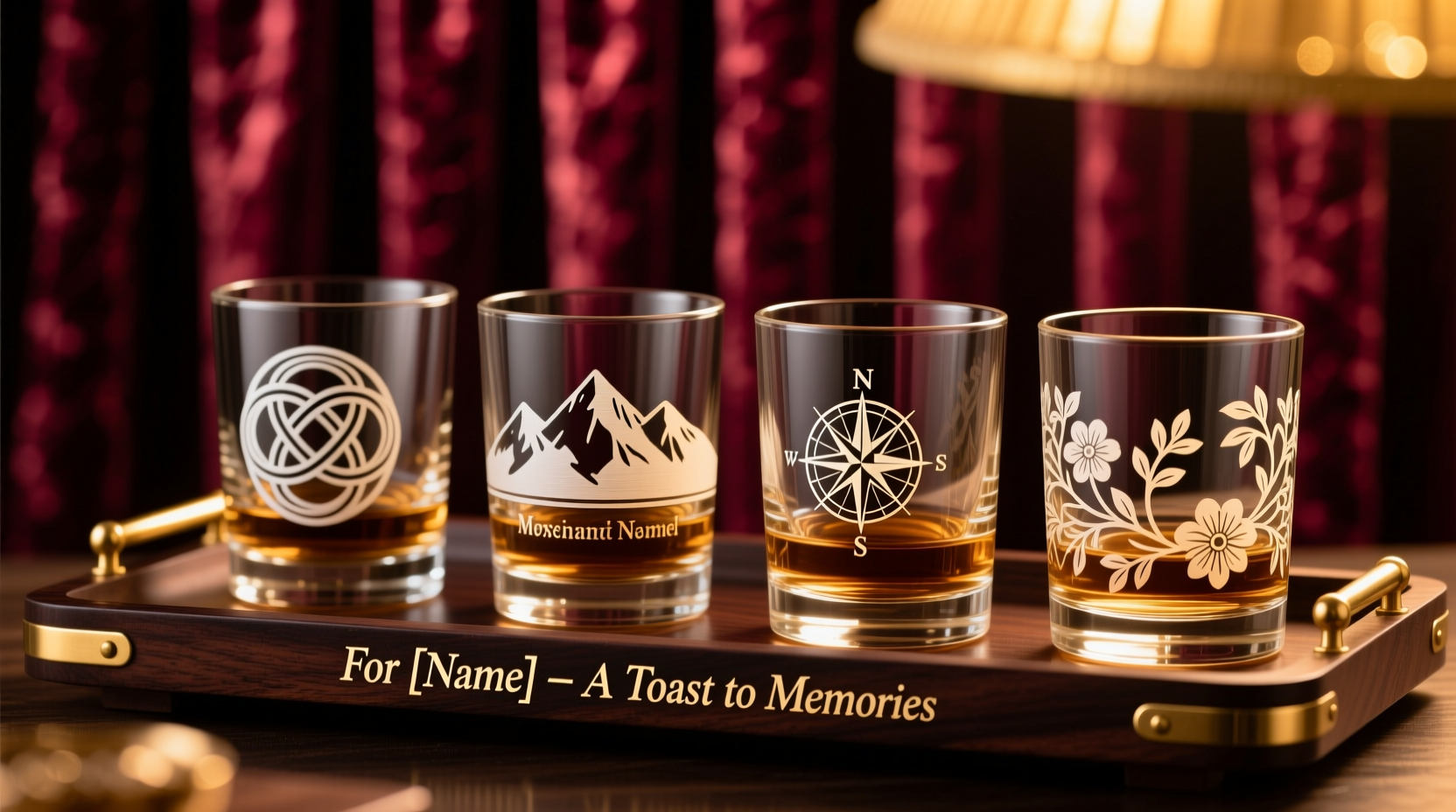
- Dimensional layering: Combine elements thoughtfully—e.g., a small compass rose + latitude/longitude + “Home is where the cask is.” Each component reinforces the other without clutter.
- Avoid ephemeral references: Inside jokes only two people understand may lose meaning over time. Opt instead for timeless values (“Curiosity,” “Steadfast,” “Gather”) or enduring symbols (a stag silhouette, a mountain range, a distillery’s iconic still shape).
- Typography as tone: Serif fonts (e.g., Garamond, Baskerville) convey tradition and gravitas; clean sans-serifs (e.g., Montserrat, Lato) suggest modernity and clarity; hand-drawn scripts should be used sparingly—and only if legible at 8pt size under natural light.
Engraving placement also affects impact. Base engraving remains discreet—visible only when the glass is lifted or turned, inviting discovery. Side engraving commands attention immediately but risks visual competition with label reading or hand placement. Rim engraving is rare and technically demanding but offers poetic subtlety—revealed only when the drinker brings the glass to their lips.
Real-World Impact: A Case Study in Intentional Gifting
In late 2022, Sarah Chen commissioned four custom whiskey glasses for her father’s 65th birthday—a man who’d quietly collected single malts for 42 years but rarely spoke about them. She didn’t choose his favorite distilleries. Instead, she selected four regions—Speyside, Islay, Highland, Campbeltown—and worked with a master engraver to inscribe each glass with a phrase her father had written in his tasting journal decades earlier: “Speyside: Where honey meets smoke,” “Islay: Salt, peat, and stubbornness,” “Highland: Mountains in a glass,” “Campbeltown: The forgotten heartbeat.” Below each, she added his initials and the year he first visited each region.
The reaction wasn’t just appreciation—it was emotional recalibration. Her father held the Speyside glass, traced the words with his thumb, and said, “I wrote that in ’83. I’d forgotten I’d even kept that notebook.” For weeks afterward, he poured different whiskies into each glass—not for flavor matching, but to revisit the memory each inscription evoked. The glasses became conversation starters at dinner, teaching tools for his grandchildren, and quiet companions during evening reflection. They didn’t replace his collection—they deepened its meaning.
“Personalization works only when it reflects lived experience—not just identity. A name is data. A phrase that echoes someone’s voice, rhythm, or worldview? That’s resonance.” — Liam O’Rourke, Lead Designer at Heritage Glassworks, 18 years engraving bespoke barware
Your Smart Personalization Checklist
Before placing an order, run through this actionable checklist to ensure your custom set delivers maximum emotional and functional value:
- ✅ Confirm glass specifications: Minimum thickness (≥4.5mm base), lead-free crystal composition, dishwasher-safe certification (ASTM F1287 or ISO 8536), and weight (ideal range: 320–420g per tumbler).
- ✅ Verify engraving method: Laser engraving for fine detail and consistency; sandcarving for deeper texture and tactile depth. Avoid acid etching—it degrades glass integrity over time.
- ✅ Test readability: Request a digital proof showing exact font size, kerning, and placement—viewed at actual scale on a white background and a dark background.
- ✅ Define usage context: Will these be used daily? At formal dinners? As display pieces? This determines whether you prioritize chip resistance (reinforced rim), stackability (tapered base), or acoustic properties (bell-shaped bowl for nosing).
- ✅ Plan for longevity: Choose engravings that won’t date poorly—avoid slang, trending hashtags, or pop-culture references likely to feel archaic in five years.
Engraving Options Compared: What Works Best for Which Occasion
| Engraving Type | Ideal For | Pros | Cons | Lifespan Expectancy |
|---|---|---|---|---|
| Laser Engraving | Names, dates, short quotes, logos, fine-line illustrations | Highest precision, fastest turnaround, consistent depth, works on curved surfaces | Less tactile than sandcarving; minimal shadow contrast on clear crystal | Indefinite—no wear under normal use |
| Sandcarving | Monograms, crests, nature motifs, layered text, high-contrast visibility | Deep, matte finish; highly legible; excellent for gifting photos or signatures; creates rich texture | Requires skilled operator; slightly longer production time; not ideal for ultra-fine script | Indefinite—physically removes glass, cannot fade |
| Hand-Etched (Traditional) | Artisanal commissions, limited editions, museum-quality pieces | Uniquely expressive, variable line weight, irreplaceable human touch | Expensive; inconsistent across sets; fragile detail may require extra handling care | Indefinite—but delicate lines may show micro-scratches over decades of polishing |
| Digital UV Printing | Budget sets, temporary branding, event giveaways | Full-color capability, fast, low minimums | Surface-level only; fades with washing; not food-safe long-term; feels “sticker-like” | 12–24 months with gentle hand-washing |
Step-by-Step: Ordering Your Set Without Regret
Follow this proven sequence to avoid common pitfalls and secure a set you’ll proudly present—and keep using—for years:
- Define the “why” clearly: Is this for a retirement toast? A 25th anniversary? A tribute to a mentor? Write it down. This anchors every subsequent decision.
- Select the glass profile first—not the engraving: Choose between classic lowball (for neat pours), double-old-fashioned (for larger ice), or copita-style (for serious nosing). Ensure wall thickness and base stability match intended use.
- Source three vetted engravers: Check their portfolio for consistency in spacing, depth control, and error correction. Read reviews mentioning “legibility after washing” and “packaging safety.”
- Submit text *exactly* as it should appear: No “TBD” or “maybe add a heart.” Specify capitalization, punctuation, and spacing. Engravers cannot interpret intent—they execute instructions.
- Request physical proof on scrap glass: Reputable makers will send a test engraving sample before full production. Examine it under varied lighting and hold it while pouring water to assess balance and grip.
- Confirm packaging specs: Individually boxed? Foam-lined? Rigid outer shipping box? Glass breaks in transit—not from impact, but from vibration-induced microfractures. Quality packaging prevents this.
FAQ: Practical Questions Answered
Can engraved whiskey glasses go in the dishwasher?
Yes—if they’re made from properly annealed, lead-free crystal and the engraving is laser or sandcarved (not surface-printed). However, hand-washing with warm water and a soft sponge preserves brilliance longer. Dishwasher heat and detergent can dull the luster of high-end crystal over time, especially on engraved surfaces where microscopic residue may accumulate in recesses.
How deep should engraving be for durability and aesthetics?
Optimal depth is 0.15–0.25mm. Shallower than 0.1mm risks fading under aggressive cleaning; deeper than 0.3mm compromises structural integrity and increases risk of chipping at engraving edges. Reputable artisans measure depth with digital calipers—not estimation.
Is it appropriate to engrave humorous or irreverent messages?
Yes—with caveats. Humor ages quickly and may misfire across generations or contexts. If using wit, ground it in shared history (“Still better than your golf swing, Dad—2024”) rather than broad satire. When in doubt, choose warmth over wit: “To the one who always knows which pour makes the moment right.”
Why These Glasses Outlive Trends—and How to Honor That Legacy
Fashion fades. Gadgets obsolete. Even fine whiskey changes with climate and cask trends. But a well-made, thoughtfully engraved whiskey glass endures—not because it’s indestructible, but because it’s irreplaceable. Its value compounds with use: the faint watermark ring left by years of careful rinsing, the softened edge of the engraving from thousands of thumb swipes, the way light bends differently through a glass warmed by human hands. These aren’t consumables. They’re vessels for continuity.
When you give custom engraved whiskey glasses, you’re not just offering a place to hold liquor. You’re affirming presence. You’re saying: *I see your journey. I remember the details. I want this object to accompany your next chapter—not as decoration, but as witness.* That intention transforms glass into gravity. It turns a simple toast into a covenant.
💬 Your turn: What phrase, date, or symbol would you engrave on a glass meant to last 50 years? Share your idea in the comments—we’ll feature thoughtful responses in our monthly curation of enduring personalizations.








