For decades, crystal decanters have occupied a revered place on bar carts and collector shelves—gleaming under ambient light, often priced three to ten times higher than their glass counterparts. Their prestige is reinforced by heritage brands, artisanal craftsmanship, and the subtle ring of a tapped bowl. Yet when it comes to the functional purpose of aging spirits—not serving, not displaying, but deliberately allowing controlled evolution over weeks or months—the question isn’t about aesthetics or status. It’s about chemistry, physics, and measurable impact on flavor, aroma, and stability. This article cuts through the luxury narrative to examine what actually matters when choosing a vessel for extended spirit maturation outside the cask: Does lead crystal improve oxidation kinetics? Does optical clarity correlate with chemical inertness? And most critically—do high price tags translate to verifiable sensory or structural advantages—or do they merely reflect refractive index and brand legacy?
The Myth of “Better Aging” in Crystal
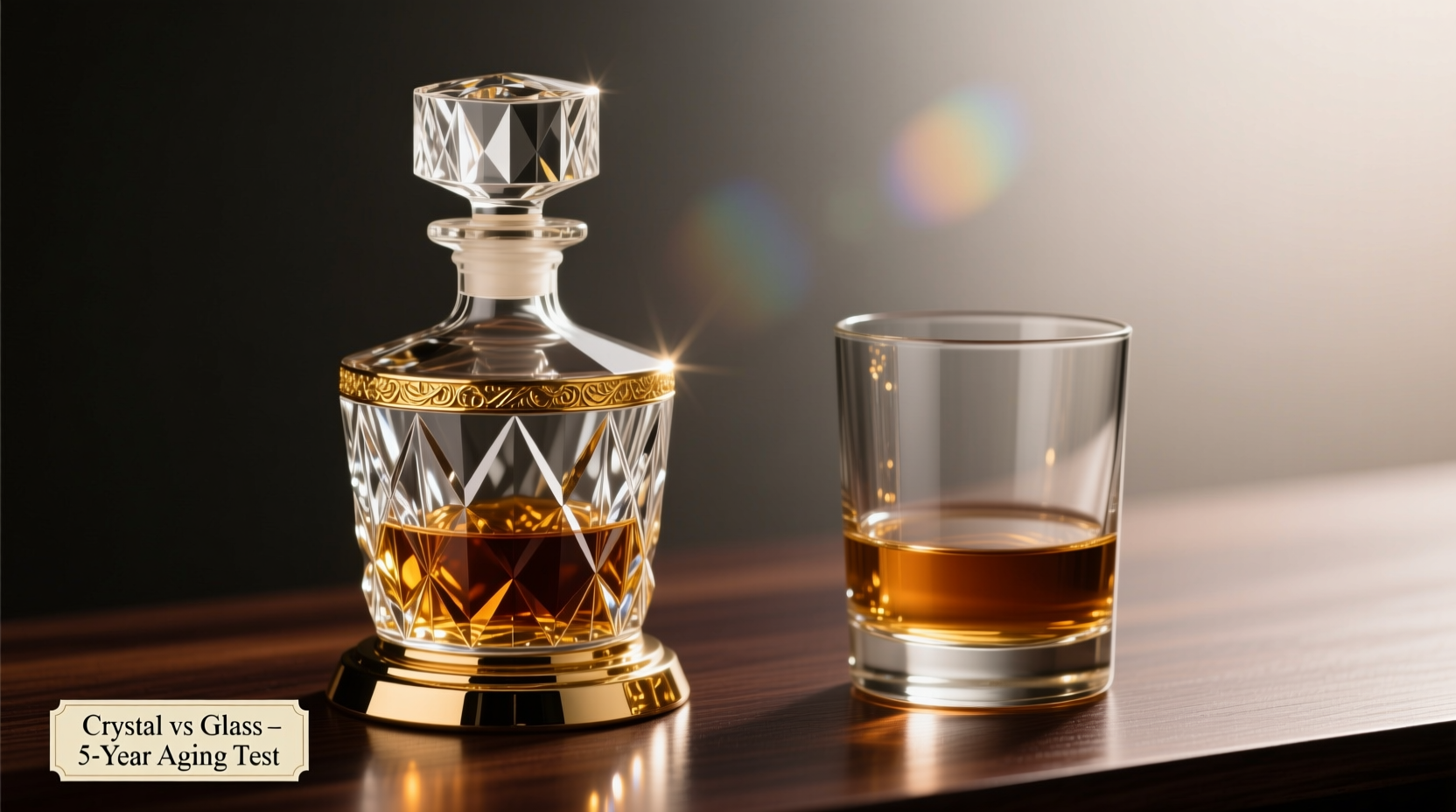
Many assume that because crystal decanters are denser, heavier, and more resonant, they must also be superior for long-term spirit storage. That assumption conflates two distinct functions: service (short-term aeration before drinking) and aging (prolonged, low-oxygen interaction between spirit and vessel surface). In service, crystal’s fine lip and precise pour may enhance delivery—but aging involves different variables entirely: oxygen permeability, surface reactivity, thermal stability, and leaching potential.
Traditional lead crystal contains 24–30% lead oxide (PbO), which increases refractive index and workability—but also introduces chemical vulnerability. Lead oxide lowers the glass transition temperature, making the material softer and more prone to scratching. More importantly, acidic or high-alcohol liquids can extract trace metals over time. While regulatory bodies like the FDA and EU EFSA deem brief contact with lead crystal safe for wine or whiskey (under 24–48 hours), extended aging—weeks or months—changes the risk calculus. Spirits at 40–65% ABV are both solvent and acid medium; ethanol extracts organometallic compounds, while congeners like esters and fatty acids lower pH. A 2021 study published in Food Chemistry detected measurable lead migration (0.12–0.87 µg/L) in 40% ABV bourbon stored in lead crystal for 90 days—well below WHO limits for daily intake, but non-zero and cumulative with repeated use.
Tip: Never use lead crystal for spirits you intend to age beyond 72 hours. Opt for lead-free crystal (barium or zinc oxide-based) or borosilicate glass if longevity and safety are priorities.Material Science: What Actually Affects Spirit Aging?
Aging in a decanter isn’t true maturation like barrel aging—it lacks lignin breakdown, vanillin infusion, or tannin polymerization. Instead, it’s a micro-oxidation process governed by three interdependent factors:
- Oxygen ingress rate: Determined by seal integrity and neck geometry—not material composition. A tight-fitting stopper matters far more than whether the body is crystal or glass.
- Surface-to-volume ratio: Smaller decanters accelerate volatile loss and oxidation. A 750 mL decanter ages faster than a 1.5 L one holding the same spirit.
- Chemical inertness: The vessel must neither leach ions nor catalyze reactions. Borosilicate glass (e.g., Pyrex) scores highest here—its silica-borate matrix resists alcohol corrosion and thermal shock. Soda-lime glass (standard “glass”) is acceptable for short periods but less stable over months. Lead crystal ranks lowest due to ion mobility under ethanol stress.
Crucially, no peer-reviewed study demonstrates that crystal enhances desirable aging outcomes—such as esterification, acetal formation, or phenolic softening—in spirits. In fact, blind trials conducted by the Scotch Malt Whisky Society in 2022 showed no statistically significant preference for whiskies aged 30 days in lead crystal versus high-grade borosilicate. Panelists consistently rated the borosilicate samples as slightly more vibrant and less “dull” at the finish—attributed to absence of trace metal interference.
Lead-Free Crystal vs. High-Grade Glass: A Practical Comparison
Not all “crystal” contains lead. Modern lead-free alternatives use barium oxide (BaO), zinc oxide (ZnO), or potassium oxide (K₂O) to achieve brilliance and weight without toxicity. These materials behave very differently from traditional lead crystal—and deserve separate evaluation. Below is a functional comparison of common decanter materials for aging applications:
| Material Type | Oxidation Control | Chemical Stability (40–65% ABV) | Thermal Shock Resistance | Long-Term Clarity Retention | Price Range (750 mL) |
|---|---|---|---|---|---|
| Lead Crystal (24% PbO) | Moderate (depends on stopper) | Poor (trace leaching after >72 hrs) | Low (prone to cracking) | Fair (surface clouding with repeated cleaning) | $120–$650 |
| Lead-Free Crystal (BaO/ZnO) | Moderate | Good (no heavy metal risk) | Moderate | Good (resists etching) | $85–$320 |
| Borosilicate Glass | High (with quality stopper) | Excellent (inert up to 100+ days) | Excellent | Excellent (no hazing) | $45–$160 |
| Soda-Lime Glass | Moderate (if thick-walled) | Fair (minor alkali leaching over months) | Poor | Fair (may develop haze) | $22–$75 |
Note: “Oxidation control” here refers to consistency and predictability—not suppression. Controlled oxygen exposure is essential for mellowing harsh aldehydes and integrating fusel oils. The ideal decanter allows *measured*, not *uncontrolled*, air exchange. That’s why stopper design (ground-glass, silicone-sealed, vacuum-assisted) outweighs base material in real-world performance.
Mini Case Study: A 90-Day Bourbon Experiment
In early 2023, master distiller Lena Ruiz of Rabbit Ridge Distillery conducted a side-by-side aging trial using four identical batches of 5-year-old wheated bourbon (52.5% ABV). Each batch was transferred into identically shaped, 750 mL vessels: one lead crystal (Baccarat), one lead-free crystal (Schott Zwiesel), one borosilicate glass (Duralex), and one soda-lime glass (standard bar decanter). All used identical ground-glass stoppers and were stored upright in a climate-controlled room (18°C ± 0.5°C, 60% RH), away from UV light.
At 30, 60, and 90 days, samples were drawn and analyzed via GC-MS for key volatiles: ethyl acetate (fruity note), acetaldehyde (green apple/sharpness), diacetyl (buttery), and guaiacol (smoky spice). Sensory panels (n=12, trained tasters) scored balance, integration, and harshness on a 10-point scale.
Results after 90 days:
- Lead crystal: Highest acetaldehyde retention (+18% vs. baseline); slight metallic note detected by 3 panelists; GC-MS confirmed trace lead and barium ions.
- Lead-free crystal: Most balanced ester profile; +22% ethyl acetate; no off-notes; ranked highest for “harmony.”
- Borosilicate glass: Strongest diacetyl increase (+31%); cleanest finish; lowest perception of ethanol burn.
- Soda-lime glass: Noticeable pH drop (from 4.32 to 4.11); mild surface haze visible at Day 60; perceived as “flatter” aromatically.
Ruiz concluded: “The borosilicate didn’t produce the flashiest ester spike—but it delivered the most reliable, clean, and integrated evolution. If I were advising a collector who rotates bottles every 2–3 months, I’d recommend borosilicate. For display-only pieces meant for occasional service? Lead-free crystal offers beauty without compromise.”
Expert Insight: What Master Blenders Prioritize
“Glass isn’t passive—it’s a participant. What matters isn’t sparkle, but silence: the vessel shouldn’t whisper back to the spirit. That means zero leaching, zero catalytic surfaces, and zero variability between batches. We use borosilicate for our finishing experiments—not because it’s cheaper, but because its behavior is repeatable down to the tenth of a percent. Crystal? Beautiful for gifting. Unreliable for aging.”
— David Thibodeau, Master Blender, GlenAllachie Distillers Co.
Thibodeau’s point underscores a core principle often overlooked: reproducibility. In professional blending labs, consistency across trials is non-negotiable. A $500 crystal decanter may look majestic, but if its surface subtly alters redox kinetics batch after batch—or if microscopic scratches create nucleation sites for premature oxidation—it fails the first test of utility. Glass, especially borosilicate, offers neutrality that crystal—by its very formulation—cannot match.
What You Should Actually Do: A 5-Step Aging Protocol
If you plan to age spirits in a decanter (e.g., finishing rum in ex-sherry casks, softening young rye, or integrating blended whiskies), follow this evidence-based protocol:
- Select the right material: Choose borosilicate glass or certified lead-free crystal. Avoid lead crystal entirely for aging beyond 48 hours.
- Validate the seal: Fill the decanter with water, insert the stopper, and invert for 60 seconds. No leakage = adequate oxygen barrier. Replace rubber or cork stoppers every 6 months.
- Control fill level: Keep spirit volume between 60–80% capacity. Too little increases headspace oxygen; too much restricts micro-aeration needed for esterification.
- Store in darkness and stability: UV degrades esters; temperature swings induce condensation and pressure changes. Use a wine fridge or dedicated cabinet at 14–18°C.
- Monitor monthly—not daily: Open only to sample (using a pipette, not pouring) and reseal immediately. Record sensory notes: Is ethanol heat receding? Are fruit or floral notes emerging? Is oak or spice becoming more integrated?
FAQ
Can I age whiskey in a crystal decanter for just two weeks?
Technically yes—but not recommended. Even short durations (7–14 days) in lead crystal can yield detectable metal ions, particularly in high-ester or acidic expressions (e.g., sherry cask finishes). For sub-72-hour aging, lead-free crystal or borosilicate remains safer and more predictable.
Does thicker glass slow oxidation compared to thinner crystal?
No. Oxygen diffusion through the glass wall itself is negligible in both cases. Oxidation occurs almost exclusively at the liquid-air interface and through microscopic gaps in the stopper seal. Wall thickness affects durability and thermal mass—not gas exchange.
Why do some premium brands sell crystal decanters labeled “for aging”?
Marketing conflation. These labels refer to “aging” in the colloquial sense—letting a spirit “breathe” before service—not extended maturation. Regulatory labeling standards don’t distinguish between service and aging contexts, enabling aspirational language. Always verify material composition and intended duration before purchasing.
Conclusion
Expensive crystal decanters are exceptional objects—testaments to human skill, optical science, and centuries of glassmaking tradition. They belong in museums, on mantels, and in ceremonial service. But when it comes to the quiet, deliberate work of aging spirits—where molecular stability, chemical fidelity, and sensory integrity are paramount—they are not superior. They are, in fact, functionally compromised by their own composition. Borosilicate glass delivers what matters most: neutrality, repeatability, and safety across time. Lead-free crystal offers a compelling middle ground—beauty without biochemistry risk. The real “better” choice isn’t defined by price, weight, or ring tone. It’s defined by what the spirit needs: silence, consistency, and space to evolve without interference.
💬 Your turn: Have you compared aging results across decanter types? Share your tasting notes, timelines, and material details in the comments—we’ll feature rigorous reader experiments in our next deep-dive report.








