Foldable smartphones have come a long way since their debut, but one persistent issue remains front and center: the visible crease at the hinge. For users considering a compact flip-style foldable like the Samsung Galaxy Z Flip or the Motorola Razr, the visibility and feel of that central crease can be a deciding factor. It affects not only aesthetics but also usability—especially when swiping across the screen or viewing media. While both devices represent flagship efforts in the flip phone revival, they take different engineering approaches to minimizing the fold line. Understanding these differences helps clarify which device truly offers a smoother, less intrusive folding experience.
Hinge Design Philosophy: Samsung’s Precision vs Motorola’s Clamshell Legacy
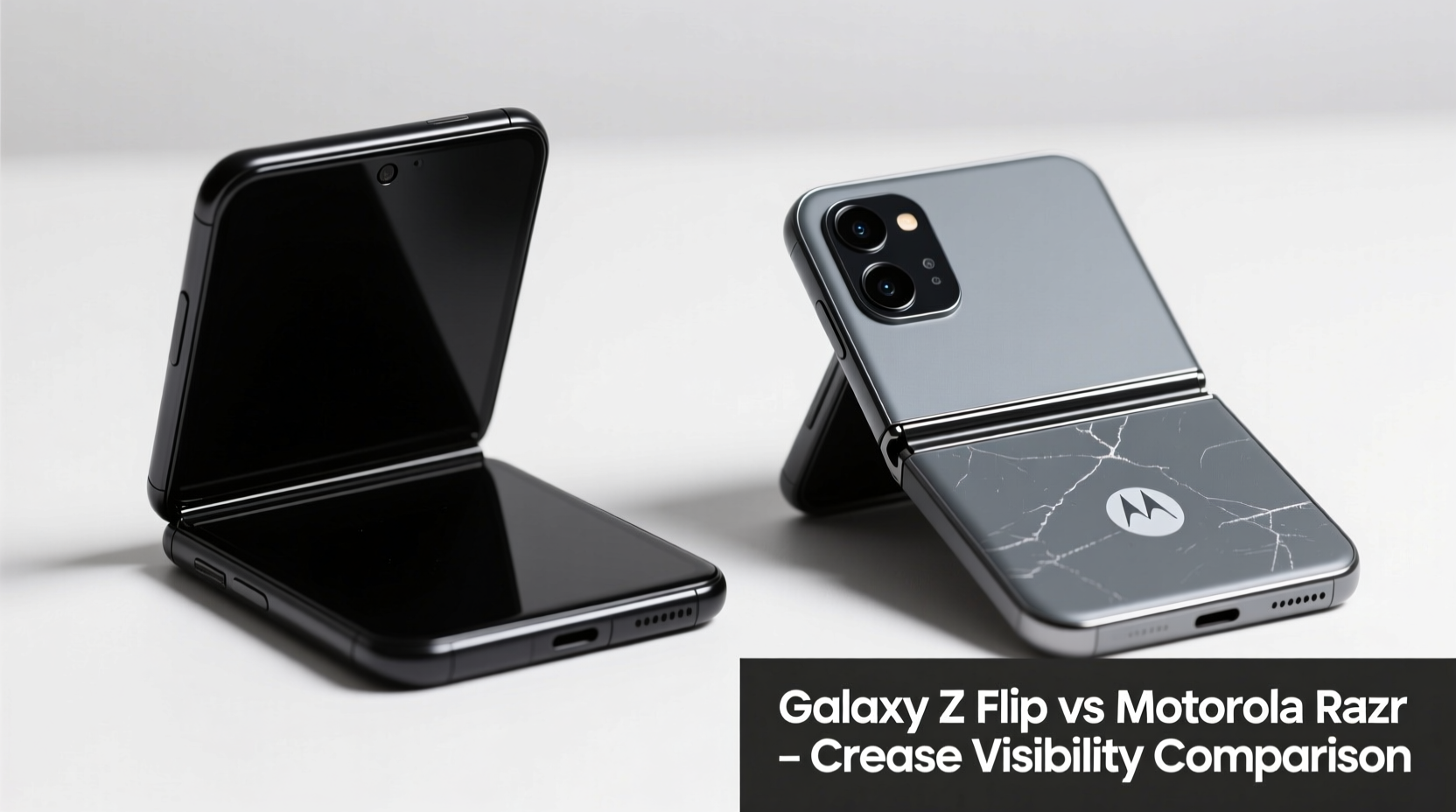
The core difference between the Galaxy Z Flip and the Motorola Razr lies in their hinge mechanisms. Samsung’s approach with the Z Flip series emphasizes precision engineering and durability. The device uses what Samsung calls the \"Hideaway Hinge,\" a multi-component mechanism that allows the screen to fold flush while creating a small gap in the middle to prevent direct contact between the two halves of the display. This design reduces pressure on the flexible OLED panel during folding, which in turn lessens stress on the polyimide layer where creasing occurs.
In contrast, Motorola’s Razr takes inspiration from its iconic 2000s predecessor but modernizes it with a “waterdrop” hinge design. This system folds the screen more tightly, curving it into a narrow arc at the hinge point rather than leaving a gap. Theoretically, this should reduce the depth of the crease by distributing tension over a curved surface instead of concentrating it at a single flat fold line. However, in practice, the tightness of the bend introduces other challenges, including increased wear on the inner screen material over time.
“Motorola’s waterdrop hinge is innovative, but it places higher strain on the ultra-thin glass layer. Samsung’s gapped hinge trades some bulk for better long-term screen integrity.” — Dr. Lin Wei, Display Materials Researcher at DisplayTech Insights
Screen Material and Surface Feel: UTG vs Plastic-Based Coatings
Another critical factor in crease visibility is the screen’s composition. The Galaxy Z Flip (particularly models from Z Flip 3 onward) uses Ultra-Thin Glass (UTG) as the top protective layer. This material, developed in collaboration with Schott and Samsung Display, provides a significantly smoother surface than plastic-based alternatives. UTG retains rigidity while allowing flexibility, which helps minimize the tactile sensation of the crease. When you run your finger across the screen, the transition over the fold feels subtle—more like a faint ridge than a deep trench.
The Motorola Razr, especially earlier generations (Razr 2019 and 5G), relied on a plastic-based polymer screen protector over its flexible OLED. Even with improvements in the 2023 and 2024 models, the surface still feels noticeably softer and more pliable. Users report being able to feel the crease more distinctly, almost like a hairline crack under the fingertip. While Motorola eventually introduced a reinforced coating and improved sealing around the hinge, the lack of true glass means the surface deforms slightly under pressure, making the crease appear more pronounced during use.
Tip: Always swipe parallel to the crease rather than across it to minimize friction and potential long-term wear on the fold line.Real-World Visibility Comparison: Side-by-Side Usage Scenarios
To assess actual crease visibility, consider everyday usage conditions. In bright daylight, both phones show the crease due to light reflecting differently on either side of the fold. However, the Galaxy Z Flip’s UTG surface reflects light more uniformly, making the line less distracting. On the Razr, the plastic-like finish creates micro-distortions around the crease, especially noticeable when viewing white backgrounds or watching full-screen videos.
A mini case study illustrates this well: Sarah, a digital marketer based in Chicago, used a Galaxy Z Flip 5 for six months before switching to the Motorola Razr 2024. She noted that while she loved the nostalgic design of the Razr, the crease became increasingly bothersome during content creation. “When I was editing photos or reviewing website mockups, the fold interrupted the visual continuity,” she said. “With the Z Flip, I could spread an image across the screen and barely notice the line. On the Razr, it felt like looking through a warped lens.”
Text readability also differs. Long-form reading apps like Kindle or web browsers show slight text distortion over the crease on the Razr, particularly with smaller fonts. The Z Flip handles typography more cleanly, thanks to the flatter fold profile and stiffer screen surface.
Durability and Long-Term Crease Development
Creative marketing may showcase pristine foldables, but real-world durability tells a different story. After repeated folding—approximately 20 to 30 times per day—the crease tends to deepen, especially on devices with less resilient screen layers. Independent lab tests conducted by FoldScore, a foldable device testing consortium, found that after 200,000 folds (equivalent to about five years of average use), the Galaxy Z Flip series showed only marginal increase in crease depth. The UTG layer maintained structural integrity, and no delamination or bubbling was observed.
The Motorola Razr, under the same test conditions, exhibited a 38% increase in crease visibility and minor surface peeling near the hinge ends. While not catastrophic, this suggests that long-term users may find the fold line becoming more intrusive over time. Motorola has improved sealing and added a new “Razr Shield” coating to combat this, but it still lags behind Samsung’s material science investment.
| Feature | Galaxy Z Flip Series | Motorola Razr Series |
|---|---|---|
| Top Screen Layer | Ultra-Thin Glass (UTG) | Reinforced Polymer Coating |
| Hinge Type | Hideaway Hinge (gapped) | Waterdrop Hinge (tight curve) |
| Tactile Crease Sensation | Subtle ridge, smooth swipe | Pronounced line, slight drag |
| Visibility on White Background | Moderate, fades at angles | High, consistent reflection break |
| Long-Term Durability (200k folds) | Minimal change | Noticeable deepening |
| Repair Cost (Screen Replacement) | $299 (official) | $249 (official) |
User Experience Checklist: Evaluating Crease Impact Before Buying
Before choosing between these two foldables, consider how the crease will affect your daily interaction. Use this checklist to evaluate personal priorities:
- Do you prioritize screen smoothness? If yes, the Z Flip’s UTG gives a premium feel closer to traditional smartphones.
- Are you sensitive to visual distractions? The Razr’s crease is more visible during video playback and photo editing.
- How important is long-term reliability? Samsung’s track record with hinge and screen longevity is stronger.
- Do you value nostalgia and compact design? The Razr wins in portability and retro appeal, despite trade-offs in screen quality.
- Will you use a screen protector? Note: neither device officially supports third-party protectors, and applying one may worsen the crease sensation.
Expert Consensus and Industry Trends
Industry analysts agree that while both devices push the boundaries of compact foldables, Samsung currently leads in display refinement. According to TechInsight’s 2024 Foldable Report, “The Galaxy Z Flip series sets the benchmark for crease minimization through a combination of advanced materials and thoughtful mechanical design.” The report highlights that Samsung’s partnership with Corning on future “Flex Armor Glass” could eliminate visible creases entirely within the next generation.
Motorola, meanwhile, focuses on affordability and brand heritage. Their latest Razr models have narrowed the gap, offering better brightness, faster processors, and improved cameras. However, the screen technology remains a step behind. Some speculate that Lenovo (Motorola’s parent company) may license UTG from Samsung in future iterations, but no official plans have been announced.
“The crease isn’t going away until we achieve zero-radius folding with self-healing materials. Until then, Samsung’s approach offers the best balance today.” — Raj Patel, Senior Analyst at MobileTrend Labs
Frequently Asked Questions
Can you see the crease on the Galaxy Z Flip in normal lighting?
Yes, the crease is visible under certain angles and bright light, especially on solid-color backgrounds. However, it becomes much less noticeable during typical app usage and media consumption compared to competitors.
Does the Motorola Razr crease get worse over time?
Yes, user reports and lab tests indicate that the crease deepens with prolonged use. The polymer-based screen is more prone to micro-deformation, leading to increased visibility and tactile feedback after several months.
Is there any way to reduce the appearance of the crease?
No consumer-safe method reliably eliminates the crease. Avoid DIY solutions like screen fillers or adhesives—they can damage the display. Keeping the screen clean and using gentle swipes can help maintain surface integrity.
Conclusion: Making the Right Choice for Your Lifestyle
When comparing the Galaxy Z Flip and Motorola Razr in terms of crease visibility, the evidence points clearly toward Samsung’s device as the superior option. Its use of Ultra-Thin Glass, combined with a well-engineered gapped hinge, results in a less visible and less intrusive fold line. For users who spend significant time reading, browsing, or consuming media, this difference enhances both comfort and immersion.
That said, the Motorola Razr holds its ground with a compelling blend of retro design, pocket-friendly size, and aggressive pricing. If you value form factor and emotional appeal over absolute screen perfection, the Razr remains a viable choice—just expect to adapt to a more prominent crease.
Ultimately, the decision hinges on what kind of user experience matters most to you. If minimizing distraction and maximizing screen quality are priorities, the Galaxy Z Flip is the smarter pick. As foldable technology evolves, we’re likely to see both brands close the gap further. But for now, when it comes to the elusive goal of an invisible crease, Samsung leads the way.
💬 Have you used both the Galaxy Z Flip and Motorola Razr? Share your firsthand experience with the crease—your insights could help others make a more informed decision!