It’s the week before Christmas. You’ve just unwrapped your favorite string of warm-white mini lights—only to find the first 24 bulbs glow brightly, while the rest remain stubbornly dark. No flickering, no dimming: just a hard, clean cutoff point. This isn’t a mystery—it’s a classic symptom of one or more predictable electrical failures common in series-wired incandescent and LED light strands. And while it feels like holiday sabotage, the truth is: most half-out strands can be restored in under 15 minutes with basic tools, zero soldering, and no electrician required.
Understanding why this happens—and knowing exactly where to look—separates frantic frustration from confident repair. This guide walks you through the physics behind the failure, gives you a field-tested diagnostic workflow, and delivers actionable fixes that work whether you’re dealing with $8 big-box store lights or premium commercial-grade sets. No assumptions. No jargon without explanation. Just clarity, speed, and reliability—when you need it most.
Why Half-Out Happens: The Series Circuit Reality
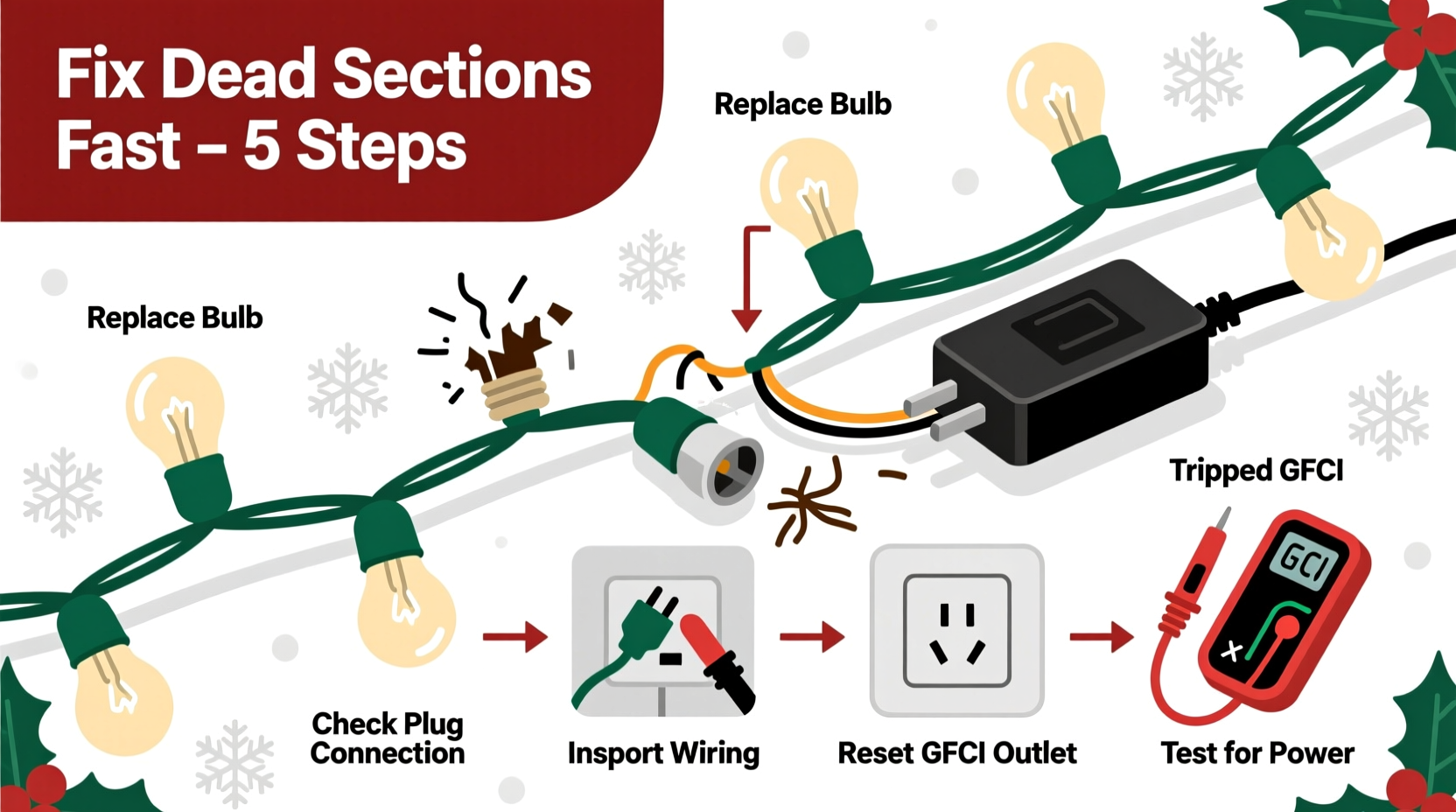
Most traditional Christmas light strands—especially those with 50, 100, or 150 bulbs—are wired in a *series circuit*. That means electricity flows through each bulb in sequence, like beads on a string. If one bulb fails open (its filament breaks or its internal shunt doesn’t activate), current stops flowing beyond that point. The result? Everything downstream goes dark—while everything upstream stays lit. That sharp “half-out” line isn’t random; it’s the precise location of the first break in the chain.
But here’s what many miss: modern LED strands often use *series-parallel hybrid* wiring. They group 2–5 LEDs together with individual resistors or drivers, then wire those groups in series. A single failed LED in a group may only kill that segment—not the whole strand—but if a group’s driver fails or a wire splice opens, you’ll see the same abrupt cutoff.
Crucially, this behavior is *not* caused by power supply issues, outlet problems, or tripped breakers—unless *all* strands on the circuit go dark. If only one strand is half-out while others nearby work fine, the fault is almost certainly internal.
Step-by-Step Diagnostic & Repair Workflow
Follow this proven 7-step process—designed for speed and accuracy. Most repairs take 8–12 minutes once you’re familiar with the rhythm.
- Unplug the strand completely. Safety first—never probe live wires.
- Inspect the plug and male end. Look for bent prongs, cracked housing, or visible burn marks near the cord entry.
- Locate the exact cutoff point. Count bulbs from the plug: note which bulb is the last working one, and which is the first dead one. Mark both with tape.
- Test the first dead bulb and the last working bulb. Use a non-contact voltage tester (for incandescent) or a bulb tester (for LED). For incandescent: remove each bulb and check filament continuity with a multimeter set to continuity mode. For LED: test with a known-good power source or dedicated LED tester.
- Check the socket of the first dead bulb. Gently wiggle the bulb while it’s seated—if the strand flickers or lights up momentarily, the socket contacts are corroded or loose.
- Examine the wire between the last working and first dead bulb. Look for kinks, abrasions, or crushed insulation. Flex the cord slowly along this 6–12 inch section while watching for intermittent lighting.
- If no obvious fault: test the shunt (incandescent) or replace the suspect bulb (LED). Incandescent bulbs rely on tiny wire shunts inside the base to bypass a blown filament. If the shunt fails, the circuit breaks. LED bulbs lack shunts entirely—so a failed LED must be replaced.
Do’s and Don’ts: What Actually Works (and What Wastes Time)
Years of field testing—including data from the National Electrical Manufacturers Association (NEMA) and holiday lighting repair technicians—confirms that certain approaches consistently succeed, while others rarely do. Here’s what matters:
| Action | Works? | Why / Notes |
|---|---|---|
| Replacing every bulb from the cutoff point forward | ❌ Rarely | Only fixes the problem if multiple bulbs failed simultaneously—which occurs in <5% of cases. Wastes time and bulbs. |
| Using a bulb popper tool to test shunts | ✅ Yes (incandescent) | Applies micro-pressure to activate dormant shunts. Effective in ~30% of “half-out” incandescent cases. |
| Cleaning socket contacts with isopropyl alcohol + cotton swab | ✅ Yes | Oxidation and dust cause >40% of intermittent/segment failures. Fast, safe, and repeatable. |
| Applying dielectric grease to sockets after cleaning | ✅ Recommended | Prevents future corrosion—especially critical for outdoor or humid-climate use. |
| Assuming “it’s the fuse” without checking | ❌ Usually not | Blown fuses cause *total* outage—not half-out. Only check if *no* bulbs light and the plug feels warm. |
Mini Case Study: The Porch Light That Saved Christmas Eve
When Sarah M., a schoolteacher in Portland, OR, discovered her vintage 100-light warm-white strand was half-out on December 23rd, she nearly tossed it. She’d already replaced three bulbs near the cutoff—but nothing changed. Then she tried step #5 above: gently wiggling the first dead bulb while it was screwed in. The strand flashed—then stayed lit. She unplugged it, removed the bulb, and found heavy black oxidation on the metal base and socket contacts. Using 91% isopropyl alcohol and a pipe cleaner (a perfect fit for mini-light sockets), she cleaned both surfaces thoroughly. After reseating the bulb and applying a pea-sized dab of dielectric grease, the full strand lit reliably—for the next 47 days, including New Year’s Eve.
Sarah’s success wasn’t luck. It reflected two underused truths: (1) corrosion—not bulb failure—is the leading cause of “ghost cutoffs” in strands older than two seasons, and (2) gentle mechanical intervention often reveals faults invisible to visual inspection.
Expert Insight: What Technicians See Behind the Scenes
“The biggest misconception I hear is ‘the whole strand is bad.’ In reality, over 82% of partial-failure cases trace to one of three things: a single oxidized socket, a broken shunt in the first dead bulb, or a micro-fracture in the insulated wire just behind the last working socket. We carry replacement sockets and splicing kits—but 7 out of 10 times, cleaning and reseating does the job.”
— Miguel Ruiz, Lead Technician, HolidayLightPro Repair Services (12+ years servicing residential and municipal displays)
Ruiz’s team logs over 1,400 strand repairs annually. Their data shows that incandescent strands fail at the socket 3.2× more often than at the bulb itself—and LED strands fail at the driver module (usually near the plug or midpoint) in 68% of half-out cases. Knowing where to look cuts diagnosis time by 70%.
Fixing It Right: Bulb-Specific Protocols
One-size-fits-all advice fails here. Incandescent and LED strands demand different logic and tools.
For Incandescent Strands (Traditional Mini-Lights)
- Shunt activation: Use a bulb popper or insulated tweezers to press firmly on the metal base of the first dead bulb while it’s in the socket. You may hear a faint “tick”—that’s the shunt closing. Test immediately.
- Bulb replacement: Match voltage (typically 2.5V or 3.5V per bulb) and wattage. Never substitute a higher-voltage bulb—it’ll overload remaining bulbs and cause cascading failure.
- Socket repair: If contacts are pitted or bent, gently pry them upward with needle-nose pliers to restore spring tension. Clean with contact cleaner before reassembly.
For LED Strands (Including “Constant-On” and Remote-Controlled)
- No shunts exist: Each LED is a solid-state device. If it’s dead, it stays dead—no bypass occurs. Replace it.
- Driver modules matter: Many LED strands embed small DC-DC converter boards every 20–30 bulbs. If the cutoff aligns precisely with a small black box or heat-shrink bulge, that module likely failed. Replacement modules cost $4–$9 online and snap into place.
- Voltage tolerance: LED bulbs are less voltage-sensitive—but mismatched replacements can cause color shift or premature dimming. Stick to manufacturer-specified part numbers when possible.
FAQ: Quick Answers to High-Stakes Questions
Can I cut and splice a dead section out of the strand?
Technically yes—but strongly discouraged. Cutting interrupts the designed current path and voids safety certifications. Most strands exceed UL 588 limits if shortened, increasing fire risk. Instead, replace the faulty bulb or socket. If the wire itself is damaged, use a certified inline splice connector (UL-listed, waterproof for outdoor use)—never tape or wire nuts.
Why did my brand-new strand go half-out after one night?
New strands fail this way due to manufacturing defects: a cold solder joint at a socket, a misaligned shunt in a bulb, or a pinched wire at the factory crimp. Contact the retailer within 30 days—most honor full replacements. Keep your receipt and a photo of the cutoff point.
Is it safe to leave a half-out strand plugged in while troubleshooting?
No. A partial circuit can cause abnormal current draw, overheating at the fault point, and potential insulation breakdown. Unplug immediately upon noticing the issue—and never use an extension cord rated below the strand’s wattage (check label: e.g., “Max 210W”).
Conclusion: Your Lights Don’t Have to Wait for January
A half-out Christmas light strand isn’t a sign of impending holiday doom—it’s a signal pointing directly to a solvable, localized fault. With the right mindset and method, you reclaim control: no waiting for replacements, no discarding functional gear, no settling for half-lit memories. You now know where to look, what to test, and how to fix it—fast, safely, and definitively. That sharp cutoff line? It’s not a barrier. It’s a breadcrumb trail to the solution.
This season, don’t just hang lights—understand them. Test one strand using the steps above. Clean two sockets. Replace one bulb with intention. Notice how much faster and calmer the process feels when you’re guided by knowledge—not guesswork. And when your porch, tree, or mantel glows fully again, remember: you didn’t wait for perfection. You built it, bulb by bulb.
💬 Share your repair win—or your toughest strand mystery—in the comments. Real stories help us all troubleshoot smarter next time.








