
As the holiday season approaches, many families face a familiar decision: how to bring festive cheer into their homes with traditional decorations. Two of the most beloved options—Christmas villages and model train sets—offer charm, nostalgia, and visual storytelling. But they also demand time, space, and attention. Choosing between them isn’t just about aesthetics; it’s about understanding which option aligns better with your living environment, available time, and long-term commitment.
While both can coexist in expansive setups, most households must prioritize based on practical constraints. This guide breaks down the spatial demands, assembly effort, maintenance requirements, and overall complexity of Christmas villages versus train sets to help you make an informed choice.
Space Requirements: How Much Room Do You Really Need?
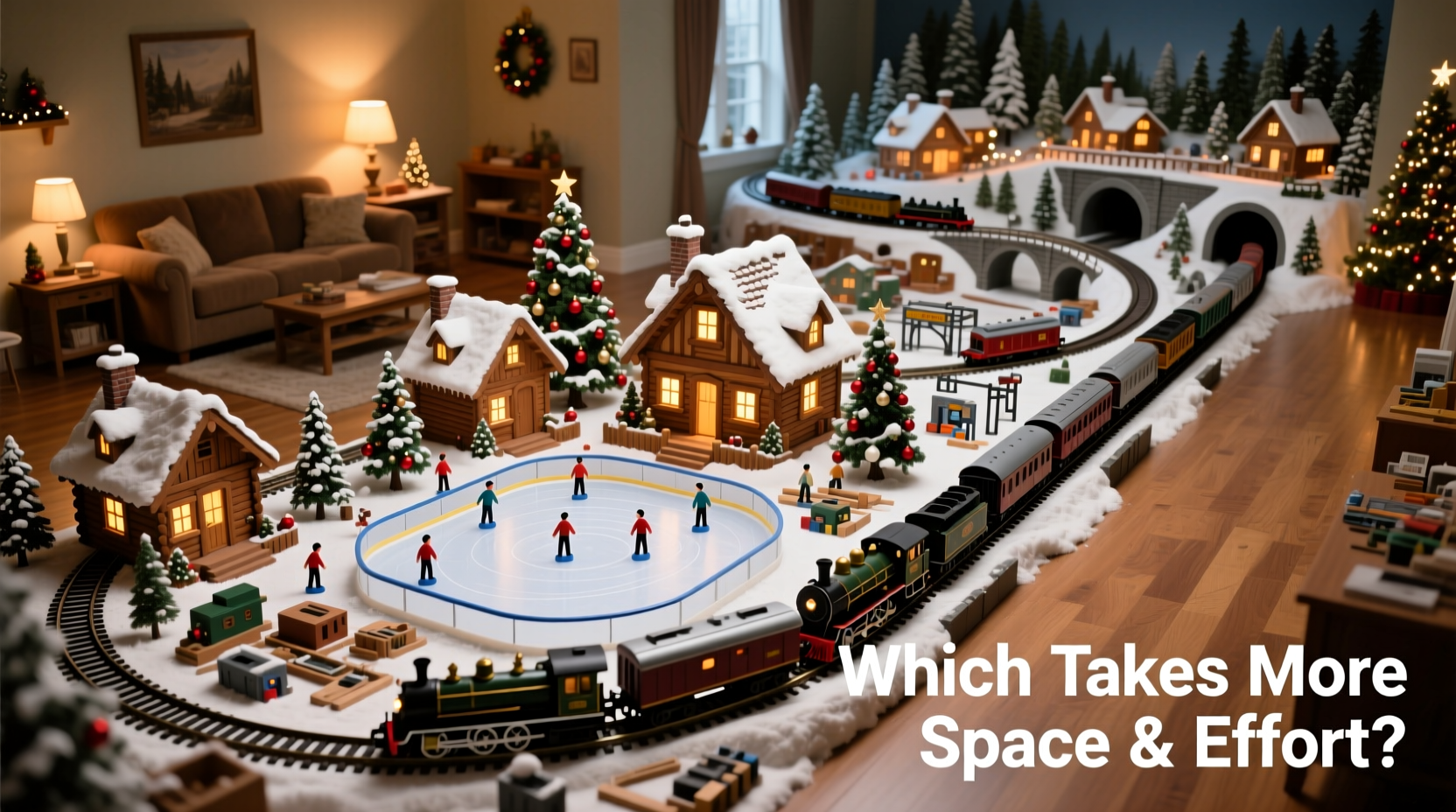
The first factor to consider is physical space. Both displays require dedicated areas, but the nature of that space differs significantly.
Christmas villages are typically more flexible in layout. They can be arranged on shelves, tabletops, mantels, or even across multiple levels like stairs or sideboards. A small village might occupy just 2–3 square feet, while larger scenes can stretch across 6–8 feet or more if spread out organically. The key advantage is modularity—buildings can be spaced apart, clustered, or expanded gradually over years without needing continuous surface area.
In contrast, model train sets require a continuous, level platform to support tracks. Even basic oval layouts need at least 4' x 8' for O-scale trains, while HO scale (the most common) fits into roughly 3' x 6'. Larger, more elaborate layouts with loops, sidings, and tunnels easily consume 100+ square feet. Trains also need clearance above and around the track—no low-hanging decorations or foot traffic zones.
Tip: Measure your intended display area before purchasing components. For train sets, ensure you have at least 6 inches of clearance on all sides for safe operation and future expansion.Effort and Assembly: What Goes Into Building Each Display?
Beyond space, the real differentiator lies in effort—initial setup, ongoing assembly, and yearly reassembly.
Setting up a Christmas village begins with placing buildings, adding figurines, trees, and snow accents. Most pieces are static and snap together easily. Lighting is often plug-and-play LED-based, requiring minimal wiring. Once arranged, the layout remains consistent year after year, making reassembly faster each season. Expanding the village is as simple as adding one new building annually.
Train sets, however, involve mechanical assembly. Tracks must be connected precisely to avoid derailments. Wiring for power, switches, and accessories requires planning. Locomotives need battery charging or transformer connections. Sound systems, remote controls, and automated features add layers of technical complexity. Even a minor misalignment in rail joints can halt operations, demanding troubleshooting skills.
A seasoned hobbyist might enjoy this challenge, but for casual decorators, the learning curve can be steep. According to Mark Thompson, a model railroading instructor with the National Model Railroad Association:
“Building a reliable train layout isn’t just about laying track—it’s about electrical continuity, alignment, and understanding how moving parts interact under load. It’s rewarding, but it’s not plug-and-play.” — Mark Thompson, NMRA Certified Modeler
Comparison Table: Key Differences at a Glance
| Factor | Christmas Village | Train Set |
|---|---|---|
| Footprint | Modular; can fit on shelves or small tables | Large, continuous base required (min. 3'x6') |
| Setup Time (Initial) | 1–3 hours | 6–20+ hours |
| Reassembly Time (Yearly) | 30–90 minutes | 2–8 hours |
| Technical Skill | Low (plug-and-play lighting) | Moderate to high (wiring, mechanics) |
| Maintenance | Dusting, occasional bulb replacement | Track cleaning, motor servicing, lubrication |
| Child Involvement | High (safe to touch, arrange) | Low (moving parts, electrical hazards) |
| Expandability | Easy (add buildings incrementally) | Complex (requires layout redesign) |
Real-World Example: The Miller Family’s Holiday Dilemma
The Millers live in a mid-sized suburban home with a 12' x 15' living room—their primary holiday display zone. For years, they used a modest Christmas village on their coffee table and TV stand. Their two children, ages 7 and 9, loved arranging the tiny figures and turning on the glowing church steeple each night.
Last year, inspired by a neighbor’s elaborate train layout, they purchased an HO-scale starter set. Excitement turned to frustration when they realized the train required a dedicated platform. They repurposed a dining table, but it meant eating in the kitchen during December. Setup took three weekends: one to build the base, another to lay and test-track, and a third to troubleshoot power issues causing frequent stalls.
By Christmas Eve, the train ran—but only in one direction. The kids were disappointed. After the holidays, disassembly was slow, and storage became a problem. The locomotive was damaged when a box shifted in the garage. The following November, they reverted to their original village setup, keeping the train stored indefinitely.
Their experience reflects a common reality: train sets offer dynamic appeal but come with hidden logistical costs. For families with limited space or time, villages provide a more sustainable tradition.
Step-by-Step Guide: Choosing and Setting Up Your Display
Follow this process to determine which option suits your household best.
- Assess Available Space
Measure the length, width, and height of your intended display area. Note nearby furniture, foot traffic, and pet access. - Evaluate Time Commitment
Ask: How many hours per week can you dedicate to setup and maintenance? Train sets may require weekly track cleaning during display season. - Consider Household Members
Do you have young children or pets? Villages are safer for curious hands. Trains have small parts and electrical components. - Set a Budget
Entry-level villages start under $100. Basic train sets begin around $150, but expandable layouts can exceed $1,000 with accessories. - Decide on Long-Term Goals
Want a growing collection over decades? Villages allow gradual expansion. Prefer engineering challenges? Trains offer deeper technical engagement. - Start Small
Begin with a single building or a train oval. Test your interest and space before investing further. - Create a Storage Plan
Use labeled bins, foam padding, and climate-controlled storage to protect delicate pieces. Photograph your layout before disassembly for easier reassembly next year.
Checklist: Pre-Purchase Evaluation
- ☐ Measured display area (length, width, height clearance)
- ☐ Confirmed flat, stable surface for train tracks (if applicable)
- ☐ Checked storage space availability (off-season)
- ☐ Reviewed product reviews for reliability and ease of use
- ☐ Considered safety around children and pets
- ☐ Allocated time for initial and annual setup
- ☐ Researched spare parts availability (bulbs, track connectors, etc.)
- ☐ Determined budget including future expansion items
FAQ: Common Questions Answered
Can I combine a Christmas village and a train set?
Yes, many enthusiasts integrate both. Some train layouts include village elements like stations, depots, and towns along the route. However, this doubles space and effort requirements. Ensure your layout has enough room to accommodate both without overcrowding.
Which is more expensive over time?
Train sets generally cost more long-term. While villages grow through individual purchases, trains require compatible track systems, power supplies, and maintenance tools. Replacement motors or digital command systems can run hundreds of dollars. That said, high-end village collections with rare pieces can also become costly.
Do train sets require special electrical outlets?
Most modern train sets operate on standard 110V household current using included transformers. However, large layouts with multiple trains, lighting, and sound effects may benefit from dedicated circuits to prevent overload. Always check manufacturer specifications before connecting multiple accessories.
Conclusion: Making the Right Choice for Your Home
Ultimately, the decision between a Christmas village and a train set comes down to personal priorities. If you value flexibility, ease of setup, and family participation, a village is likely the better fit. It offers visual warmth with minimal technical demands, making it ideal for renters, small spaces, or those who prefer seasonal simplicity.
If you’re drawn to mechanics, motion, and engineering puzzles, a train set delivers unmatched satisfaction. Watching a locomotive chug through a snowy landscape, navigating switches and tunnels, creates a living scene few decorations can match. But it demands respect for its complexity and space needs.
Neither option is inherently superior—only more suitable for certain lifestyles. By evaluating your space, time, and goals honestly, you can choose a display that brings joy, not stress, each holiday season.
💬 Have you switched from a train set to a village—or vice versa? Share your story in the comments. Your experience could help others find their perfect holiday balance.








