Every December, thousands of pet owners find pine needles in their dog’s teeth, sticky sap on their muzzles, or a conspicuously lopsided Christmas tree. It’s not mischief—it’s instinct, biology, and environmental stress converging at the most festive time of year. Dogs don’t chew tree branches to sabotage your holiday spirit. They do it because scent, texture, novelty, and unmet needs make the tree an irresistible stimulus. Yet this seemingly harmless habit carries real risks: gastrointestinal obstruction, pine oil toxicity, needle impalement, and electrocution from exposed lights or cords. Understanding *why* requires looking beyond “they’re just being curious.” It means recognizing how seasonal changes disrupt routine, how canine senses interpret evergreen scents differently than ours, and how holiday chaos amplifies underlying anxiety or boredom. This article unpacks the behavioral science behind the chewing—not as a quirk to be scolded, but as a signal demanding thoughtful, compassionate response.
The Scent Factor: Why Pine Smells Like Opportunity to Dogs
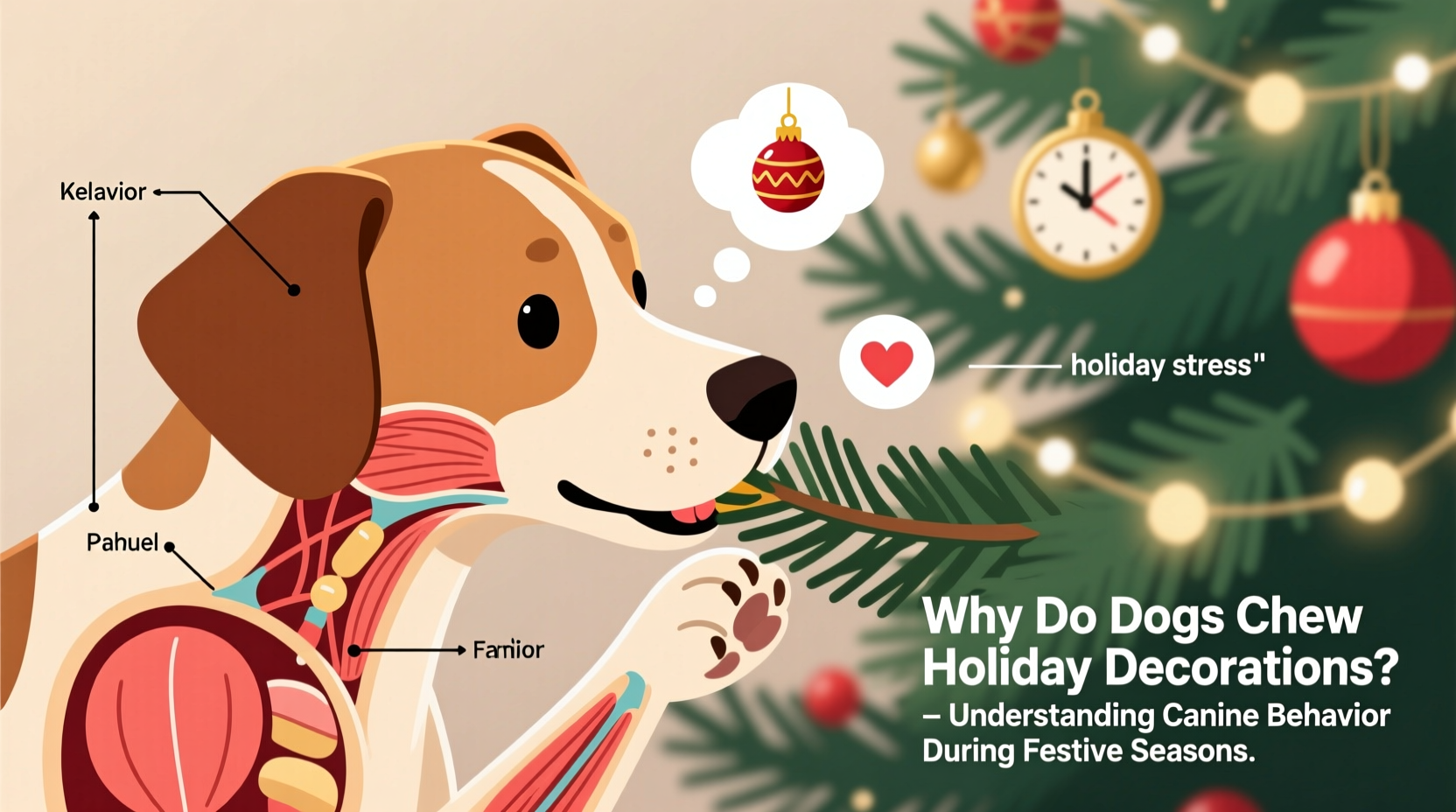
Dogs possess up to 300 million olfactory receptors—roughly 40 times more than humans. Their olfactory bulb is proportionally 40 times larger. To a dog, the sharp, resinous aroma of a fresh-cut fir or spruce isn’t “festive.” It’s biologically loaded: terpenes like pinene and limonene trigger primal neural pathways associated with exploration, marking, and even prey detection. These volatile compounds mimic natural plant signals that, in the wild, might indicate food sources, medicinal herbs, or territorial markers. A study published in Applied Animal Behaviour Science (2022) observed that dogs spent 68% more time investigating live conifer branches than neutral wooden dowels—even when unscented versions were presented side-by-side—confirming that odor alone drives engagement.
Compounding this is the fact that many commercial Christmas trees are treated with preservatives, flame retardants, or anti-desiccant sprays. While invisible to us, these chemicals often contain esters and aldehydes that register as intensely novel—and potentially rewarding—to a dog’s nose. When combined with the tactile appeal of brittle, snapping twigs and the visual contrast of deep green against bright ornaments, the tree becomes a multisensory magnet.
Tip: Opt for an artificial tree if your dog has shown persistent interest in real ones—even before setup. The scent-free environment removes the primary biological trigger.Stress, Routine Disruption, and Holiday Anxiety
Holidays disrupt the two pillars of canine emotional stability: predictability and control. Visitors, loud music, rearranged furniture, unfamiliar scents (candles, baked goods, guests’ perfumes), and altered feeding or walking schedules all elevate cortisol levels. For dogs prone to anxiety—or those who lack consistent mental enrichment—the Christmas tree becomes both a stressor and a coping outlet. Chewing releases endorphins, offering temporary relief. But unlike chewing a designated toy, tree chewing also delivers novelty and sensory feedback that self-soothing behaviors rarely provide.
A 2023 survey by the American Veterinary Society of Animal Behavior found that 71% of dogs exhibiting increased destructive chewing during December had experienced at least three major household changes in the preceding four weeks—including hosting guests, changing bed locations, or introducing new decorations. Notably, small- and medium-breed dogs (especially terriers, spaniels, and herding mixes) were overrepresented, suggesting breed-typical energy retention and alertness amplify sensitivity to environmental flux.
“Dogs don’t ‘misbehave’ during the holidays—they respond neurologically to disruption. What looks like defiance is often dysregulation. Our job isn’t to punish the symptom, but to stabilize the system.” — Dr. Sarah Lin, DVM, DACVB, Board-Certified Veterinary Behaviorist
Physical Needs Unmet: Boredom, Teething, and Nutritional Gaps
Chewing serves multiple physiological purposes. Puppies under six months may target branches due to teething discomfort—pine bark offers firm resistance ideal for sore gums. Adult dogs, however, often chew out of functional deprivation: insufficient daily exercise, lack of problem-solving opportunities, or inadequate dietary fiber. Conifers contain trace amounts of vitamin C, flavonoids, and tannins—nutrients dogs don’t require but may instinctively seek when gut microbiomes are imbalanced or diets are overly processed.
Consider this: the average indoor dog receives only 37 minutes of active mental stimulation per day (per 2021 data from the Companion Animal Parasite Council). During December, that number drops further as owners prioritize shopping and social obligations. A tree—tall, textured, fragrant, and off-limits—becomes the most stimulating object in the room. Its inaccessibility only increases its allure through “forbidden fruit” psychology.
Safety Risks: Beyond the Obvious
Most owners know pine needles can puncture intestines—but the lesser-known dangers are equally urgent:
- Pine oil toxicity: Ingestion of >0.5 mL/kg of concentrated pine oil (found in some tree preservatives or essential oil diffusers near the tree) can cause vomiting, tremors, and respiratory depression within 30 minutes.
- Electrical hazards: Chewing cords—even low-voltage LED strands—can deliver painful shocks that damage oral tissue and increase future fear-based aggression.
- Ornament ingestion: Tinsel, glass baubles, and plastic hangers pose choking, laceration, and heavy metal poisoning risks (e.g., lead in vintage ornaments).
- Water contamination: Tree stands often harbor stagnant water mixed with fertilizers, aspirin (a common preservative), or bacteria—consuming even small amounts may induce pancreatitis or sepsis.
| Risk | Onset Time | Early Warning Signs | Immediate Action |
|---|---|---|---|
| Pine needle impaction | 6–48 hours | Vomiting, lethargy, straining to defecate | Call vet immediately; do not induce vomiting |
| Pine oil exposure | 5–30 minutes | Drooling, pawing at mouth, ataxia | Rinse mouth gently with water; contact ASPCA Animal Poison Control (888-426-4435) |
| Electrical burn | Within seconds | Oral swelling, blackened gums, breath odor | Unplug device; cool compress; urgent veterinary exam |
| Tinsel ingestion | 12–72 hours | Abdominal pain, dehydration, constipation | Do not wait—tinsel causes linear foreign body obstructions requiring surgery |
A Real-World Scenario: How One Family Turned Crisis into Clarity
When Maya adopted Finn, a 2-year-old Australian Shepherd mix, she knew he was energetic—but nothing prepared her for Christmas Eve 2022. Finn had already pulled down three ornaments, chewed through a garland cord, and swallowed half a pinecone. On Christmas morning, he vomited twice, then collapsed beside the tree, trembling. At the emergency clinic, X-rays revealed two pine needles embedded in his duodenum and mild aspiration pneumonia from inhaling sap vapor.
Instead of rehoming him, Maya consulted a veterinary behaviorist. They discovered Finn’s daily walks had been shortened by 40% since November due to icy sidewalks, and his puzzle feeders had been replaced with kibble bowls for convenience. His “tree obsession” wasn’t willfulness—it was cumulative deprivation. Over six weeks, they implemented structured enrichment: 20-minute scent-work sessions using birch oil (a safe, non-toxic alternative to pine), twice-daily leash walks with sniff breaks, and a rotating set of chew toys frozen with bone broth. By Thanksgiving 2023, Finn ignored the tree entirely—curled instead on his designated mat, gnawing a deer antler while carols played.
Practical Prevention: A Step-by-Step Safety & Enrichment Plan
Prevention isn’t about making the tree “dog-proof.” It’s about making your dog *uninterested*. Follow this evidence-informed sequence:
- Weeks Before Setup: Assess your dog’s baseline stress level. Record frequency of lip-licking, yawning, or pacing during normal days. If elevated, consult a behaviorist *before* decorations arrive.
- Tree Selection Day: Bring home the tree in a closed vehicle (not the trunk), then carry it directly to the setup area. Avoid letting your dog investigate cut ends or sawdust—these concentrate volatile oils.
- Setup Phase: Use a sturdy, weighted base. Surround the trunk with a removable barrier: a baby gate, a circular wire mesh panel (18” diameter, 30” tall), or a repurposed laundry basket with the bottom cut out. Anchor it firmly.
- Daily Maintenance: Sweep fallen needles *immediately*. Refill the stand with fresh water *daily*—never add aspirin, fertilizer, or sugar. Place citrus-scented deterrent sprays (non-toxic, pet-safe formulas only) on lower branches—dogs dislike d-limonene.
- Enrichment Integration: Every time you decorate, give your dog a long-lasting chew (e.g., stuffed Kong frozen overnight) placed 6 feet from the tree. Pair proximity with reward—not punishment. Repeat for 10 minutes, 3x daily.
What NOT to Do: Common Missteps That Backfire
Well-intentioned interventions often worsen the problem. Avoid these:
- Spraying bitter apple on branches: May work short-term but teaches avoidance via aversion—not redirection. Can generalize to fear of all greenery or outdoor plants.
- Yelling or startling when caught: Increases arousal and associates the tree with conflict. Dogs learn to chew only when unsupervised.
- Using electric shock collars or motion-activated sprayers: Violates AAHA/AVSAB ethical guidelines. Causes learned helplessness and damages trust.
- Leaving the tree unattended for >2 hours daily: Even “well-behaved” dogs act on impulse when bored. Supervision is non-negotiable until reliable alternatives are established.
FAQ: Your Top Concerns, Answered
Is any real Christmas tree truly safe for dogs?
No real tree is 100% safe—but Nordmann firs and Douglas firs pose lower risk than pines or spruces. Their needles are softer, less oily, and less likely to detach. Still, supervision remains essential. Artificial trees eliminate scent-based attraction and physical hazards—but ensure materials are lead-free and cords are fully concealed.
My dog only chews the lower branches. Should I just trim them off?
Trimming creates more temptation: exposed sap, fresh cuts, and dangling fragments invite investigation. Instead, install a physical barrier at the 18-inch height mark and reinforce it with positive associations (e.g., scatter treats *around*—not on—the barrier perimeter).
Will crate training solve this?
Crating during unsupervised hours is wise—but it doesn’t address root causes. Crating without concurrent enrichment leads to frustration, vocalization, or redirected chewing on crate bars. Use crating *alongside* daily mental exercise, not as a standalone fix.
Conclusion: Reframe the Branch as a Bridge, Not a Barrier
Your dog isn’t testing boundaries when they chew Christmas tree branches. They’re communicating—through scent-driven curiosity, stress-induced displacement, or unmet physical needs. This behavior isn’t a flaw in your pet; it’s feedback about their environment, routine, and relationship with you. By responding with observation rather than correction, enrichment instead of exclusion, and science-backed strategy over superstition, you transform a seasonal challenge into an opportunity for deeper connection. You’ll gain insight into your dog’s sensory world, strengthen trust through consistent care, and cultivate habits that extend far beyond December. This holiday season, let every snapped twig remind you not of damage done—but of attention deserved. Start today: assess one routine change, introduce one new chew, and watch how quickly your dog chooses comfort over chaos.
💬 Your experience matters. Have you navigated tree-chewing successfully? Share your most effective strategy in the comments—your insight could help another family celebrate safely this year.