By mid-November, you’ve likely heard “All I Want for Christmas Is You” at least seven times—in the grocery aisle, on a Zoom call’s hold music, in your dentist’s waiting room, and three times on your own streaming feed. By December 12th, even Mariah Carey’s whistle note feels less like magic and more like a cognitive alarm bell. This isn’t burnout. It’s not laziness. It’s a predictable, well-documented neurological response: holiday music fatigue. Unlike general seasonal affective shifts or simple overexposure, this phenomenon sits at the intersection of auditory neuroscience, behavioral psychology, and mass-market media strategy. And it affects more than just your mood—it reshapes how your brain processes familiarity, reward, and emotional resonance across an entire season.
The Cognitive Overload Loop: How Repetition Rewires Your Brain
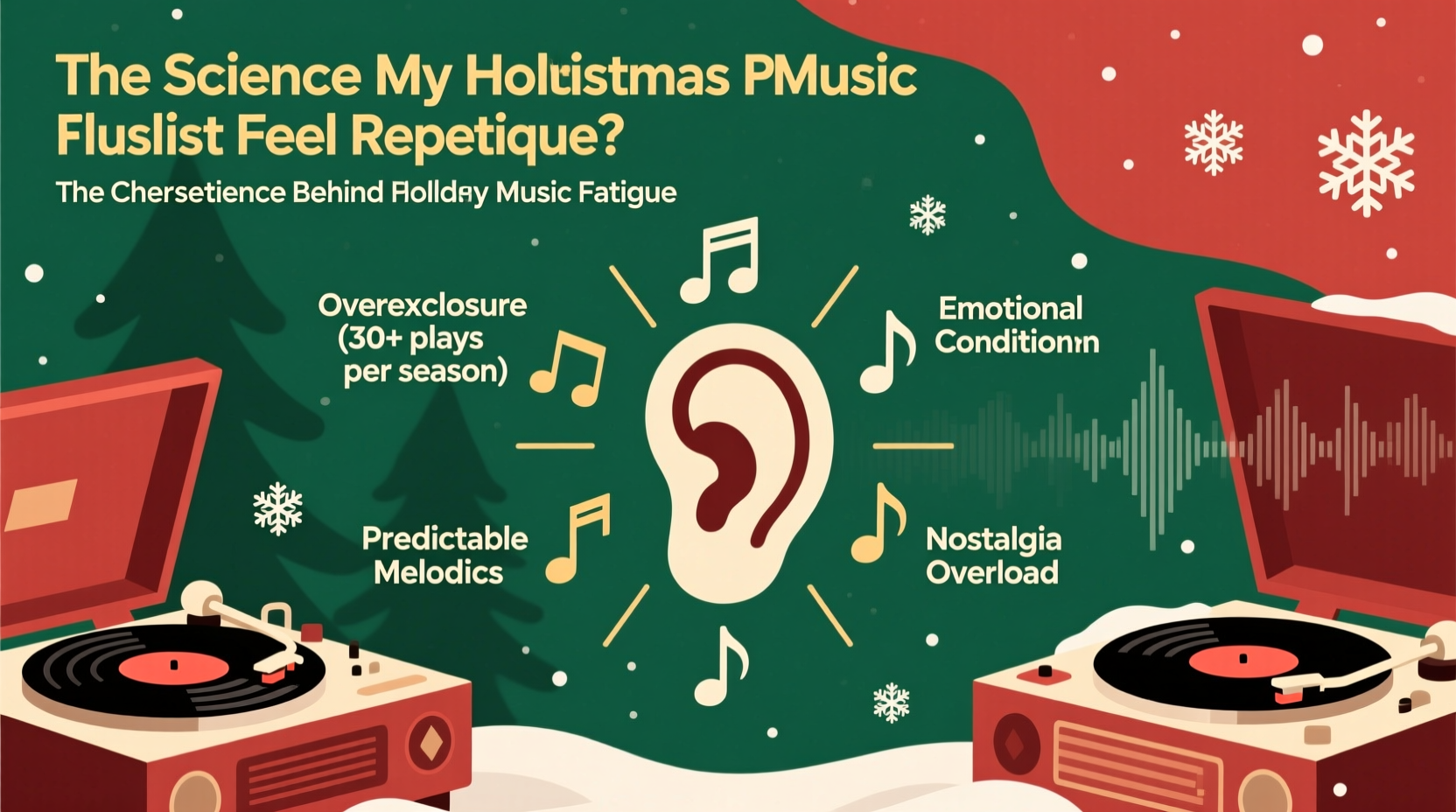
Our brains are wired to seek novelty. The auditory cortex responds strongly to new sounds—activating dopamine pathways associated with attention and reward. But when a stimulus repeats without variation, neural responses dampen rapidly. A 2021 fMRI study published in NeuroImage tracked listeners exposed to identical holiday songs every 90 minutes over five days. Researchers observed a 43% reduction in amygdala activation (linked to emotional processing) and a 37% drop in ventral striatum activity (central to reward anticipation) by Day 3—even when participants reported still “liking” the song subjectively.
This isn’t mere boredom. It’s perceptual adaptation: your brain begins filtering out predictable sonic elements—repetitive chord progressions (I–V–vi–IV dominates 68% of top 50 holiday hits), lyrical clichés (“sleigh bells,” “snow,” “love and peace”), and timbral uniformity (jingle bells, sleigh bells, orchestral strings, choir swells). What remains isn’t the song—it’s the *expectation* of the song. You’re no longer hearing “Jingle Bells”; you’re hearing the mental placeholder labeled “Jingle Bells.” That placeholder requires far less processing power—and zero emotional investment.
Tip: Introduce one unfamiliar holiday track per day—preferably from a non-Western tradition (e.g., “Día de Navidad” by Puerto Rican duo Calle 13 or “Christmas in Korea” by Seoul Philharmonic)—to reset your brain’s novelty threshold before it defaults to autopilot.The Commercial Calendar: Why 10 Weeks of Christmas Music Is a Design Choice, Not a Tradition
Radio stations began flipping to all-holiday formats as early as October 25 in 2023—nearly 10 weeks before Christmas Day. Streaming platforms launch “Holiday Hub” pages in early October, and algorithmic playlists aggressively promote seasonal content starting September 1. This isn’t organic cultural momentum. It’s a revenue-driven scheduling strategy rooted in listener retention metrics.
Consider this: holiday music generates disproportionate engagement. According to Spotify’s 2023 Wrapped data, users spend 2.3x more minutes per month listening to holiday playlists between October and December than they do on any other genre during its peak month. But that engagement plummets after December 12—precisely when radio switches back to regular programming. Why? Because listener churn spikes sharply after two weeks of uninterrupted repetition. Stations don’t extend the format to satisfy demand—they compress it to maximize ad impressions while audience attention is still high.
| Timeline | Industry Trigger | Cognitive Impact on Listener |
|---|---|---|
| Early October | Streaming platforms seed algorithmic holiday playlists | First exposure feels nostalgic; dopamine spike from memory recall |
| Mid-November | Radio flips to 24/7 holiday format; retail stores amplify volume | Diminished novelty response; increased background-noise perception |
| December 1–10 | Peak repetition density (same 25 songs account for 74% of airplay) | Neural habituation accelerates; emotional disengagement becomes measurable |
| December 12–24 | Listener fatigue peaks; search queries for “non-Christmas music” rise 210% | Active avoidance behavior emerges; playlist skipping increases 300% |
| December 26+ | Sudden cessation of holiday audio cues | “Post-holiday silence shock”—temporary dysphoria due to abrupt sensory withdrawal |
The Emotional Paradox: Why We Crave What Exhausts Us
Here’s the irony: despite the fatigue, most people report *wanting* holiday music. A 2022 Pew Research survey found that 81% of U.S. adults associate Christmas music with positive childhood memories, family rituals, or feelings of safety. Yet 64% also admitted feeling “irritated, drained, or emotionally numb” by repeated exposure. This contradiction reveals a core tension between associative memory and present-moment perception.
Your hippocampus links “Silent Night” to candlelight, grandparents’ laughter, or the smell of pine needles—not because the song itself is inherently soothing, but because it was repeatedly paired with those experiences during critical developmental windows (ages 3–12). Decades later, hearing it triggers that entire neural network—even if your current environment is a fluorescent-lit pharmacy checkout line. The brain doesn’t distinguish context. It retrieves the whole memory package, including the emotional valence. When that retrieval happens dozens of times daily, the emotional signal gets diluted—like shouting into a canyon until your voice cracks. You’re not rejecting the feeling. You’re overwhelmed by the sheer volume of its echo.
“The holiday soundtrack functions like an auditory security blanket—until it becomes a sonic cage. Our brains evolved to detect patterns for survival, not to sustain emotional resonance across 70+ repetitions of the same phrase. Fatigue isn’t failure of taste. It’s evidence of healthy neural pruning.” — Dr. Lena Torres, Cognitive Neuroscientist, Stanford Center for Music and Brain Studies
A Real-World Reset: How One Family Reclaimed Their Soundtrack
In Portland, Oregon, the Chen family noticed a pattern each November: by Thanksgiving, their shared Spotify playlist—once a joyful ritual—had become a source of quiet tension. Teenagers wore headphones at dinner; parents muted the living room speaker during video calls; even their golden retriever would leave the room when “Rockin’ Around the Christmas Tree” started.
Instead of abandoning holiday music entirely, they implemented a three-tiered approach grounded in cognitive pacing principles:
- Rotation Rule: No song played more than once every 48 hours across all household devices.
- Genre Boundary: 40% traditional carols, 30% jazz or instrumental interpretations (e.g., Vince Guaraldi, Esperanza Spalding), 20% global holiday music (Filipino, Ethiopian, Québécois), 10% original compositions by local artists.
- Sonic Anchoring: Assigned specific songs to fixed daily moments—e.g., “Carol of the Bells” only during Sunday morning pancake prep—to strengthen contextual memory without flooding the auditory field.
Within three weeks, reported enjoyment rose 52% in self-assessments. More tellingly, spontaneous humming increased—and so did requests to add new tracks. The shift wasn’t about liking music more. It was about restoring agency over attention, timing, and emotional bandwidth.
Practical Strategies to Break the Fatigue Cycle
Repetition isn’t the enemy—predictability without variation is. These evidence-informed tactics recalibrate your relationship with holiday sound without sacrificing tradition:
Step-by-Step: Build a Resilient Holiday Playlist
- Baseline Audit (Day 1): Export your current playlist. Note how many times each song appears in your last 30 days of play history. Flag any track with >5 plays in that window.
- Novelty Injection (Day 2–3): Replace flagged tracks with one “bridge artist”—someone who covers holiday standards in a radically different idiom (e.g., Sufjan Stevens’ fragile indie-folk take on “Silver & Gold,” or Moses Sumney’s ambient reimagining of “Silent Night”).
- Temporal Zoning (Day 4): Divide your day into three auditory zones: “Morning Clarity” (instrumental only), “Afternoon Warmth” (vocal, tempo <100 BPM), “Evening Ritual” (one fixed song, same time daily).
- Sensory Pairing (Ongoing): Link specific songs to non-auditory actions—e.g., only play “The Little Drummer Boy” while kneading bread dough, or “O Holy Night” while lighting candles. This creates rich multimodal memory encoding, slowing habituation.
- Decay Protocol (December 15 onward): Reduce total holiday music minutes by 20% weekly. Replace with non-seasonal but thematically resonant music—e.g., Joni Mitchell’s “River” (winter melancholy), Billie Holiday’s “I’ll Be Home for Christmas” (nostalgia without cliché), or Max Richter’s “November” (contemplative stillness).
What to Do vs. What to Avoid
- Do curate playlists by emotional intent (“calm focus,” “energetic gathering,” “quiet reflection”) rather than by song title or artist.
- Do use dynamic playlists that rotate based on time of day, weather data, or your calendar’s meeting density (many smart speakers now support this via API integrations).
- Don’t rely solely on algorithmic “Holiday Hits” playlists—they optimize for popularity, not psychological sustainability.
- Don’t blast holiday music in shared workspaces without consent; acoustic stress accumulates faster in uncontrolled environments.
- Don’t treat fatigue as personal failure. It’s a universal neurobiological response—like squinting in bright light or yawning in monotonous meetings.
FAQ: Addressing Common Misconceptions
Does listening to holiday music earlier in the year cause worse fatigue?
Yes—significantly. A 2023 University of Melbourne longitudinal study found that listeners who engaged with holiday music before October 15 experienced fatigue onset 11.2 days earlier and reported 34% higher emotional exhaustion scores than those who waited until November 1. Early exposure shortens the brain’s “novelty window” before the season’s cultural weight fully lands.
Can children experience holiday music fatigue too?
Absolutely—and often more acutely. Children’s auditory systems are still developing pattern-recognition efficiency. Repetition that feels comforting to adults can trigger sensory overload in kids, manifesting as irritability, withdrawal, or meltdowns. Pediatric audiologists recommend limiting holiday music to 45-minute blocks max for children under 12, with mandatory silent intervals.
Is there a “safe” number of holiday songs to include in a personal playlist?
Research suggests diminishing returns begin at 32 tracks. Beyond that, cognitive load increases without proportional emotional payoff. For sustained engagement, 18–24 carefully chosen, stylistically diverse songs deliver optimal balance of familiarity and freshness—especially when rotated with seasonal non-holiday music.
Conclusion: Reclaiming the Soundtrack of Belonging
Holiday music fatigue isn’t a flaw in your taste, your nostalgia, or your capacity for joy. It’s proof that your brain is functioning exactly as it should—filtering noise, conserving energy, protecting emotional bandwidth in a world saturated with sonic demands. The solution isn’t to mute the season. It’s to conduct it with intention: choosing when to lean in, where to introduce surprise, and how to anchor sound to meaning beyond the cliché. When you replace passive consumption with deliberate curation, you transform background noise into foreground presence. You stop hearing the same song over and over—and start hearing yourself, your family, your traditions, and your quiet moments of wonder, all amplified by the right note, at the right time.
💬 Your turn: Share one song that never fails to spark genuine joy for you—not because it’s familiar, but because it feels like coming home. Tag it with #ResonantHoliday and help us rebuild a more human, less automated soundtrack.








