Walk down a quiet street on a December evening, and you’ll likely notice a subtle but unmistakable divide: one home bathed in crisp, uniform white light—sharp, bright, almost clinical—while the next glows with a soft, uneven amber radiance, flickering faintly like candlelight caught in glass. That second home? Almost certainly strung with vintage incandescent mini-lights—the kind sold in cardboard boxes with yellowed labels and hand-tied wire spools. These aren’t just decorations; they’re heirlooms, time capsules, and quiet acts of resistance against the relentless march of efficiency. The preference isn’t nostalgia for nostalgia’s sake. It’s rooted in physiology, psychology, design history, and even neuroaesthetics—how our brains process light, color, and rhythm. Understanding this divide reveals far more than holiday taste preferences. It uncovers how technology reshapes emotion, why “improvement” sometimes erodes meaning, and why, in an age of hyper-optimization, many are choosing warmth over wattage.
The Physics of Feeling: Why Light Temperature Matters More Than You Think
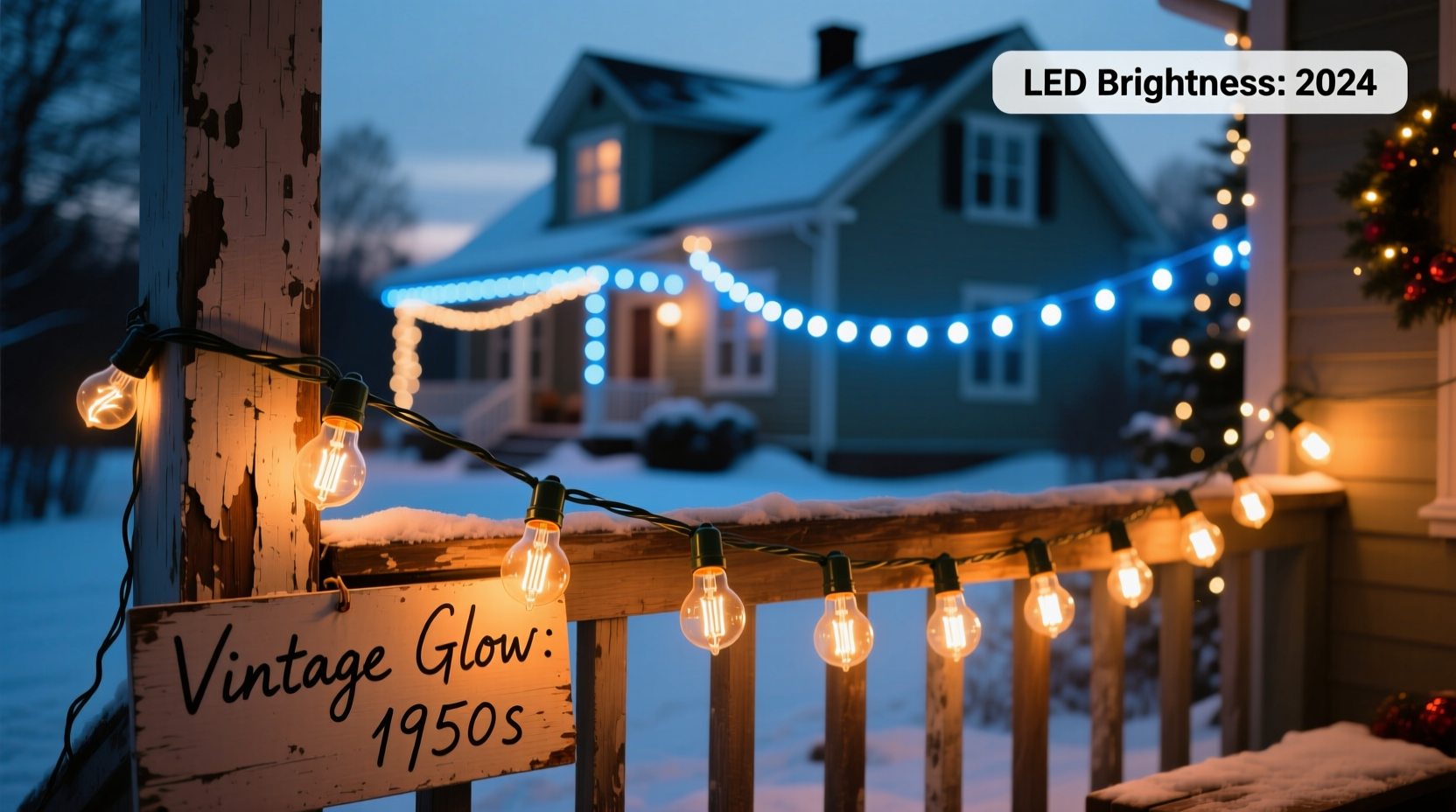
LEDs dominate the market for good reason: they use up to 90% less energy, last 25 times longer, and generate virtually no heat. Yet those advantages come at a perceptual cost. Incandescent bulbs operate by heating a tungsten filament until it glows—producing a continuous spectrum of light rich in warm reds and ambers (typically 2200K–2700K). This mimics firelight, sunset, and candle flame—the very sources that shaped human circadian rhythms and emotional associations over millennia. LEDs, by contrast, create light through electroluminescence in semiconductors. Most white LEDs are actually blue diodes coated with yellow phosphor—a process that results in a spectral spike around 450nm and a pronounced dip in the red-orange range. Even “warm white” LEDs (2700K–3000K) lack the full-bodied red emission of incandescents, making their glow feel thinner, flatter, and subtly artificial.
This isn’t subjective conjecture—it’s measurable. A 2022 study published in Lighting Research & Technology found that participants consistently rated incandescent-lit environments as “more comforting,” “more inviting,” and “more emotionally resonant” than identical spaces lit with spectrally matched LED sources—even when color temperature and lumen output were held constant. The researchers concluded that spectral continuity—not just correlated color temperature (CCT)—drives affective response. In plain terms: our eyes and brains don’t just register “warmth”; they register *how* warmth is made.
Tip: If you must use LEDs, choose models labeled “full-spectrum” or “high CRI (≥95)” and verify they include deep red (620–660nm) and near-infrared emission—rare in consumer strings but available in specialty heritage lighting lines.The Rhythm of Memory: Flicker, Pulse, and the Absence of Perfection
Vintage incandescent lights—especially pre-1990s sets—don’t shine steadily. They pulse. Not the dangerous, headache-inducing 100Hz flicker of cheap electronics, but a gentle, barely perceptible 60Hz oscillation synced to AC current. This creates a subtle shimmer, a breathing quality that feels alive. When dozens of bulbs pulse independently—due to slight variations in filament thickness, age, and manufacturing tolerances—the effect multiplies into a soft, organic undulation across the string. It’s the visual equivalent of hearing individual voices in a choir rather than a synthesized chorus.
Modern LEDs eliminate flicker entirely—or attempt to. High-end drivers suppress it below perceptible thresholds (<0.1% flicker percent), but that very elimination removes a layer of biological familiarity. Neurologist Dr. Sarah Lin, who studies photobiology and mood regulation, explains: “Our visual system evolved under dynamic light sources—fire, water-reflected sunlight, bioluminescence. Steady-state light is the exception, not the rule. Removing micro-variations doesn’t just erase ‘annoyance’; it flattens the sensory signature that signals ‘natural’ and ‘safe’ to subcortical pathways.”
“The most beloved vintage lights weren’t designed to be perfect—they were designed to work, survive shipping, and glow warmly. Their imperfections became their personality. Today’s LEDs are engineered to disappear—to be invisible infrastructure. But during the holidays, we don’t want infrastructure. We want presence.” — Thomas Reed, Lighting Historian & Curator, Museum of Decorative Arts
The Tactile and Textural Divide: Wire, Bulb Shape, and the Weight of History
Hold a vintage incandescent bulb in your hand and you hold a small artifact of mid-century manufacturing. Its glass envelope is thicker, often slightly warped from hand-dipping. The filament is visible—a delicate, coiled structure that casts intricate shadows. The wire is heavier, insulated in rubber or cloth-wrapped PVC, with soldered connections that develop a patina over decades. This isn’t just durability; it’s material honesty. You can *feel* its age, its craft, its weight in both literal and metaphorical senses.
Compare that to a modern LED mini-light: injection-molded plastic housing, hair-thin copper-clad steel wire, surface-mount diodes hidden behind diffusers. It’s lighter, sleeker, more compact—but also more disposable. There’s no tactile story. No evidence of human hands in its making. And crucially, the light source itself lacks dimensionality. Incandescent filaments emit light omnidirectionally, creating soft gradients and gentle halos around each bulb. LEDs are inherently directional; even with diffusers, their light appears “painted on” rather than emanating from within.
This textural difference extends to installation. Vintage strings require careful handling—bending wire too sharply breaks solder joints; pulling too hard snaps filaments. The act of decorating becomes deliberate, reverent, even ritualistic. Modern LED strings encourage speed and coverage: “just plug and go.” One enables mindfulness; the other enables efficiency. For many, the holiday season isn’t about maximizing coverage—it’s about slowing down, reconnecting with hands-on tradition, and honoring objects that have witnessed family milestones.
Why “Vintage Glows” Are Often More Sustainable—Despite the Energy Math
On paper, incandescents lose every sustainability argument. A 100-bulb incandescent string draws ~40 watts per hour; an equivalent LED set uses ~4.5 watts. Over a six-week season, that’s ~40 kWh vs. ~4.5 kWh. But sustainability isn’t only about kilowatt-hours. It’s about lifetime, repairability, material toxicity, and cultural longevity.
| Factor | Vintage Incandescent Strings | Modern LED Strings |
|---|---|---|
| Average Lifespan | 15–30+ years (with bulb replacement) | 3–7 years (driver failure, wire fatigue, non-repairable PCBs) |
| Repairability | High: Individual bulbs unscrew; sockets re-soldered; wire spliced | Negligible: Bulbs are sealed modules; drivers are proprietary; wires lack service loops |
| Material Composition | Glass, copper, brass, rubber—fully recyclable or inert | Plastic housings, rare-earth phosphors, lead-free solder (but complex e-waste stream) |
| Cultural Longevity | Passed between generations; bulbs collected, traded, curated | Rarely kept beyond 2–3 seasons; high discard rate |
Consider the math differently: a single 1978 GE “Fairy Light” string, meticulously maintained and re-bulbed, may have illuminated 42 Christmas seasons. Its cumulative energy use remains lower than replacing seven disposable LED strings—each requiring new mining, manufacturing, shipping, and eventual landfill disposal. As sustainability strategist Maya Chen notes, “We’ve optimized for energy at the expense of endurance. True sustainability includes emotional durability—the willingness to keep something because it means something.”
A Mini Case Study: The Anderson Family Lights
In Portland, Oregon, the Andersons have hung the same string of 1965 NOMA “Candlelight” bulbs on their front porch since 1973. The set originally had 50 bulbs; today, it holds 42 originals and 8 carefully sourced NOS (New Old Stock) replacements. Each November, 82-year-old Eleanor Anderson unwinds the string from its original cardboard tube, checks each socket with a multimeter, replaces any dark bulbs using her late husband’s bulb tester (a repurposed doorbell transformer), and secures the wire with vintage porcelain insulators.
“People stop their cars,” she says. “They take pictures. They ask if it’s ‘real.’ I tell them it’s real because it remembers my children’s first steps on the snow, my son’s wedding night, the year we lost the oak tree in the storm. The LEDs across the street? They’re bright. But they don’t remember anything.” Her grandson, a lighting engineer, designed a custom low-voltage DC converter so the vintage set runs safely on modern circuits—preserving the glow without compromising safety. This isn’t Luddism. It’s layered stewardship: honoring legacy while adapting intelligently.
Practical Pathways: Bridging the Gap Without Compromise
You don’t need to choose between ethics and aesthetics, efficiency and emotion. Thoughtful integration is possible. Here’s how to honor the spirit of vintage glows while acknowledging practical realities:
- Start with hybrid strings: Use LED “vintage-style” bulbs (filament LEDs with visible etched glass and warm CCT) for main displays, reserving authentic incandescents for focal points—wreaths, mantels, or tabletop trees where proximity makes spectral richness most impactful.
- Seek true spectral fidelity: Look for LEDs certified to TM-30-18 with Rf >90 and Rg >98—these measure fidelity *and* gamut. Avoid “warm white” labels alone; demand spectral power distribution (SPD) charts.
- Embrace intentional flicker: Some boutique manufacturers now offer LEDs with programmable 50/60Hz micro-flicker modes. Use sparingly—on 10–20% of your display—to reintroduce organic rhythm without sacrificing reliability.
- Curate, don’t consume: Buy one exceptional vintage string (check eBay sellers specializing in tested, documented sets) and maintain it. Treat it like fine china—not as decor, but as ceremonial object.
- Reclaim the ritual: Dedicate an evening to “light checking”—not as chore, but as family tradition. Let children test bulbs, sort spares, wrap wire. Turn maintenance into memory-making.
FAQ
Are vintage incandescent lights dangerous?
When used properly—on grounded, GFCI-protected circuits, with undamaged wire and sockets—they pose no greater risk than modern lighting. Their heat output is minimal (a 100-bulb string warms less than a cup of tea), and fire incidents are overwhelmingly linked to damaged insulation or overloaded outlets—not the bulbs themselves. Always inspect wire for cracks, replace brittle sections, and never daisy-chain more than three strings.
Can I mix LED and incandescent strings on the same circuit?
No. Incandescents draw significantly more current and can overload LED-rated controllers or timers. More critically, mixing technologies on one circuit risks voltage drop issues and unpredictable behavior. Use separate circuits or smart plugs with individual scheduling.
Why do some new “vintage” LED bulbs still feel “off”?
Many mimic shape and color temperature but fail at spectral continuity and spatial emission. They use cool-blue LEDs + heavy amber phosphor, creating a narrow red peak instead of broad red-orange emission. They also lack omnidirectional glow—light escapes only through the front diffuser, losing the halo effect that makes vintage bulbs feel dimensional. Look for filament LEDs with exposed, serpentine filaments and glass envelopes—not plastic domes.
Conclusion
The debate over Christmas lights isn’t really about lumens or lumens per watt. It’s about what we permit technology to erase in the name of progress—and what we’re willing to fight to preserve. Vintage glows endure because they carry weight: the weight of handmade imperfection, the weight of shared memory, the weight of light that breathes and remembers. Choosing them isn’t rejecting innovation; it’s insisting that advancement serve humanity—not the reverse. It’s recognizing that warmth isn’t just a color temperature—it’s a feeling encoded in biology, culture, and love. So this season, whether you hang a single rescued 1960s bulb or invest in a spectral-fidelity LED string, do it with intention. Test the flicker. Feel the wire. Notice how the light falls on your child’s face. Because the most enduring holiday traditions aren’t measured in volts or volts-per-hour—they’re measured in moments that glow long after the bulbs go dark.
💬 Your glow matters. Share your own vintage light story, restoration tip, or favorite spectral hack in the comments—let’s build a living archive of light that remembers.








