
It begins in early November. A coffee shop switches its playlist. A grocery store aisle hums with sleigh bells. By mid-December, the same three carols repeat every 90 seconds on radio stations, elevators, and checkout lines. For many, this is festive. For others, it’s a slow-burn assault—triggering irritability, anxiety, or even physical discomfort. This isn’t mere grumpiness. It’s a documented psychological response rooted in neurobiology, social expectation, and personal history. Over 35% of adults report actively disliking holiday music before December 25th, according to a 2023 YouGov survey—and that number climbs to nearly 60% among neurodivergent adults and those with anxiety disorders. Understanding why requires moving beyond “Scrooge” stereotypes and examining how sound, memory, and societal pressure converge in ways that can feel deeply personal—and profoundly exhausting.
The Overexposure Effect: When Repetition Rewires the Brain
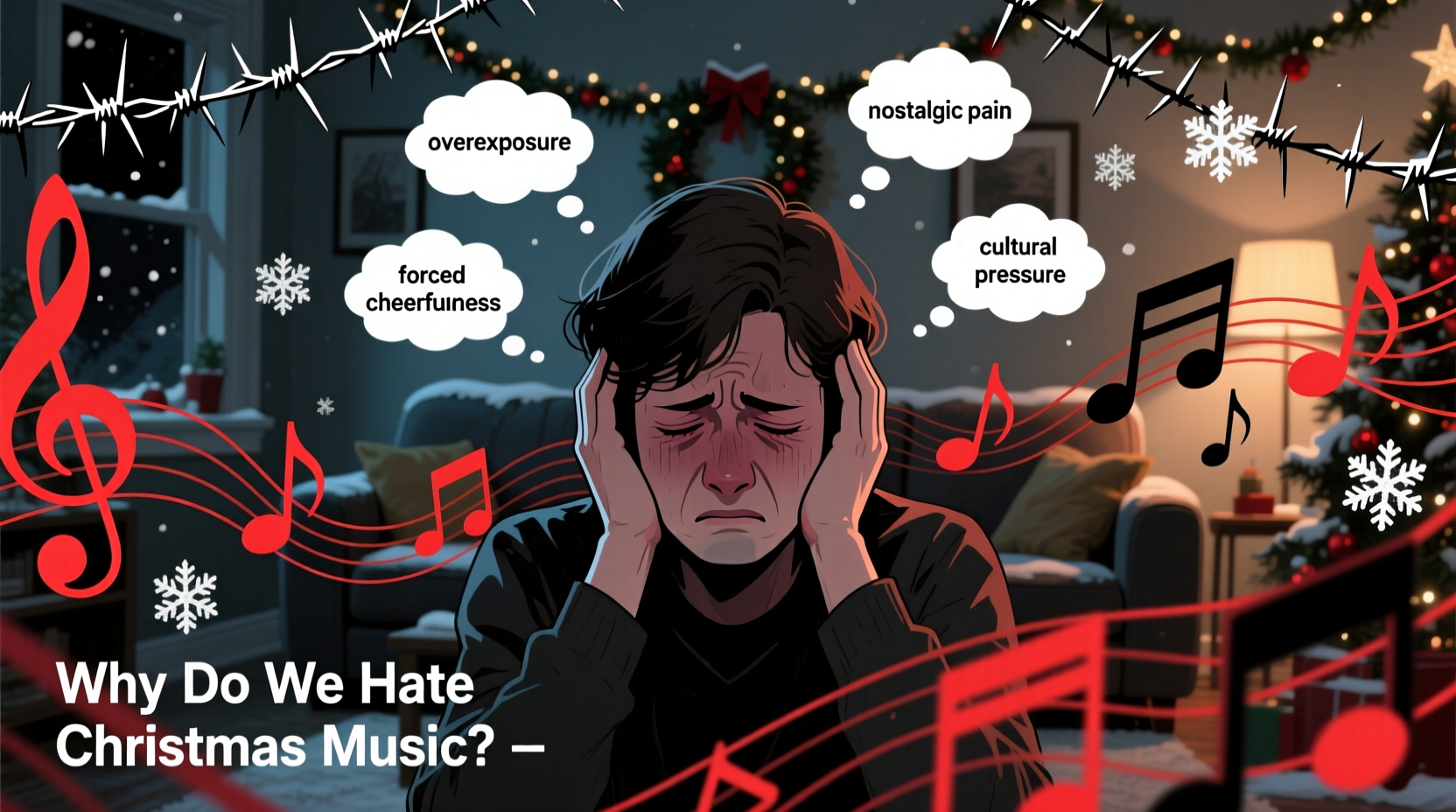
Christmas music isn’t just played—it’s overplayed. Between October and December, listeners may hear the top 10 holiday songs an average of 42 times per week in public spaces alone (Nielsen Music, 2022). This frequency triggers what psychologists call the overexposure effect: a well-documented phenomenon where repeated exposure to a stimulus reduces positive affect—and eventually flips it into aversion. Unlike novelty-driven dopamine hits, familiarity without variation drains neural reward response. The brain stops registering “Jingle Bells” as pleasurable and starts flagging it as background noise requiring active suppression—a cognitively taxing process.
This isn’t subjective preference; it’s measurable physiology. fMRI studies show that overexposed music activates the anterior cingulate cortex—the brain’s error-detection and conflict-monitoring region—more than novel music does. In plain terms: your brain doesn’t just tune out the song—it argues with it. That low-grade mental friction accumulates across the season, contributing to decision fatigue, reduced patience, and heightened emotional reactivity.
Tip: Use noise-canceling headphones or ambient sound apps (e.g., rain, café white noise) in high-exposure environments—not to escape joy, but to preserve cognitive bandwidth for things that truly matter to you.Sensory and Neurological Vulnerabilities
For people with sensory processing differences—including those with autism, ADHD, misophonia, or chronic migraines—the sonic texture of Christmas music presents unique challenges. Many holiday arrangements feature dense layering: jingling percussion, staccato brass, rapid vocal harmonies, and sudden dynamic shifts (think the abrupt choral swell in “Hark! The Herald Angels Sing”). These elements violate predictable auditory patterns the nervous system relies on for regulation.
Misophonia—a condition characterized by intense emotional reactions to specific sounds—often includes trigger responses to repetitive rhythmic elements like sleigh bells or tambourine shakes. A 2021 study in the Journal of Clinical Psychology found that 78% of misophonia participants reported heightened distress during the holiday season, with “repetitive percussive holiday motifs” cited as the most common auditory trigger category.
Similarly, individuals with ADHD may experience Christmas music not as background ambiance but as an intrusive, attention-hijacking force—especially when lyrics contain narrative complexity (“The Twelve Days of Christmas”) or rapid lyrical shifts that compete with internal thought streams.
Cultural and Identity Dissonance
Holiday music carries heavy symbolic weight. It’s rarely neutral. Carols reference theological concepts (“O Come, All Ye Faithful”), colonial-era traditions (“We Three Kings”), or idealized domesticity (“Rockin’ Around the Christmas Tree”). For people who don’t share those beliefs—or whose lived experiences contradict the narratives—this music can feel like auditory exclusion.
Consider these real-world tensions:
- Secular or non-Christian individuals may feel pressured to perform enthusiasm for religious lyrics they find alienating or doctrinally incompatible.
- People grieving recent loss often describe holiday music as emotionally violent—its cheerfulness clashing violently with private sorrow, turning public spaces into sites of involuntary emotional labor.
- Those from marginalized cultural backgrounds may hear Christmas music as part of a broader seasonal erasure—where their own traditions receive no airtime while dominant cultural symbols saturate every channel.
“Holiday music isn’t just sound—it’s a social contract. When someone feels forced to nod along to lyrics that don’t reflect their values, grief, or worldview, the irritation isn’t about the melody. It’s about the silence that follows when their reality isn’t acknowledged.” — Dr. Lena Torres, Cultural Psychologist, University of Toronto
The “Forced Cheer” Phenomenon and Emotional Labor
Christmas music functions as an ambient mood regulator—designed to cue warmth, generosity, and togetherness. But when that cue conflicts with internal state, it creates what sociologists term emotional labor: the effort required to manage one’s outward expression to meet social expectations. Retail workers, teachers, healthcare staff, and service industry employees often report the highest rates of Christmas music aversion—not because they dislike the songs, but because they’re required to embody the associated emotions while exhausted, underpaid, or grieving.
A mini case study illustrates this concretely:
Maya, 29, retail associate in Chicago: “I work 40 hours a week from Black Friday through New Year’s Eve. My store plays the same 12-song loop on repeat. At first, I hummed along. By Week 3, I’d get nauseous hearing ‘All I Want for Christmas Is You’—not because I hate Mariah, but because I’d just spent 20 minutes calming a customer screaming about a missing gift while my shift supervisor watched me, waiting for me to smile again. That song stopped sounding joyful. It sounded like surveillance.”
Her experience reflects findings from a 2022 Harvard Business Review analysis: employees in high-emotion-regulation roles showed a 3.2x higher likelihood of reporting seasonal auditory fatigue—and 68% linked that fatigue directly to mandated holiday soundscapes.
Memory Triggers and Unresolved Associations
Music is uniquely potent at activating autobiographical memory—especially emotionally charged memories. Neuroimaging confirms that familiar songs engage the hippocampus (memory center) and amygdala (emotion center) simultaneously. For many, Christmas music doesn’t evoke generic “holiday feelings”—it resurrects highly specific, often unresolved moments: a parent’s divorce announced during caroling practice, a childhood trauma tied to a church service, or the last Christmas before a loved one’s death.
What makes this especially taxing is that these memories often surface without conscious consent. You don’t choose to remember your father’s angry voice echoing over “Silent Night” in the living room—you just hear the first chord and feel your chest tighten. There’s no warning. No opt-out. Just involuntary emotional time travel.
This explains why some people develop visceral, body-level reactions—sweating, nausea, or sudden anger—to songs with no objective “offensive” qualities. The brain isn’t reacting to the music. It’s reacting to the memory it unlocked.
Do’s and Don’ts: Navigating the Season with Psychological Self-Awareness
| Action | Why It Helps | Risk of Skipping It |
|---|---|---|
| Curate your personal soundtrack — create non-holiday playlists for home/work | Reduces passive exposure and restores agency over auditory environment | Continued neural fatigue and emotional dysregulation |
| Name the feeling accurately — e.g., “This isn’t hatred—it’s overwhelm from sensory stacking” | Reduces shame and enables targeted coping (e.g., stepping outside vs. suppressing emotion) | Self-labeling as “grumpy” or “difficult,” leading to avoidance or guilt |
| Set public-space boundaries — use earplugs in stores, request quiet zones at work | Prevents cumulative stress buildup; models healthy self-advocacy | Chronic activation of stress response, impacting sleep and immunity |
| Reframe “dislike” as data — notice what specific elements trigger you (tempo? lyrics? repetition?) | Turns aversion into actionable insight—e.g., avoiding fast-tempo carols if ADHD-related | Generalized resentment replacing precise, solvable discomfort |
| Normalize opting out — decline holiday parties, mute group chats, skip office singalongs | Conserves emotional energy for meaningful connections—not performance | Resentment toward holidays themselves, rather than the unsustainable expectations |
FAQ
Is it normal to feel physically ill from Christmas music?
Yes—and it’s more common than most realize. Physical symptoms (nausea, headache, shortness of breath) often signal autonomic nervous system dysregulation—your body’s fight-or-flight response activating in response to perceived threat (e.g., emotional overwhelm, sensory overload, or memory triggers). This isn’t “just in your head”; it’s your physiology responding authentically to environmental stressors.
Can childhood trauma make holiday music harder to tolerate?
Absolutely. Trauma imprints itself on sensory memory. If a traumatic event occurred in a context saturated with holiday music—such as a family argument during Christmas dinner or abuse following a church service—the brain may wire those sounds to danger signals. This is called sensory-based conditioning, and it operates below conscious awareness. Therapy modalities like EMDR or somatic experiencing can help decouple the sound from the threat response.
Does disliking Christmas music mean I’m anti-holiday or emotionally closed off?
No. Disliking the music is distinct from rejecting celebration, connection, or meaning. Many people who avoid holiday playlists still host intimate dinners, donate to causes, write heartfelt letters, or light candles in quiet reflection. The music is one narrow channel—not the entire river of human warmth.
Conclusion
Hating Christmas music isn’t a character flaw. It’s often a quiet, intelligent signal—a neurological boundary being drawn, a cultural mismatch being voiced, or a nervous system saying, “I’ve reached capacity.” When we dismiss this response as mere Scroogery, we miss the opportunity to build kinder, more inclusive seasonal practices: workplaces that offer audio choice, retailers that rotate playlists meaningfully, families that honor varied emotional needs without judgment. Your irritation matters—not as a problem to fix, but as data worth listening to. This year, give yourself permission to mute, step away, curate, and protect your inner soundscape. Joy doesn’t require volume. Meaning doesn’t demand melody. And presence—true, unperformed presence—is always available, whether the speakers are playing or silent.
💬 Your experience matters. If this resonated—if you’ve ever walked out of a store to escape “Frosty the Snowman” or muted a Zoom call during forced caroling—share your story in the comments. Not to vent, but to normalize: our ears, our nerves, and our histories deserve space in the holiday conversation.








