For many, the flicker of holiday lights evokes warmth, nostalgia, and festive cheer. Yet a significant minority experiences genuine discomfort—sometimes escalating to anxiety, nausea, headaches, or even panic—when exposed to blinking or strobing Christmas lights. This reaction isn’t mere “grumpiness” or seasonal curmudgeonry. It reflects measurable neurological, perceptual, and emotional processes rooted in human biology and lived experience. Understanding why blinking lights provoke such strong aversion helps us move beyond dismissal (“just turn them off”) toward empathy, accommodation, and inclusive design—not just during the holidays, but year-round.
The Sensory Overload Hypothesis: When Light Becomes Noise
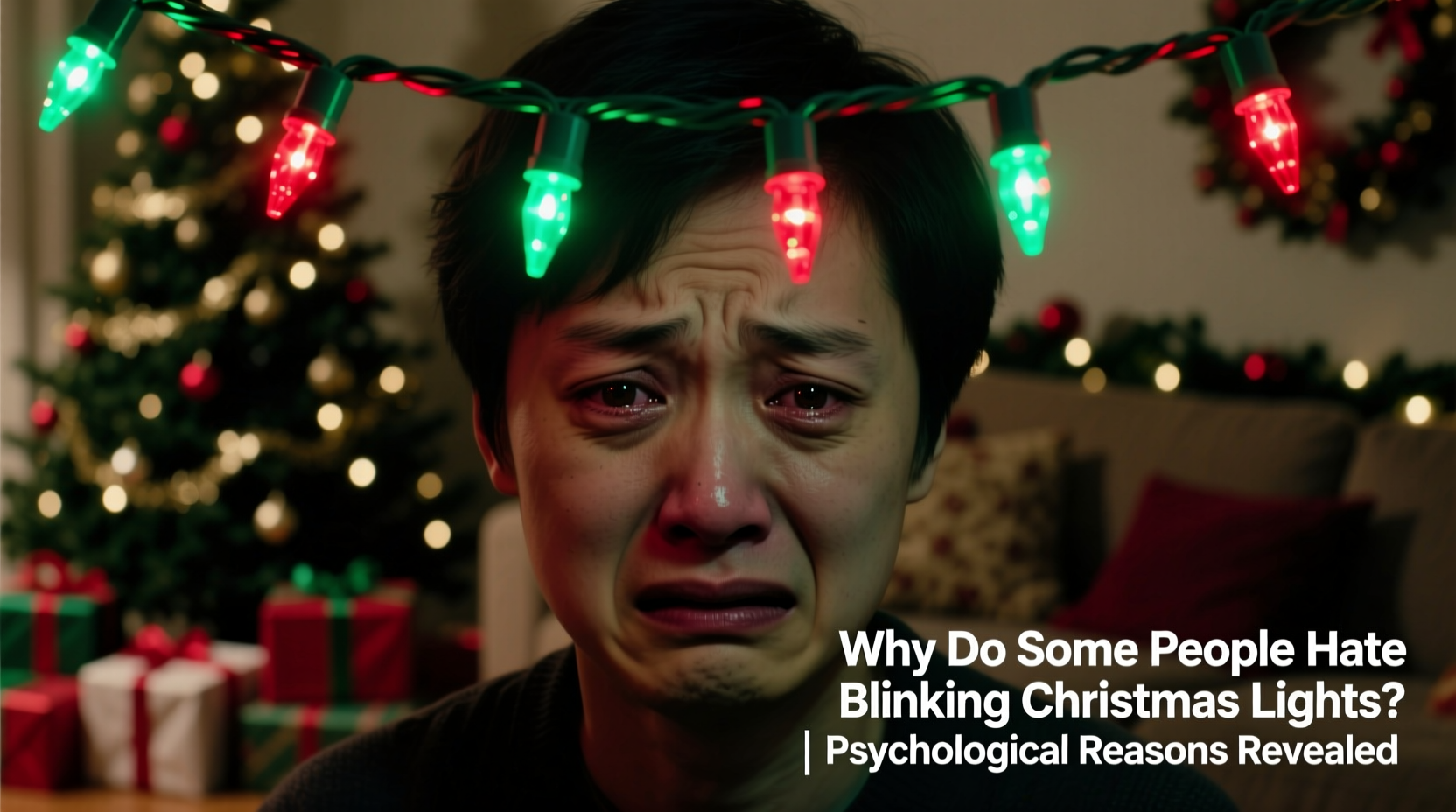
Human vision evolved for stability—not rapid, unpredictable change. Blinking lights introduce a temporal discontinuity that forces the visual system into constant recalibration. Unlike steady illumination, which allows neural pathways to settle into efficient processing, rhythmic on-off cycles (especially at frequencies between 3–70 Hz) trigger heightened cortical arousal. This is particularly taxing for individuals with lower sensory gating thresholds—the brain’s ability to filter out irrelevant stimuli.
Neuroimaging studies confirm that strobing light increases metabolic demand in the occipital and parietal lobes. In susceptible individuals, this manifests not as visual interest but as cognitive friction: difficulty concentrating, irritability, or a visceral sense of being “overstimulated.” The effect intensifies when multiple light sources blink asynchronously—a common feature of neighborhood light displays—creating a chaotic visual field the brain cannot predict or ignore.
Tip: If you or someone you live with reacts negatively to blinking lights, opt for warm-white, non-blinking LED strings—or use smart bulbs programmed to fade smoothly rather than snap on/off.Evolutionary Vigilance: Why Our Brains Treat Flicker as Threat
From an evolutionary perspective, sudden, irregular light changes rarely occur in nature without cause: fire spreading, predator movement, or environmental collapse. Our ancestors who reacted quickly to unpredictable visual transients had a survival advantage. That legacy persists in modern neurology: the superior colliculus—a midbrain structure governing reflexive attention—responds more robustly to intermittent stimuli than to continuous ones. This reflex prioritizes change over constancy, making blinking lights inherently salient—even when consciously recognized as harmless.
This vigilance becomes maladaptive in safe, artificial environments. A study published in Frontiers in Psychology (2022) found that participants exposed to 5-Hz blinking lights showed elevated skin conductance responses (a marker of sympathetic nervous system activation) even when told the lights posed no danger. Their bodies responded before their minds could intervene—a classic example of bottom-up neural priming.
“Flicker doesn’t need to be consciously perceived to trigger physiological stress. Sub-threshold strobing—light changes too fast to register as ‘blinking’—can still disrupt alpha-wave dominance in the brain, impairing relaxation and increasing fatigue.” — Dr. Lena Torres, Cognitive Neuroscientist, University of Sussex
Neurodivergence and Sensory Processing Differences
Autistic individuals, those with ADHD, migraine disorders, or photosensitive epilepsy are disproportionately affected by blinking lights—not because their perception is “defective,” but because their sensory processing systems operate with different gain settings. For example:
- Autism: Up to 90% of autistic adults report heightened sensitivity to light, sound, and motion. Blinking lights compound existing challenges with sensory integration, often triggering meltdowns or shutdowns as protective neurological responses.
- Migraine disorders: 40–60% of migraineurs identify visual triggers, with flickering light cited as the second most common (after glare). Cortical hyperexcitability lowers the threshold for photic-induced neuronal firing, sometimes preceding aura or headache onset by minutes.
- ADHD: Impaired habituation—the brain’s ability to stop responding to repeated stimuli—means blinking lights remain perceptually “novel” across time, depleting attentional resources needed for focus or social engagement.
Crucially, these differences exist on spectrums. Many neurotypical people also experience subclinical versions—such as eye strain after prolonged exposure to LED holiday displays or discomfort while driving past animated storefronts. Dismissing such reactions as “overreaction” ignores the biological reality of individual neurophysiological variance.
Learned Associations and Emotional Conditioning
Psychological aversion isn’t always innate—it can be acquired. Traumatic or stressful experiences linked to blinking lights create powerful associative memories. Consider these realistic scenarios:
Mini Case Study: Maya, 34, graphic designer
Maya developed acute light sensitivity after a concussion at age 28. During recovery, her neurologist used a strobe light during vestibular testing—a procedure that triggered vertigo and vomiting. Two years later, walking past a neighbor’s blinking LED reindeer display induced immediate dizziness and nausea. Her amygdala had encoded the visual pattern as predictive of physical distress, bypassing rational reassurance. Only after systematic desensitization therapy—starting with static white lights and progressing slowly to low-frequency fades—did her reaction diminish.
Similar conditioning occurs in less dramatic contexts: childhood fear of the dark paired with a blinking nightlight; hospital stays where overhead lights flickered during moments of pain or anxiety; or even repeated exposure to poorly designed digital interfaces with aggressive animations. Each instance strengthens neural pathways linking visual transience with threat or discomfort.
Environmental and Design Factors That Amplify Discomfort
Not all blinking lights are equally provocative. Specific technical characteristics dramatically influence tolerability. The table below outlines key variables and their psychological impact:
| Feature | Tolerable Range | High-Risk Range | Why It Matters |
|---|---|---|---|
| Blink Frequency | 0.5–2 Hz (slow pulse) | 4–12 Hz (mid-range strobe) | 4–12 Hz overlaps with natural brainwave frequencies (theta/alpha), increasing risk of entrainment and disorientation. |
| Contrast Ratio | ≤ 3:1 (soft transition) | ≥ 10:1 (sharp on/off) | High contrast demands greater pupillary adjustment and retinal recovery, accelerating visual fatigue. |
| Color Temperature | 2700K–3000K (warm white) | 5000K+ (cool/blue-white) | Blue-rich light suppresses melatonin and stimulates intrinsically photosensitive retinal ganglion cells (ipRGCs), heightening alertness—and agitation—in sensitive individuals. |
| Spatial Pattern | Uniform, predictable sequence | Random, multi-directional, overlapping | Unpredictability prevents anticipatory neural dampening, sustaining attentional load and stress response. |
Actionable Strategies: Reducing Harm and Increasing Inclusion
Understanding the “why” empowers practical solutions—not just for individuals managing personal sensitivity, but for communities, retailers, and designers shaping shared spaces. Below is a step-by-step guide for implementing compassionate lighting practices:
- Assess your current displays: Use a smartphone slow-motion video (240 fps) to observe blink patterns. Note frequency, contrast, and randomness.
- Replace high-risk strings: Swap cool-white LEDs blinking at 6–10 Hz with warm-white, dimmable strings using smooth fade transitions (not on/off).
- Layer lighting intentionally: Combine static ambient lights (e.g., icicle strands) with one subtle animated element (e.g., a single slow-pulsing star)—not dozens of competing blinkers.
- Provide advance notice and alternatives: If hosting events with animated lights, label zones (e.g., “Calm Corner: Static Warm Lighting Only”) and offer sunglasses or blue-light-filtering glasses at entry points.
- Advocate for policy change: Encourage local ordinances limiting public display strobe frequencies to ≤2 Hz and requiring warm-color options—similar to accessibility standards for audio announcements or tactile signage.
FAQ
Can blinking lights actually trigger seizures in people without epilepsy?
Yes—though rarely. Photosensitive reflex seizures occur in approximately 3% of people with epilepsy, but non-epileptic photic-induced symptoms (dizziness, nausea, confusion, or temporary loss of coordination) affect up to 15% of the general population. These are distinct from seizures but share underlying mechanisms of cortical hyperexcitability. The International Commission on Illumination (CIE) recommends avoiding repetitive light changes above 3 Hz in public spaces for this reason.
Is there a difference between “blinking” and “fading” lights from a neurological standpoint?
Significant. Blinking involves abrupt luminance transitions (near-zero to full brightness), demanding rapid neural reset. Fading uses gradual, logarithmic intensity changes that align with natural pupil adaptation curves—reducing retinal stress and minimizing cortical surprise responses. Studies show fading lights produce 40–60% lower EEG gamma-band activity (associated with visual processing load) compared to equivalent-frequency blinking.
Why do some people tolerate blinking lights indoors but not outdoors?
Context matters. Indoor environments offer control (dimmer switches, curtains, ability to leave the room) and reduced visual complexity. Outdoor displays often combine high-intensity LEDs, uncontrolled ambient light (streetlamps, car headlights), wind-induced movement, and lack of escape routes—amplifying sensory load through multisensory integration. The unpredictability of outdoor viewing (e.g., lights appearing suddenly around a corner) also activates threat-response circuitry more strongly than voluntary indoor exposure.
Conclusion
Hating blinking Christmas lights isn’t a quirk or a flaw—it’s a signal. A signal that our nervous systems are doing exactly what they evolved to do: prioritize safety, conserve energy, and respond authentically to environmental input. Dismissing this aversion as “not getting into the spirit” overlooks decades of neuroscience, clinical observation, and lived testimony. It also misses an opportunity: to redesign celebration around inclusion rather than uniformity.
This holiday season, consider swapping one set of jarring blinkers for soft, warm, rhythmic pulses. Add clear signage to your light display indicating which sections use gentle animation. Share this understanding with neighbors, schools, and local councils—not as criticism, but as an invitation to expand what “festive” can mean. Empathy begins with recognizing that comfort isn’t universal—and that the most joyful traditions are the ones everyone can experience without cost to their well-being.
💬 Have you experienced light sensitivity—or supported someone who has? Share your insight, accommodation tip, or respectful suggestion in the comments. Real-world wisdom helps build kinder, more attuned communities—one thoughtful light at a time.








