It’s a familiar holiday moment: as daylight fades and streetlights flicker on, you glance at your outdoor light display—and notice something unexpected. The warm-white or even “pure white” string of LED Christmas lights you installed last week now looks distinctly cool, almost icy—tinged with blue. Not all strings do it. Not all viewers see it equally. And it’s not a defect in the bulbs. This subtle chromatic shift is rooted in well-documented physiological, optical, and perceptual phenomena that converge precisely during twilight. Understanding why helps not only in selecting better festive lighting but also reveals how deeply our vision adapts to changing environments—a quiet marvel of human biology operating every evening.
The Twilight Transition: When Daylight Becomes Dusk
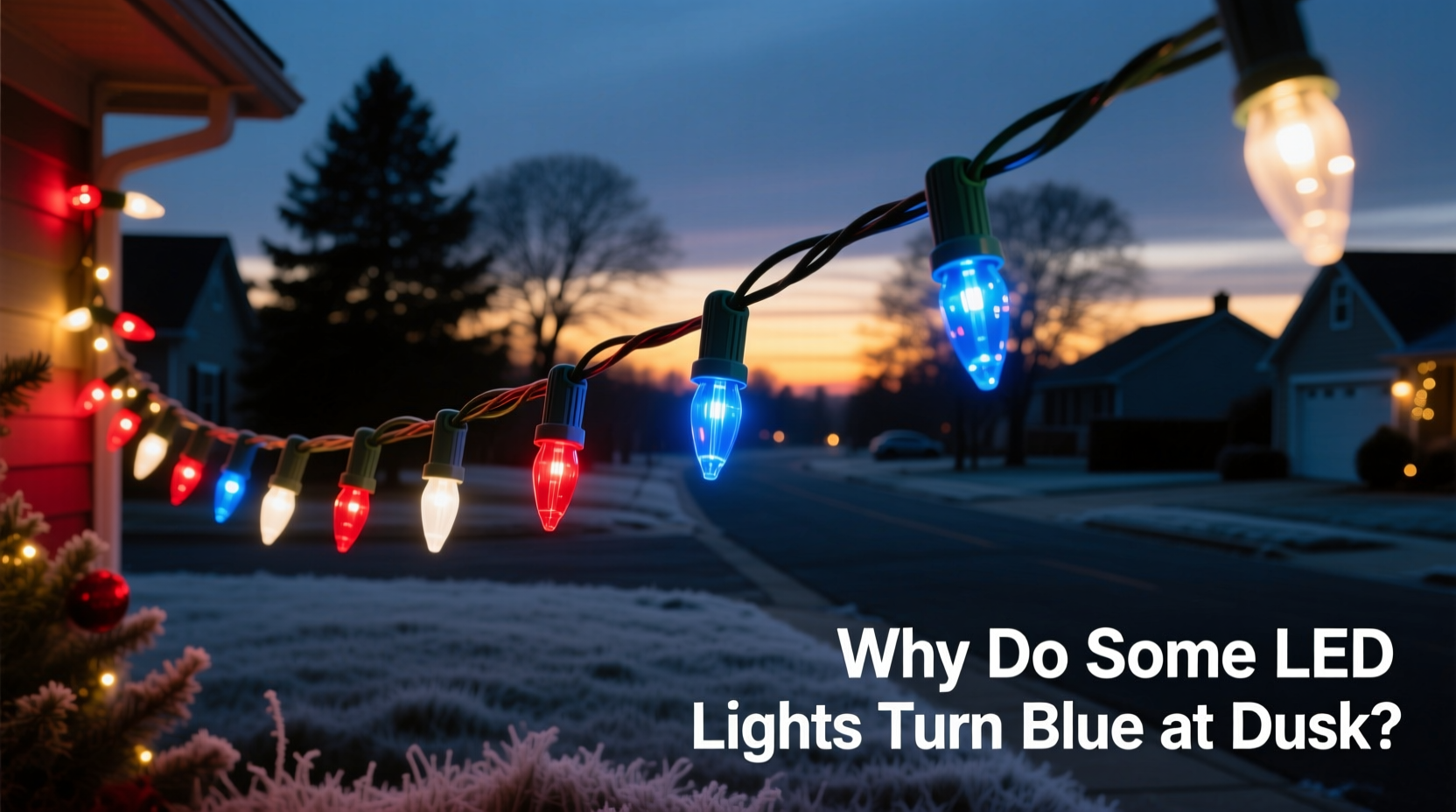
Dusk is not a single instant—it’s a dynamic 20–45 minute window known scientifically as civil twilight, bracketed by sunset and when the sun dips 6° below the horizon. During this period, ambient light undergoes two critical changes: a rapid decline in overall luminance (brightness) and a pronounced spectral shift toward shorter wavelengths. Sunlight at noon contains a balanced mix of red, green, and blue light. But as the sun nears the horizon, its rays pass through more atmosphere, scattering shorter-wavelength blue and violet light high overhead—leaving the direct beam increasingly enriched in amber and red. Meanwhile, the sky itself—now the dominant source of ambient illumination—glows with scattered blue light. The result? A scene bathed in low-intensity, spectrally “cool” light.
This shift matters because human vision relies on two parallel photoreceptor systems: cones (for color vision in bright light) and rods (for monochrome vision in dim light). Cones dominate in daylight; rods take over in near-darkness. But during dusk, both are active—a state called *mesopic vision*. Crucially, rods are most sensitive to light around 498 nm—right in the blue-green part of the spectrum—while the three cone types (L, M, S) have peak sensitivities at longer wavelengths (red, green, blue). In mesopic conditions, rod input disproportionately influences perceived color, especially for light sources emitting energy near 498 nm. Many “white” LEDs emit a strong spike in that very region.
LED White Light: Not All White Is Created Equal
Most white LEDs don’t generate white light directly. Instead, they use a blue LED chip (typically 450–455 nm) coated with a yellow phosphor (often cerium-doped yttrium aluminum garnet, or YAG). The blue light excites the phosphor, which emits broad-spectrum yellow light. The mixture of unconverted blue and emitted yellow creates the perception of white. But the exact ratio determines the light’s correlated color temperature (CCT), measured in kelvins (K).
Lower CCTs (2700–3000 K) mimic incandescent warmth, with less blue leakage and stronger red/yellow output. Higher CCTs (5000–6500 K) appear “cool white” or “daylight,” with significantly more blue in the 440–490 nm range—including that critical 498 nm rod-sensitivity peak. Even LEDs labeled “warm white” can vary widely in their spectral power distribution (SPD). Some budget or older-generation warm-white LEDs still retain a pronounced blue hump beneath the phosphor layer. That residual blue becomes perceptually amplified at dusk—not because it’s brighter, but because our visual system weights it more heavily.
Tip: Check the manufacturer’s spectral power distribution chart (if available) rather than relying solely on CCT labels—look for minimal energy between 440–500 nm if you want consistent warm appearance at twilight.Rod-Cone Interaction and the Purkinje Effect
The phenomenon responsible for the heightened blue perception at dusk is the Purkinje effect, first documented by Czech anatomist Jan Evangelista Purkinje in 1825. He observed that as light levels fall, red flowers appear darker relative to blue flowers—even though both reflect equal luminance in daylight. This occurs because rods, which drive scotopic (low-light) vision, have peak sensitivity at ~498 nm, while the L-cones (red-sensitive) drop off sharply below 550 nm. As ambient light dims and rods contribute more to perception, colors near the rod peak appear relatively brighter—and those at longer wavelengths (reds, oranges) appear comparatively duller.
Applied to LED Christmas lights: a string emitting 15% of its total radiant power in the 480–500 nm band may look neutral white at noon, when cone vision dominates and balances the spectrum. At dusk, however, rod input boosts the perceptual weight of that same blue band by up to 3× relative to red components. The brain interprets the imbalance not as “more blue light,” but as “bluer light.” This isn’t an illusion—it’s accurate neural processing of real photoreceptor signals under changing adaptation states.
“The Purkinje effect isn’t a flaw in vision—it’s evidence of elegant evolutionary optimization. Our ancestors needed to detect predators in twilight shadows, where contrast in short-wavelength cues was often the only reliable signal.” — Dr. Lena Torres, Visual Neuroscientist, University of Rochester Institute of Optics
Why It Varies: Individual, Environmental, and Technical Factors
Not everyone perceives the blue shift equally—and not all LED strings exhibit it to the same degree. Several interlocking variables determine visibility:
- Age-related lens yellowing: The human crystalline lens naturally yellows with age, absorbing more blue light before it reaches the retina. People over 50 often report less intense blue shift—or none at all—because their lenses filter out the very wavelengths rods respond to most strongly.
- Surrounding context: A string hung against a warm-toned brick wall will appear bluer than the same string against a gray stucco or snow-covered ground, due to simultaneous color contrast.
- LED driver quality: Cheap constant-voltage drivers may allow slight current fluctuations as ambient temperature drops at dusk. Since LED wavelength shifts minutely with junction temperature (a phenomenon called “thermal droop”), even a 2–3 nm blueward shift can enhance the effect.
- Viewing angle and diffusion: Frosted or opal LED housings scatter light more evenly, diluting directional blue spikes. Clear-lens LEDs project sharper blue peaks—making the effect more noticeable head-on.
| Factor | Amplifies Blue Shift? | Why |
|---|---|---|
| Youthful lens (under 40) | Yes | Minimal blue absorption; higher retinal irradiance at 498 nm |
| High-CCT LED (>5000 K) | Strongly | Naturally higher blue spectral power, overlapping rod peak |
| Clear-lens bulb design | Moderately | Less diffusion of blue spike; higher directionality |
| Mounting against warm background | Yes | Simultaneous contrast enhances perceived coolness |
| High humidity or light fog | Yes | Rayleigh scattering amplifies ambient blue, raising mesopic rod contribution |
A Mini Case Study: The Elm Street Holiday Display
In December 2022, the Peterson family in Portland, Oregon, installed two identical-looking strings of “warm white” LED mini lights along their front eaves. Both were rated 2700 K and purchased from the same national retailer. By 4:45 p.m.—just 25 minutes after sunset—their neighbor commented, “Your left side looks like icicles, but the right side is cozy.” Confused, they took spectral measurements with a handheld spectrometer. The left string (manufactured in Q3 2021) showed a 455 nm blue peak at 38% intensity relative to its yellow phosphor hump. The right string (Q4 2022 revision) had the same nominal CCT but used an improved phosphor blend that suppressed the blue spike to just 12%. Under mesopic conditions, the left string triggered significantly stronger rod response—creating the stark perceptual difference. After swapping the left string for a newer batch, the “blue dusk effect” vanished. The lesson wasn’t about faulty products—it was about understanding that CCT alone doesn’t capture spectral fidelity.
Practical Solutions and Selection Strategies
Want consistent warm appearance from dusk until midnight? Prioritize these evidence-based criteria—not marketing claims:
- Seek LEDs with high CRI (≥90) and R9 >50: High Color Rendering Index, especially strong R9 (saturated red) values, indicates a fuller, more balanced spectrum—and usually correlates with reduced blue spikes.
- Prefer “full-spectrum” or “sunlight-mimicking” LEDs: These use multi-phosphor or RGB+phosphor hybrids to fill spectral gaps, minimizing narrow blue peaks.
- Test before committing: Install one string at least 3 days before full deployment. Observe it at 4:30 p.m., 5:00 p.m., and 5:30 p.m. on clear, partly cloudy, and overcast days. Note whether blue shift intensifies under cloud cover (increased diffuse blue skylight).
- Use warm-colored accent lighting: Place low-intensity, battery-powered warm-amber path lights or lanterns near your display. Their long-wavelength output helps stabilize mesopic adaptation and reduces the contrast-driven perception of blue.
- Consider dimming compatibility: Quality trailing-edge dimmers reduce LED current smoothly, lowering both brightness and correlated color temperature slightly—counteracting the dusk shift.
FAQ
Will using a blue light filter or gel fix the problem?
No—and it will likely worsen it. Adding a blue-absorbing filter cuts overall output, deepening mesopic conditions and further amplifying rod influence on remaining wavelengths. It also reduces efficiency and may cause uneven color rendering across the string. Address the root cause (spectral distribution), not the symptom.
Do incandescent Christmas lights show this effect?
No, not perceptibly. Incandescents emit a continuous black-body spectrum with negligible energy below 500 nm. Their peak output is in the infrared, with strong red/orange/yellow emission—but almost no blue. Rods simply don’t receive enough stimulus from them to trigger Purkinje-based color shifts. Their warmth remains stable from noon to night.
Can software or smart lighting compensate for this?
Yes—if your lights support tunable white (CCT-adjustable) via app or controller. Set an automation that gradually warms the CCT by 300–500 K starting 30 minutes before sunset. For example, shift from 2700 K at dusk to 2200 K by 6:00 p.m. This proactively counterbalances the rod-driven perceptual cooling. Look for systems with astronomical time scheduling (e.g., Philips Hue, Nanoleaf) for precision.
Conclusion
The blue tint you see in some LED Christmas lights at dusk isn’t a manufacturing flaw, a sign of poor quality, or mere optical trickery. It’s a visible signature of your own biology working as intended—rods and cones negotiating light in real time, shaped by evolution, physics, and physiology. Recognizing this transforms a minor seasonal curiosity into a meaningful entry point for deeper engagement with lighting design, human perception, and even environmental awareness. Next time you notice that cool glow emerging as twilight settles, pause—not to adjust the lights immediately, but to appreciate the silent, sophisticated dialogue happening between sky, semiconductor, and synapse. Choose LEDs with intention. Observe them with curiosity. And remember: the most beautiful holiday displays aren’t just seen—they’re experienced across changing light, time, and biology. Your lights may shift color at dusk—but your understanding of why doesn’t have to stay in the dark.
💬 Have you observed this effect with specific brands or models? Share your spectral notes, installation tips, or dusk-time observations in the comments—we’ll compile reader insights into a community reference guide for next holiday season.








